Service level agreements are only useful when both sides can see what was promised, how performance will be measured, and what happens when service quality slips. The examples in this guide give you ready-made SLA workflows for creating agreements, reviewing them, and tracking service management metrics over time.
Use these 17 service level agreement examples to start with the right template for your situation, from IT and cloud services to call centers, HR, managed hosting, and network services. If you need the fundamentals first, read what an SLA is. If you want to build one from scratch, use our service level agreement template guide.
17 service level agreement examples: Addressing various use cases
Below you can access 17 different service level agreement workflow templates.
The idea behind their construction was to broaden the scope of our general SLA creation template to include management review and metric tracking processes that follow months or even years after the agreement has been put in place.
For example, 3 months after the agreement was set, the client may request that the terms of the agreement be changed slightly, or the service provider needs to iterate their objectives.
Or you simply want to conduct periodic reviews of the agreement to ensure that all requirements are being met.
“Any service provider you choose should be more than happy to create an SLA with you. However, having an SLA isn’t enough. Always remember to review the contract as your business grows or changes. Your needs may change over time and your SLA should always reflect your organization’s evolving needs.” – CloudCarib, 3 Reasons Why You Need to Have an SLA with Your Service Provider
That’s what these templates enable you to do with ease.
Furthermore, each example addresses a different industry/use case. These include IT services, social media services, call center services, and HR services.
So, before we get into a quick intro for each template, let me clarify what you’ll be looking at.
3 of the templates are what we refer to as “master” templates. The first is the Service Level Agreement Template Process – the checklist presented in January in the second article I linked to earlier in the post.
The second master template is the SLA Management Checklist Template, which is simply an extension of the first master, which includes additional tasks following the SLA’s creation to review the agreement once a month. This master branches out into 7 other templates that are customized for various use cases.
The third and final master template is the SLA Metrics Tracking Process Template, which is designed to conduct periodic reviews of a service level agreement to ensure that all requirements are being met by both parties, and evaluate if any changes need to be made moving forward. Like the second master, this template also sets the foundation for 7 other templates addressing different use cases.
Let’s dive in.
If you want to go straight to the checklists, there are quick links right below. Otherwise, scroll down for a brief intro to each one and to learn a little bit more about what makes Process Street’s checklists so powerful.
- Service Level Agreement Template Process (Master #1)
- SLA Management Checklist Template (Master #2)
- IT Service SLA Management Checklist Template
- Cloud Service SLA Management Checklist Template
- Social Media SLA Management Checklist Template
- Network Services SLA Management Checklist Template
- Managed Web Hosting SLA Management Checklist Template
- Call Center SLA Management Checklist Template
- HR Service SLA Management Checklist Template
- SLA Metrics Tracking Process Template (Master #3)
- IT Service SLA Metrics Tracking Process Template
- Cloud Service SLA Metrics Tracking Process Template
- Social Media SLA Metrics Tracking Process Template
- Network Services SLA Metrics Tracking Process Template
- Managed Web Hosting SLA Metrics Tracking Process Template
- Call Center SLA Metrics Tracking Process Template
- HR Services SLA Metrics Tracking Process Template
Our 17 service level agreement examples for complete SLA management
Service Level Agreement Template Process (Master #1)
This is the general service level agreement creation process that we published back in January.
The template covers an SLA’s most important components, including:
- An agreement overview
- The agreement’s purpose, goal, and objectives
- The services being supplied and their scope
- Supplier and customer requirements and responsibilities
- A section regarding performance monitoring and reviews
- A section on service management
- Plus, in-built approval steps!
Once you’ve completed the checklist, you will have a clean, concise SLA emailed to the customer.
Click here to get the service level agreement template process.
SLA management checklist template (Master #2)
This template is quite simply an extension of the general template linked above. The process does not end with the creation of the document but includes tasks for a 3-month review period.
The review process includes evaluating KPIs and other relevant metrics to ensure that performance is in compliance with the current SLA.
If it is not and adjustments need to be made, our conditional logic feature will kick in and present you with additional tasks to make the necessary iterations and inform the relevant personnel of the shortcoming and what needs to change moving forward.
Bear in mind that if you would like the review process to stretch further, let’s say for 1 year, then all you have to do is duplicate the review tasks for each month and make minor changes to reflect the time period.
Click here to get the SLA management checklist template
IT service SLA management checklist template
Based off the template above, this workflow is customized for IT services – one of, if not the most common use case when it comes to service level agreements.
Considering how much SLAs differ from company to company, as well as the broad scope of “IT services”, the level of customization has deliberately been kept low.
“SLAs are inherently broad; there are no hard-and-fast rules regarding what should and what should not go into an SLA. It could be all on one page, or it could be a whopping 100+ page document.” – Thom James Carter, Service Level Agreement Template: How to Create Solid SLAs at Super Speed
Nevertheless, if you are an IT services provider looking to create flawless SLAs in quick and easy fashion, the layout and terminology in this workflow will be what you are looking for.
Click here to get the IT services SLA management checklist template
Cloud service SLA management checklist template
A cloud service level agreement is essential for outlining the minimum level of service that needs to be maintained regarding response times to system failures, general data security and other deliverables that have been clearly defined in the SLA.
In other words, the document is there to establish a mutual understanding of the services, prioritized tasks, responsibilities, guarantees and warranties provided by the cloud service provider.
This workflow will enable you to outline these services, ensuring that all requirements are both specific and measurable, in order that they can be effectively reviewed down the line.
Click here to get the cloud service SLA management checklist template
Social media SLA management checklist template
If you are a social media services provider looking to help your customers engage with their target market and get the most out of our their social media accounts, an SLA will help you focus on the most important tasks by specifying what goals the customer wants to accomplish, and in what time span.
For example, the customer wants all tweets and Facebook messages to be responded to within 2 hours of receiving them. If you satisfy this requirement, then the customer is happy and you can easily prove that you are meeting the terms of the agreement.
This workflow will guide you through the SLA creation process and provide the tools to conduct monthly reviews of the SLA to make sure both the service provider and customer are satisfied with the way things are going.
Click here to get the social media SLA management checklist template
Network services SLA management checklist template
This undoubtedly falls under “IT services”, but we felt it deserved its own template because it is a massive use case within the IT industry, and a big one for service level agreements.
Network service SLAs often depend on availability, response time, repair time, escalation paths, and regular service reviews. Cisco’s service-level management guidance treats these as core inputs for managing service quality across network environments.
This workflow will help you make sure that you are clarifying what services you will be providing, as well as those that you will not be providing, and should not be expected by the customer.
Click here to get the network services SLA management checklist template
Managed web hosting SLA management checklist template
The purpose of a managed web hosting service level agreement is to ensure that the proper elements and commitments are in place to provide consistent support and maintenance for the client.
This is incredibly important because the level of support provided by the service provider can vary greatly.
“Especially in web hosting, the SLA includes all detailed information about the use and amount of the hosting resources. It also mentions the time period of service, response time and issue resolution time-frame. For example, if you call their support team about an issue and wait for a response. SLA will tell you how long this waiting period can be – ten seconds or ten minutes.” – Patricia Eldridge, The Importance of a Good Web Hosting Service Level Agreement (SLA) When Choosing a Hosting Service
As a web hosting service provider, run this workflow whenever you need to create a new SLA with a client. It will help you outline all services such as managed phone support, bug fixes, software and security updates, system backups, and whatever else is necessary.
Click here to get the managed web hosting SLA management checklist template
Call center SLA management checklist template
Service level agreements for call centers are nothing short of essential because there are numerous quantitative metrics like response time, on-hold time, and first call resolution (FCR) that clearly demonstrate the quality of service being provided.
Run through this workflow to determine all of the KPIs and other metrics that will be referred to when evaluating performance and show whether or not you as the service provider are meeting expectations.
Click here to get the call center SLA management checklist template
HR service SLA management checklist template
HR services vary greatly from the other use cases mentioned in this article in that the primary purpose of the services being provided is not related to IT.
Typically, HR services will include things like:
- Payroll administration
- Tax management
- Employee benefits (including health, medical and life insurance, 401(k) plans)
- Recruiting, hiring and firing
While the services being provided lean more towards qualitative than quantitative, there are still clear requirements and metrics that need to be laid out, and when done so properly lead to a number of benefits for the HR department and organization as a whole.
These benefits include an increase in HR productivity, efficient resource allocation, and perhaps most importantly, an uplift in employee experience.
“By providing HR with the means by which they can deliver faster response rates and greater case transparency to their employees along with the visibility they need to continually improve HR services, an SLA helps meet the expectations employees now have of their workplace technology.” – Kane Frisby, Top 5 Benefits of Service Level Agreements (SLA) in HR Service Delivery for 2020
To set the foundations for a well-oiled HR machine, use this workflow to create, share, and review SLAs with your customers or internally with your organization.
Click here to get the HR service SLA management checklist template
The next step: Service level agreement metrics tracking process
As I mentioned at the beginning of the post, the following 8 checklist templates are designed to conduct periodic reviews of service level agreements for the same use cases.
They assume that the SLA document has already been created and implemented, and are concerned with monitoring, reviewing, tracking metrics/KPIs, identifying and making any necessary iterations to ensure the relationship is maintained.
SLA metrics tracking process template (Master #3)
With this SLA metrics tracking process checklist, you will input relevant information in each task and conduct an effective review of performance.
This is the master checklist that is the foundation for the rest of the 7 templates that follow.
Components of the checklist include:
- Basic information about the companies involved
- The objective of the agreement
- Service provider and customer requirements
- Performance data and metrics
- Approval tasks to ensure SLA compliance
- Evaluation of SLA alignment with business goals
- Actionable insight from customer feedback
- Summary of overall performance
- Identification and implementation of any necessary changes to the SLA
This workflow is suitable for both service providers customers. Our conditional logic feature will customize the checklist depending on which one you are.
A specific example of how conditional logic will work is if you are the service provider, then there will be additional tasks concerned with gathering customer feedback and identifying actionable insights to improve service delivery. Of course, if you are the customer, this would not be relevant.
A second example is if you have identified that changes need to be made to the SLA, additional tasks will appear guiding you through the process of communicating with the relevant personnel, confirming that the updates have been made, and gaining approval from senior management.
Click here to get the SLA metrics tracking process template
IT service SLA metrics tracking process template
There is no getting around the fact that SLAs are difficult to track.
“To see how they’re performing against SLA, many IT managers have to extract a ton of raw data, write custom queries, and build elaborate Excel formulas and reports.” – Atlassian, How to set, measure and report on SLAs
Nevertheless, this doesn’t mean its impossible, and definitely should not be ignored if you are looking to maintain a long-term relationship with your customer or service provider.
There are also ways the process can be simplified, without having to “build elaborate Excel reports”.
The first and most important step is to set a baseline.
“Take an inventory of what you offer, and how it aligns to the business goals of your company and your customers.” – Atlassian, How to set, measure and report on SLAs
Then you can effectively evaluate whether or not current performance is meeting the requirements stated in the agreement, and determine if any changes need to be made.
That’s what this workflow enables you to do.
First, you gather all of the important performance data, conduct a thorough review, and make any necessary adjustments, ensuring that you are communicating clearly with the other party throughout the process.
Click here to get the IT service SLA metrics tracking process template
Cloud service SLA metrics tracking process template
As organizations are moving their systems, applications and data to the cloud, service level agreements have become increasingly important.
Without conducting frequent reviews, however, their relevance and impact on performance diminish greatly.
The cadence of reviews should be clearly outlined in the agreement. Without this conducting effective reviews will always be an uphill battle that will inevitably result in communication breakdowns and jeopardize the relationship.
Cloud SLAs should include a review cadence so the agreement continues to match changing business needs, usage patterns, and service expectations.
Assuming that the timing and method of review processes is agreed upon between the customer and service provider, this workflow will enable you to conduct the review in an efficient manner.
Click here to get the cloud service SLA metrics tracking process template
Social media SLA metrics tracking process template
Evaluating SLA metrics for social media performance is relatively simple because almost all data is quantitative and has a very narrow scope (social media platforms like Twitter and Facebook).
For example, one of the most basic and important methods of assessing a company’s social media customer service is the customer satisfaction score; a rating from typically 1-5 that the customer gives after an issue is resolved via a social media platform.
These scores need to be collected and can then be entered into this workflow so they can be compared against the requirements that were laid out in the SLA.
Other performance data like average response times and net promoter scores (NPS) should be gathered in the checklist so they can be evaluated.
Click here to get the social media SLA metrics tracking process template
Network services SLA metrics tracking process template
These metrics depend on exactly what kind of network services are being provided.
“There are a large number of metrics that exist within Information Technology (IT). In a Telco the important are mostly Mean Time to Respond, Mean Time to Repair and Availability. The norm in a Tier 1 Telco is 20 minutes to respond, 4 hours to repair and 99% availability.” – Ronald Bartels, Network Service Level Agreement (SLA) management within a Telco
One of the essential metrics to determine for network services is the time when a client should be contacted when a link outage has been detected. The metric that follows is the time before when the outage should be resolved.
Whether you are the network service provider or the customer, run this workflow periodically, ideally once a month, to ensure that your requirements are being met and that the SLA is still in line with your business objectives.
Click here to get the network services SLA metrics tracking process template
Managed web hosting SLA metrics tracking process template
The KPIs and metrics for managed web hosting are very similar to those that apply to network services that I briefly went through for the previous template.
As the service provider, you want to make sure that you are receiving payment for all support costs at the agreed intervals. You also want to verify that a client representative is available when resolving a service-related incident or request.
As the customer on the other hand, you want to make sure that phone and email support are being provided as was agreed upon in the service level agreement. Other services like regular backups of your website, bug fixes, and security testing need to be evaluated to ensure SLA compliance.
Whichever side of the relationship you are on, enter the relevant information in this workflow and move forward knowing that you and the other party are on the same page.
Click here to get the managed web hosting SLA metrics tracking process template
Call center SLA metrics tracking process template
There are numerous metrics that apply to call center services, and frequently reviewing them is a must-do to continuously improve service delivery.
“In the customer service industry, businesses must track and improve the essential call center metrics to understand where the business is heading to and what action plan is required to achieve better results.” – Jasmina Aneja, 15 Essential Call Center Metrics Your Business Must Measure
A few examples of important call center metrics include:
- Agent availability (usually expressed as a percentage of logged on time)
- Average handling time (AHT)
- Answered calls ratio
- Agent talk time
- Call abandonment rate
- First call resolution (FCR)
The level of expected performance regarding such metrics will be outlined in your service level agreement. For review, gather the most up-to-date data, enter them into the checklist and proceed to compare them with what was agreed upon in the SLA.
Click here to get the call center SLA metrics tracking process template
HR service SLA metrics tracking process template
The difficulty with measuring the performance of HR services is you often have to translate qualitative data into quantitative data. This of course can never be 100% accurate, but is simply the nature of dealing with us complex humans.
Nevertheless, there are a number of key data points that can be used to evaluate performance, namely the SLA achievement rate, which is the percentage of requests and transactions that the HR service provider resolved within the agreed-upon time frame.
This workflow will guide you through the process of collecting information that can be reviewed against the SLA to verify that the service provider is meeting expectations.
If they are not, then the checklist will present you with the steps needed to update the terms of the agreement, or at worst, terminate it.
Click here to get the HR services SLA metrics tracking process template
Use approvals to govern SLA changes
SLAs change as customers, services, systems, and risk levels change. Approval tasks help you route those changes through the right people before they affect the live agreement.
In Process Street, you can add approval tasks to an SLA workflow so service owners, legal reviewers, compliance leads, or customer stakeholders can review the requirement, approve the change, and keep the evidence attached to the workflow run.
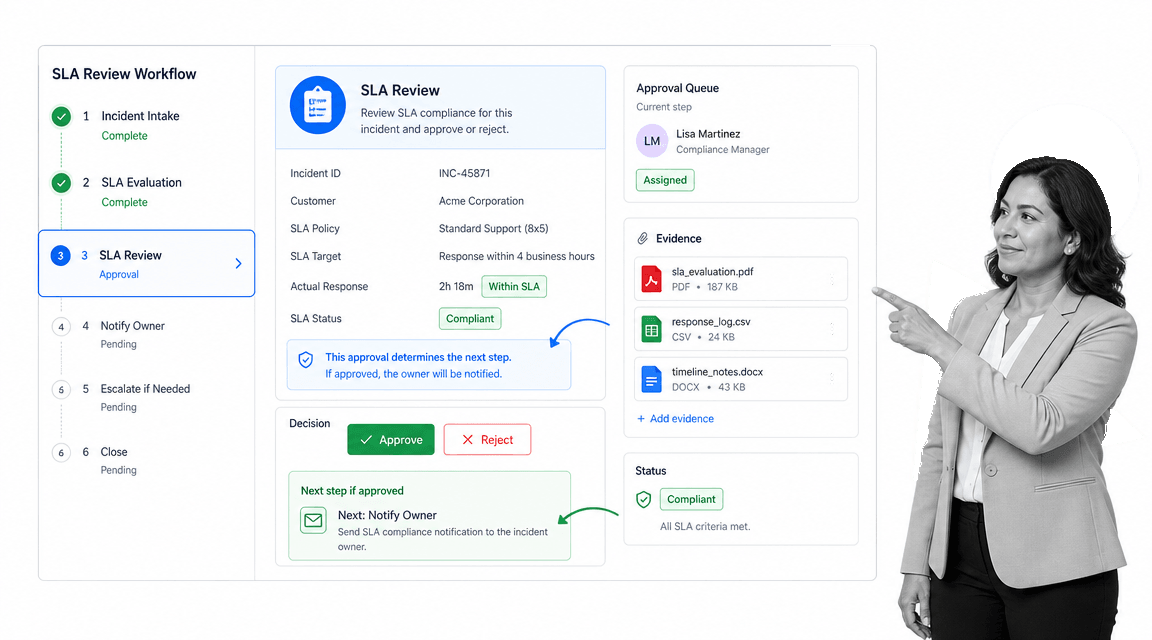
For SLA management, approvals are useful when you need to:
- Approve new customer requirements before the SLA is finalized.
- Review missed service targets before changes are implemented.
- Confirm that updated response times, escalation paths, or evidence requirements are ready to publish.
- Keep a clear audit trail of who approved each SLA decision.
Approve SLA decisions from the workflow
Approval decisions should not live in scattered emails or private messages. When they happen inside the workflow, the decision, owner, evidence, and next step stay connected to the SLA record.
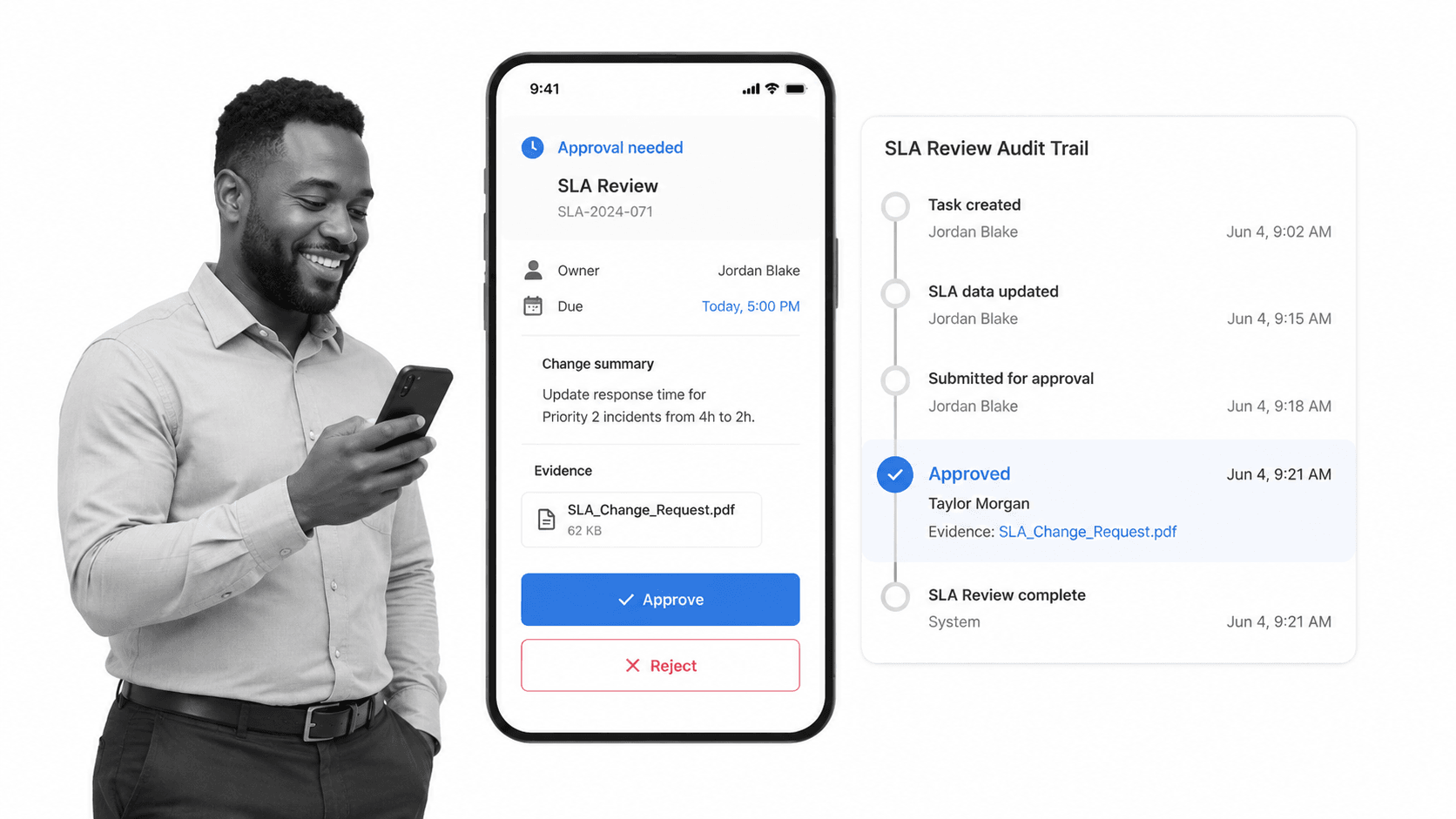
This is especially useful for recurring SLA reviews. The same workflow can collect the current metrics, route exceptions for approval, notify the right people, and document the decision before the agreement is updated.
Process Street can help you achieve exceptional service level management
Process Street is a Compliance Operations Platform that turns SLA procedures into governed, auditable workflows. You can document the agreement in a workflow, run recurring SLA reviews, route exceptions for approval, and keep the performance evidence connected to the work itself.
That matters because SLA management is not just a document control problem. It is recurring operational work: collecting metrics, checking service targets, escalating misses, approving changes, and proving that the right review happened at the right time. Process Street gives teams a practical workflow management software layer for that recurring work.
Check out our intro video for more on how Process Street works.
With features like stop tasks, conditional logic, dynamic due dates, task permissions, task assignments, role assignments, and approvals, your SLA examples become repeatable workflows that enforce the process and preserve proof.
Service level agreement examples: FAQ
What should a service level agreement include?
A service level agreement should define the services covered, the service provider and customer responsibilities, measurable performance targets, review cadence, escalation path, reporting expectations, and what happens if the target is missed.
How often should SLAs be reviewed?
Most SLAs should be reviewed on a regular cadence, often monthly or quarterly, depending on service risk and customer requirements. The important point is to define the review cadence in the agreement and run the review consistently.
Which SLA metrics matter most?
Common SLA metrics include response time, resolution time, uptime, availability, first call resolution, customer satisfaction, abandonment rate, and SLA achievement rate. The right metrics depend on the service being provided.
Who should own SLA reviews?
SLA reviews usually need one operational owner and one approval path. The owner collects performance data and runs the review. Approvers may include service leads, account owners, legal, compliance, or customer stakeholders.
How do you track SLA compliance?
Track SLA compliance by running a recurring workflow that collects metrics, compares them against agreed targets, records exceptions, routes required approvals, and stores evidence for future audits or customer reviews.
The post 17 Service Level Agreement Examples to Track Your Service Management Metrics first appeared on Process Street | Compliance Operations Platform.


0 Commentaires