Useful applications of AI and machine learning are no longer limited to research labs, ad platforms, or giant enterprise teams. AI now shows up inside everyday business processes: reviewing documents, routing work, predicting risk, drafting responses, inspecting quality, and helping teams decide what should happen next.
The practical question is not whether AI can do impressive things. It is where AI can remove repetitive work, improve decisions, and still leave the right human approval gates in place. This guide walks through 20 applications of AI across business functions and industries, with a focus on where the technology changes how work gets done.
Current adoption data points in the same direction. McKinsey’s 2025 State of AI research found broad use of AI across organizations, including growing experimentation and scaling of AI agents. At the same time, Pew Research Center found that workers are still more worried than hopeful about AI at work. That tension is why AI needs to be designed into processes carefully, not just added as another tool.
Jump to a section:
- AI and machine learning: a simple explanation
- Applications of AI in healthcare
- Applications of AI in finance
- Applications of AI in human resources
- Applications of AI in retail
- Applications of AI agriculture
- Applications of AI in security
- Applications of AI in energy
- Applications of AI in education
- Applications of AI gaming
- Applications of AI social media
- Applications of AI marketing
- Applications of AI manufacturing
- Applications of AI transportation
- Applications of AI in travel
- Applications of AI in customer service
- Applications of AI in law
- Applications of AI in entertainment
- Applications of AI automobiles
- Applications of AI in government
- Applications of AI in e-commerce
- How Process Street turns AI into governed execution
AI and machine learning: a simple explanation
Artificial intelligence is the broad field of software systems that perform tasks that normally require human judgment, pattern recognition, language understanding, planning, or decision support. Machine learning is one way to build those systems: the model learns patterns from data instead of relying only on rules written by a human.
Generative AI adds a different capability. It creates new text, images, summaries, code, plans, or drafts from a prompt and context. AI agents go a step further: they can plan a task, call tools, move work across systems, and ask for approval before taking an action. In business processes, these four ideas usually work together.
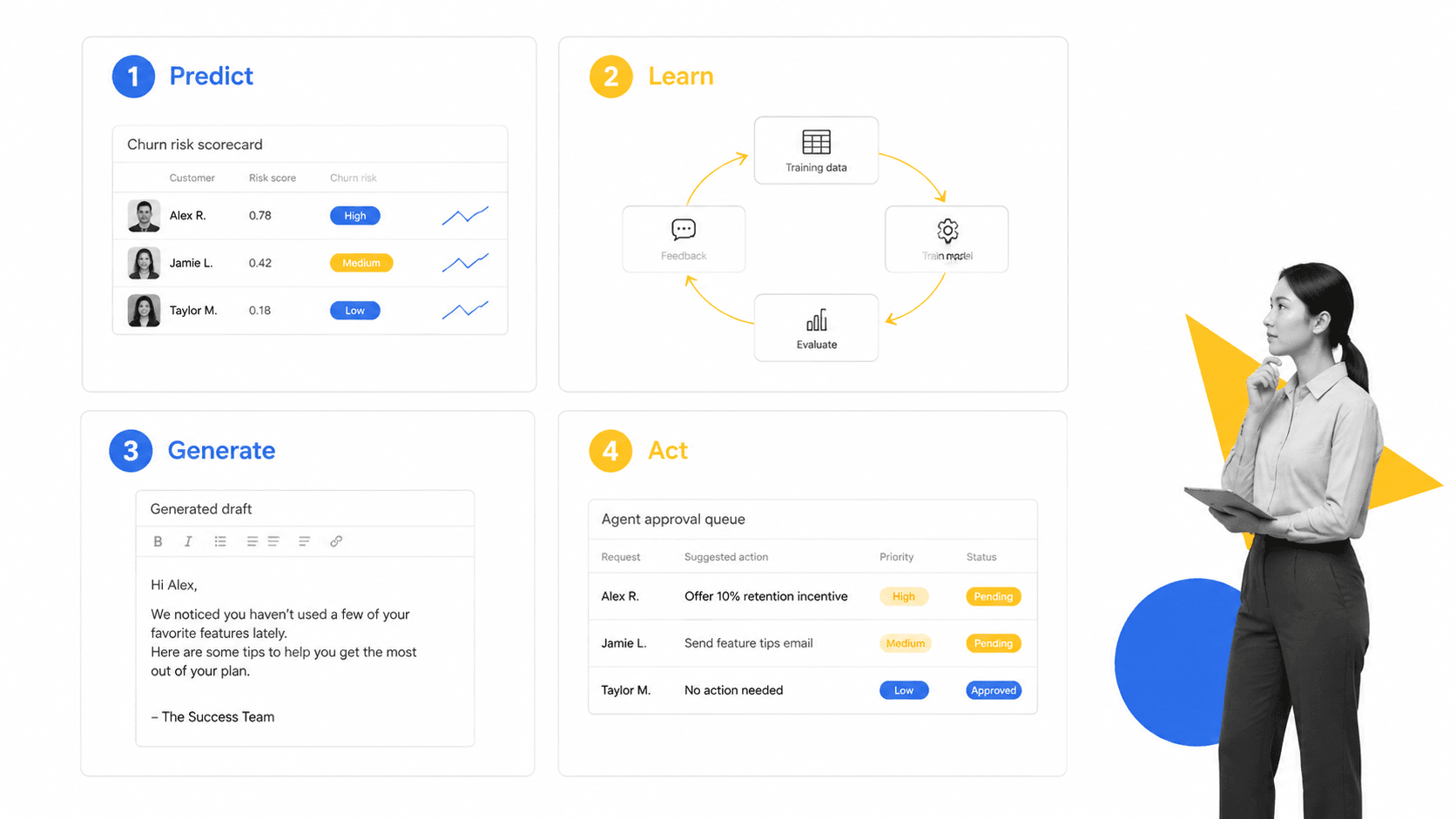
That distinction matters because each capability belongs in a different part of a process. Prediction helps prioritize. Machine learning improves recommendations. Generative AI drafts or summarizes. Agents move work forward. Governance determines what the system is allowed to do and where a person must approve the next step.
Applications of AI in healthcare
Healthcare uses AI for triage, imaging support, patient outreach, documentation, scheduling, and operational forecasting. The most visible examples are clinical, but a lot of value sits in the operational layer: routing referrals, checking intake completeness, preparing documentation, and reducing administrative backlog.
The field is active enough that the FDA maintains a public list of AI-enabled medical devices. For business teams, the lesson is broader: AI works best in healthcare when it improves a defined workflow, leaves a clear audit trail, and supports trained professionals rather than bypassing them.
Related Process Street reading: process mapping in healthcare.
Applications of AI in finance
Finance teams use AI to classify transactions, detect anomalies, forecast cash flow, screen investments, monitor fraud, summarize documents, and prioritize exceptions. Machine learning is useful when the task depends on spotting patterns across historical data. Generative AI is useful when the task depends on turning documents, emails, or notes into structured review work.
The strongest use cases do not replace controls. They make controls faster. An AI system can flag an unusual invoice, prepare a variance explanation, or summarize an investment memo, but the approval, evidence, and segregation of duties still need to be built into the process.
Related Process Street template: investment portfolio management process.
Applications of AI in human resources
HR teams use AI for candidate screening support, onboarding checklists, employee feedback analysis, internal knowledge search, policy Q&A, performance review summaries, and workforce planning. The risk is that HR processes carry sensitive data and real consequences for employees, so every AI-assisted step needs a clear owner.
A practical HR process might use AI to summarize interview feedback, suggest missing onboarding tasks, or group employee feedback themes. A person should still approve hiring decisions, policy changes, and sensitive employee actions.
Related Process Street reading: employee feedback loops.
Applications of AI in retail
Retailers use AI to forecast demand, optimize pricing, personalize offers, detect fraud, plan inventory, and route customer service issues. Recommendation engines are still important, but operational AI is becoming just as valuable: keeping shelves stocked, reducing returns, and helping teams respond to customer behavior faster.
The useful pattern is simple: connect customer, inventory, and operational data to a workflow that assigns action. A forecast only matters when it triggers replenishment, a merchandising review, or a customer communication.
Related Process Street reading: customer acquisition vs. retention.
Applications of AI agriculture
Agriculture uses AI for crop monitoring, disease detection, irrigation planning, yield forecasting, equipment maintenance, and supply-chain planning. Computer vision can inspect fields and livestock. Predictive models can help teams decide when to water, fertilize, harvest, or repair equipment.
The business-process angle is important here. AI does not just produce a prediction. It should trigger a checklist, assign a field inspection, log evidence, or escalate a risk before the window for action closes.
Applications of AI in security
Security teams use AI to detect anomalies, classify alerts, identify phishing attempts, monitor access patterns, summarize incidents, and prioritize vulnerabilities. AI helps because the signal volume is too high for humans to review every event manually.
Security AI still needs governance. The NIST AI Risk Management Framework is useful because it treats AI risk as something that must be governed, mapped, measured, and managed. In security work, that means AI can triage alerts, but incident response still needs ownership, evidence, and escalation paths.
Related Process Street template: physical security risk assessment checklist.
Applications of AI in energy
Energy teams use AI for demand forecasting, grid balancing, preventive maintenance, outage prediction, and asset optimization. As electricity demand rises and grids become more complex, AI helps operators plan capacity and respond faster to changing conditions.
The International Energy Agency’s Electricity 2026 analysis highlights how electricity systems are under growing pressure. AI can help with forecasting and operational planning, but it needs to sit inside accountable processes because energy decisions affect reliability and safety.
Applications of AI in education
Education uses AI for tutoring, lesson planning, accessibility support, grading assistance, student-risk detection, and administrative automation. The best use cases help teachers and administrators spend less time on repetitive work and more time helping students.
AI can draft feedback or identify students who may need support, but schools still need policies for privacy, fairness, and teacher review. A useful education workflow defines what AI can suggest, what a teacher approves, and what evidence is kept.
Related Process Street reading: process automation examples.
Applications of AI gaming
Gaming uses AI for non-player character behavior, procedural content, moderation, personalization, testing, and fraud detection. Generative AI is also changing how teams prototype characters, worlds, scripts, and game assets.
For game studios, the process value is in iteration speed. AI can create draft content and flag defects, but creative direction, quality review, and release approval still need human control.
Applications of AI social media
Social media platforms use AI for ranking feeds, recommending content, detecting spam, moderating harmful material, generating captions, and helping creators repurpose posts. Businesses use AI to draft posts, analyze engagement, summarize comments, and route customer issues.
The process risk is quality control. AI can speed up content production, but teams still need review steps for accuracy, brand voice, compliance, and customer privacy.
Applications of AI marketing
Marketing teams use AI for audience segmentation, content drafts, campaign analysis, landing-page testing, lead scoring, personalization, and competitive research. The highest-value teams do not use AI only to produce more content. They use it to tighten the feedback loop between market signal, campaign action, and pipeline learning.
A strong marketing process uses AI to prepare drafts and summarize performance, then routes approvals, publishing, and measurement through a repeatable workflow.
Related Process Street reading: content creation tips.
Applications of AI manufacturing
Manufacturing uses AI for predictive maintenance, quality inspection, demand planning, production scheduling, safety monitoring, and root-cause analysis. Computer vision can inspect defects. Predictive models can flag equipment risk. Agents can coordinate handoffs between maintenance, quality, and operations.
The key is to connect AI signals to standard work. A defect prediction should trigger inspection. A maintenance risk should create a work order. A quality exception should require evidence and approval before the line moves on.
Related Process Street reading: process optimization in manufacturing.
Applications of AI transportation
Transportation teams use AI for route optimization, fleet maintenance, demand forecasting, warehouse coordination, and driver safety. AI can reduce wasted miles, improve delivery estimates, and identify assets that need attention before they fail.
These systems work best when they are tied to operating rules. A route recommendation, maintenance alert, or safety warning should move into a defined process with ownership, status, and proof of completion.
Applications of AI in travel
Travel companies use AI for pricing, itinerary planning, customer support, fraud detection, disruption management, and personalized offers. When flights change or bookings fail, AI can summarize the situation and recommend the next best action.
The useful process pattern is exception handling. AI identifies the traveler, context, policy, and available options. A workflow routes the issue to the right person or system so the customer gets an answer quickly.
Applications of AI in customer service
Customer service is one of the clearest applications of AI. Teams use AI to classify tickets, suggest replies, summarize conversations, surface knowledge-base answers, route issues, detect sentiment, and identify churn risk.
The important distinction is between answering and resolving. A chatbot can answer a simple question. A governed AI workflow can collect context, check policy, draft a response, update a system, and escalate the case when a human decision is needed.
Related Process Street reading: customer service AI and customer support processes.
Applications of AI in law
Legal teams use AI for contract review, discovery, research, clause comparison, matter intake, policy review, and document summarization. These use cases can save time, but they also create accuracy, privilege, confidentiality, and accountability risks.
AI belongs in legal processes when the workflow makes review explicit. The system can draft or compare. The lawyer approves. The process records what was reviewed, what changed, and who signed off.
Related Process Street reading: how to ensure compliance.
Applications of AI in entertainment
Entertainment teams use AI for recommendations, editing support, localization, script ideation, visual effects, audience analysis, and production planning. Streaming recommendations are the classic example, but AI is now also part of creative and operational workflows.
Teams still need quality gates. AI can accelerate a draft, cut, or translation, but approvals protect brand, rights, accuracy, and creative intent.
Applications of AI automobiles
Automotive companies use AI for driver assistance, autonomous systems, predictive maintenance, manufacturing quality, supply-chain planning, and customer support. AI also helps analyze sensor data and identify patterns that human review would miss.
The business-process value extends beyond self-driving cars. Service workflows, recall processes, quality inspections, and parts forecasting all benefit when AI signals are connected to accountable action.
Applications of AI in government
Government agencies use AI for document processing, service routing, fraud detection, translation, public inquiry triage, inspection planning, and resource allocation. These use cases can improve service delivery, but they also require transparency, privacy controls, and clear accountability.
Public-sector AI should be designed around policy, evidence, and appeal paths. If an AI system helps prioritize a case or recommend an action, the process should show who reviewed it and why the decision was made.
Applications of AI in e-commerce
E-commerce teams use AI for product recommendations, search, dynamic merchandising, fraud detection, demand forecasting, returns analysis, support automation, and personalized messaging. AI helps teams understand behavior at scale and respond faster.
The practical workflow is not just “recommend a product.” It is identify intent, check inventory, personalize the offer, route exceptions, and measure the result. That is where AI becomes part of business process automation.
Common AI capabilities across industries
Across these applications, the same AI capabilities appear in different forms. Medical imaging analysis uses algorithms to analyze X-rays, MRIs, and CT scans, aid detection of abnormalities, personalize treatment plans, support drug discovery and development, and identify at-risk patients before complications grow. Finance teams apply fraud detection and prevention, fraud filters, account management, credit risk assessment, algorithmic trading, and personalized financial advice to make more accurate decision-making possible at scale.
People operations teams use recruitment and candidate screening, talent management, workforce planning, employee engagement analysis, employee retention analysis, HR analytics, and benefits administration to find skills gaps, identify high-potential employees, and reduce the burden of repetitive administrative tasks. Retail teams combine personalized customer recommendations, demand forecasting, inventory management, supply chain management, competitive pricing analysis, and customer behavior analysis so stock levels, stockouts, excess stock, and pricing changes are easier to manage.
In agriculture, AI supports precision farming through sensors, drones, and satellites. It can analyze data about irrigation, fertilization, pesticide use, crop monitoring, crop health, crop yields, crop prices, pest and disease management, and harvesting schedules so farmers can optimize planting and react to deficiencies earlier. Security teams use threat detection, behavior analysis, biometric authentication, facial recognition, fingerprints, voice patterns, access control, identity verification, video surveillance, and cyber attack detection to alert security personnel and reduce suspicious activities.
Energy operations use energy management, power grid optimization, renewable energy integration, energy storage solutions, battery systems, predictive maintenance, and weather forecasting to manage fluctuating energy sources, predict equipment failures, reduce wastage, and improve efficient energy distribution. Education teams use personalized learning, intelligent tutoring systems, automating grading and assessment, individualized assistance, administrative task automation, educational games, virtual reality, augmented reality, and adaptive learning to create more effective educational experiences.
Gaming teams use non-player characters, NPCs, procedural content generation, maps, quests, player behavior analysis, dynamic difficulty adjustment, cheating detection, and game design tools to create more immersive gaming experiences. Social media and marketing teams use content recommendation, content personalization, customer service chatbots, automated messaging, sentiment analysis, image and video recognition, ad targeting, audience segmentation, lead scoring, predictive analytics, content generation, audio and video drafts, and campaign optimization to understand audience segments and drive growth.
Manufacturing, transportation, travel, legal, government, entertainment, automobiles, and e-commerce all repeat the pattern. AI can detect defects, prevent costly breakdowns, optimize route planning, forecast travel demand, support booking confirmations and itinerary changes, expedite airport check-in with facial recognition technology, analyze contracts and statutes, summarize corporate records and regulatory filings, handle citizen inquiries, monitor cameras and sensors, create music compositions and visual effects, support adaptive cruise control and lane departure warnings, reorder products automatically, and personalize the shopping experience. The valuable part is not the isolated model; it is the controlled process that turns signals into accountable action.
The core AI task set is broad: identifying emotion in text or speech, tagging and classifying documents, understanding emails and replying like a human, writing product descriptions or other formulaic copy, summarizing key points from long text, picking objects out of images, writing unit tests for software, planning projects, and even beating the world’s top Go player. Cloud computing is more affordable, processing power has reached higher levels, and machine learning restrictions that once kept these systems out of everyday operations have fallen away.
Legal and compliance work shows how broad applications become controlled workflows. AI-powered platforms can scan large volumes of legal documents, statutes, case law, and regulations to provide relevant information and insights to lawyers and judges. Legal chatbots can provide legal information, guidance, and support to clients, answer routine legal questions, assist with form completion, and prepare documents, but the process still needs attorney review and evidence capture.
Finance and retail examples show the same operating logic. Algorithmic trading systems can analyze market data in real time and execute trades at high speeds, while fraud detection and prevention models analyze large volumes of transactions to identify patterns or anomalies that may indicate fraudulent activity. Personalized financial recommendations can analyze human behavior, spending habits, investment preferences, and financial goals, while inventory management systems continuously analyze sales data and relevant factors to make real-time inventory management decisions.
Physical-world AI adds another layer of operational detail. AI-driven robots and drones can perform seeding, harvesting, and spraying with minimal human intervention, increasing efficiency and reducing labor costs. Pest and disease management systems can identify pests and diseases in crops through image recognition and suggest appropriate intervention strategies, reducing reliance on harmful pesticides and chemicals.
Identity, energy, and safety use cases require especially careful governance. AI-powered biometric systems can accurately identify individuals based on unique biological characteristics, such as fingerprints, facial features, and voice patterns. Smart energy systems can monitor, control, and optimize energy usage in homes, buildings, and industrial facilities, while predictive maintenance can identify failures before they create downtime or safety issues.
Entertainment and marketing examples are often more visible to customers. Streaming platforms such as Netflix and Spotify use AI algorithms to analyze user data and provide personalized content recommendations based on preferences and viewing or listening history. Marketing teams use neural networks to analyze large datasets, identify patterns and preferences, create personalized campaigns, monitor social media conversations, identify emerging trends, predict consumer behavior, and provide valuable insights for marketing and business strategy.
Other practical examples include projecting sales figures based on historical data and market conditions, identifying and protecting against suspicious network activity, learning to drive vehicles, improving manufacturing processes by identifying waste, predicting content popularity, screening and grading job applicants, and making relevant content recommendations like YouTube and Netflix. Many companies, from tiny startups to global giants, use these capabilities to move difficult or repetitive work into more consistent operating systems.
Several narrower applications matter because they connect directly to operations. AI can detect unusual network traffic, identify potential cyber attacks, flag suspicious behavior, automatically tag and categorize visual content, describe images and videos, analyze player data, predict player preferences and behaviors, dynamically adjust game difficulty, and support travel recommendations for accommodations, activities, and dining based on customer preferences and past behavior.
How Process Street turns AI into governed execution
AI becomes useful in business when it is connected to execution. Process Street is a Compliance Operations Platform that brings together Docs for governed SOPs, Ops for execution workflows, and Cora, an AI compliance agent that helps monitor processes and surface risk.
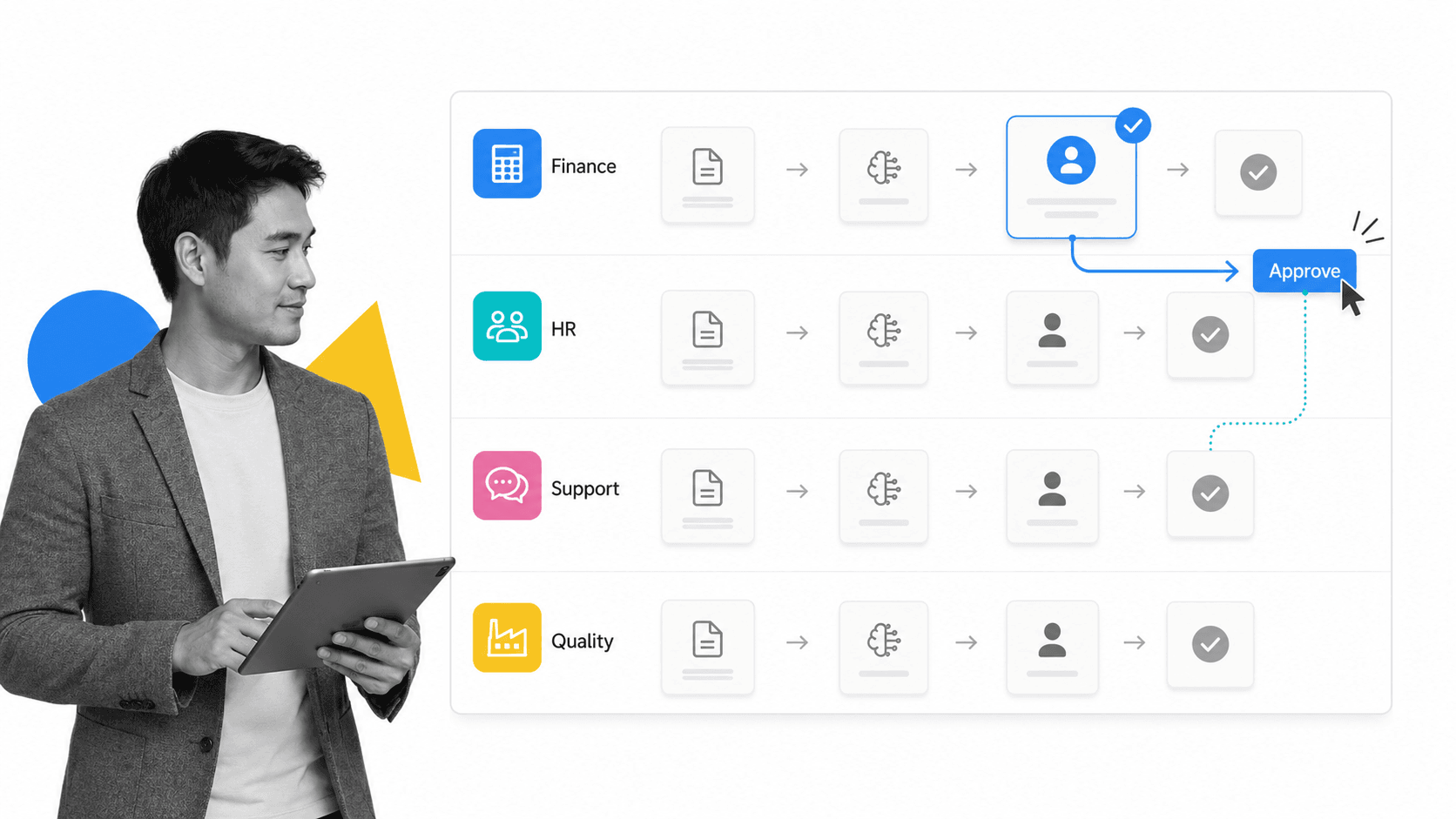
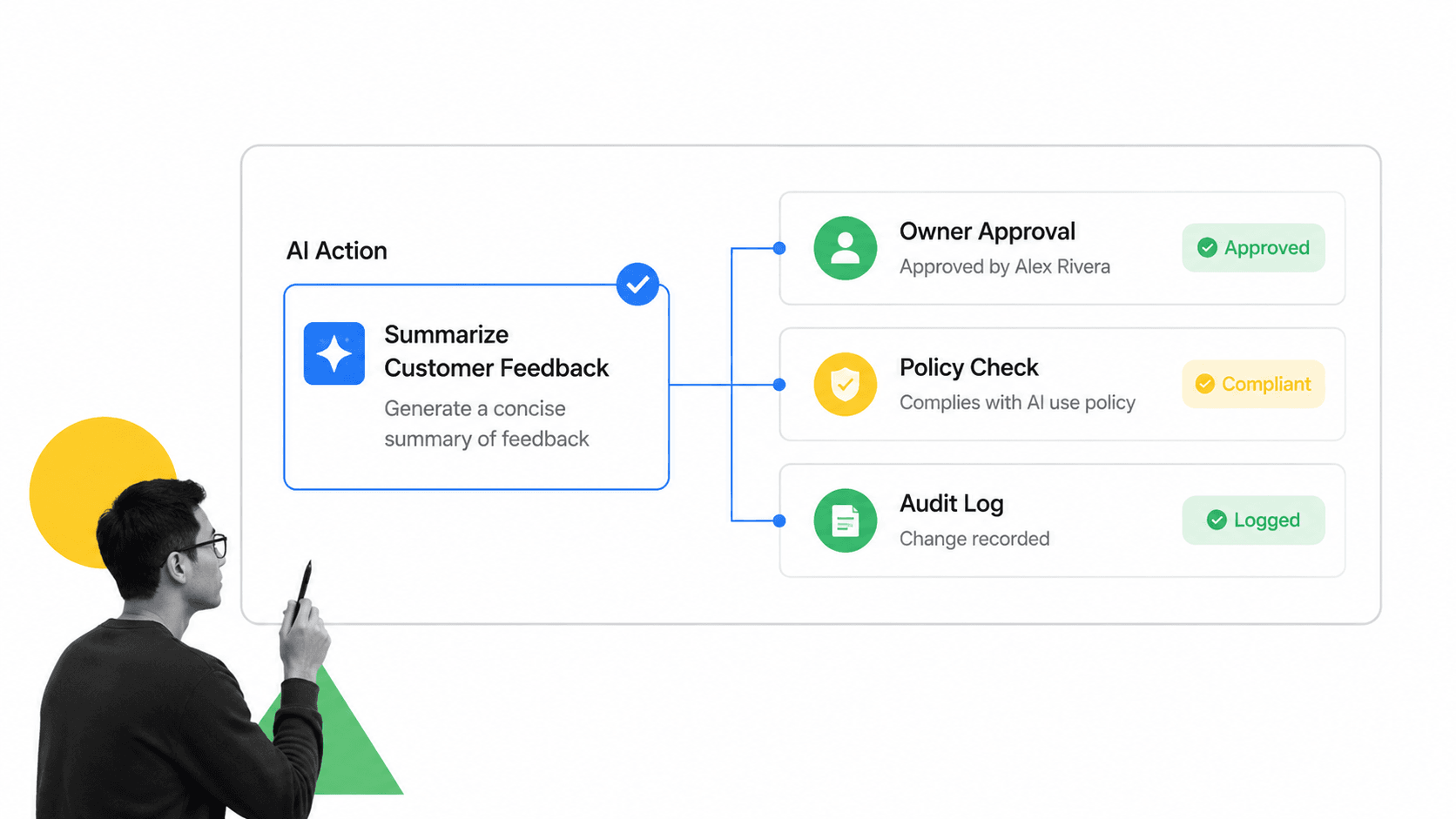
That matters because most AI applications need more than a model. They need inputs, owners, routing, approvals, evidence, and audit logs. A team can use AI to draft a policy, summarize a customer issue, classify a risk, or recommend the next task, but the process still needs to prove what happened.
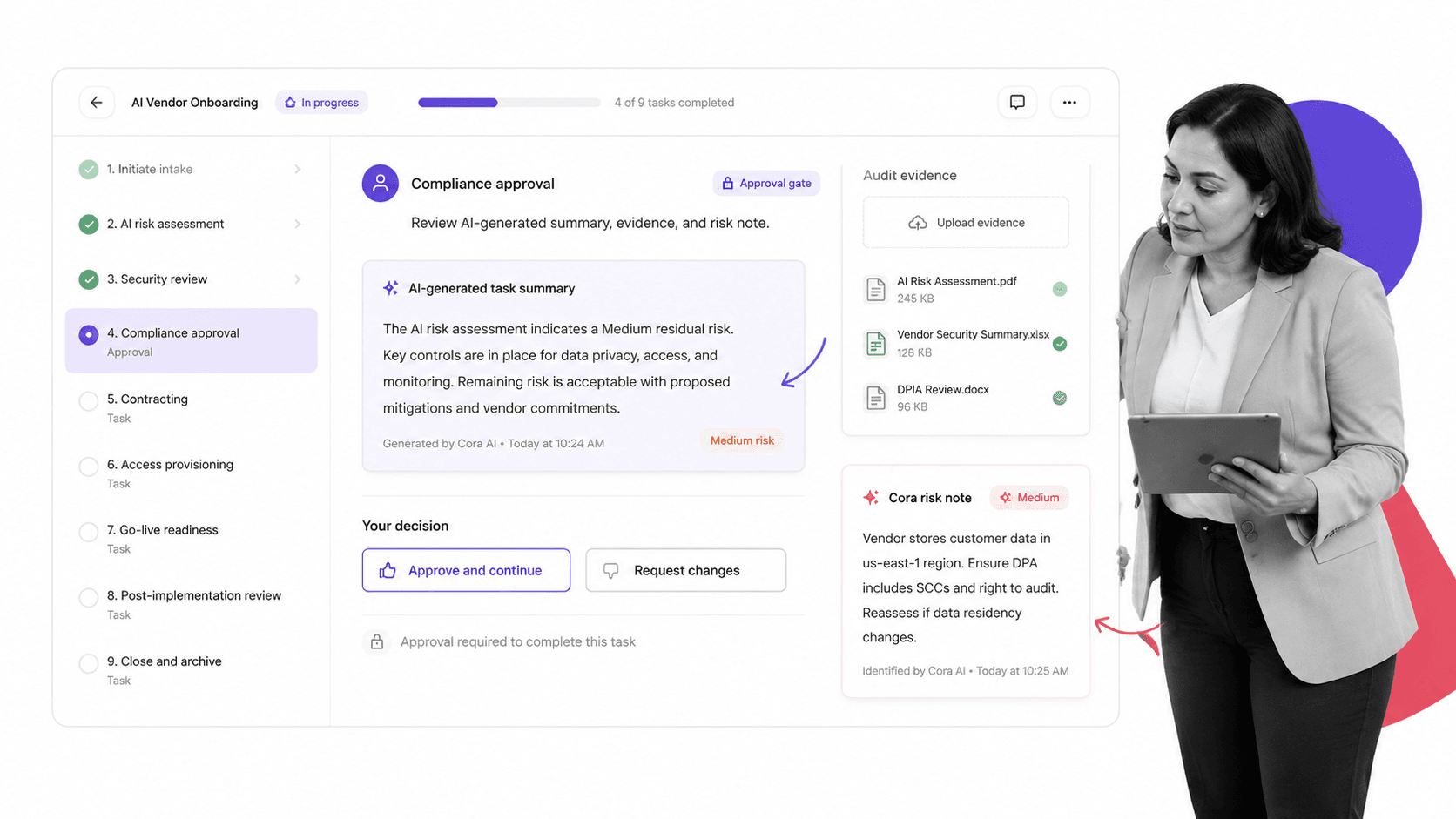
If you are evaluating what an AI compliance agent is, the clearest test is whether it can help work move through controlled steps rather than just answer questions. Useful AI should generate, route, check, and escalate work inside the rules your business already depends on.
Managing AI risk and governance
Every application of AI introduces a control question: what can the system do by itself, and what needs a person to approve? That question is not a blocker. It is how teams make AI safe enough to use in real work.
A practical AI governance process defines the allowed use case, the data source, the owner, the approval gate, the exception path, and the evidence that gets stored. Without that, AI becomes another unsupervised shortcut. With it, AI becomes a reliable part of the operating system.
Applications of AI FAQs
What are the most useful applications of AI in business?
The most useful applications of AI in business are the ones tied to repeatable processes: document review, customer support routing, fraud detection, demand forecasting, quality inspection, risk triage, workflow generation, and approval support.
How is machine learning different from generative AI?
Machine learning learns patterns from data and is often used for prediction, classification, and recommendations. Generative AI creates new outputs such as text, images, summaries, code, or plans from prompts and context.
Where should a company start with AI?
Start with a process that is frequent, measurable, and painful. Good candidates include support triage, document intake, compliance evidence collection, onboarding, invoice review, and quality checks. Avoid starting with work where the decision logic is unclear or the approval owner is undefined.
Why do AI workflows need human approval gates?
Human approval gates keep AI accountable. They make sure high-impact actions, sensitive decisions, and compliance-critical work are reviewed before completion. They also create proof of who approved what and when.
The post 20 Useful Applications of AI & Machine Learning in Your Business Processes first appeared on Process Street | Compliance Operations Platform.


0 Commentaires