GRC tools help teams manage integrated governance, risk, and compliance strategy in one operating system instead of three disconnected workstreams. The best tools connect policies, controls, risk registers, approvals, evidence, audits, owners, and remediation work so teams can prove what happened.
This guide covers 14 top GRC tools for integrated governance, risk, and compliance, then shows how Process Street can connect governed Docs, automated Ops workflows, and Cora, the AI compliance agent, to the work behind your GRC program.
- What is GRC?
- GRC as a revolutionary approach and why it is important
- Our top 14 GRC tools
- Using Process Street to integrate your governance, risk, and compliance solutions
- Take control of your GRC demands using Process Street and our top 14 GRC tools
Let’s jump straight to it.
What is GRC?
GRC is an integrated approach used by organizations to take control of their governance, risk, and compliance.
Organizations have always adopted methods for corporate governance, risk, and compliance, and in this sense, GRC is nothing new. However, it was in 2007 that GRC as an integrated approach became more commonplace – we’ll touch more on this later.
Before moving further, let’s cover the basics and define what is meant by the individual terms governance, risk, and compliance.
What is corporate governance?
Corporate governance refers to the systems of rules, practices, and processes by which companies act.
Corporate governance looks at how the company board chooses to run the organization, and how they set the mission and values of the company. This can be distinguished in day-to-day business operations.
For instance, consider Process Street as an example. Process Street’s mission statement is:
“Make recurring work fun, fast, and faultless for teams everywhere.”
To succeed in this mission, employees follow 6 core values:
- Act like the owner.
- Default to action.
- Focus on the process.
- Practice prioritization.
- Pay attention to details.
- Over-communicate everything twice.
Our mission statement and set of values define the heart of Process Street, determining how teams run, how the organization as a whole operates, and how it’s governed.
Process Street then set out to build and document every procedure and process that keeps the organization functioning like a well-oiled machine. These documented processes are distributed to all team members to assist remote work and are built with the core vision, mission, and values in mind. Legal requirements are integrated into these processes, which can be accessed from anywhere via the cloud. This allows Process Street to operate as a fully remote organization.
What is risk management?
Risk management in a business sense acknowledges that risk happens, and takes measures to ensure you’re completely prepared for it.
The International Organization for Standardization (ISO) defines business risk management as:
“…[The] systematic application of policies, procedures, and practices to the activities of communicating and consulting, establishing the context and assessing, treating, monitoring, reviewing, recording and reporting risk” – ISO, ISO 31000 Risk Management Guidelines
For instance, business response to the COVID-19 pandemic exemplifies risk management in action.
One of the main visible results of the 2020 COVID-19 outbreak has been the mainstream transition from traditional office-based work to remote work-from-home (WFH) arrangements.
As such, the pandemic has amped up risk management, pushing employees into a remote-work lifestyle as an adaptive response to manage global pandemic risks.
What is compliance?
Compliance is the ability to act according to an order, set of rules, or requests. It’s a catch-all term for how well a company follows the laws and regulations governing its business.
Compliance requirements will vary from place-to-place, however, requirement failure has consequential impacts including fines, loss of good standing, and legal action.
For example, you might remember the 2007-2015 Danske Bank scandal. Denmark’s biggest financial institution took part in a $237 billion money-laundering affront via its Estonian branch. Compliance failures included staff training defects and compliance officer absence at the management level. These compliance failures resulted in prosecution.
GRC as a revolutionary approach and why it’s important
Before an integrated approach was adopted, using disjointed governance, risk, and compliance activities caused several problems.
For instance, separate departments were required for performance management, risk management, compliance, corporate social responsibility, etc.
With this departmental design, programs were often siloed, ineffective, and yielded troubling drawbacks, such as:
- High-costs;
- A lack of visibility into risks;
- An inability to address third party risks;
- Difficulty measuring risk-adjusted performance;
- Too many negative surprises.
Operating in isolation, departments established counter-productive objectives, selected sub-optimal strategies, and lacked performance quality.
Using governance, risk, and compliance via an integrated approach
Looking at governance, risk, and compliance as entities to be integrated was an approach that hit the mainstream in 2007. The first scholarly article on GRC was written by Scott Mitchell, who formally defined GRC as:
“The integrated collection of capabilities that enable an organization to reliably achieve objectives, address uncertainty and act with integrity” – Scott Mitchell, GRC360: A framework to help organizations drive principles performance
The research referred to common keep the company on track activities, with the inclusion of all departments in a collaborative and integrated mix, conducting procedures such as internal audits, compliance, risk management, legal, finance, IT, and HR processes.
Integrating GRC capabilities does not mean crafting a mega-department, and doing away with decentralized management.
GRC is about establishing an approach that ensures the right people get the right information at the right time, under the right objectives, regardless of department. This brings benefits, as outlined by Finextra, such as:
- Quick and informed decision making. ️
- Organizational protection from financial and reputation loss, data breaches, compliance violations, and more.
- Continuous collaboration across departments, creating a holistic representation of risk.
- A single source of truth is provided to all employees, auditors, and regulatory bodies. ✅
- Accuracy of risk and control information enabling stakeholders to make fast, risk-informed business decisions.
- Effective compliance programs to address changes to regulations, technology, and business – these changes are a given.
- Consistency in GRC measures and comprehensive insights into the internal operating environment.
- Ability to respond proactively to risks by the break down of restrictive functional, business, and organizational silos.
- A unified operating model for the business with the agility needed to manage emerging risks.
- Lower cost of assurance.
GRC tools
GRC tools help organizations meet governance, risk, and compliance demands. GRC tools come under the umbrella term, GRC software, the 2 terminologies are used interchangeably.
Today, using an integrated approach to GRC is not a viable option without GRC software and tools. To do so would be considered reckless due to today’s GRC complexity.
When establishing GRC integration, the key is to start small. That is, you’ll want to implement a phased GRC plan, with clearly defined roles and priorities for each stage so that everybody understands what’s required.
The best GRC programs treat governance, risk, and compliance as interconnected workstreams, not siloed departments. The tools in this guide reflect that shift: each one connects multiple GRC functions in a single platform rather than solving one piece in isolation.
In the next section, we rank 14 GRC tools from enterprise-grade integrated platforms to modern compliance automation, then show how Process Street ties the operational compliance work together.
Our top 14 GRC tools
The GRC tools market has matured from spreadsheet-driven compliance into purpose-built platforms that connect risk registers, policy libraries, control testing, evidence collection, and audit trails in a single system. The best tools in 2026 use AI to flag regulatory changes, automate evidence gathering, and quantify risk in financial terms.
Here are 14 GRC tools that cover the full spectrum, from enterprise-grade integrated platforms to modern compliance automation.
1. ServiceNow GRC
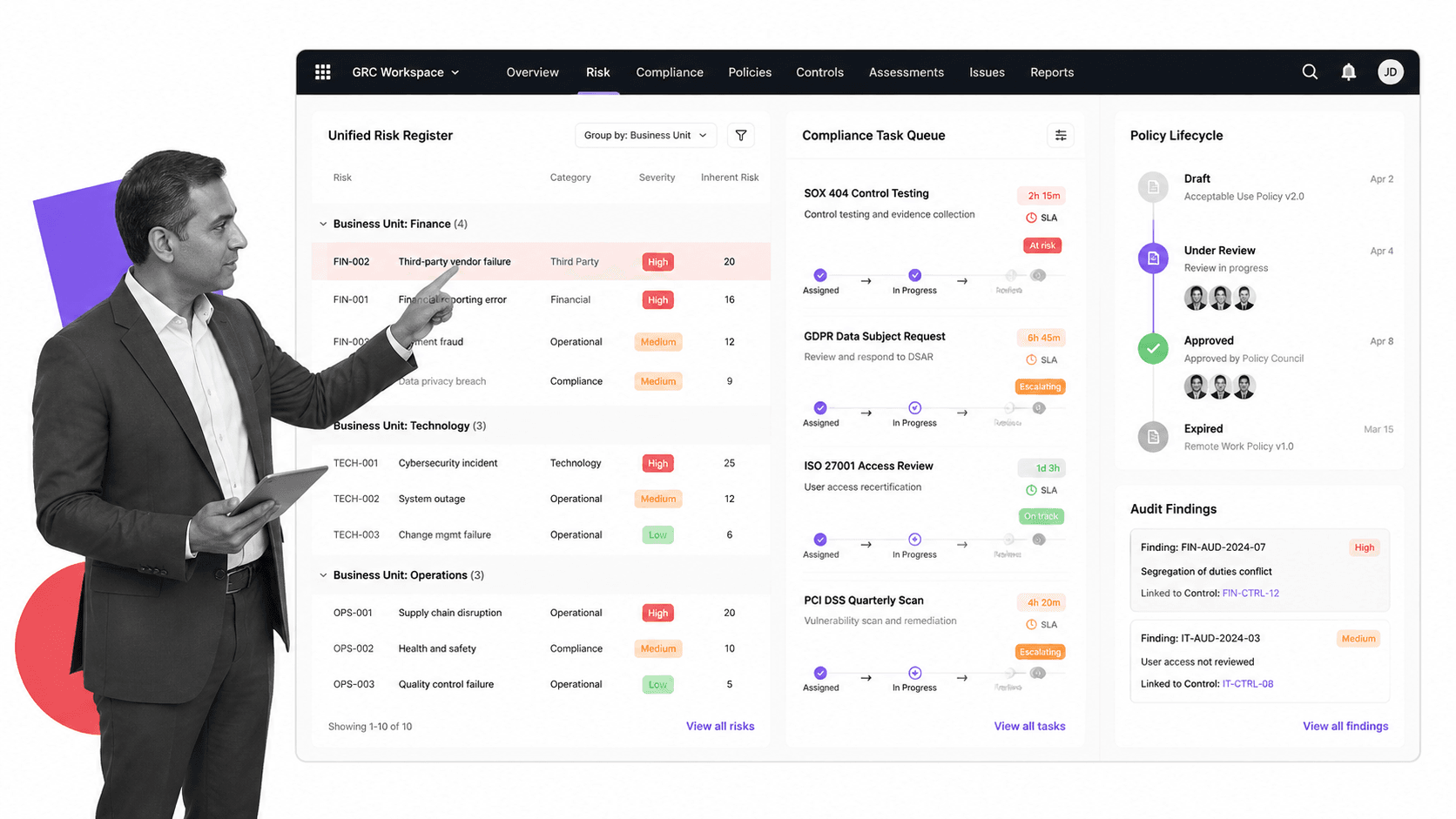
What it does: ServiceNow GRC brings governance, risk, and compliance into the Now Platform, the same infrastructure thousands of enterprises already use for IT service management. Risk, compliance, audit, and policy management run on a single data model, so a control deficiency discovered in an audit automatically updates the risk register and triggers remediation workflows.
Why it’s on this list: ServiceNow is the default enterprise GRC platform for organizations already running on the Now Platform. The unified data model means risk, compliance, and audit teams work from the same records instead of reconciling across siloed tools.
Best for: Large enterprises that need GRC embedded in their existing ServiceNow IT and business operations environment.
Price: Custom enterprise pricing. Contact ServiceNow for a quote.
Learn more about ServiceNow GRC
2. Process Street
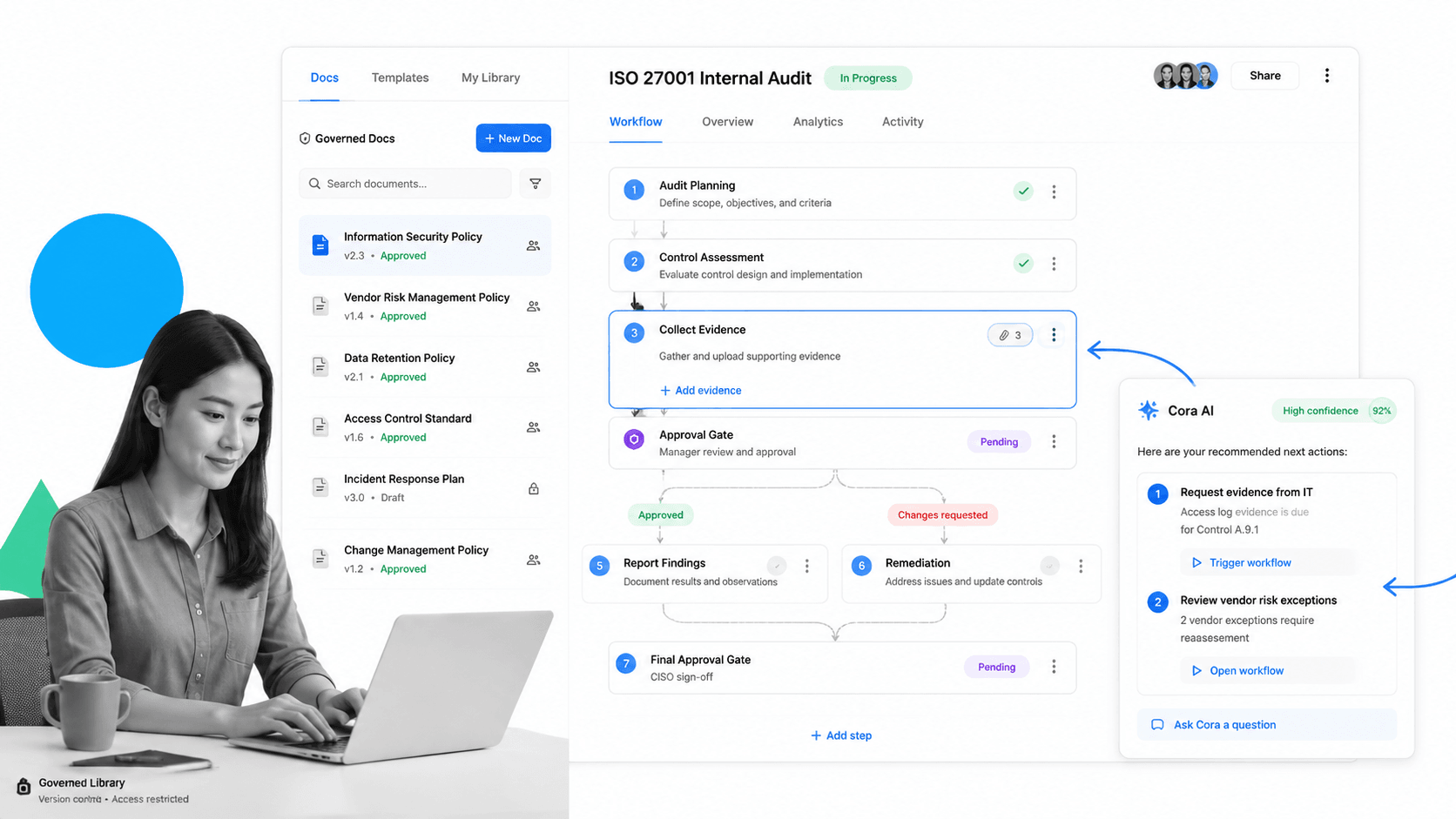
What it does: Process Street is a Compliance Operations Platform that turns GRC requirements into structured, repeatable workflows. Docs governs policies and SOPs with version control and access permissions. Ops automates the compliance work: task assignments, approvals, evidence collection, conditional logic, and audit trails. Cora, the AI compliance agent, monitors running workflows, flags risks, and suggests process improvements.
Why it’s on this list: Most GRC tools organize the control environment. Process Street executes the actual compliance work. When an auditor asks “show me proof this happened,” Process Street produces timestamped workflow runs with approval records, collected evidence, and complete audit trails.
Best for: Operations and compliance teams that need to run, track, and prove recurring GRC work, not just document it.
Price: Plans start at $100/month. See pricing.
Learn more about Process Street
3. Diligent
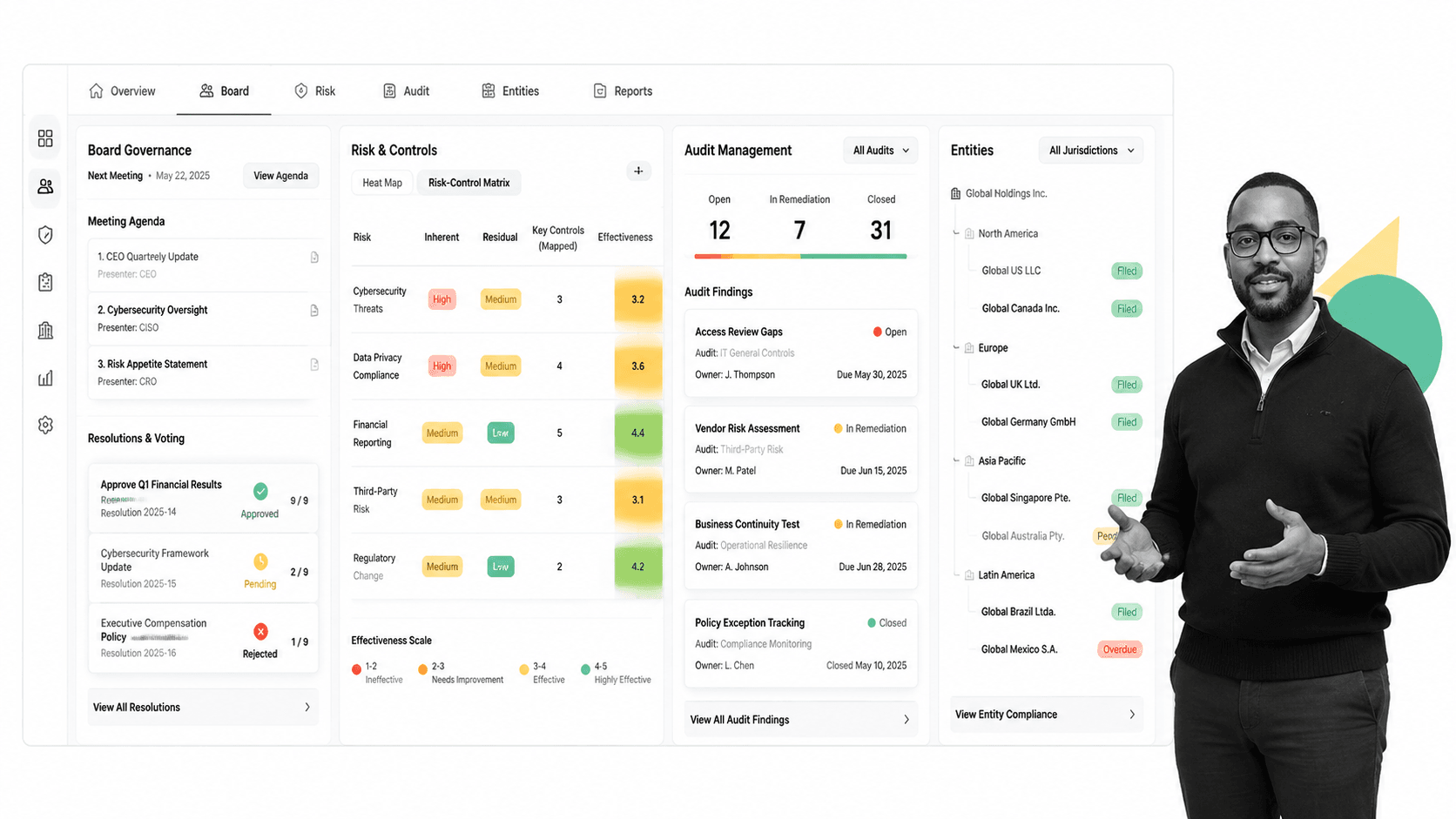
What it does: Diligent provides a full-suite GRC platform spanning board governance, enterprise risk management, internal audit, compliance, and entity management. The platform connects boardroom decisions to operational risk and compliance execution. Diligent acquired Galvanize (formerly ACL) to deepen its risk analytics and audit automation capabilities.
Why it’s on this list: Diligent is a 2025 Gartner Magic Quadrant Leader for GRC. It is one of few platforms that covers the full chain from board-level governance decisions through operational risk management to entity-level compliance filings.
Best for: Enterprises that need board governance, entity management, and risk/audit in one platform.
Price: Custom enterprise pricing. Contact Diligent for a quote.
4. LogicGate Risk Cloud
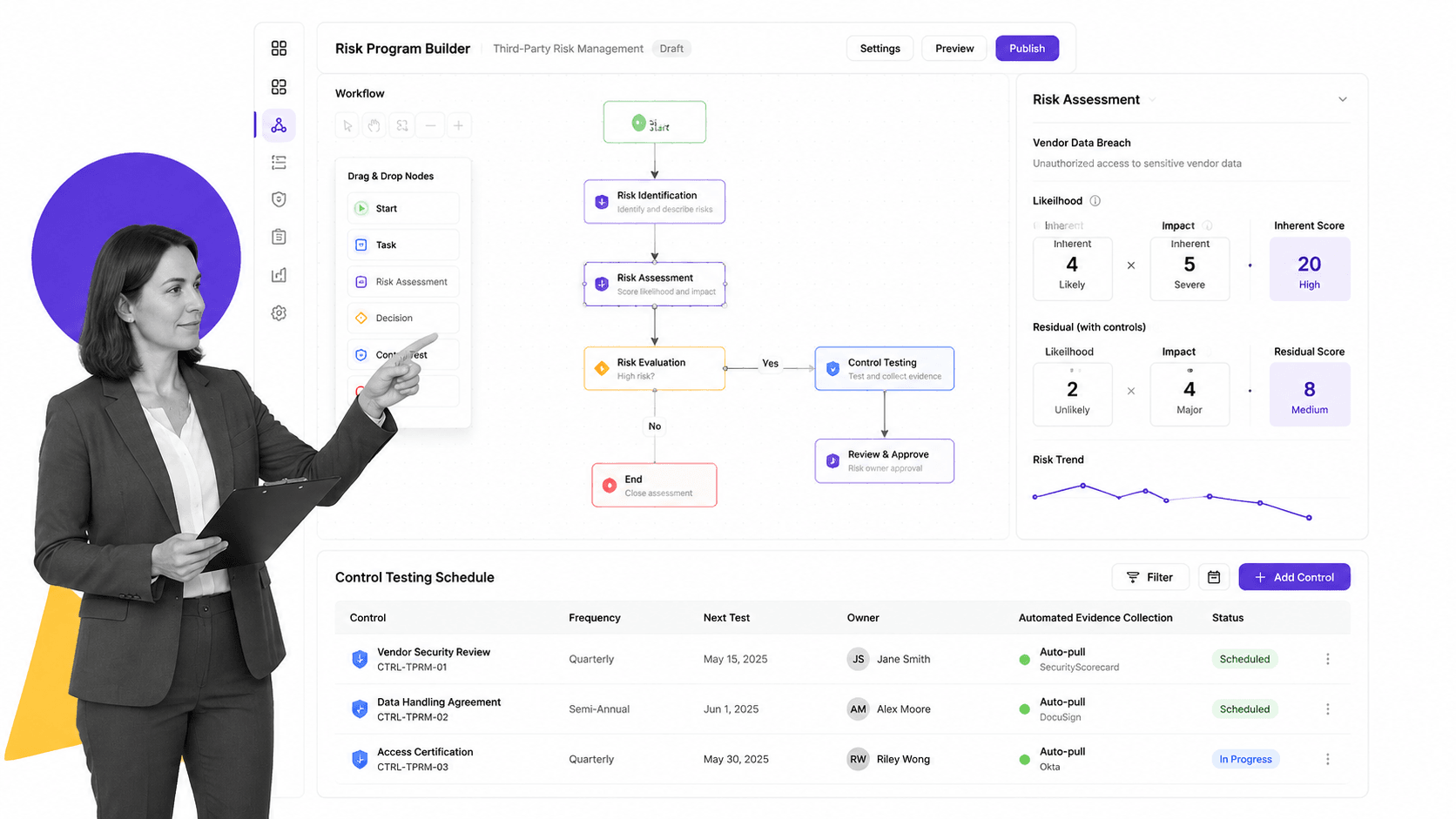
What it does: LogicGate Risk Cloud is a cloud-native, modular GRC platform built around a visual workflow builder. Teams configure risk programs, compliance processes, and audit workflows by connecting drag-and-drop nodes. The platform supports quantitative risk scoring, automated control testing, and evidence collection across multiple frameworks simultaneously.
Why it’s on this list: LogicGate is a 2025 Gartner Magic Quadrant Leader, positioned as a Visionary for its flexibility and customization. Unlike rigid enterprise platforms, Risk Cloud lets teams build exactly the GRC programs they need without custom development.
Best for: Mid-market to enterprise teams that need highly customizable GRC workflows without heavy implementation projects.
Price: Custom pricing based on modules and users. Contact LogicGate for a quote.
Learn more about LogicGate Risk Cloud
5. IBM OpenPages
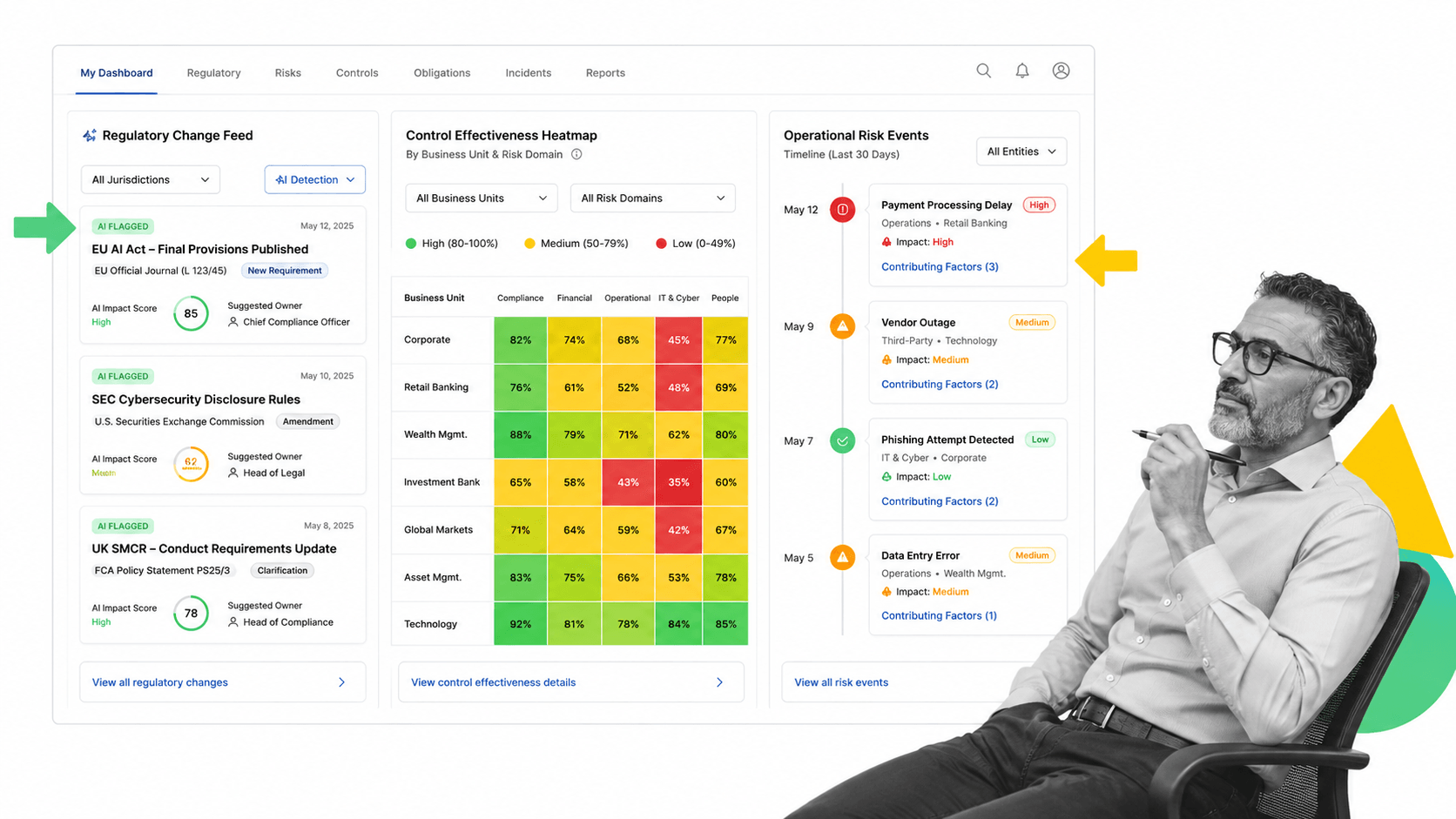
What it does: IBM OpenPages uses AI to power enterprise-scale governance, risk, and compliance management. The platform monitors regulatory changes, flags relevant updates to compliance teams, scores their potential impact, and suggests assignees. Operational risk events feed into a unified timeline that links incidents to contributing factors, failed controls, and remediation plans.
Why it’s on this list: IBM OpenPages is a 2025 Gartner Magic Quadrant Leader for GRC. Its AI-powered regulatory change management is a differentiator: instead of teams manually tracking regulatory updates across jurisdictions, OpenPages surfaces relevant changes and scores their organizational impact automatically.
Best for: Large enterprises in regulated industries (financial services, healthcare, energy) that need AI-driven regulatory intelligence.
Price: Custom enterprise pricing. Contact IBM for a quote.
Learn more about IBM OpenPages
6. OneTrust
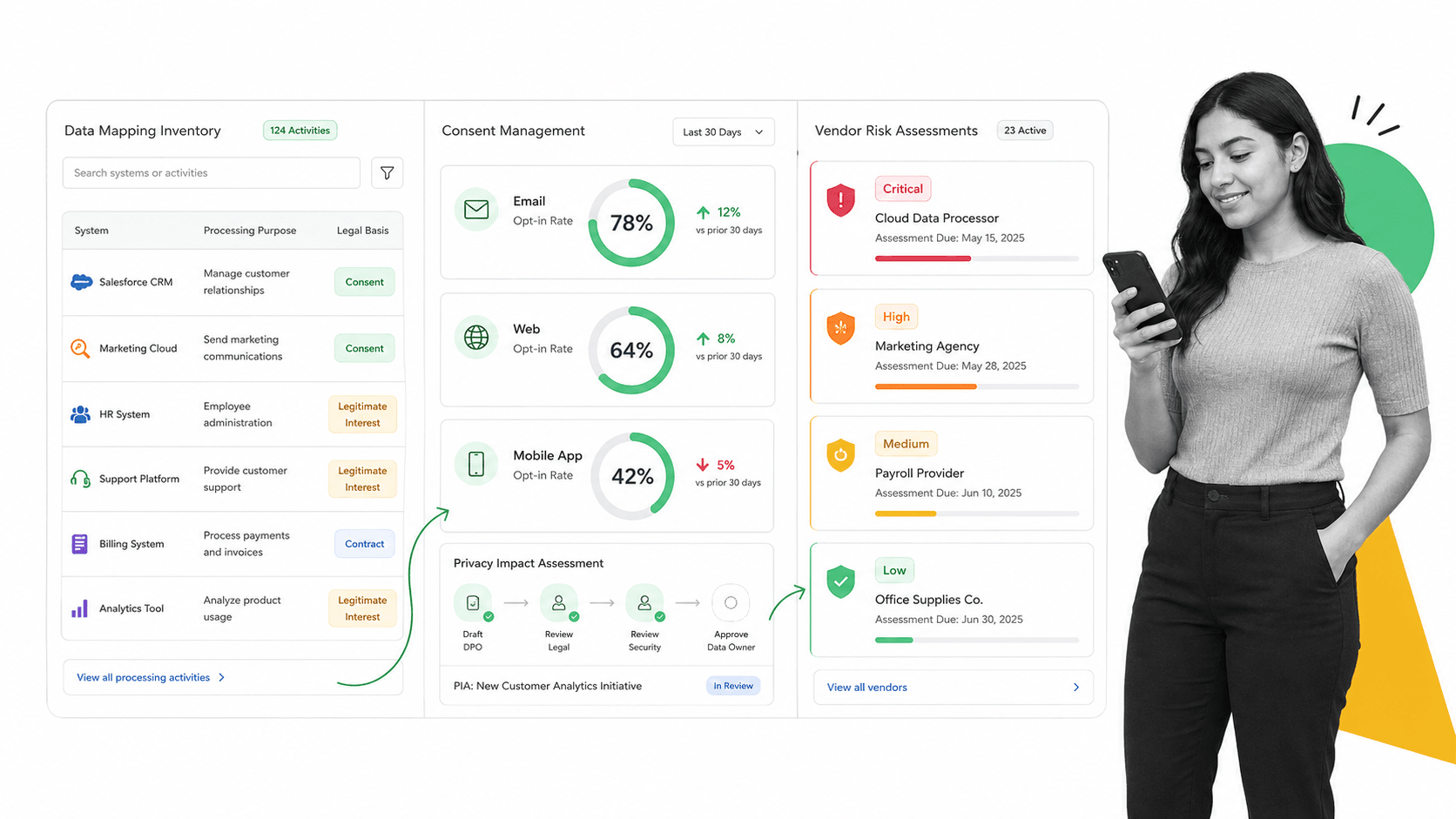
What it does: OneTrust started as a privacy management platform and has expanded into a comprehensive GRC suite covering data governance, risk management, ethics, compliance, and third-party risk. The platform maintains a data processing inventory, manages consent across channels, runs vendor security assessments, and automates privacy impact assessments.
Why it’s on this list: OneTrust is the market leader in privacy and data governance, and its expansion into full GRC makes it a strong choice for organizations where data privacy is the entry point to broader compliance work. The platform supports 200+ global privacy regulations.
Best for: Organizations where privacy compliance (GDPR, CCPA, LGPD) is the primary GRC driver and vendor risk management is critical.
Price: Enterprise pricing starting around $50K/year. Contact OneTrust for a quote.
7. Optro (formerly AuditBoard)
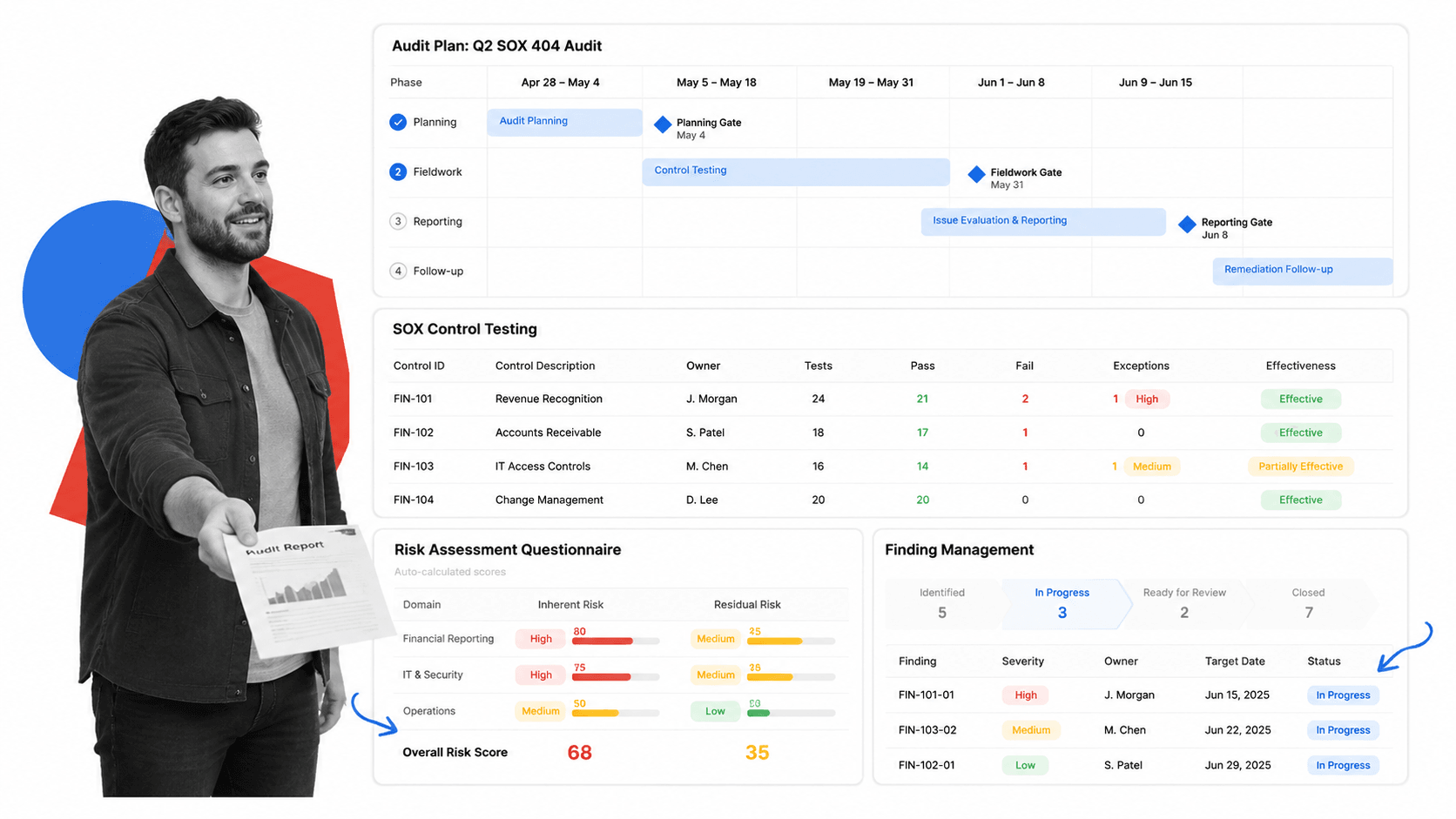
What it does: Optro (rebranded from AuditBoard in 2025) is an audit, risk, and compliance platform built around internal audit workflows. The platform manages audit planning, fieldwork scheduling, SOX control testing, risk assessments, and finding remediation in a unified workspace. Auto-scored risk questionnaires and audit evidence automation reduce manual data collection.
Why it’s on this list: Optro is a 2025 Gartner Magic Quadrant Leader for GRC and consistently ranks as the top-rated GRC product on G2. Its audit-first approach makes it particularly strong for SOX compliance, internal audit management, and risk assessment programs.
Best for: Internal audit teams and SOX compliance programs that need structured audit workflows with risk assessment capabilities.
Price: Custom pricing. Contact Optro for a quote.
8. MetricStream
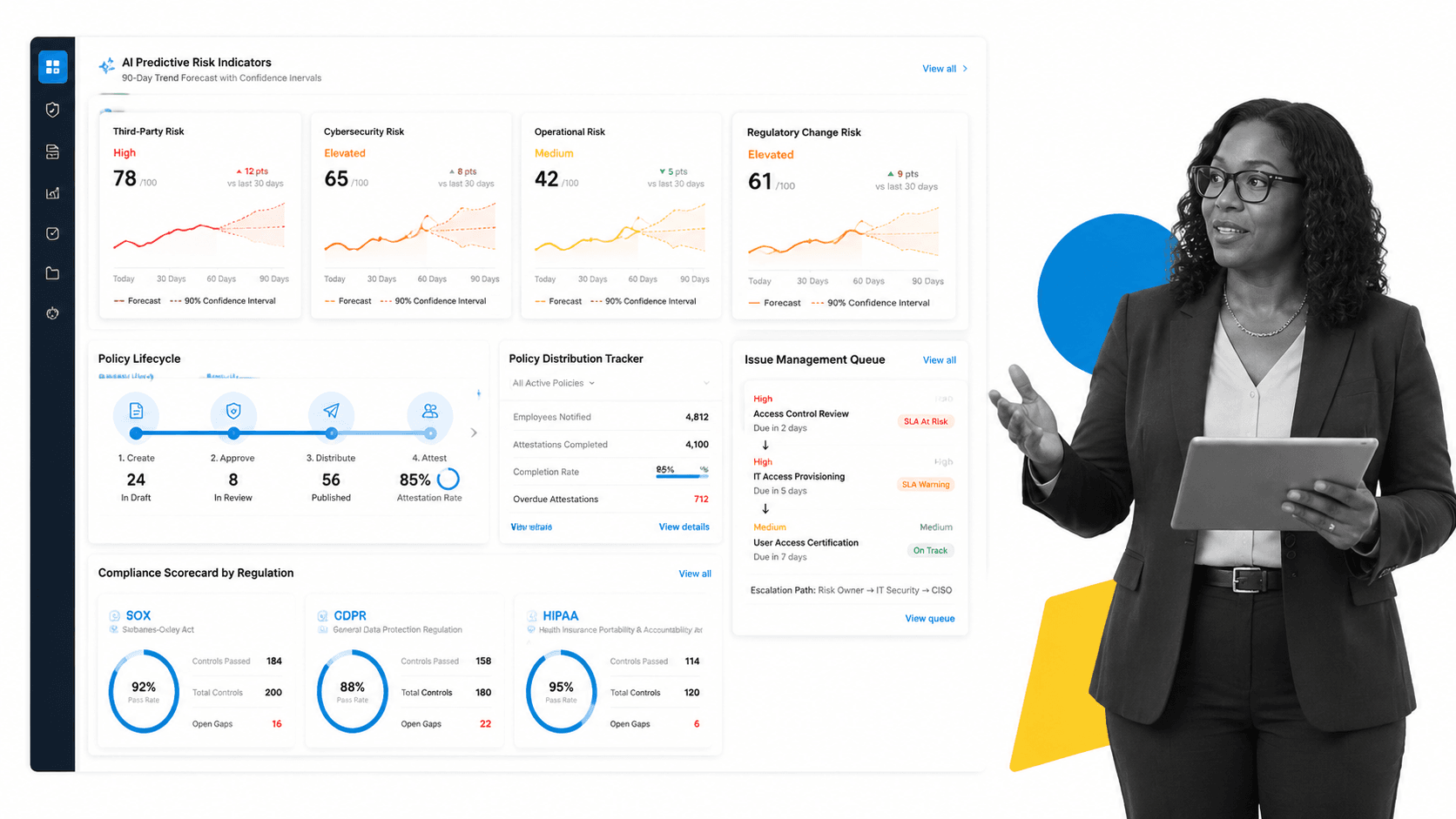
What it does: MetricStream is a long-standing enterprise GRC platform used by Fortune 500 companies for integrated risk management, policy lifecycle management, compliance program management, and audit automation. The platform uses AI to generate predictive risk indicators, forecast risk trends, and identify emerging compliance gaps before they become audit findings.
Why it’s on this list: MetricStream has been in the GRC market for over two decades and serves some of the largest regulated enterprises globally. Its AI-driven predictive risk analytics and regulation-specific compliance scorecards make it a strong choice for mature GRC programs.
Best for: Large enterprises with mature GRC programs that need AI-driven risk prediction and multi-regulation compliance management.
Price: Custom enterprise pricing. Contact MetricStream for a quote.
9. Drata
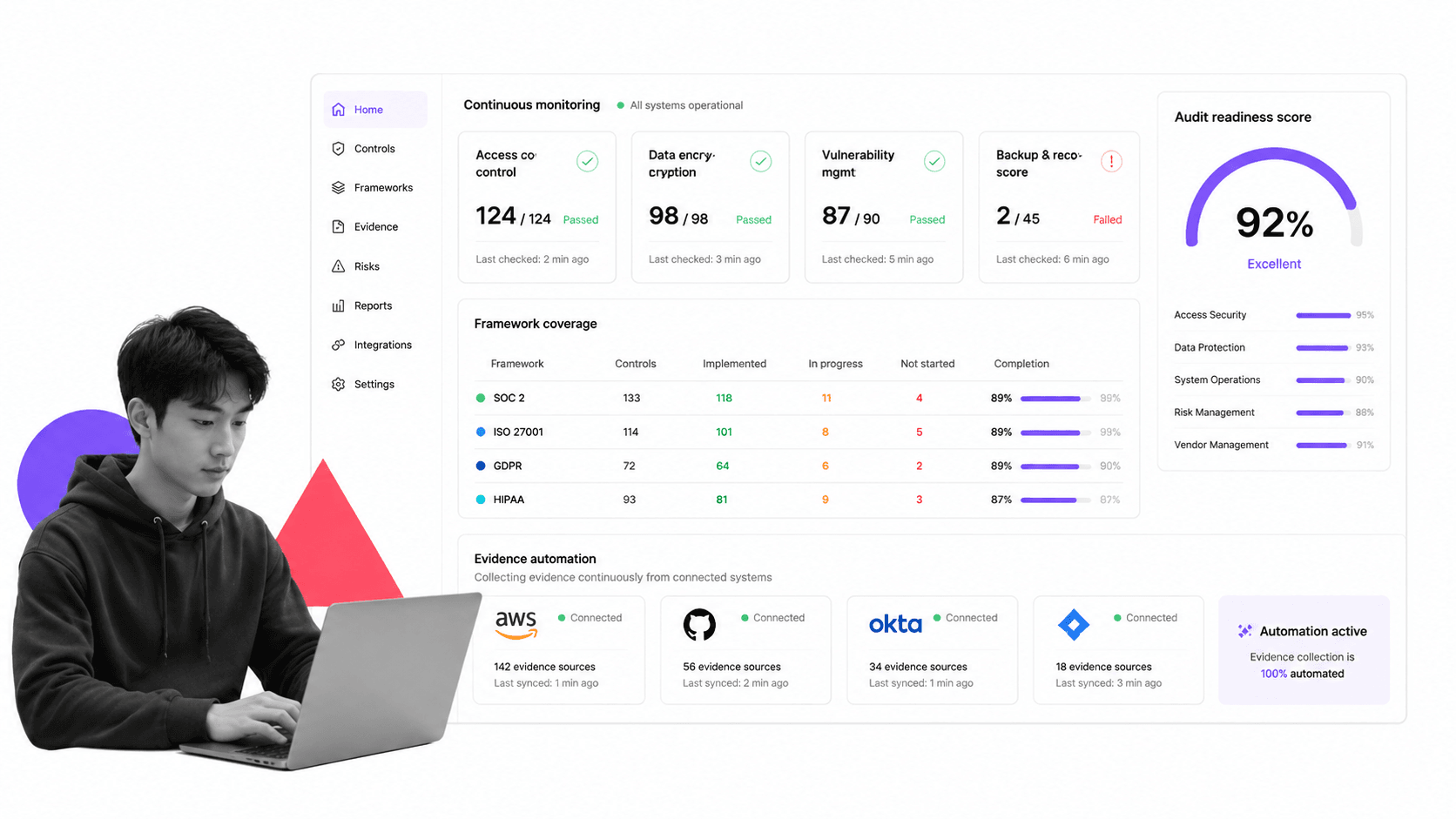
What it does: Drata automates compliance monitoring and evidence collection across 25+ frameworks including SOC 2, ISO 27001, GDPR, HIPAA, PCI DSS, and more. The platform connects to your infrastructure (AWS, Azure, GCP, GitHub, Okta, and 100+ integrations), continuously monitors control effectiveness, and automatically collects audit evidence. When a control drifts out of compliance, Drata flags it in real time.
Why it’s on this list: Drata represents the compliance automation wave that is making GRC accessible to mid-market companies. Continuous monitoring replaces point-in-time audits, and automated evidence collection eliminates the manual screenshot-and-spreadsheet approach.
Best for: SaaS companies and tech organizations pursuing SOC 2, ISO 27001, or multi-framework compliance with limited compliance headcount.
Price: Starting around $7,500/year for startups. Mid-market plans from $22,000/year. Contact Drata for enterprise pricing.
10. Vanta
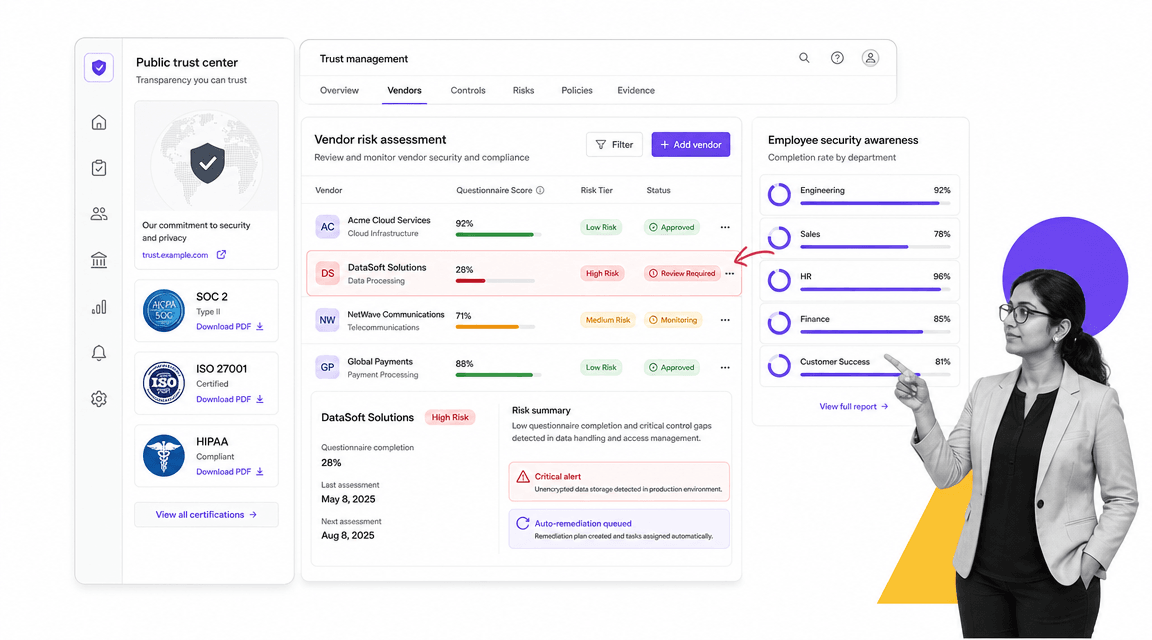
What it does: Vanta is a trust management and compliance automation platform. It automates compliance across frameworks (SOC 2, ISO 27001, HIPAA, GDPR, PCI DSS), manages vendor risk through automated security questionnaires, tracks employee security awareness training, and provides a public trust center where prospects can verify your compliance status and download certificates.
Why it’s on this list: Vanta is a top-rated GRC product on G2 and the leading trust management platform. The public trust center is a unique differentiator: instead of sharing compliance documents manually during sales cycles, prospects self-serve from a branded portal.
Best for: Growth-stage companies that need compliance automation, vendor risk management, and a customer-facing trust center to accelerate sales.
Price: Starting around $22,000/year. Contact Vanta for a custom quote.
11. Hyperproof
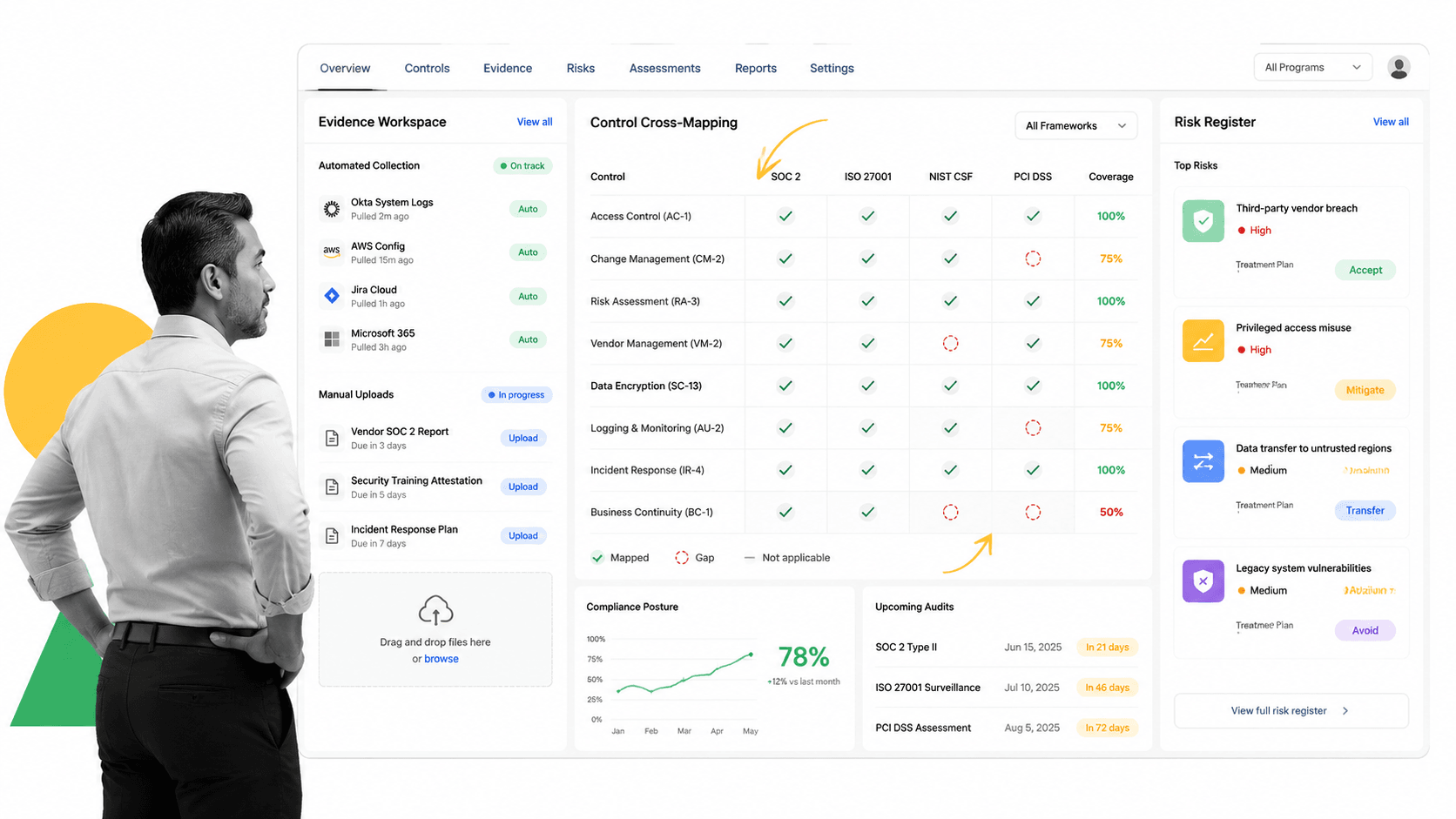
What it does: Hyperproof is a compliance operations platform that bridges the gap between compliance automation and traditional GRC. The platform manages control cross-mapping across multiple frameworks, automates and organizes evidence collection (both automated pulls and manual uploads), runs risk assessments with treatment plan options, and provides audit-ready program health dashboards.
Why it’s on this list: Hyperproof fills the space between lightweight compliance automation tools and heavyweight enterprise GRC suites. Its control cross-mapping shows which controls satisfy multiple frameworks simultaneously, reducing duplicated compliance work.
Best for: Mid-market compliance teams managing multiple frameworks that need both automation and traditional GRC capabilities.
Price: Starting around $12,000/year. Enterprise plans available. Contact Hyperproof for a quote.
12. Archer IRM
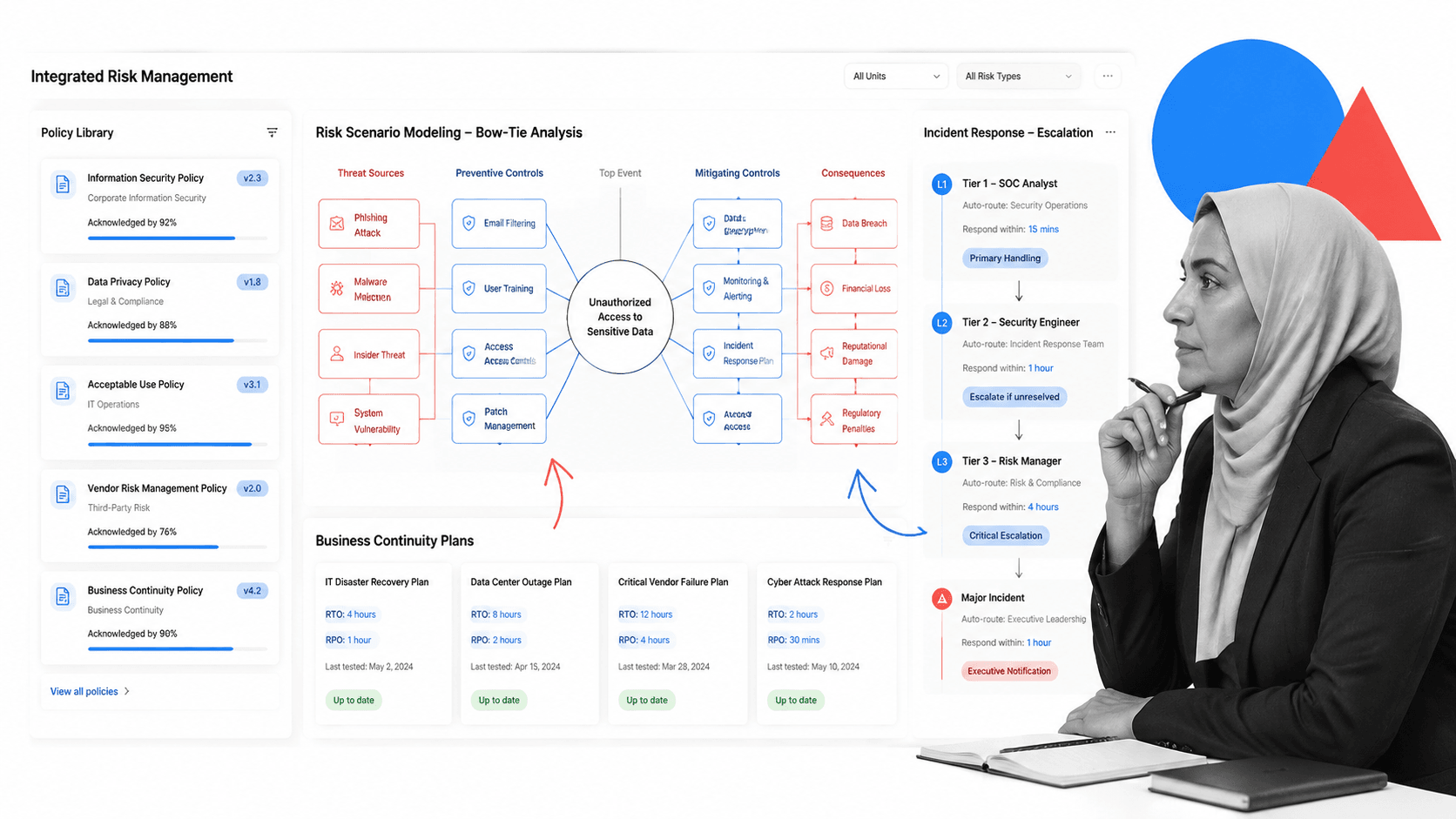
What it does: Archer is an established integrated risk management platform covering enterprise risk assessment, policy lifecycle management, incident response, business continuity planning, and regulatory compliance. The platform supports bow-tie risk analysis (mapping threats through preventive controls to consequences and mitigating controls), policy distribution with employee attestation tracking, and tiered incident escalation with SLA-based auto-routing.
Why it’s on this list: Archer has been a foundational enterprise IRM/GRC platform for over 15 years. Its depth in risk scenario modeling (bow-tie analysis), business continuity planning, and incident escalation makes it a strong choice for organizations with complex operational risk environments.
Best for: Enterprises with complex operational risk environments that need deep risk modeling, incident management, and business continuity capabilities.
Price: Custom enterprise pricing. Contact Archer for a quote.
13. Resolver
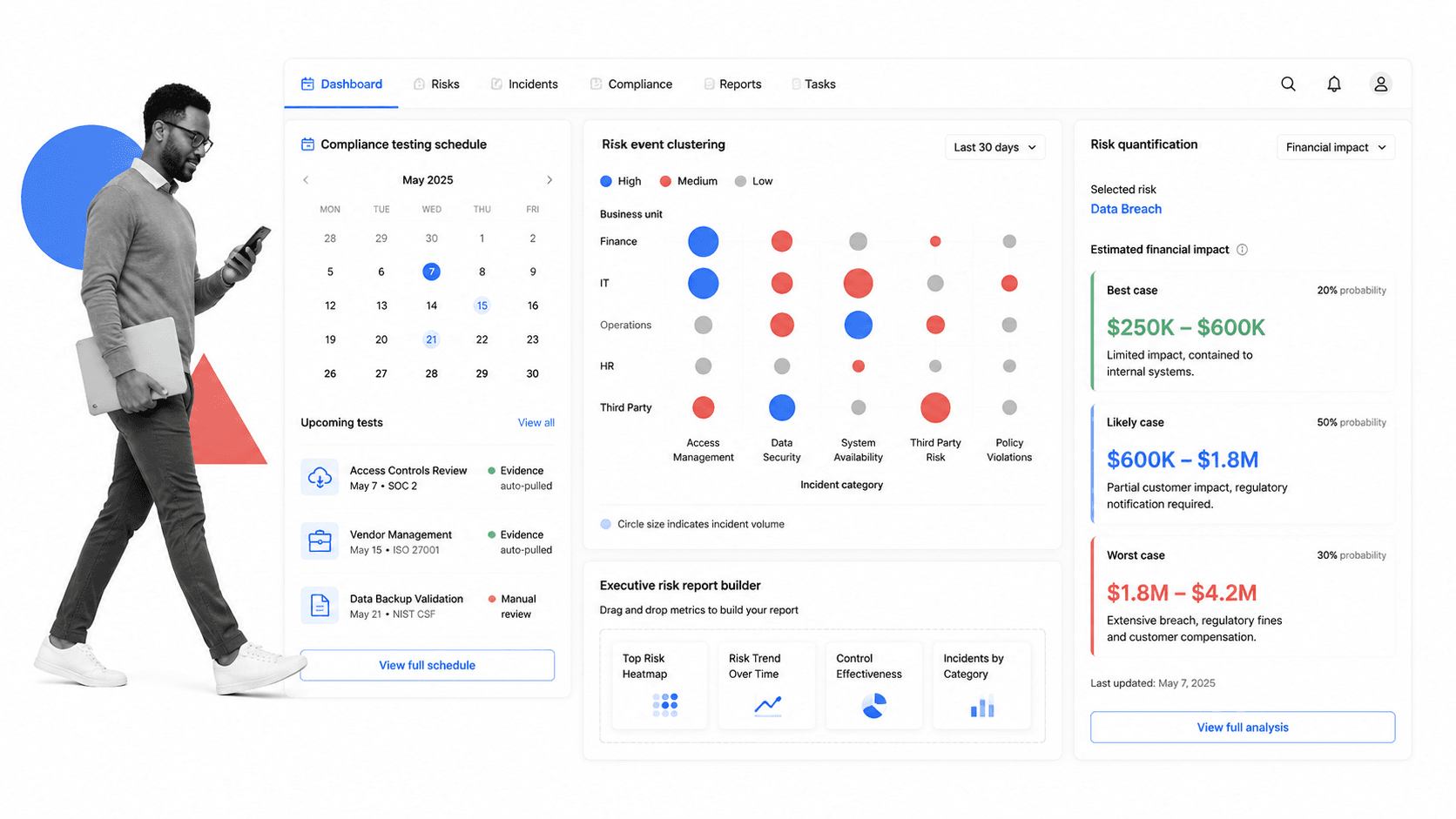
What it does: Resolver is a cloud-based GRC platform focused on risk event management, compliance testing, and risk quantification. The platform clusters risk events by category and business unit, automates compliance testing schedules with evidence collection, and quantifies risk in financial terms (best case, likely case, worst case impact ranges). An executive report builder lets risk teams assemble board-ready reports from live data.
Why it’s on this list: Resolver’s risk quantification capabilities translate risk register entries into financial impact ranges that executives and board members can act on. The risk event clustering visualization helps teams identify patterns across incidents.
Best for: Risk management teams that need to quantify risk in financial terms and present board-ready risk reports.
Price: Custom pricing. Contact Resolver for a quote.
14. Sprinto
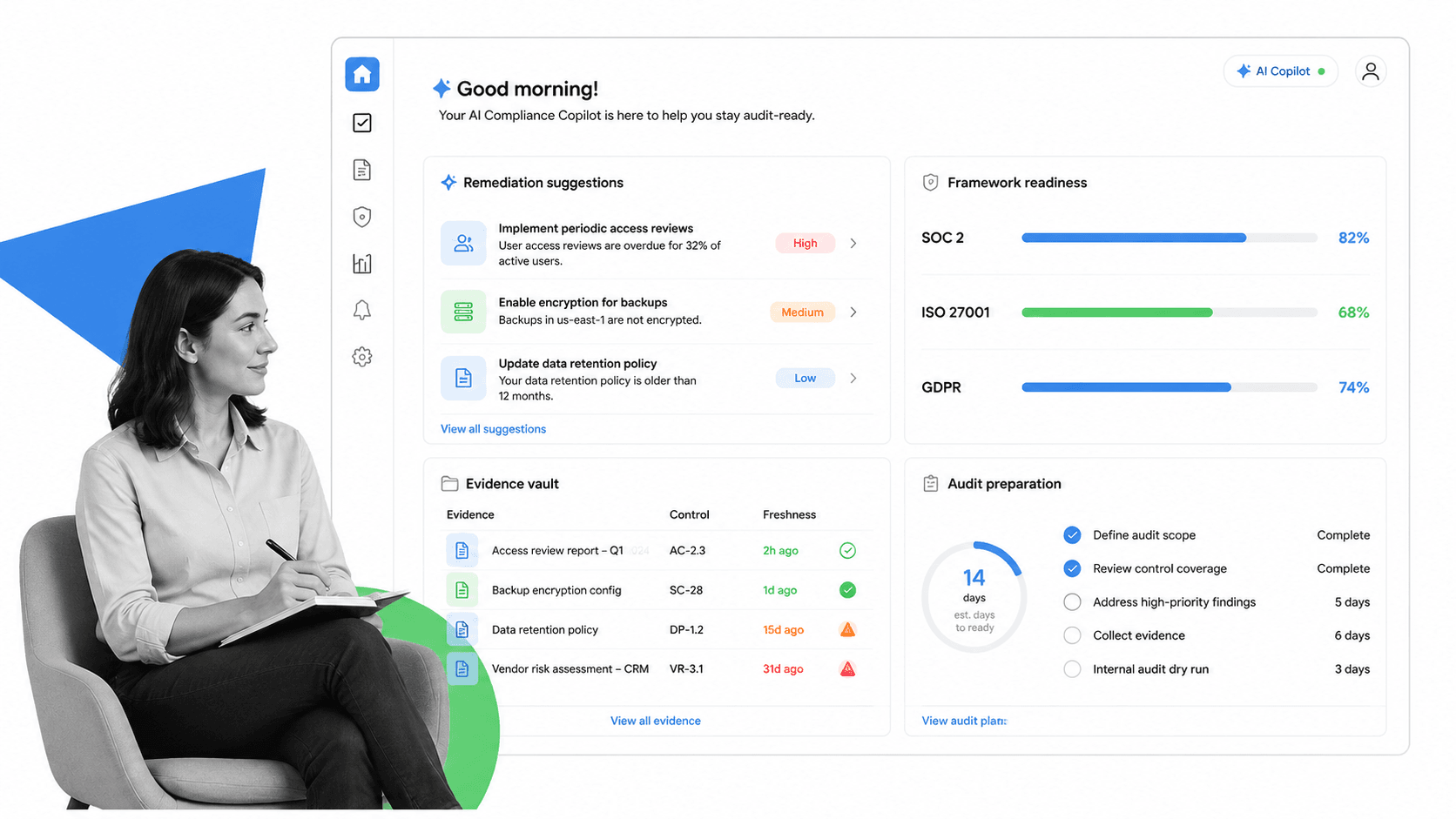
What it does: Sprinto is an AI-native GRC platform that uses an AI compliance copilot to accelerate audit preparation and ongoing compliance management. The copilot suggests specific remediation actions (with one-click implementation), estimates days-to-audit-readiness, identifies blockers, and automates evidence collection and freshness monitoring. The platform supports SOC 2, ISO 27001, GDPR, HIPAA, and other frameworks.
Why it’s on this list: Sprinto represents the AI-native approach to GRC where the platform actively drives compliance work forward instead of passively tracking it. The compliance copilot and audit readiness estimator are differentiators for teams with limited compliance headcount.
Best for: Startups and SMBs pursuing their first compliance certifications that need AI-driven guidance through the process.
Price: Contact Sprinto for pricing.
Using Process Street to integrate your governance, risk, and compliance solutions
Process Street is a Compliance Operations Platform that helps teams turn GRC requirements into recurring, auditable work. Docs governs policies and SOPs. Ops runs the workflows, approvals, task assignments, automations, and evidence collection. Cora helps monitor work, flag risks, and suggest improvements.
Most GRC tools organize the control environment. Process Street makes sure the supporting process is followed. A vendor review, policy acknowledgement, internal audit, financial control, or risk remediation workflow can run with owners, due dates, approvals, and a complete audit trail.
Process Street acts as a central hub for your documented governance, risk, and compliance processes.
Using the above-mentioned tools provides the specificity needed to meet governance, risk, and compliance demands. Then, by using Process Street to document your governance, risk, and compliance procedures, you create a centralized platform offering full process transparency and a means for cross-departmental collaboration. All processes are stored in-the-cloud and available, visible, and accessible on a global scale.
Process Street supports an integrated GRC approach, whether you’re utilizing our already pre-made templates, or documenting your processes from scratch. By using Process Street, along with the tools presented above, you can develop a fully effective GRC solution that:
- Provides adequate reporting functionality;
- Provides an audit trail;
- Documents and stores workflows and tasks;
- Acts as a platform for team collaboration;
- Enforces compliance, governance, and risk controls.
Take control of your GRC demands using Process Street and our top 14 GRC tools
To be effective in managing governance, risk, and compliance demands, you’ll want to use an integrated approach that also comes with the specificity needed for each entity.
To recap, our top 14 tools for GRC are:
- Google Workspace
- Slack
- Airtable
- Qualityze
- ISO 9001:2015
- Resolver
- TimeCamp
- SpiraPlan
- A1 Tracker
- Wolters Kluwer StandardFusion
- ISO 14001:2015
- Diligent Entities
- OneTrust Ethics and Compliance
- ERM Libryo
… and Process Street.
Use these top tools to formulate an integrated GRC approach for your business. Establish immediate and long-term risk control, eliminate non-value adding activities, build business transparency, and reduce costs.
How do you control and manage governance, risk, and compliance demands in your organization? What GRC tools have helped you? We’d love to hear from you, please comment below. Who knows you may even get featured in an upcoming article!
GRC tools FAQ
What are GRC tools?
GRC tools are software systems that help organizations manage governance, risk, and compliance. They often include policy management, risk registers, control libraries, audit management, evidence collection, issue remediation, regulatory change tracking, third-party risk, and reporting.
Can general productivity tools like Google Workspace or Slack replace GRC software?
No. Productivity tools support collaboration and communication, but they lack the control mapping, evidence collection, audit trails, risk quantification, and regulatory intelligence that dedicated GRC platforms provide. Teams that rely on spreadsheets and general tools for GRC work typically struggle to prove compliance when audited.
What is the difference between GRC software and compliance operations software?
GRC software usually organizes the risk and control program. Compliance operations software focuses on making the required work happen through governed documents, workflows, approvals, automations, and audit trails.
The post 14 Top GRC Tools for an Integrated Governance, Risk and Compliance Strategy first appeared on Process Street | Compliance Operations Platform.


0 Commentaires