
Google is still the fastest way to find a source, a statistic, a competitor page, or a weird corner of the internet, but only if you know how to ask for what you actually want.
These Google search tips focus on precision. Use them when AI summaries are too broad, personalized results are noisy, or you need the original source instead of another recycled answer.
The basics still matter: exact phrases, exclusions, site searches, file types, date filters, and Advanced Search. The marketing tricks come next, then a few just-for-fun searches and safety checks for advanced queries.
Google search operators and research basics
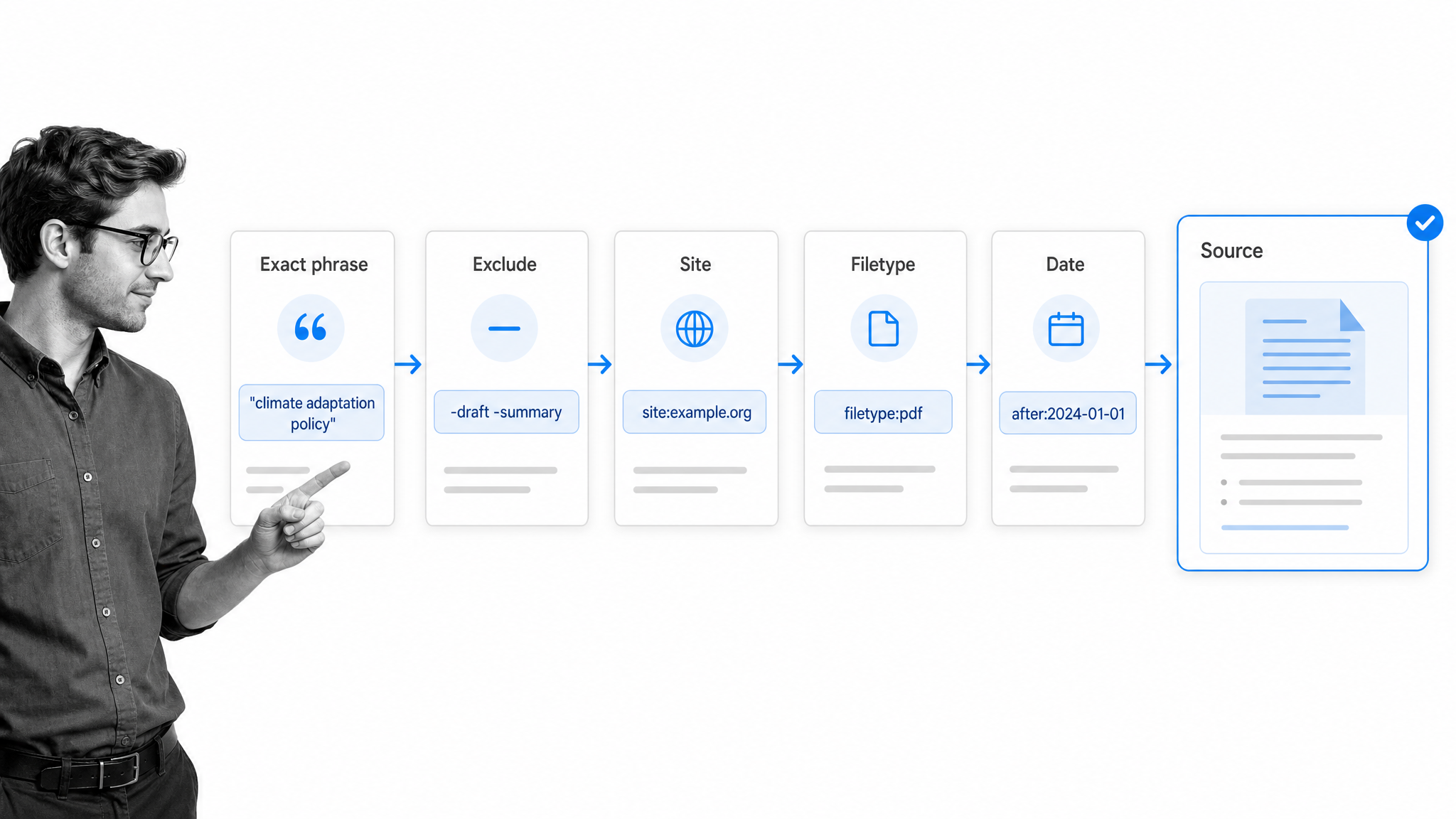
Quick operator reference
For research marketing work, these pro Google search tips are easiest to reuse when the operators are close at hand. Treat this as a compact reference for exact wording, Boolean logic, exclusions, title filters, wildcards, date ranges, file searches, site searches, image searches, news searches, conversions, and a few classic Google tricks. Legacy operators can change, so verify important queries before relying on them.
familiar with it, it's easy to learn: OR : returns results from either side of the query. Example: intitle:"saas development" OR intitle:"saas software" AND : returns results from both sides of the query. Example: growth hacks AND youtube NOT : returns results excluding everything after the word NOT. Example: monty python NOT bbc It's vital to put the operators in all caps because otherwise Google will treat them as part of the query. Use – to exclude one specific word from results What if you wanted to learn all about the town of Rugby, but didn't want to see anything to do with the sport. You could try something like Rugby -sport . Any time you notice the results being polluted by something irrelevant, use a – to get better, clearer options. Use + to denote one essential word (disables synonyms) Google will often act like a thesaurus when you search, substituting words for synonyms slightly, trying to find better results. In some cases, this is a great feature; in others, it can get in the way of finding the best results. If there's a word in your search query that should stay
exactly the way it is (and be given more importance in the query), prefix it with a + , like this: scotland +jetty Use ~ to search synonyms of a word If you're unsure as to whether you're using the exact right word, you can put a ~ sign before it and force Google to search around for synonyms and variations. In contrast to the previous example, if you're looking for harbors, piers, jetties and marinas in Scotland (not just specifically jetties), you could search like this: scotland ~jetty Use intitle: to show only results with a specific word in the title You can use intitle: multiple times in your query, and combine it with other operators. For example: apartments intitle:florida OR intitle:texas Use allintitle: at the start of your query to show results containing all words in the title Unlike intitle: , allintitle: must be used at the start of a query and will force Google to show only results that include every following word in the title. Use a * for a wildcard word If you don't quite remember the title of something, wildcards are wildly (;)) useful. When Google sees a * in your
search, it knows that you're asking it to fill in the gap with any word it can. What about if you needed to find the title of some half-forgotten song from your distant past? "the cat's in the * and the * spoon" That might do the trick. But note it works only in quoted strings. Use AROUND(10) to find results where two words appear within 10 words of each other This tip is great for when you can remember that two phrases were in the same paragraph or sentence (or need to see all instances of two words being mentioned in the same sentence), but the search results are too broad to get what you need. Here's an example of a very narrow search that tells me the three instances where China and Brazil appear close together: Search within a specific time and date range There are a few ways to narrow down your search results by date. The most obvious and easiest is to use the dropdown in the Tools menu: Google used to let you use the bewildering Julian date system (it's stardate-esque!) and get very specific about the range you want to filter by, but it seems to have retired it now because
it's possible to specify a date range using the same dropdown menu I showed you above by choosing 'Custom range'. Use filetype: to find downloadable files Sometimes using pdf in a search query only gets you so far. By using filetype:pdf , you can force only actual PDF documents to appear. The same goes for mp3, epub, zip, or any other file extension you can think of. Use site: to get only results from a specific domain This is easily one of the most useful tips, and I use it almost daily to find articles I can't remember the title of, or to find articles on specific topics from sources I trust. Searching site:process.st productivity will return all productivity-related pages from only the process.st domain, for example. Use -pinterest.com in Google Images to get better quality results Pinterest makes image searching harder. Unlike real image results, it provides exclusively low resolution images you can't easily save without signing up. So, to get better image results and not "1000+ ideas about X", exclude Pinterest from image results. Search in Google News Google News has its own
operators you can use to filter the news to your taste. They include: location:France source:"The Guardian" Find higher quality version of images Sometimes you find the perfect image, but it's so small that it looks terrible in context. The best way to find a higher quality version of that same image is to use reverse image search. Go to Google Images and hit the camera icon in the search bar. You can also use this method to find the proper sources for images, and show visually similar images, too. Use site:news.google.com/newspapers to search inside a huge archive of digital newspaper text Google has scanned almost a million newspaper pages, going back centuries in history. You can see original coverage of the American Civil War, find famous advertisements in their first incarnation, and find obscure information that may have never otherwise made it to the web. Unfortunately, Google was forced to scrap the project in 2011 , but what they managed to scan is still indexed, and the scanned text is searchable. Use related: to show a list of similar sites The related: trick doesn't seem
to be talked about very often, but it's an awesome way to find similar sites and products. By searching related:moz.com I was able to find 5 pages of SEO news sites and products: Often at Process Street we want to find reading material or blogs that write about specific topics based on what we already know. If you're looking for sites to add to your RSS feed, using related: could be a great way. Use .. between numbers to show results containing the full range I'm not sure why anyone would need to do this — perhaps for price or date ranges — but it's possible. If you search: 500..1000 piece puzzles …You'll get puzzles with anywhere between 500 and 1000 pieces! Use stocks: to show stock price If you know the stock ticker symbol, you can get stock information without leaving Google's result page. In the above example, I've done stocks:twtr to check on the status of my favorite ailing tech company. Easily search for time-zone conversions I often need to schedule things with people who aren't in my timezone (because no one is in my timezone). They might say something like "How's 6pm
EST?", and at that point I'd search like this: And I'd say, let's reschedule. Use in for translations and conversions Google's moving away from pushing you to external services for information, and trying to give you as much as it can right inside the search engine: Examples: hello in russian 30 centimeters in inches 1000 zloty in usd Use cache: to find the last cached version of a site If you ever find a result in Google search that's giving you a 404, you've got a couple of options: you can check to see if the page is archived in Archive's Wayback Machine , or you can search Google for the last cached version of a site. For example: cache:process.st If all else fails… try Advanced Search Queries with multiple operators and complex logic can be hard to write and even harder to make work properly. If all else fails, try Google's Advanced Search form. You can choose it straight from the Google
1. Use quotes to search for an exact phrase
Put quotes around a phrase when the order matters. Search "annual compliance report" instead of annual compliance report when you want pages that use that exact phrase, not pages that merely discuss annual reports and compliance separately.
Quotes are especially useful for names, policy titles, error messages, source quotes, and snippets from PDFs. If Google still broadens the result, open the Web filter or use Advanced Search to tighten the match.
2. Use the minus sign to exclude a word or site
Put - directly before a word, phrase, or site you want removed from the result set. For example, apple -iphone pushes consumer-phone results out of a search about fruit or the company more broadly.
You can also exclude domains: workflow automation -site:pinterest.com. Do not add a space after the minus sign. The operator works best when the thing you exclude is unambiguous.
3. Use OR when either term is acceptable
Google usually assumes you want all important words in your query. Use uppercase OR when either term can satisfy the search: "standard operating procedure" OR SOP template.
This is useful when people use different names for the same thing. Keep OR uppercase so it is interpreted as an operator, not a normal word.
4. Group alternatives with parentheses
When a query has multiple alternatives, group them so the logic stays readable: (SOP OR "standard operating procedure") compliance checklist.
Parentheses are not magic, but they make complex research queries easier to maintain. If the result set looks strange, simplify the query and add filters one at a time.
5. Use site: to search one domain
Use site: when you only want results from one website. Search site:process.st workflow automation to find Process Street pages that mention workflow automation.
For research, this is one of the highest-value operators. It helps you search a vendor site, a competitor blog, a government domain, or your own website without relying on that site’s internal search.
6. Use filetype: to find PDFs, spreadsheets, and decks
Use filetype: when you need downloadable sources: vendor risk report filetype:pdf, audit checklist filetype:xlsx, or onboarding plan filetype:ppt.
Google’s own Advanced Search help still points users to file type filters for formats such as PDF, XLS, PPT, DOC, and other document types. This is useful for market reports, public-sector documents, academic materials, and templates.
7. Use intitle: for pages with a word in the title
Use intitle: when the page title matters. Search intitle:checklist vendor onboarding to find pages that deliberately frame themselves around checklists.
This is stronger than searching the body text alone because title words often reveal the page’s main job. Use it sparingly; too many title filters can overconstrain the search.
8. Use allintitle: for title-heavy searches
Use allintitle: when every following word should appear in the title, such as allintitle: vendor onboarding checklist.
This is useful for finding exact-fit articles, but it can become too narrow quickly. If the results are thin, switch back to one intitle: term and let the rest of the query search the page body.
9. Use inurl: to find pages with a word in the URL
Use inurl: when a URL pattern matters. For example, inurl:templates onboarding checklist can surface template libraries and resource hubs.
For SEO research, inurl: helps reveal how competitors structure content. For general research, it helps find pages where the publisher intentionally organized content around a term.
10. Use before: and after: for date windows
Use before: and after: to set a date boundary inside the query: AI governance report after:2025-01-01 before:2026-01-01.
This is cleaner than relying only on the search tools menu when you need a reproducible query. It is especially useful for policy, regulatory, SEO, and market-research work where dates change the answer.
11. Use the search tools menu for quick recency filters
For quick searches, use Google’s Tools menu and filter results by time. It is faster than typing a date operator when you only need results from the past day, week, month, or year.
Use query operators when you need to save or repeat the exact search. Use the menu when you are exploring.
12. Use the Web filter when AI or rich results get in the way
Google’s result page changes by query. You may see AI Overviews, videos, shopping modules, image packs, forums, news, or other filters before you get to plain links.
When you need source pages rather than a summarized answer, use the Web filter if it appears. Pair it with quotes, site:, and date filters to get closer to the original source.
13. Use Advanced Search when operators get hard to manage
Google’s Advanced Search gives you fields for exact words, excluded words, language, region, file type, site, and where terms appear on the page.
Use it when you are teaching someone else, documenting a repeatable search, or debugging a query that has become unreadable.
14. Search a quoted sentence to find the original source
If you see a quote, statistic, or claim repeated across many sites, put one distinctive sentence in quotes. That often surfaces the earliest or most authoritative source.
This is a simple way to avoid citing a rewritten summary when the original report, transcript, or announcement is available.
15. Search within a source plus an exact phrase
Combine site: with quotes when you know the likely source. For example: site:sec.gov "cybersecurity risk management".
This pattern is useful for legal, regulatory, academic, and procurement research because it keeps you inside a trusted domain while preserving phrase precision.
16. Exclude low-value domains from image research
If image results are crowded with reposts, marketplaces, or social networks, exclude the sites that keep getting in the way: brand system examples -site:pinterest.com.
This does not guarantee perfect results, but it gives you a cleaner starting point before using Google Lens or source-specific searches.
17. Use Google Lens for reverse image research
For image searches, use Google Images and Google Lens to identify objects, find similar images, or trace where an image appears online.
The old camera-icon workflow has changed over time, so describe the job instead of memorizing one UI path: upload or select an image, then inspect visually similar matches and source pages.
18. Search Google News for current events
Use the News filter when freshness matters. A normal web search can mix current coverage with evergreen explainers, old press releases, and recycled summaries.
For research workflows, pair News with date filters and exact terms. That keeps the result set current and reduces the chance you cite an outdated article.
19. Use Google Trends to test demand direction
Google Trends helps you see whether a topic is rising, falling, seasonal, or concentrated in certain regions.
Trends is not a keyword-volume tool. Treat it as a directional signal, then validate with SERPs, customer language, and keyword tools.
20. Use conversions and calculations directly in search
Google can answer many simple conversions directly: 10 USD in EUR, 42 inches in cm, 9am New York in London, or 18% of 2400.
Use this for quick checks, not for financial, legal, medical, or compliance decisions where the source and timestamp matter.
21. Use define: for quick definitions
Use define: when you need a fast definition: define:throughput or define:attestation.
For specialized terms, use the definition as a starting point and then search trusted sources. Definitions vary by industry.
22. Use the Wayback Machine when cache is not available
Google’s old cache: operator no longer works in Search. If you need an older version of a page, use the Wayback Machine instead.
For important sources, save the current URL and capture the date you accessed it. That makes your research easier to audit later.
23. Search specific file names when you have partial evidence
If you know part of a file name, put it in quotes and add a file type or domain: "board-pack-q3" filetype:pdf.
This is useful when a document has been moved, mirrored, or cited by another page but is hard to find through navigation.
24. Search for errors exactly as they appear
When troubleshooting, put the error message in quotes and remove machine-specific IDs if they make the query too narrow.
Start exact, then broaden. If the quoted query returns no useful results, remove one phrase at a time until you find the common version of the problem.
25. Save repeatable searches as a checklist
When a search pattern works, save it. The exact query, filters, source domains, date range, and notes matter if you need to repeat the work later.
This is where search becomes an operational process instead of a one-off trick. Document the pattern so the next person can run it without rediscovering the logic.
Google tricks for SEO and marketing research
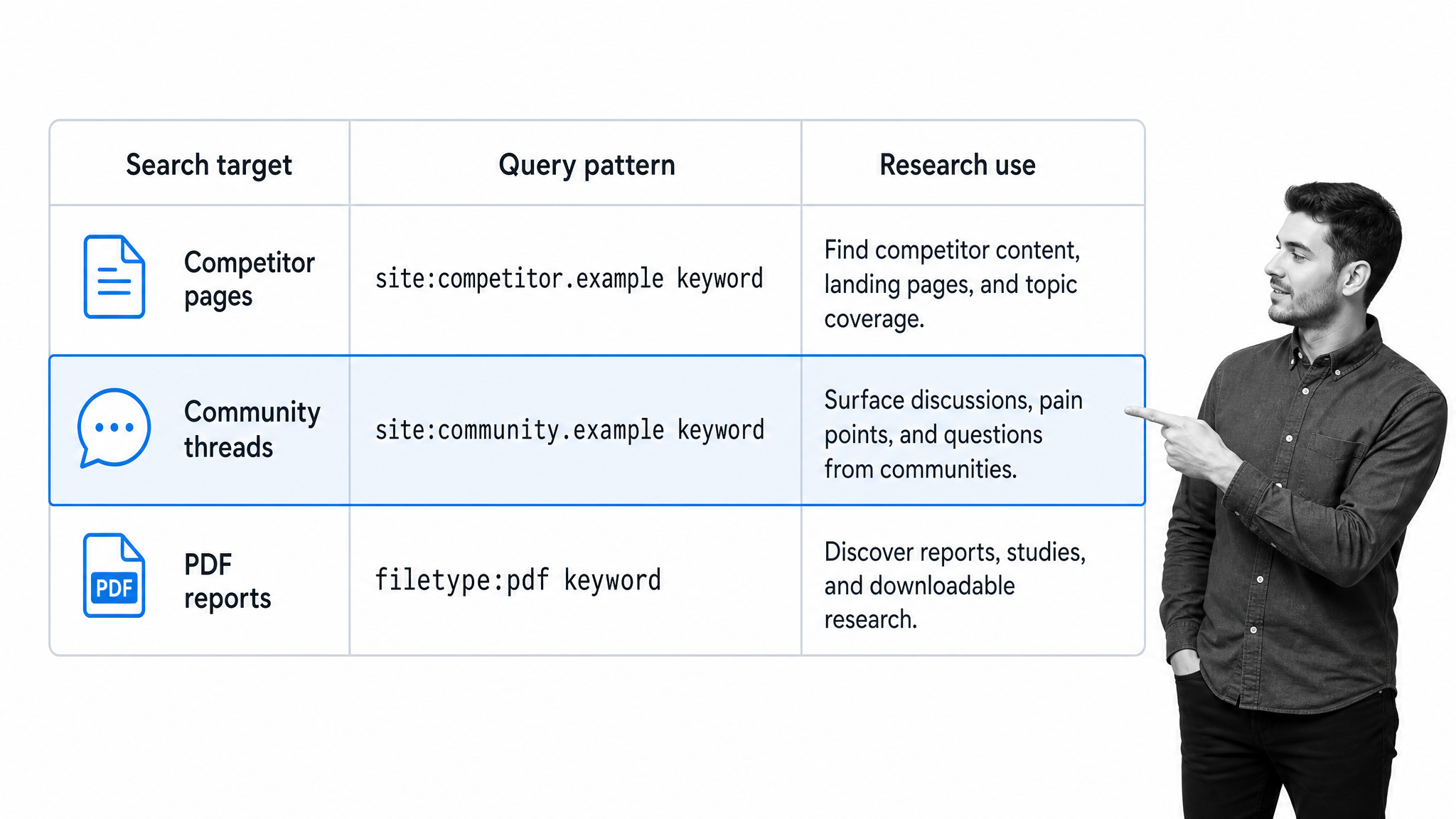
26. Find new landing pages from competitors
Search a competitor’s domain with terms that usually appear in commercial pages: site:competitor.com inurl:solutions, site:competitor.com inurl:features, or site:competitor.com "request a demo".
This helps you see what they are actively positioning, which audiences they target, and which product narratives they are testing.
27. Find competitor PDFs, reports, and sales decks
Search for documents competitors or analysts have published: site:competitor.com filetype:pdf compliance workflow or "workflow automation" filetype:ppt.
Downloadable files often contain stronger claims, diagrams, and language than a public landing page. Validate dates before using them.
28. Find forum conversations buyers actually use
Search current communities instead of old parked domains. Try site:reddit.com/r/operations "workflow automation", site:growthhackers.com Google search, or a niche forum plus the exact pain you are researching.
Forum results are messy, but they reveal objections, vocabulary, and edge cases that polished vendor pages hide.
29. Check whether your own pages are indexed
Use site:yourdomain.com exact page topic to see whether Google is surfacing your page for a topic. This is not a replacement for Search Console, but it is a quick public check.
If a page does not appear, check technical indexing, canonical tags, internal links, and whether the page actually answers the query.
30. Find internal link opportunities
Search your own site for pages that mention a topic but do not yet link to the target page. For example: site:process.st "note taking".
For this article, a natural next step is to capture and organize research notes with an AI note taking assistant after you find useful sources.
31. Compare SERP language before writing copy
Search the target phrase and read the titles, snippets, People Also Ask questions, and forum results. Look for repeated verbs and nouns.
Do not copy competitors. Use the SERP to understand how readers frame the job, then write a sharper answer.
32. Search for recent reports before citing statistics
Use a date-bounded file search: market research report filetype:pdf after:2025-01-01.
If the statistic matters, find the primary source. If you cannot verify the number from a credible source, do not use it.
33. Use Google Trends before committing to a campaign angle
Trends can show whether the language you want to use is gaining or fading. Compare two or three phrases rather than trusting one favorite term.
For SEO and content planning, Trends is a direction check. Pair it with keyword data, conversion data, and customer language.
34. Turn recurring research into a Process Street workflow
If your team repeats the same search process every week, turn the query pattern into a workflow. Process Street Docs stores the research procedure, Ops runs the steps, and Cora can help monitor whether the work is complete.
That keeps research from living in one person’s browser history. It also gives your team proof of what was checked, when, and by whom.
Just-for-fun Google tricks
35. Search Google like it is 1998
The original Google in 1998 Easter egg is no longer a normal search-results feature, but the nostalgia still lives on through archived experiences and mirrors such as elgooG’s Google 1998 page.
Keep this one for fun, not serious research. For historical research, use the Wayback Machine and primary archives instead.
36. Search askew
Search askew and Google may tilt the results page. It is a tiny visual gag, but it is still one of the most reliable Google tricks.
It also proves a useful point: some search results are direct experiences, not just links.
37. Search do a barrel roll
Search do a barrel roll for another classic Google animation. It is not productive, but it is memorable.
If it does not trigger in your browser, try a normal search window without aggressive extensions. Easter eggs change by region, device, and rollout.
38. Flip a coin
Search flip a coin when you need a quick heads-or-tails result. Google will show a simple coin flipper in the results.
Use it for low-stakes choices. Do not use it for anything that needs a recorded or auditable randomization process.
39. Roll a die
Search roll a die or roll dice to get a dice roller. You can usually choose different dice types from the result widget.
This is useful for games, teaching probability, or quick random choices.
40. Set a timer or stopwatch
Search timer 10 minutes or stopwatch to get a timer tool directly in search results.
It is a small trick, but it is useful when you are timing writing sprints, research passes, interviews, or review sessions.
41. Slow down if Google thinks you are a robot
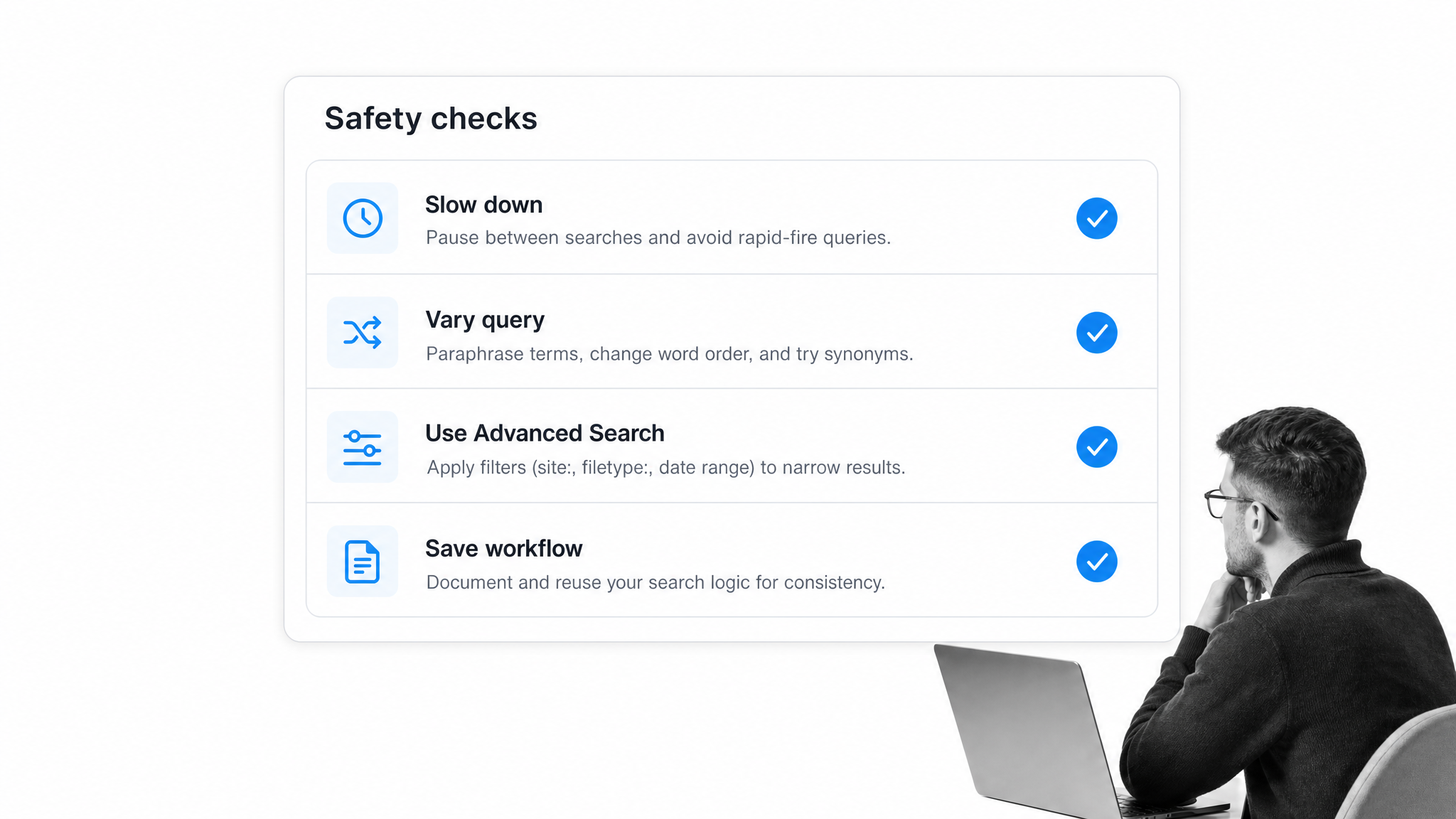
Advanced operators can look like automated scraping if you run too many searches too quickly. If Google shows a robot check, pause, simplify the query, and avoid blasting variations in rapid succession.
For team research, document the query pattern in a workflow instead of having everyone hammer Google independently. It is cleaner for the team and less likely to trigger defensive checks.
Good search is not about memorizing every operator. It is about knowing how to narrow a question until the right source has nowhere left to hide. Start with the basic operators, add date and source filters when the stakes rise, and save the searches your team will need again.
The post 41 Pro Google Search Tips for Research, Marketing, and Fun first appeared on Process Street | Compliance Operations Platform.


0 Commentaires