“Those who cannot remember the past are condemned to repeat it,” wrote George Santayana. Business mistakes are rarely that dramatic, but the principle still applies: someone has already tested a similar idea, process, or organization and left clues about what worked.
Greek philosophers were not management consultants, but their arguments about truth, virtue, failure, and reason map surprisingly well onto business. These nine thinkers offer practical ways to question assumptions, improve processes, manage risk, learn from setbacks, build stronger cultures, and make better decisions. The stranger stories make the lessons easier to remember.
| Greek philosopher | Business lesson |
|---|---|
| Socrates | Talk through problems with the people closest to the work. |
| Plato | Treat the ideal product as a direction, then improve through use and feedback. |
| Zeno of Citium | Do not let small control failures become normal. |
| Democritus | Small operational details determine the quality of the whole. |
| Diogenes | Use an outsider’s perspective to challenge assumptions. |
| Epictetus | Separate what you control from what you do not, then learn and act. |
| Epicurus | Build a culture around friendship, trust, and shared principles. |
| Pythagoras | Use data as evidence, with context and judgment. |
| Aristotle | Make good judgment and good character part of how the business operates. |
Who are the Greeks and why are they important?

Ancient Greece was not comparable to a modern nation state or even to the Roman Empire. There was no single, unified nation or organization of Greek speakers. What we call Ancient Greece usually refers to a collection of communities that flourished from roughly the eighth century BCE through the Hellenistic period, spread across the Mediterranean and Black Sea.
Greek-speakers lived across that world, debating ethics, politics, reasoning, and decisions based on evidence available to them.
Classicist Edith Hall describes that range in The Guardian: Greek speakers lived in hundreds of villages, towns, and cities from Spain and Libya to the Nile Delta and the Black Sea. Their communities were culturally elastic, intermarried with neighboring peoples, and readily adopted foreign gods. The closest thing to political unity came with Alexander the Great’s powerful but short-lived Macedonian Empire.
After Alexander’s death, his generals divided the empire into Hellenistic successor kingdoms, including the Seleucid and Ptolemaic realms. Rome later absorbed much of that world while also adopting and adapting Greek art, literature, and philosophy. That wider geography matters: Greek thinkers are part of a Mediterranean, Middle Eastern, and North African intellectual history, not simply emblems of a narrow Western tradition.
Greek thinkers contributed enormously to ethics, politics, mathematics, and the natural sciences. Their texts also traveled by more than one route. Byzantine scholars preserved Greek works; Syriac and Arabic translators studied and extended them; and later translators carried material from Arabic and Greek into Latin. The result was not a simple handoff from one civilization to another, but a long chain of preservation, argument, correction, and reuse.
Thomas Aquinas combined Christian theology with Aristotelian thought. Later philosophers such as Hegel returned to Greek arguments when building their own systems. The important business lesson starts before any individual philosopher appears: valuable ideas survive because people question them, translate them, test them, and make them useful in a new setting.
The label “Greek philosopher” therefore covers people separated by centuries, cities, political systems, and schools. Socrates, Plato, and Aristotle form a famous Athenian line, but the list also reaches to Citium, Samos, Abdera, Sinope, and the Roman world. Their disagreements are as important as their common inheritance. Philosophy advances here as an argument, not a single doctrine.
Nonetheless, Greek thinkers contributed hugely to our understanding of the world. Our understanding of ethics, politics, mathematics, and the natural sciences owes a lot to ancient thinkers. There has always been a great deal to learn from the world of the Ancient Greeks, provided we treat the history as a network of arguments rather than a single heroic lineage.
Socrates believes in talking problems out
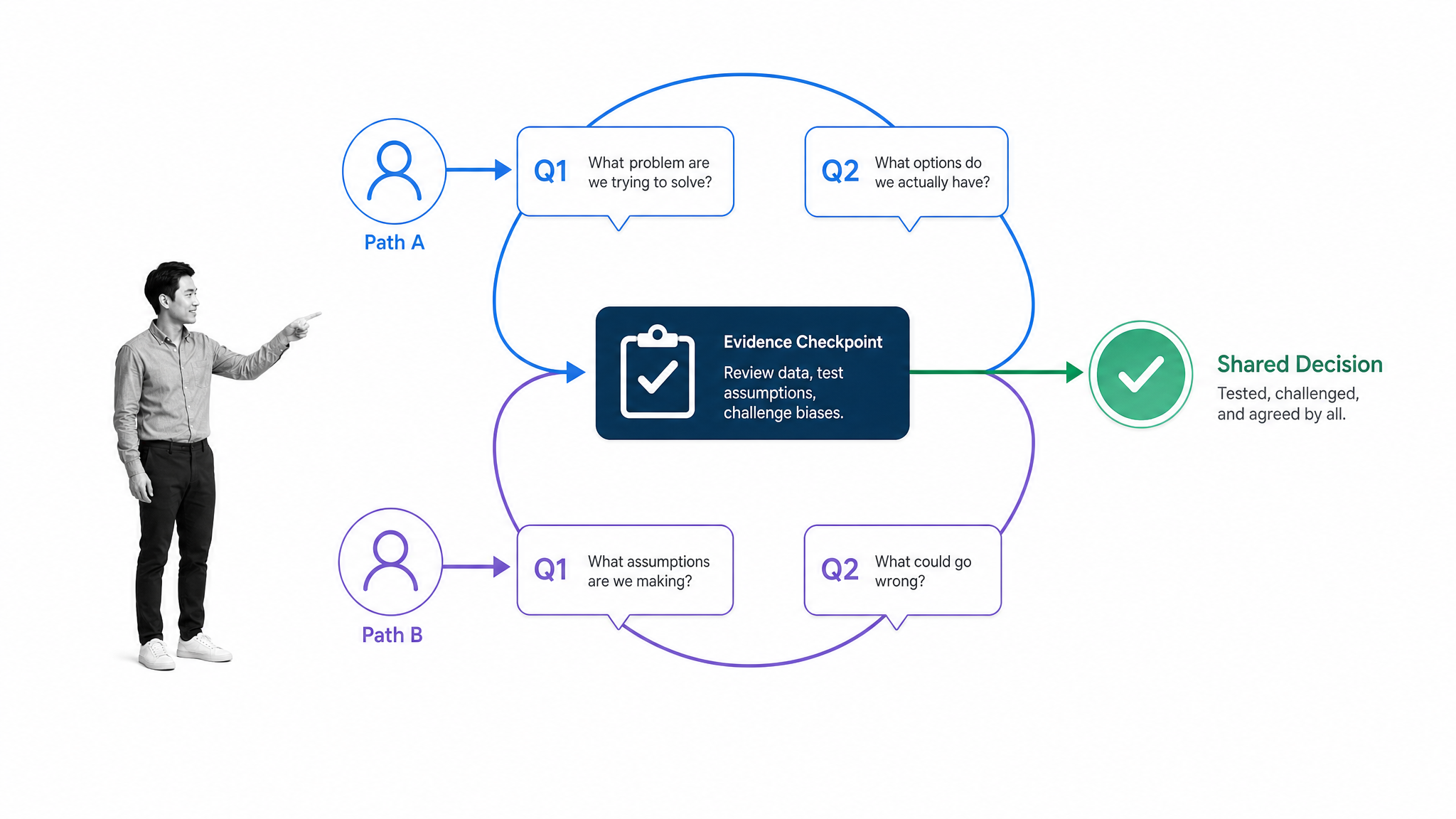
That heading is an intentional oversimplification. Socrates did not calm disagreements with a soothing voice. He treated dialogue as a route to clearer thinking, questioning definitions and testing a person’s claims until contradictions became visible.
We know Socrates chiefly through Plato and Xenophon, which creates the Socratic problem: it is difficult to separate the historical person from the literary character. What survives clearly is a method. Instead of delivering a finished answer, Socrates asks a sequence of questions that forces the participants to inspect what they think they know.
We call this competitive verbal jousting the Socratic method, or elenchus. Its emphasis on dialogue over instruction gives businesses a practical lesson. The people closest to a process can usually see friction that a distant designer cannot. A manager who arrives with a complete answer may get compliance; a manager who asks precise questions can get evidence.
When you want to improve a business process, start with the employees who perform it. Ask where work waits, where information arrives incomplete, which exceptions occur repeatedly, and which control exists only on paper. Draft the change with them, test it, and listen again. The dialogue turns a process from an imposed diagram into a shared operating agreement.
Once a procedure is agreed, Process Street turns it into work people can follow and prove. It is one Compliance Operations Platform: the Docs capability area governs approved procedures, the Ops capability area turns them into enforced workflows, and built-in AI helps teams automate work and catch risk.
Bridgewater founder Ray Dalio made a related idea central to the culture described in Principles. His language of radical truth and radical transparency is not identical to Socratic philosophy, but the mechanism is familiar: surface disagreement, expose assumptions, and work toward a decision that can withstand questions. Discussion is useful only when it produces clearer action.
The quality of the questions matters. “Why did you miss the target?” invites a defense. “At which step did the evidence become unavailable?” invites an investigation. “Who failed to follow the process?” looks for a culprit. “What made the expected path harder than the workaround?” looks for a system condition. Socratic management is not endless debate; it is disciplined curiosity aimed at a decision.
The focus on finding truth through the exchange of logical arguments can be better than a purely instructive approach. In a practical business sense, you take the time to talk to employees about pain points, suggest process changes, and listen to their suggestions. You develop new workflows through that discourse, then give people a method they will actually want to follow.
Plato thinks your ideal product is out there somewhere

One thing Plato was big on, other than recording old men, was an idea called Forms. He proposed that the changing things we encounter relate to stable, intelligible forms. The usual classroom example is a chair: individual chairs differ, yet we recognize the concept that makes each one a chair.
For Plato, the highest knowledge came from trying to understand what was stable and true beneath imperfect appearances. That is not a literal theory of product management, but it creates a useful analogy. A team normally begins with an idea of the outcome a product should deliver. The first material version will be incomplete.
Plato proposed that there was an ideal version of a concept to which all material versions relate. Like, there is a pure idea of a chair. That idea of the chair is what gives all other chairs their chairness. The pursuit of knowledge of the Forms was, for Plato, a noble endeavor.
A Minimum Viable Product, or MVP, serves the essential need well enough to encounter reality. Customers then reveal what the team misunderstood. Resources change. Constraints appear. The product improves through feedback, iteration, and sometimes an entire rebuild. The ideal operates less like a blueprint hidden in the clouds and more like a direction that helps the team judge each version.
It will develop as it interacts with the public and as you gather their feedback. As you attain greater resources, you will make improvements and iterations, maybe even an entire rebuild. The same is true of anything you want to construct or improve: you do not know how a process is meant to look until you have built it, used it, and found what is wrong with it.

Consider the Dandy Horse, an early human-powered two-wheeler. It had no pedals, and a modern rider would barely recognize it as a bicycle, but it pursued a durable job: helping a person move from A to B faster than walking. Later designs added steering refinements, pedals, chains, pneumatic tires, gears, brakes, and new frame materials.
Maybe the Form behind the Dandy Horse was never the bicycle at all. Maybe it was a luxurious 1997 Ford Ka, the most nimble way to get around yet invented by humanity. Or maybe that stretches Plato a little.
The serious point is that a product, procedure, or service becomes legible through use. You do not fully know how a process should look until people run it, exceptions test it, and evidence exposes the gap between the ideal and the real. The team’s job is to keep the purpose stable while allowing the implementation to learn.
This also guards against a common product mistake: confusing the current feature set with the underlying job. If the job is reliable movement, the Dandy Horse is one attempt, the bicycle another, and the Ford Ka an admittedly questionable third. Teams can retire a beloved mechanism without abandoning the purpose it served. The ideal is useful precisely because no single version exhausts it.
Zeno of Citium would be a ruthless CEO

Zeno of Citium founded the Stoic school around 300 BCE. Its name came from the Stoa Poikile, the Painted Porch on the north side of the Athenian agora where Zeno taught. He had studied under Crates of Thebes and other philosophers before developing his own system.
Stoicism is more demanding than the modern instruction to keep a stiff upper lip. It argues that virtue and reason should govern how a person responds to pleasure, pain, fear, desire, and events outside personal control. Zeno and later Stoics carefully classified emotions because they cared about the judgments behind them.
Virtue ethics is a school in moral philosophy that prioritizes good moral character, unlike deontology, which emphasizes duties and rules, or consequentialism, which evaluates actions by their outcomes. Zeno’s system placed unusual weight on reason. If an impulse did not adhere to reason, it deserved examination rather than automatic obedience.
That rigor supplies the business analogy. A small deviation from a safety or compliance standard is not proof that disaster is coming, but it is evidence that a control may not be functioning as designed. Repeated success in spite of a deviation can make the exception feel safe. The absence of a bad outcome is then mistaken for the presence of a good process.
NASA’s Challenger launch is the most severe example. Engineers and managers had seen evidence of problems involving O-rings and field joints in the solid rocket boosters. The launch proceeded, and the shuttle broke apart, killing all seven crew members. Sociologist Diane Vaughan’s work on the disaster gave us the term normalization of deviance: unacceptable conditions can gradually become treated as normal when an organization repeatedly escapes consequences.
A Zeno-inspired operator would not remove every imperfect thing on sight. Ruthlessness without judgment creates its own failures. The useful discipline is to treat deviations as information, investigate causes, define ownership, and decide explicitly whether a control must change. An undocumented exception should never become policy merely because it worked last time.
That discipline requires a visible exception path. Employees need to know how to stop work, whom to notify, what evidence to preserve, and who can authorize a deviation. Leaders then need to reward escalation when it protects the system. Otherwise the formal rule says “raise the risk” while the lived culture says “do not slow the launch,” and the lived culture will win.
Democritus reminds us to pay attention to the little things

Democritus is sometimes called the father of modern science, which is generous given the long gap between ancient atomism and experimental science. Plato reportedly disliked his ideas, and none of Democritus’s works survived intact. Even so, his name remains attached to one of antiquity’s most memorable theories.
Leucippus is usually credited with originating Greek atomism; Democritus developed and systematized it. They argued that substances were made from tiny, indivisible parts moving through empty space. Their descriptions of those atoms were scientifically wrong, but the structural intuition was powerful: the properties and arrangement of small parts shape the larger whole.
There is not too much point going in depth on how Democritus imagined atoms to work, or how they would be categorized, because it is scientifically inaccurate. He believed iron atoms would have the properties of iron, and water atoms the properties of water: slippery and smooth. What matters is the theory that tiny indivisible parts contributed to the properties of the larger whole they formed.
A successful business is not just a good idea. Anyone can have an idea. The result depends on small operational parts: the accuracy of an input, the clarity of an owner, the timing of a handoff, the quality of a review, and the behavior of a control when an exception arrives.
A good business needs to pay attention to the details.
Teams that improve these parts make fractional gains. Each adjustment may look modest, but recurring work gives improvements many chances to compound. Removing one ambiguous field can prevent incomplete requests. Adding one verification step can stop a bad record from moving downstream. Assigning one clear owner can keep an exception from bouncing between teams.
How fractional gains compound in a real process

Take a customer-onboarding process. The team first records where work waits, which questions customers ask repeatedly, and which submissions return for correction. It then changes one element at a time: clarify the request form, validate required evidence before review, route exceptions to a named owner, and notify the customer when the next action is theirs.
No individual change transforms the business. Together they reduce rework, shorten feedback loops, and make the customer’s progress visible. The important evidence is not a dramatic launch-day metric but a stable pattern across repeated cases: fewer preventable errors, faster recovery from exceptions, and a clearer trail of what happened.
A large whole is made from small parts. Democritus was wrong about the physical character of atoms, but the business metaphor holds: the quality of the components and their relationships determines the quality of the operation.
There is a second caution in the metaphor. Optimizing a part in isolation can damage the whole. A review team may reduce its own queue by rejecting ambiguous cases immediately, only to create more work for customers and downstream teams. Fractional gains are real gains only when the end-to-end outcome improves. Measure the whole process as well as the component.
Diogenes looked at society from the outside

Diogenes of Sinope lived in Athens and Corinth during the fourth century BCE. He embraced poverty, slept in a large ceramic vessel, and criticized the social conventions around him. His outsider position gave him a sharp view of how respectable institutions protected assumptions that did not survive a simple test.
The stories are difficult to separate from legend, but they preserve his method. Diogenes reportedly walked through Athens in daylight with a lamp, saying he was looking for an honest man. When Plato defined a human as a featherless biped, Diogenes plucked a chicken, brought it into the Academy, and announced: “Behold! I’ve brought you a man.” Plato’s definition soon acquired qualifications.
Diogenes criticized the cultural and social norms of Athens, attempting to live a life outside those norms. His experience as an outsider within society gave him surprisingly valuable insights that challenged conventional Athenian thought. His removed position from the Academy meant he could see problems and holes within claims made by established philosophical thinkers.
Plato is said to have called him “a Socrates gone mad.” Diogenes advocated virtue, simplicity, and nature while rejecting moral abstraction and status. He influenced the Cynic tradition, which in turn shaped Stoicism through figures such as Crates, Zeno’s teacher. That chain is more accurate than the familiar but false claim that Diogenes taught Zeno directly.
His lesson for business is not that every outsider is right. It is that insiders accumulate invisible assumptions. Industry language, familiar benchmarks, old org charts, and successful products can make one operating model feel inevitable. Someone who does not share those habits can ask why the model exists at all.
Looking at a set of established thoughts and seeking to disrupt them with something new is a timeless part of business. Some businesses iterate on previous models while others tear the models down and start fresh.
How to borrow the outsider’s view

An outsider review begins with the job a customer or employee is trying to complete, not with the current departments or tools. Ask a person unfamiliar with the process to narrate what each step appears to accomplish. Then compare that explanation with the team’s intended outcome.
The gaps are revealing. A form may collect information nobody uses. A risk review may happen after the irreversible decision. A customer may have to translate the same facts into three systems because the organization sees three departments where the customer sees one request. These are the business equivalent of the plucked chicken: a concrete test that exposes a definition built for the institution rather than reality.
Some businesses iterate on established models; others redraw the model. Both can benefit from sitting in the outsider’s place long enough to challenge the obvious. The point is not disruption for its own sake. It is the ability to distinguish a necessary constraint from a convention that survived because nobody asked.
Rotating this role prevents it from becoming theater. Invite someone from legal to observe onboarding, someone from customer support to inspect product planning, or a new employee to document the first week before familiarity erases the friction. The outsider supplies questions; the process owner still supplies context. Neither perspective is sufficient alone.
Epictetus teaches us to deal with failure

Epictetus was a Greek-speaking Stoic philosopher of the Roman era, born into slavery in what is now Turkey. He lived and taught in Rome before being expelled with other philosophers and establishing a school in Nicopolis, in northwestern Greece. His philosophy was something to be practiced, not merely admired.
At its center is a distinction between what is up to us and what is not. We can govern our judgments, choices, and actions. We cannot command the market, the weather, another person’s response, or the past. Confusing those categories wastes attention and creates the illusion that worry is a form of control.
His perspective was that philosophy is something to be lived, not simply thought about. He believed in a radical program of self-improvement centered on the idea that you only have control over yourself. You cannot control external circumstances, only your own actions. Trying to improve yourself was not merely an option but a moral responsibility.
In a business failure, the distinction prevents two common mistakes. The first is fatalism: external conditions changed, so there is nothing to learn. The second is total self-blame: because the outcome was bad, every choice must have been foolish. A useful postmortem separates context from action. What signals existed? What decision did the team make with the evidence available? Which control failed? What will be different next time?
Entrepreneur Christina Wallace has written openly about the collapse of her first company and the emotional recovery that followed. Her first-person account resists the polished version of startup life in which every setback becomes an instant lesson. Recovery took time. Only then could she rejoin the work with a clearer understanding of herself and the conditions around the company.
That is closer to Epictetus than pretending failure feels good. You cannot revise what already happened, but you can preserve evidence, run a blameless review, repair the control, practice the missing skill, and decide what risk to take next. The learning loop converts an outcome outside your control into an action that is up to you.
A good postmortem ends with fewer but stronger commitments. Each action should have an owner, a due date, and a way to show whether the condition changed. “Communicate better” is not an action. “Require the approver to record the source evidence before release” is. Stoic acceptance begins after reality is described accurately, not before.
Epicurus loved developing company culture

Epicurus is often reduced to pleasure, food, or disbelief in divine intervention. David Hume later sharpened a famous problem associated with him: if a deity is willing to prevent evil but unable, or able but unwilling, what follows? Dante placed Epicureans in the Inferno, while Chaucer’s Franklin was described as “Epicurus owene sone” because he treated delight as perfect happiness.
Epicurus’s old questions are yet unanswered. Is he willing to prevent evil, but not able? Then is he impotent. Is he able, but not willing? Then is he malevolent. Is he both able and willing? Whence then is evil?
Epicurus also makes an appearance in the prologue to Chaucer’s Canterbury Tales. The Franklin likes bread soaked in wine and holds the opinion that plain delight was perfect happiness. This materialism was seen as very Epicurean, even though the Garden’s own understanding of pleasure was more restrained.
The caricature misses the kind of pleasure Epicurus valued. His philosophy emphasized freedom from fear, modest needs, friendship, and a tranquil life. In Athens he bought a property for his school, known simply as the Garden. Women and enslaved people were among the students, an unusually open community in its setting.
The Garden provides the company-culture analogy. Its members did not gather around office perks. They gathered around a shared view of the good life and the importance of friendship. Their practices reinforced the principles. Culture, in that sense, was not a slogan above a door but a pattern of membership, conversation, and conduct.
A modern organization also reveals its culture through repeated choices. Who gets heard when a decision is contested? What behavior earns promotion? Can someone surface a mistake without being punished for the disclosure? Do stated values survive a deadline? A company mission statement can name the destination, but operating practices determine whether people believe it.
How Ray Dalio designed his Garden

In Ray Dalio’s book Principles, he describes the ideas used to shape culture at Bridgewater Associates. Radical truth gives honesty priority. Radical transparency makes relevant information available. “Getting in sync” creates shared understanding so a team can act.
Those ideas are not Epicureanism, and Bridgewater is not the Garden. The parallel is structural: a community organizes itself around explicit principles, then creates practices that make those principles observable. Dalio writes that truthfulness and the willingness to receive truth expose a person to feedback essential for learning.
- Radical Truth: Give truth supreme importance, even when it is uncomfortable.
- Radical Transparency: Make the information needed to reach truth available to the people making the decision.
- Getting in sync: Create shared truths that teams can operate around and turn into practical action.
A healthy company culture can support trust, retention, and better coordination, but culture is not automatically pleasant and shared language is not automatically shared truth. The test is whether the system helps people do good work together, resolve disagreement, and learn. Whether the accounting department will build the founder a statue remains to be seen.
Rituals make that system tangible. A careful onboarding process teaches what the group values. Decision records show whether dissent was considered. Recognition tells people which behavior is worth repeating. Exit interviews reveal where the official culture and the lived culture diverge. Epicurus would recognize the principle: a community is built through repeated relationships, not a decorative list of nouns.
Pythagoras would absolutely love Big Data

We all know who Pythagoras was. We learned that in school, right? There is a good chance he did not personally discover the theorem that bears his name. The evidence linking specific discoveries to one individual is thin, and later tradition often blended Pythagoras with the Pythagorean community.
Walter Burkert’s Lore and Science in Ancient Pythagoreanism helped separate later legend from historical evidence. The correction matters because Homo Necans, another Burkert book, is sometimes mistakenly cited in its place. This is why you should be careful with heroes, kids.
Pythagoras lived more than a century before Plato. The work associated with his school helped shape the mathematical and rational traditions we connect with Greek thought, but it also included mysticism. Aristotle said the Pythagoreans excelled in mathematics while treating numbers as principles of reality. Mathematics was not merely a practical instrument; it revealed cosmic order.
They had discovered a new tool and they were pretty good at using it; they just had not figured out what it was best to use it for. Their mathematical discoveries were closer to a religious experience than the practical conception of mathematics most businesses use today.
The Pythagoreans loved the number 3 because it had a beginning, middle, and end. But 3 had some stiff competition in 10, which the Pythagoreans thought was the ideal number. So good was the number 10 that Pythagoreans would never gather in groups of more than 10. They represented it as a perfect triangular arrangement called the tetractys.
It would be like going back in time and giving the Ancient Greeks a combine harvester. They might discover how to use it, but $20 says somebody would first deploy it as a weapon of war.
Data has the same risk. It helps a company replace intuition with evidence, detect patterns, compare outcomes, and test decisions. But more data is not automatically more truth. Quality, definitions, provenance, permissions, context, and judgment determine whether a model reveals something useful or merely makes an error look precise.
Amazon’s current shopping systems draw on catalog information, reviews, behavior, and web data to support generative and agentic experiences. The durable lesson is not that every company should imitate Amazon or collect everything. It is that data becomes valuable when it is governed, connected to a clear decision, and evaluated against real outcomes.
From math comes life. Maybe Pythagoras was right after all. Just do not disappoint the Pythagoreans by mistaking a large dataset for wisdom.
Before using a metric, ask five simple questions: Who created it? What exactly does it count? Which cases are missing? How recently was it updated? What decision will change because of it? Those questions turn numbers from mystical objects into operational evidence. A dashboard can then support judgment instead of replacing it.
Aristotle reckons you should keep your feet on the ground

If there is one Greek thinker placed at the center of later European philosophy, it is Aristotle. He wrote on logic, ethics, politics, biology, rhetoric, poetry, and more. The scale of the work makes any single business lesson an obvious simplification.
In the Nicomachean Ethics, Aristotle asks what it means for a human life to go well. He connects eudaimonia, often translated as flourishing or well-being, with activity in accordance with virtue. Courage, generosity, truthfulness, friendliness, and proper ambition are not isolated gestures. They are habits developed through practice and judgment.
Being a virtue ethicist, Aristotle would encourage you to be generous, courageous, sincere, modest, civil, considerate, and to act with right ambition. Through these virtues you could reach eudaimonia, a state of happiness or well-being rooted in living a life that is right for the human soul.
A modern reader need not accept everything in Aristotle. The 20th-century philosopher Bertrand Russell observed that “almost every serious intellectual advance has had to begin with an attack on some Aristotelian doctrine.” Aristotle’s authority sometimes became an obstacle when later thinkers treated his claims as conclusions rather than arguments.
That warning strengthens the business lesson. Values should guide judgment without freezing inquiry. A company can aim to be generous, courageous, sincere, modest, civil, and considerate while still asking whether its habits produce those qualities in practice.
Virtue appears in ordinary operating choices: telling a customer the truth about a delay, giving an employee the evidence behind a decision, refusing to hide a control failure, and considering the effect of the business on its community. The goal is not a perfect statement of ethics. It is a system in which good judgment becomes repeatable.
That gives us the business lessons of being considerate to those you work with or employ, being ethically and morally aware as a company, working toward sustainability, and attempting to make a positive impact on your broader community. The virtues matter when they shape a decision, not when they remain decorative words.
Aristotle’s doctrine of the mean adds useful nuance. Courage is not simply the midpoint between two quantities; it is the fitting response between cowardice and recklessness, judged in context. Business policies also need that practical wisdom. Too little control invites harm, but indiscriminate control can bury people in approvals without reducing risk. The right design serves the purpose.
Greek philosophers were Thought Leaders before it was cool

This entire article is one giant stretch after another. It is less of a philosophy seminar and more of a yoga class.
Nonetheless, the lessons hold together. Socrates asks teams to question assumptions in dialogue. Plato keeps purpose in view while the implementation evolves. Zeno refuses to confuse escaped consequences with a functioning control. Democritus examines the small parts. Diogenes tests the definition from outside. Epictetus separates action from circumstance. Epicurus builds community around shared principles. Pythagoras sees the power and danger of abstraction. Aristotle turns values into habits.
It is true that many of the debates we have today have been had for centuries or even millennia. Reading through the classics can put certain questions in perspective and highlight small, simple truths that we often take for granted. Organizations simply give those questions budgets, deadlines, org charts, and dashboards. The vocabulary changes faster than the human decisions underneath it.
At the next networking event, when someone asks how your product is taking shape, you can sprinkle in a reference to Plato and establish yourself as a Thought Leader™. More usefully, you can remember that another person has probably faced a version of your problem before. Read the argument, test it against the work, and keep the part that survives.
Ultimately, what the Ancient Greeks teach us about business is that another civilization will eventually overtake us and establish a new wave of dominance. We may as well run better processes and enjoy the ride.
The post 9 Time-Tested Business Lessons From Greek Philosophers first appeared on Process Street | Compliance Operations Platform.


0 Commentaires