Workplace culture is the set of shared values, norms, and everyday behaviors that shapes how people work together and make decisions. It appears in what leaders reward, how teams communicate, and what people do when no one is watching.
A positive workplace culture makes expectations clearer, gives employees a stronger sense of belonging, and turns stated values into consistent behavior. A poor culture creates uncertainty, weakens trust, and makes even good policies harder to follow.
- What is workplace culture?
- Workplace culture examples
- How to improve workplace culture
- Start strengthening your company’s culture today
Workplace culture has become something of a buzzword in the business world, which can muddy its definition. This guide explains what workplace culture means, shows how it works in practice, and outlines four ways to build a healthier culture without relying on slogans or one-off initiatives.
What is workplace culture?
Workplace culture, company culture, corporate culture, and organizational culture all describe the same basic idea: the shared rules that guide behavior when a handbook or manager does not provide an immediate answer.
Leadership experts Frances X. Frei and Anne Morriss describe that role clearly:
“In short, culture guides discretionary behavior and it picks up where the employee handbook leaves off. […] Employees make hundreds of decisions on their own every day, and culture is our guide. Culture tells us what to do when the CEO isn’t in the room, which is of course most of the time.”
Frances X. Frei and Anne Morriss, Culture Takes Over When the CEO Leaves the Room
To break it down, a company’s culture informs what’s expected of you in the workplace. It’s a set of:
- Values: Principles companies use to guide internal and external conduct.
- Norms: Informal, and often unspoken, guidelines dictating correct and incorrect behavior.
- Goals: Objectives set by the company to create a common purpose for employees.
These elements reinforce one another. Values describe what matters, norms reveal what is actually accepted, and goals direct attention. When they conflict, employees usually trust repeated behavior over a written statement. That is why culture can be strong without being healthy: a team may share clear norms that reward secrecy, overwork, or avoiding difficult conversations. A positive workplace culture aligns what the company says with what leaders and systems consistently support.
Culture also exists at more than one level. A company may have broad values while individual teams develop their own working norms. Managers should understand those local differences without allowing them to undermine organization-wide commitments to fairness, safety, or accountability. Listening across roles and locations helps separate a useful team practice from a harmful inconsistency.
Workplace culture examples
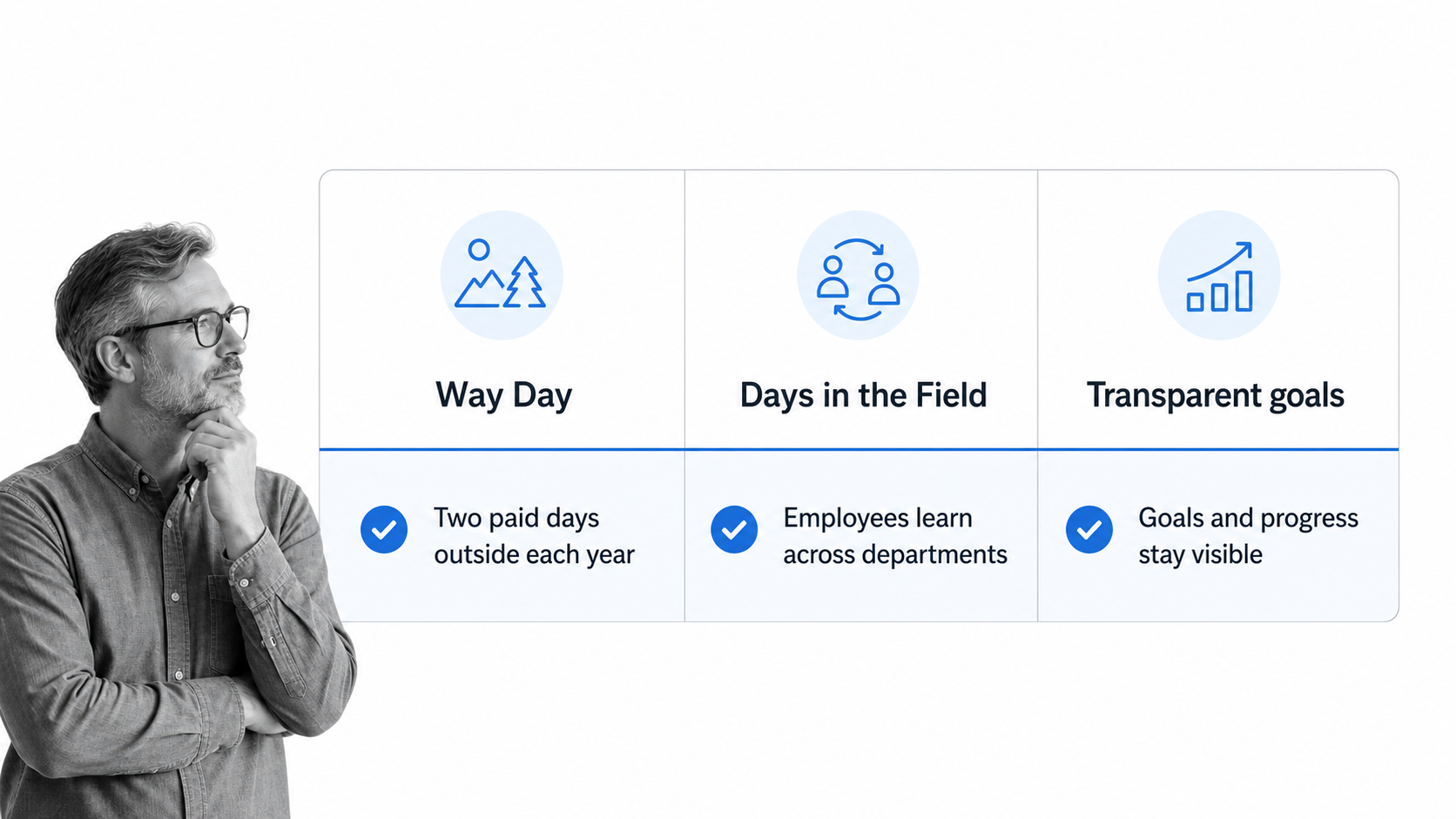
REI Co-op, Southwest Airlines, and Process Street illustrate three different ways that values become visible in everyday work. Their practices differ, but each connects a stated belief to something employees can actually experience.
Here is what that looks like in practice.
REI’s workplace culture
REI Co-op connects its workplace culture to the same outdoor purpose that defines its customer brand. The cooperative emphasizes environmental stewardship, time outside, and employee growth rather than treating those ideas as marketing language alone.
One visible example is Way Day. REI gives employees two paid days outside each year, encouraging them to spend time in nature and participate in the activities the cooperative exists to support.
Long-serving employees can also earn paid sabbaticals. These practices make the culture tangible because they give employees time and permission to act on the organization’s stated values.
A Way Day will not fit every company or industry. The transferable lesson is to identify a practice that is specific to your values and meaningful to employees, then support it consistently.
That consistency is important. A benefit used only in recruitment language will not shape culture if workloads or manager expectations make it difficult to use. Employees need to see that leaders protect the practice when deadlines, staffing changes, or competing priorities put it under pressure.
Southwest Airlines’ workplace culture
Airline employees work in an environment where delays, safety requirements, changing schedules, and customer expectations can create intense pressure. A clear culture helps people make consistent decisions when conditions change quickly.
Southwest Airlines supports that consistency through a culture centered on shared purpose, employee development, recognition, and service.
Its development practices include virtual Days in the Field, which let employees learn about work in another department. Cross-functional exposure helps employees understand how their decisions affect colleagues and customers elsewhere in the organization.
When they are not serving passengers in the sky or helping customers on the ground, employees have the opportunity to develop their skills and abilities via Southwest’s training, development, and empowerment programs.
The Southwest Airlines Gratitude program, known as SWAG, recognizes employees with points they can redeem for rewards. Employees also receive travel privileges and related discounts. These benefits reinforce the message that contribution and service matter.
The programs work because they connect to a common purpose. Tammy Romo, then Southwest’s executive vice president and CFO, described how that purpose creates ownership and pride across the company:
“We are driven by our purpose: connecting people to what’s important in their lives through friendly, reliable, and low-cost air travel. It takes all of us working together as a team to accomplish our vision to be the world’s most loved, most flown, and most profitable airline. This instills ownership and pride because we all have such a meaningful purpose.”
Tammy Romo, Company Culture Soars at Southwest Airlines
Southwest shows how values, norms, recognition, learning, and shared goals can reinforce one another. The individual benefit matters, but its cultural value comes from the behavior it encourages.
The same principle applies outside aviation. Development programs signal that learning matters, recognition systems show which contributions are noticed, and cross-functional experience reduces the distance between teams. Together, those mechanisms help employees translate a broad purpose into specific decisions during a difficult day.
Process Street’s workplace culture
Process Street is fully remote, so its culture cannot depend on what happens inside one office. Everything needs to be clear from the get-go so people know what is expected of them. Clear ownership, written expectations, transparent decisions, and repeatable processes give distributed teams a shared way to work.
Transparency is most useful when it helps people understand goals, priorities, and the reasoning behind decisions. Clear ownership then helps each person know what they are responsible for and where a handoff is needed.
The lesson is not that software creates culture. Culture becomes credible when stated values show up in daily decisions, handoffs, feedback, and management behavior.
Remote work makes gaps visible quickly. An unclear decision, missing owner, or undocumented expectation can leave people in different time zones working from different assumptions. Written context and repeatable handoffs reduce that ambiguity while still leaving room for discussion and judgment.
How to improve workplace culture
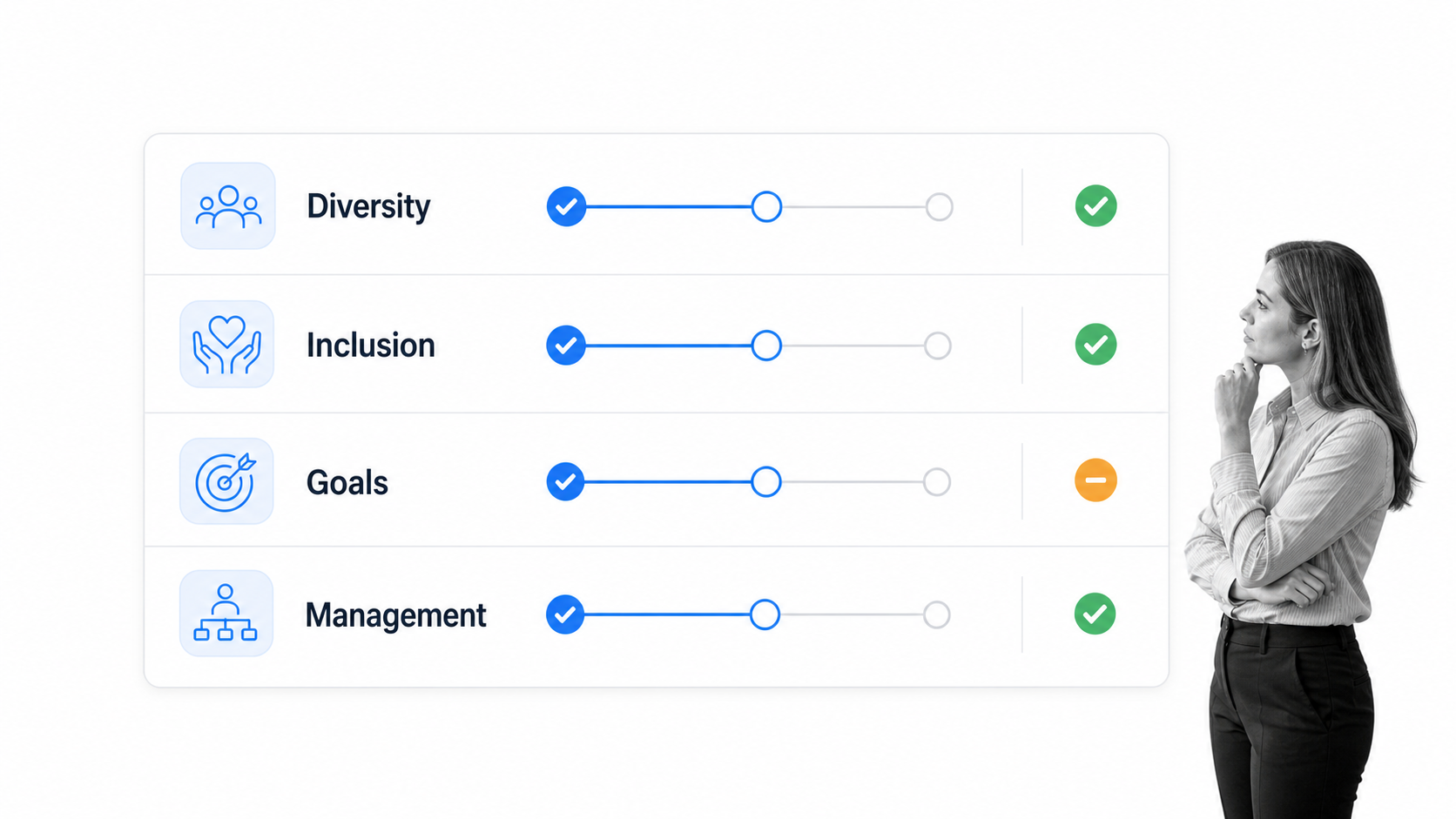
A healthier workplace culture does not require copying another company’s perks. It requires practices that make your own values visible, fair, and repeatable. Start with four connected areas: diversity, inclusion, clear goals, and effective management.
Treat these areas as a system. Representation without inclusion can leave people present but unheard. Goals without supportive management can turn clarity into pressure. Management without fair policies can produce inconsistent outcomes. Improvement is more durable when each area strengthens the others.
Celebrate diversity
From where we come from to where we live, how we were educated to how old we are, all of us have had different experiences that help form our own unique perspectives. A team does not benefit from those differences automatically; leaders have to make room for them in hiring, collaboration, and decision-making.
Research continues to associate more diverse leadership teams with financial outperformance, but diversity is not a shortcut or a headcount target. McKinsey’s 2023 analysis describes a correlation across a large international data set, not a guarantee for any individual company.
The practical value comes when different perspectives influence how problems are framed, whose needs are considered, and which options reach the table. That starts in recruitment and continues through meetings, reviews, promotions, and day-to-day work.
Look beyond representation totals. Review where candidates enter the hiring funnel, who receives stretch assignments, whose ideas are credited, and whether promotion criteria are applied consistently. The aim is to find the points where a stated commitment can be weakened by an informal norm or an avoidable process gap.
Workflows can be used to encourage diversity and help ensure you do not miss any steps in the process. They can prompt reviewers to gather evidence, involve the right people, and complete each required step. Here are three to help you get started:
- Diversity Training Process
- Diversity Management Monthly Audit
- Diversity Initiatives Quarterly Improvement Process
Prioritize inclusivity
While diversity in the workplace is incredibly important, having an inclusive workplace is just as crucial. Diversity and inclusion reinforce one another, but they are not interchangeable. Diversity concerns who is represented. Inclusion concerns whether people are treated fairly, have equal access to opportunities and resources, and can contribute fully to the organization’s success. The SHRM HR glossary is a useful reference for these concepts.
An inclusive culture makes it safer for employees to share ideas, question assumptions, ask for help, and raise concerns. It also gives managers a clearer standard for evaluating whose input is heard and whose growth is supported.
Juliet Bourke and Bernadette Dillon organized inclusion into four connected elements:
- Fairness and respect
- Valued and belonging
- Safe and open
- Empowered and growing
Their Deloitte inclusion model moves from a basic expectation of fairness toward an environment where people feel safe, valued, and able to grow.
That progression matters because inclusion is experienced through repeated decisions, not a single statement. Review access to projects, meeting participation, feedback quality, promotion criteria, and the way concerns are handled.
Managers can make inclusion more concrete by circulating agendas in advance, inviting input through more than one channel, explaining how decisions were made, and checking that development opportunities are not distributed only through informal networks. These practices benefit many employees without assuming that everyone needs the same support.
Introducing and maintaining fairness, belonging, openness, and empowerment will not be an overnight endeavor. It is still a necessary step for a business that wants to develop its company culture and improve business efficiency without treating employees as interchangeable resources.
Establish clear goals
Goals unify teams in an impressive way. Through a shared common objective, people are brought together and made more motivated. Shared, achievable goals are a practical way to influence culture in the workplace for the better. Clear goals also make culture easier to evaluate because employees can see what the organization rewards and how success is defined.
One of the best methods for establishing goals is the SMART method, which can be quickly and easily brought into any organization wanting to improve its workplace culture.
For those who have not encountered the SMART method of goal-setting before, SMART is an acronym, meaning:
- Specific: What exactly should be achieved? Where? When? How?
- Measurable: The goal should be measurable, meaning you can see and track progress.
- Attainable: So that you are not wasting time, money, effort, and morale, the goal should be attainable rather than unachievable.
- Relevant: The goal should be relevant to the company or team responsible for it.
- Timely: Set flexible, realistic deadlines so the goal can be achieved on time.
At its core, the SMART method is a way of creating and presenting clear, practical, and actionable objectives where there is no confusion and everyone is on the same page. From a workplace-culture standpoint, SMART goals help foster teamwork and collaboration, make accountability fairer, and reduce anxiety about shifting or hidden expectations. Those goals can help employees achieve better results and turn an abstract cultural achievement into visible action.
Clarity also helps employees challenge a goal constructively. When the intended outcome, owner, measure, and deadline are visible, a team can identify conflicting priorities or unrealistic assumptions early. That conversation is much harder when the goal exists only as a broad directive.
Like with most methods, having a set process in place helps ensure no steps are missed. A repeatable process helps teams set the goal, assign an owner, review progress, and capture decisions. This SMART Goal Setting Workflow provides a practical structure.
Once goals are clear, keep them with the policies and processes employees use. Process Street brings governed Docs and executable Ops together in one Compliance Operations Platform, with built-in AI. Teams can document expectations, connect them to repeatable work, and review what actually happened instead of relying on a static statement.
Effective management
Leaders establish the foundations of a positive workplace culture, but managers turn those conditions into routine behavior. With effective management, HR employees can put in place procedures, policies, and measures to help sustain a healthy company culture. People judge culture through decisions about priorities, workload, feedback, recognition, performance, and conflict.
Good performance management makes expectations visible and gives employees regular opportunities to understand progress. Set clear owners, use evidence in reviews, create a predictable feedback cadence, and document follow-up actions.
Policies matter too, especially when the stakes are high. A policy becomes credible when managers apply it consistently, employees know how to use it, and the organization can review whether the required steps actually occurred.
Managers also need support. Training, clear escalation paths, and accessible guidance reduce the chance that two employees receive very different treatment because their managers interpreted the same situation differently. Review patterns across teams so that the organization can identify where coaching or policy clarification is needed.
Repeatable workflows support that consistency without removing judgment. They help managers remember required steps, route decisions to the right people, and create a record of what happened. Useful examples include:
- Performance Review Checklist
- Employee Relations
- Code of Conduct Policy Adherence Process
- Employee Complaint Procedure
- Office Conflict Resolution Checklist
The goal is not to mechanize every conversation. It is to give managers a reliable foundation so that important cultural commitments do not disappear when work becomes busy or a difficult situation arises.
Measure both experience and execution. Employee feedback can reveal whether people feel respected and informed, while process data can show whether reviews happened on time, concerns reached the correct owner, and promised follow-up was completed. Neither view is sufficient on its own.
Use those signals to improve the system rather than to grade culture with a single score. A survey result may point to a trust issue, but interviews and process evidence can reveal whether the cause is unclear ownership, uneven manager behavior, delayed decisions, or a policy employees cannot navigate.
Start strengthening your company’s culture today
A healthy workplace culture is not a poster, perk, or annual initiative. It is the pattern created by everyday choices about who participates, how goals are set, what managers reinforce, and whether employees can trust the systems around them.
Start by examining one repeated management moment, such as onboarding, goal setting, a performance review, or an employee concern. Compare the experience with the values the organization claims to hold, then close the most important gap.
Culture becomes durable when expectations are documented and reflected in the way work actually happens. Process Street gives HR and operations teams governed Docs, executable Ops, and built-in AI in one platform, helping them connect policies to onboarding, reviews, employee relations, and recurring management work.
Clear values still require human judgment and accountable leadership. The right operating system makes that judgment easier to apply consistently and gives the organization evidence it can learn from over time.
Revisit the pattern regularly. As the organization grows, new managers, teams, tools, and working arrangements can change how employees experience the same written values. Healthy cultures keep learning without abandoning the principles that give people a clear sense of how work should be done.
The most useful next step is specific and observable. Choose one cultural commitment, identify the recurring moment where it should appear, assign an owner, and decide what evidence would show that the experience is improving. Small operational changes compound when leaders sustain them.
The post A Complete Guide to Workplace Culture: What It Is and How to Make Yours Better first appeared on Process Street | Compliance Operations Platform.


0 Commentaires