GDPR compliance is the ongoing practice of handling personal data lawfully, fairly, transparently, and securely, while being able to prove that your controls work. For SaaS companies, that means understanding when you act as a controller, when you act as a processor, and how your product, contracts, vendors, and internal workflows support both roles.
A spectre still haunts businesses that process European data, but it is no longer the uncertainty of a law waiting to take effect. It is the operational gap between a privacy policy and what people actually do. This guide explains what GDPR compliance requires, who falls within its scope, why SaaS companies face particular obligations, and how to build a step-by-step GDPR compliance process that produces evidence instead of last-minute panic.
The General Data Protection Regulation has applied since 25 May 2018. It is enforced by national supervisory authorities across the European Economic Area, and the United Kingdom operates a closely related UK GDPR regime. This article provides practical operational guidance, not legal advice. Your obligations depend on your role, processing activities, locations, contracts, and the risks to individuals, so involve qualified privacy counsel where needed.
Many people remain unsure what GDPR is, how it could affect their organization, or whether they should be worried about a particular activity. The answers come from the facts, not panic: identify the personal data, purpose, role, lawful basis, systems, recipients, safeguards, and rights involved. Those are the actionable steps that turn broad concerns about GDPR into controls accurately tailored to the way the organization operates.
What is GDPR?
The General Data Protection Regulation is the European Union’s main legal framework for protecting personal data. It sets rules for organizations that decide why and how personal data is used, organizations that process that data on their behalf, and certain organizations outside the EU that offer goods or services to people in the EU or monitor their behavior there.
The history explains why the law is broader than a security standard. The legislation was intended to standardize data regulation across Europe while providing greater protection and control over data to the consumer. It followed four years of work by the European Commission in consultation with member states, upgraded previous data laws originally ratified in 1995, and was passed through the European Parliament and European Council in April 2016. Publication in the EU Official Journal began a two-year transition period before the rules became applicable in May 2018. Times had changed, and the law changed with them.
That transition generated a rush of articles, consultancy services, and predictions about punitive powers. The data security industry focused heavily on larger fines, security failings, and global turnover. The maximum fine remains important, but enforcement is not a simple tariff and the average fine is not a useful compliance target. Governing authorities can choose among warnings, orders, restrictions, and sanctions according to the circumstances. They also expect organizations to cooperate, correct problems, and demonstrate compliant behavior. The practical objective is a system that manages data and security, is fully documented, and operates within the law’s parameters.
Personal data is broader than a name or email address. It includes information that identifies a person directly or indirectly, such as account identifiers, device IDs, location data, support histories, IP addresses, and combinations of data that can single someone out. Some information, including health data, biometric identifiers, political opinions, and religious beliefs, receives additional protection as special-category data.
GDPR is built around principles rather than a single checklist. Personal data must be processed lawfully, fairly, and transparently. It must be collected for specified purposes, limited to what is necessary, kept accurate, retained no longer than needed, and protected with appropriate security. The accountability principle ties those requirements together: an organization must comply and be able to demonstrate how it complies.
Every processing purpose needs a documented lawful basis. The six lawful bases are:
- Consent: the individual has given a freely made, specific, informed, and unambiguous indication of agreement.
- Contract: processing is necessary to perform a contract with the individual or take requested steps before entering one.
- Legal obligation: processing is necessary to comply with a law that applies to the organization.
- Vital interests: processing is necessary to protect someone’s life.
- Public task: processing is necessary for a task in the public interest or under official authority.
- Legitimate interests: processing is necessary for a legitimate interest that is not overridden by the individual’s interests, rights, and freedoms.
Consent is not automatically the safest or strongest choice. The correct basis depends on the exact purpose, and changing that purpose may require a fresh assessment and new privacy information. Document the decision before processing begins so the privacy notice, rights process, retention schedule, and evidence all tell the same story. The ICO’s lawful-basis guidance explains how purpose and lawful basis connect under the UK regime.
GDPR also distinguishes between controllers and processors. A controller determines the purposes and essential means of processing. A processor handles personal data on a controller’s documented instructions. The same company can occupy both roles for different activities. A SaaS provider may process customer-uploaded records on behalf of a customer while acting as controller for its own billing, account administration, product security, or marketing data.
Supervisory authorities can issue warnings, orders, processing restrictions, and administrative fines. For the most serious infringements, the maximum can reach €20 million or 4% of total annual worldwide turnover, whichever is higher. The actual response depends on the infringement and its circumstances. The durable lesson is not to optimize around a fine ceiling. Build controls that protect people and make compliant behavior routine.
Who is affected by GDPR?
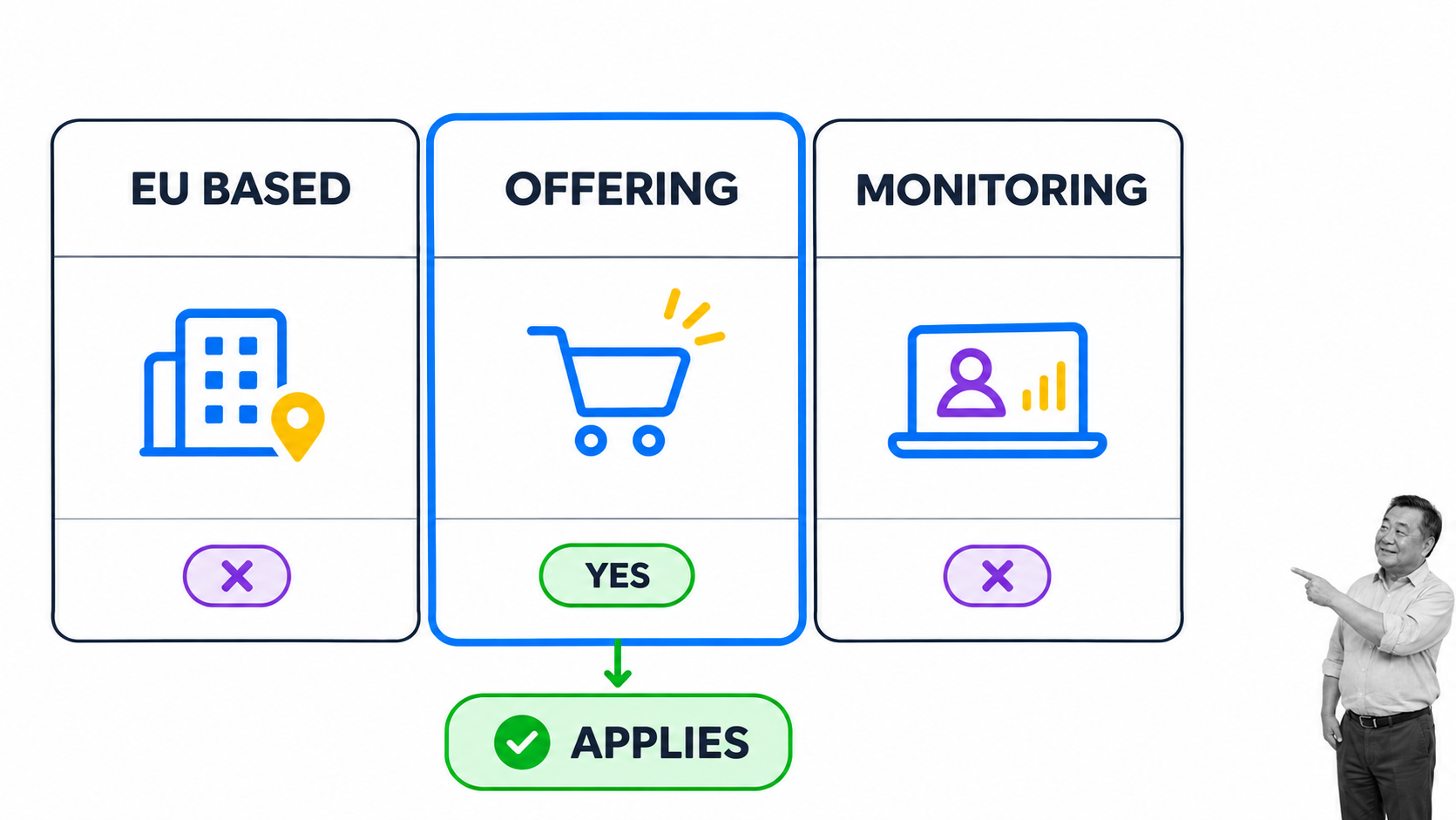
GDPR can apply through establishment or targeting. It generally applies when personal data is processed in the context of an EU establishment, even if the technical processing happens elsewhere. It can also apply to an organization with no EU establishment when that organization offers goods or services to people in the EU or monitors their behavior in the EU. This extraterritoriality definition is more precise than saying the law follows any data that “came from Europe.”
Run the scope test for each processing activity:
- Establishment: Is the processing connected to an EU office, branch, or stable business arrangement?
- Offering goods or services: Are you intentionally serving people in the EU, including through local language, currency, shipping, campaigns, or customer terms?
- Monitoring: Are you tracking or profiling people’s behavior in the EU, such as behavioral advertising, location tracking, risk scoring, or persistent analytics?
- Role: For this activity, are you a controller, joint controller, processor, or sub-processor?
- Data and risk: What personal data is involved, whose data is it, and what harm could misuse or loss cause?
Controllers carry primary responsibility for choosing lawful purposes, giving privacy information, enabling rights, selecting suitable processors, and demonstrating accountability. Processors also have direct duties. They must follow documented instructions, protect data, keep required records, control sub-processors, assist the controller with rights requests and data protection impact assessments, notify the controller of breaches without undue delay, and support audits.
The controller-processor relationship must be governed by a binding contract that covers the processing, confidentiality, security, sub-processors, assistance, deletion or return of data, and evidence of compliance. A processor cannot appoint a sub-processor outside the authorization structure agreed with the controller. The European Data Protection Board’s controller and processor guide provides practical responsibility checklists for each role.
Company size does not create a general exemption. Some record-keeping provisions have a limited exception for organizations with fewer than 250 employees, but that exception does not apply when processing is regular, likely to risk people’s rights and freedoms, or involves special-category or criminal-conviction data. Small teams still need appropriate lawful bases, notices, security, contracts, rights handling, and breach procedures.
One common misconception is that the law applies only to businesses registered in the EU or only when data has “come from” Europe. Physical presence and citizenship are not the complete tests. The regulation applies to both controllers and processors through the establishment, offering, and monitoring rules described above. An organization based outside the EU can therefore come under EU scrutiny, while a company holding data about a European citizen does not automatically fall within scope if none of the territorial triggers is met. Accurate scope analysis matters more than a slogan about extraterritoriality.
Individual protections also depend on transparency. If a company sources personal data from a third party, a publicly available notice on its website may not be enough. Article 14 can require contact details, an explanation of the legal basis for processing, information about sources and recipients, and details of the objection or opt-out process. Data subjects must generally be notified directly within the applicable timing rules unless a valid exception applies. That awareness is what allows a person to exercise access, correction, deletion, portability, objection, and other data rights.
When personal data is obtained from another source, Article 14 transparency duties may require the controller to tell the individual what data it holds, where the data came from, why it is used, the lawful basis, recipients, retention, and available rights. Timing and exceptions depend on the situation, but a quiet third-party data purchase is not a substitute for transparency.
Why should SaaS companies be concerned?
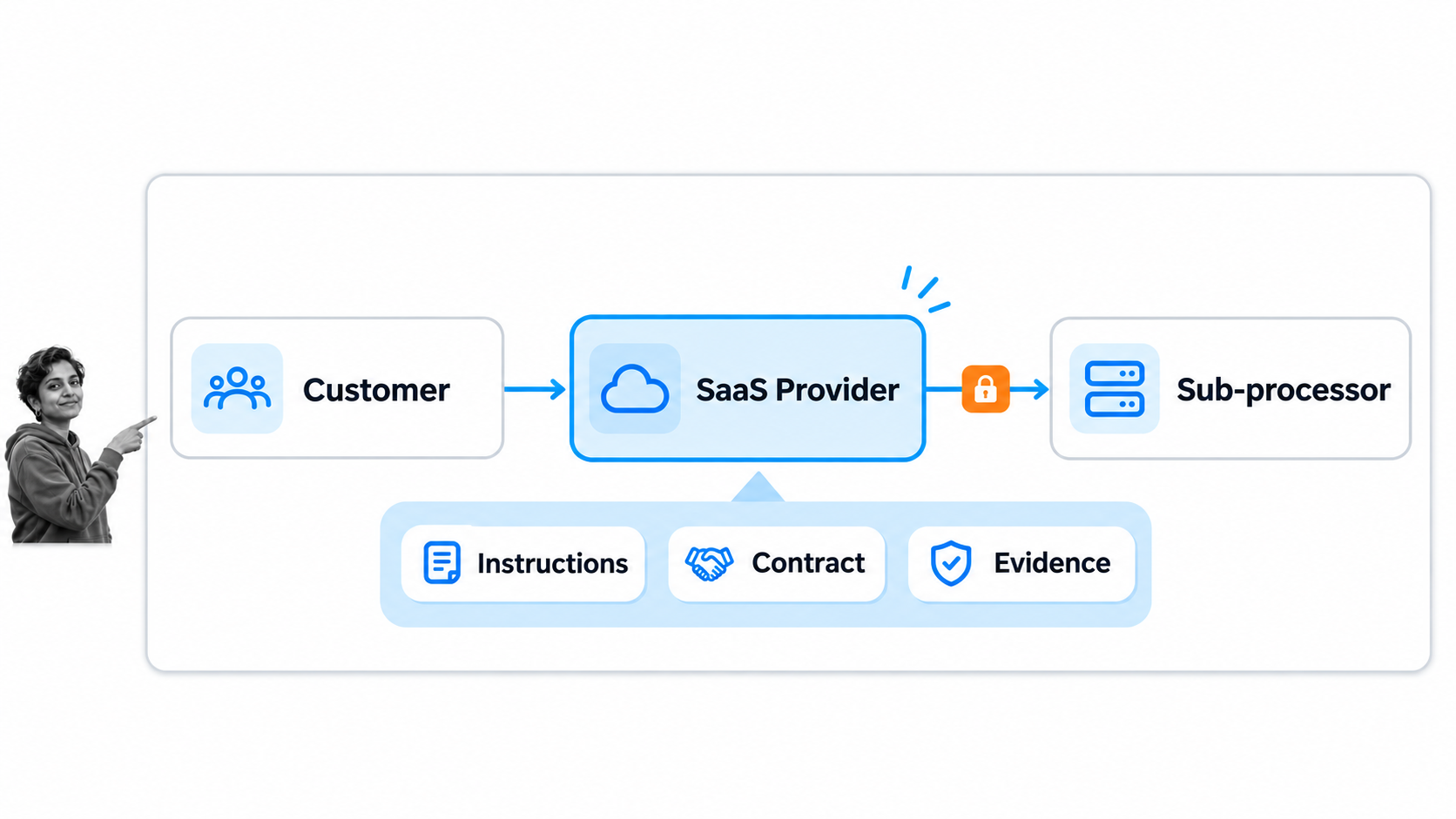
SaaS companies sit at the center of other organizations’ data flows. A customer may use a platform for HR records, support tickets, sales activity, healthcare administration, financial operations, analytics, or regulated workflows. Even when the SaaS vendor does not choose the customer’s business purpose, it may store, transmit, search, enrich, back up, or otherwise process the underlying personal data.
That creates a chain of responsibilities. The customer needs to understand which data enters the service and why. The SaaS provider needs a clear data processing agreement, documented security measures, a sub-processor inventory and authorization process, incident-response duties, deletion and return procedures, and support for data-subject requests. Each sub-processor must receive protections equivalent to those in the controller-processor arrangement.
A SaaS provider also needs to separate its processor activities from its controller activities. Customer content may be processed under customer instructions, while product telemetry, billing contacts, fraud prevention, account communications, and the provider’s own marketing have different purposes and lawful bases. Mapping those activities prevents a single vague privacy statement from hiding incompatible roles.
International data transfers require their own analysis. Hosting data outside the EEA, giving a support team access from another country, or using a global sub-processor can create a restricted transfer. Depending on the destination and arrangement, the organization may need an adequacy decision, standard contractual clauses, binding corporate rules, or another permitted mechanism, plus an assessment of whether the protection works in practice.
Security is also operational, not merely contractual. Appropriate measures may include access controls, encryption, backups, logging, vulnerability management, secure development, tenant separation, incident detection, and regular testing. The right combination depends on the nature, scope, context, and risk of the processing. A contract that promises security without an operating process behind it will not produce reliable evidence.
Procurement teams increasingly ask SaaS vendors to demonstrate these controls before purchase. A strong response connects each claim to an owner, procedure, record, and review cadence. That makes SaaS compliance part of product operations and customer trust, not a PDF assembled at the end of a sales cycle.
In practical terms, SaaS customers are often controllers and SaaS suppliers are often processors, but the labels follow the actual processing. The controller decides the purpose and essential manner in which personal data is used. The processor obtains, records, adapts, stores, or otherwise handles data on the controller’s behalf. A B2B SaaS provider can be processing European data even when its immediate customer is elsewhere, and non-EU SaaS suppliers can have direct compliance requirements and sanctions. That is why contracts, instructions, sub-processor controls, and evidence must accurately reflect the service rather than relying on a generic statement that the vendor is “just a processor.”
How to comply with GDPR
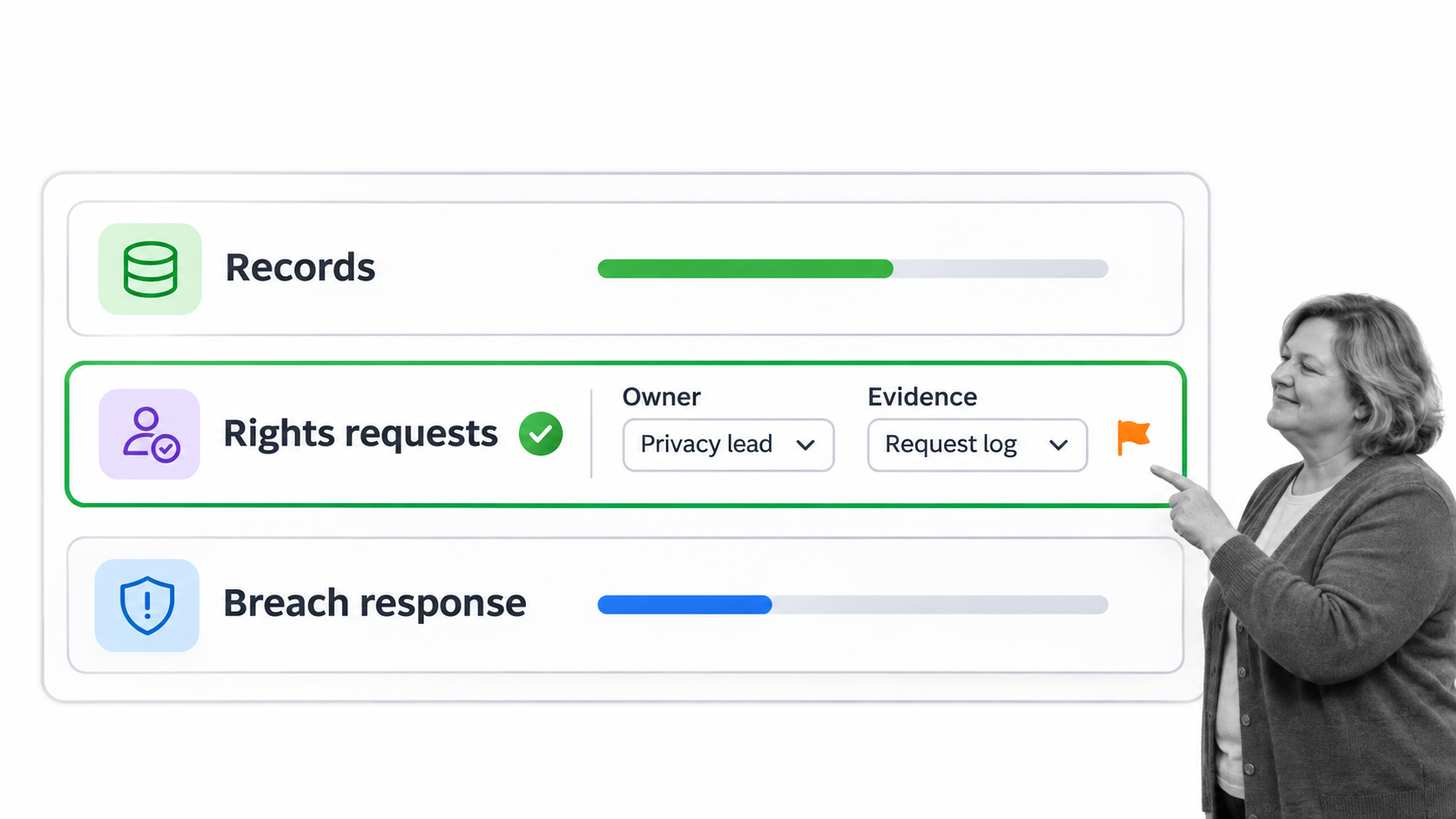
There is no universal certificate that makes an organization permanently GDPR compliant. Compliance is a managed system of decisions, controls, records, and reviews. A practical step-by-step GDPR compliance process looks like this:
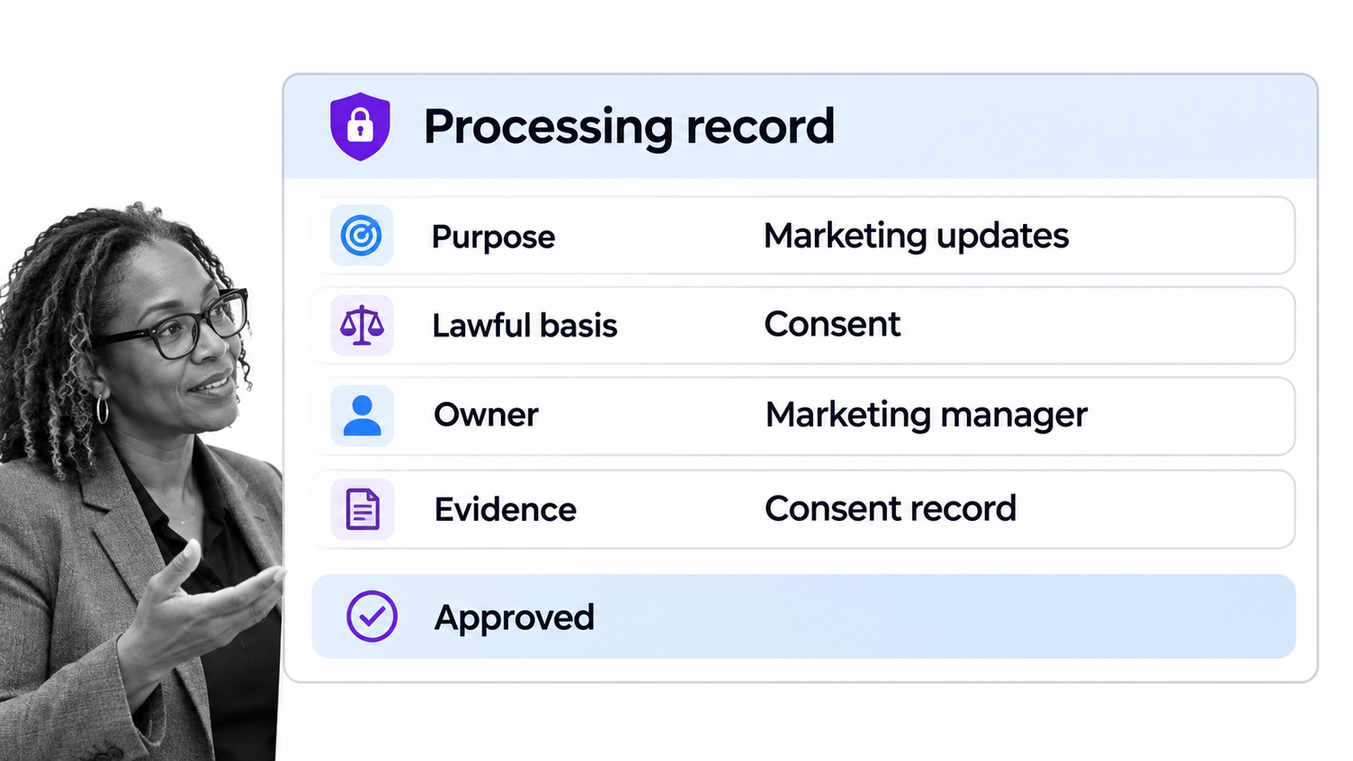
- Map processing activities. Record the data, individuals, purposes, systems, recipients, locations, retention periods, role, lawful basis, and owner for each activity.
- Minimize and govern data. Collect only what is necessary, restrict access, set retention and deletion rules, and keep information accurate.
- Align notices and consent. Make privacy information clear and specific. Where consent is used, make withdrawal as easy as giving consent and retain proof.
- Put contracts in place. Use Article 28 terms with processors, equivalent controls with sub-processors, and a governed change-notification process.
- Design for rights requests. Create intake, identity verification, search, review, approval, response, and evidence steps for access, rectification, erasure, restriction, objection, portability, and automated-decision rights.
- Assess risk before change. Run a DPIA when planned processing is likely to create high risk, and make privacy by design and default part of product and process reviews.
- Prepare for incidents. Detect, contain, assess, document, escalate, and notify through a tested breach workflow.
- Control transfers and vendors. Inventory data locations, transfer mechanisms, and sub-processors, then review them as services and laws change.
- Train and monitor. Give role-specific training, test controls, track exceptions, and review evidence with accountable leaders.
Data Protection Officer
Do not assume every company needs a formal Data Protection Officer. Assess the Article 37 criteria and document the result. A DPO is required for public authorities and certain organizations whose core activities involve large-scale regular and systematic monitoring or large-scale processing of special-category or criminal-conviction data. If you appoint a DPO voluntarily, the GDPR’s requirements for the role, independence, access, and protection still apply.
Whether or not a formal DPO is required, assign clear privacy ownership. Someone must coordinate the processing inventory, review high-risk changes, advise teams, track requests and incidents, and make sure issues reach the right decision-maker.
The idea behind appointing a Data Protection Officer is to bring data security into the boardroom. That structural change is meant to create a cultural shift in how leaders recognize individual data rights and adherence to the regulation. The DPO should have appropriate expertise, reasonable capacity for the job, direct access to senior management, and enough independence to perform the role without conflict. An organization cannot appoint someone in name only and then prevent that person from advising, monitoring, or raising concerns.
Article 37 describes the core scenarios in which a DPO is needed: large-scale regular and systematic monitoring of data subjects, or large-scale processing of sensitive data and criminal-conviction information, alongside the public-authority requirement. “Large scale” and “core activities” require a reasoned assessment rather than a head-count shortcut. Companies that nominate someone voluntarily should remember that the formal role carries the GDPR’s protections and responsibilities.
Documentation
Documentation is the connective tissue of accountability. Maintain records of processing activities where required, plus the decisions and evidence that make those records credible: lawful-basis assessments, legitimate-interest assessments, consent records, privacy notices, retention schedules, processor contracts, sub-processor approvals, transfer assessments, DPIAs, training records, security tests, rights-request logs, and breach records.
A DPIA is mandatory when planned processing is likely to result in high risk to people, such as certain large-scale sensitive-data processing, systematic monitoring, or automated evaluation with significant effects. Complete it early enough to influence the design. Identify the purpose, necessity, proportionality, risks, safeguards, owners, approvals, and residual risk, then revisit the assessment when the processing changes.
Documenting these interactions brings data governance into operational reality. For every activity, ask why the data was gathered, what legal basis justifies holding it, who has access, how it is protected from breaches, and what else it is used for. Record the answer in a form that teams can maintain rather than in a one-time preparation file. A data protection impact assessment is one definite piece of documentation for likely high-risk work, but the wider evidence set should also show how the organization reached and reviewed its decisions.
Breach reporting
A controller must notify the relevant supervisory authority of a personal data breach without undue delay and, where feasible, within 72 hours after becoming aware of it when the breach is likely to result in a risk to people’s rights and freedoms. If the breach is likely to result in a high risk, affected individuals must generally be informed without undue delay. A processor must tell the controller without undue delay so the controller can meet its obligations.
Not every breach must be reported, but every breach should be recorded with the facts, effects, risk assessment, decisions, and remediation. Your workflow should start the clock, gather required facts, separate containment from notification analysis, route legal and security review, and preserve a decision trail. The ICO breach guide is useful for UK incidents; EU incidents should be assessed against the competent EU supervisory authority and applicable EDPB guidance.
The 72-hour period is a cut-off point for feasible authority notification, not a reason to wait. Relevant stakeholders need a shared route to assess whether the breach is likely to put rights or freedoms at risk. Strong encryption that renders data unintelligible, prompt steps that remove the risk, or circumstances that make individual contact a disproportionate effort can affect the communication analysis, but they do not remove the need to document what happened. A public announcement can sometimes substitute for direct notice only when the legal conditions are met.
Data subject rights
Individuals have rights to information and, depending on the circumstances, access, rectification, erasure, restriction, portability, objection, and safeguards around solely automated decisions. The right to erasure is conditional, not absolute. The correct response can depend on the lawful basis, legal retention duties, freedom of expression, public-interest grounds, legal claims, and other exceptions.
Build one governed request process that records the deadline, verifies identity proportionately, searches all relevant systems, coordinates with processors, applies exceptions consistently, approves the response, delivers it securely, and records the evidence. Most requests must be handled without undue delay and generally within one month, subject to permitted extensions for complex or numerous requests.
Data subjects receive a host of connected protections: data portability; rectification and erasure; the right to object to processing; safeguards against certain profiling and automated decisions; and subject access requests, often shortened to SARs. Subject access requests are generally free, and the data controller must respond within one month. A reasonable fee or refusal may be possible when a request is manifestly unfounded or excessive, but the controller must be able to demonstrate why. This protects individuals while giving organizations a narrow route to address repeated or abusive requests without weakening the underlying right.
How you can use Process Street to help your compliance
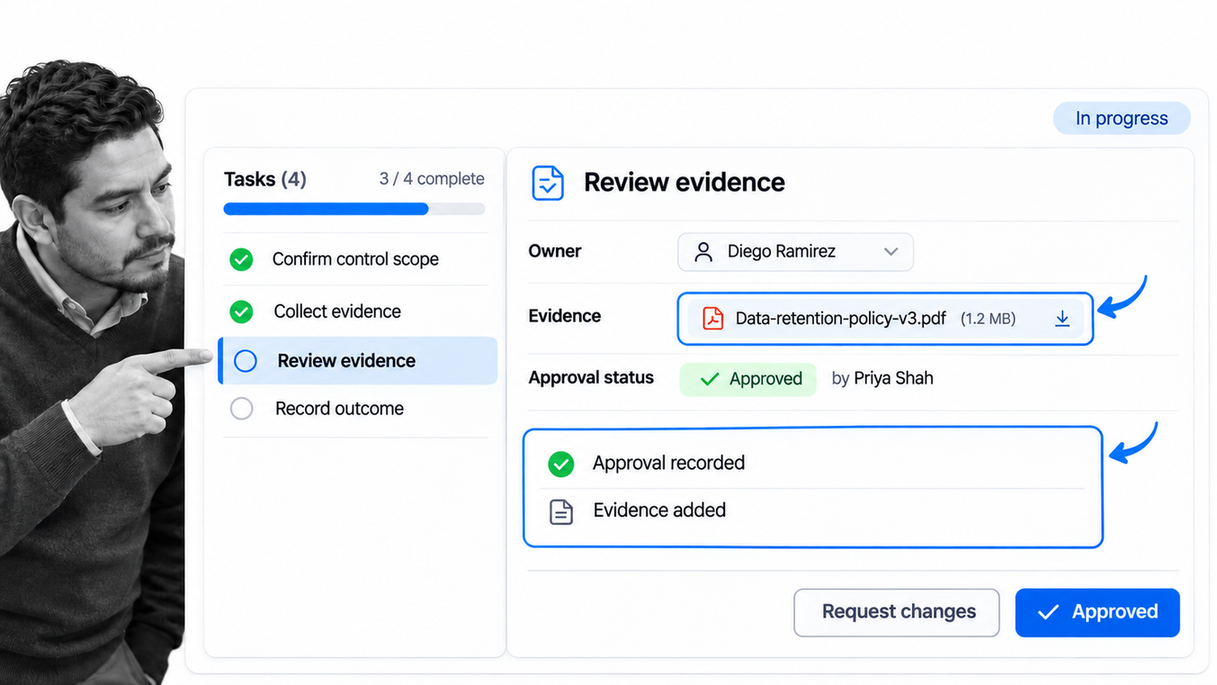
Process Street is a single Compliance Operations Platform with Docs and Ops capability areas plus built-in AI. It does not replace privacy counsel or make a legal determination for you. It helps turn approved policies and controls into assigned work, enforce required steps, collect evidence, route approvals, and retain an audit history.
Use Docs to govern policies, procedures, and control documentation with clear ownership and review. Use Ops to run repeatable workflows for rights requests, DPIAs, vendor reviews, sub-processor changes, retention reviews, consent checks, and breach response. Built-in AI can assist with drafting and operational analysis inside the governed process, while people retain accountability for legal and risk decisions.
For example, a rights-request workflow can assign identity verification, system searches, legal review, response approval, delivery, and evidence retention. Conditional logic can route an erasure request differently when a legal hold or statutory retention duty applies. Due dates and escalations keep the one-month response window visible. A complete run then becomes proof of what was reviewed, decided, approved, and communicated.
A breach workflow can capture discovery time, affected systems, categories of data, likely consequences, containment, risk assessment, supervisory-authority decision, individual-notification decision, approvals, and remediation. This creates a consistent operating record without pretending that software can make the legal judgment on its own.
The same approach supports an operational compliance program rather than a passive repository. The distinction matters when comparing compliance operations and traditional GRC: storing a policy is different from running the work, enforcing the handoffs, and retaining evidence that the control operated.
You can run this workflow for each team, product, system, or processing activity that needs review. The embedded GDPR workflow below provides a practical starting point. Adapt it to your role, regulator, data map, contracts, and risk profile before relying on it.
The interactive workflow is useful precisely because a large organization will not run it only once. Different teams or wings of the company need to analyze their activities for non-compliant structures, incomplete records, weak handoffs, or controls that have stopped operating. Assigned runs, saved evidence, and visible responses let an appointed privacy owner monitor information from each team and create a system of oversight quickly. The template is a starting structure, while the completed work and approvals are the evidence.
Act now and protect your business
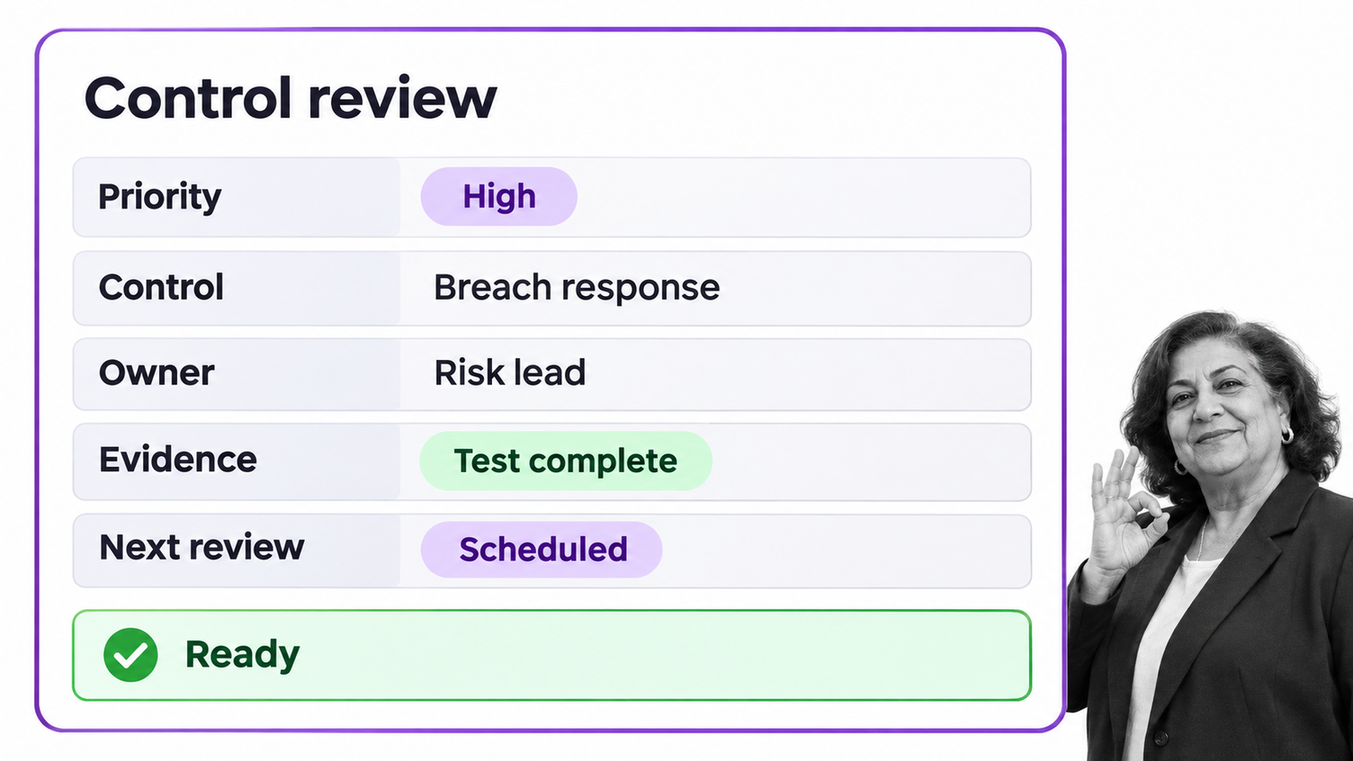
Becoming GDPR compliant is not a one-time deadline project. Products change, vendors change, people change, and new uses of data appear. Review the processing inventory, high-risk activities, contracts, rights workflow, breach process, retention controls, training, and evidence on a defined cadence. Treat exceptions as signals that a control or procedure needs attention.
Start with the activity that creates the most risk or the weakest evidence. Give it an owner, document the lawful purpose and role, map the systems and vendors, test the rights and incident paths, and close the gaps. Then repeat the process across the rest of the data estate.
To become compliant, look at the actual data being collected, being processed, being accessed, being transferred, and being kept. Review every aspect of the company’s data and the company’s interactions with individuals. Consent boxes cannot be auto-filled as “yes,” but consent is only one of several different justifications. Access requests need a reliable response path, while an excessive request needs a documented assessment before administrative costs or refusal are considered. Data must be protected adequately whether it includes a basic identifier, behavioral history, or credit card information. These practical distinctions help teams abide by the regulation without treating every activity as identical.
Specialized legal advice remains important when scope, international transfers, high-risk processing, regulator engagement, or exceptions are uncertain. Operational discipline makes that advice usable. Document your processes, update your procedures, and connect every important obligation to work that is owned, performed, reviewed, and provable.
When much is at stake, consider bringing in specialized consultancy services or qualified counsel. Experts can assess the specific scenario, identify relevant regulatory bodies, and recommend further action. GDPR was a major legislative change, but for organizations with sound data management it is also an evolution of principles that already existed. It should not create insurmountable hurdles for companies prepared to understand their data, make legally valid decisions, and correct failures. Laws and guidance develop over time, so keep up to date with data security issues as enforcement and regulatory expectations unfold.
GDPR compliance in practical terms
It is the ability to show that personal data is processed under clear purposes and lawful bases, protected with risk-appropriate measures, kept only as long as needed, and handled through reliable rights, vendor, transfer, and incident processes.
Data Protection Officer requirements for SaaS companies
No. Assess the Article 37 criteria. A DPO is mandatory for specified public-authority, large-scale monitoring, and large-scale sensitive-data scenarios. Document the assessment and assign privacy ownership even when a formal DPO is not required.
Controller and processor roles for SaaS companies
Yes. Roles attach to processing activities, not the company as a whole. A provider may process customer content under instructions while acting as controller for its own billing, account, security, and marketing activities.
GDPR control review cadence
Set a risk-based cadence and review sooner when products, purposes, vendors, transfers, laws, or threats change. High-risk processing and incident controls deserve more frequent testing than stable low-risk activities.
The post How to Be GDPR Compliant: A Guide for SaaS and Beyond first appeared on Process Street | Compliance Operations Platform.


0 Commentaires