
If Shakespeare offered to write a guest post for TechCrunch, he probably would not be declined. The same goes for Virginia Woolf, Toni Morrison, Fitzgerald, or any other great writer who wanted to contribute to the blog of a respected modern publication.
Guest posting, also called guest blogging, is the practice of writing an article for a site you do not own. This guide explains what it is, why it works, and how Process Street built a governed production system that supported more than 300 guest posts published across relevant publications.
They are the lucky few who became internationally renowned as stellar writers. The hard part would not be pitching and writing for incredible modern sites and blogs. It would be resurrecting themselves so they could write in the first place.
This deep dive shows what winning at guest posting required in practice: relevant ideas, publication fit, clear ownership, consistent review, and reliable follow-through.
Most business writers do not arrive with an internationally recognized name. They earn attention by bringing useful expertise to the right audience, following an editor’s standards, and delivering what they promised. That makes guest posting less like a shortcut and more like a repeatable editorial partnership.
How do you get your business’s writers, who are incredible in their own right but do not yet have that reputation, published by other sites? How can you add authority, improve targeted traffic, increase qualified leads, and secure relevant backlinks with guest posting? What needs to be done?
The Process Street content team learned that lesson across hundreds of contributions, including work published by TechCrunch, HubSpot, G2, and The Next Web. The work created reach, referral traffic, authority, relationships, and useful links, but only when the contribution stood on its own editorial value.
Use the sections below to move from the basic definition to the operating details:
- What is guest posting?
- The business benefits of guest posting
- Process Street’s guest post journey
- Four essential guest blogging tips
“Brevity is the soul of wit,” Shakespeare once said. So, without more ado, here is how guest posting works.
What is guest posting?

Guest posting, also known as guest blogging or guest contributing, is the act of writing blog posts for sites and blogs that you do not own. The contributor supplies relevant expertise and a finished piece. The publisher supplies editorial review, distribution, and access to an established audience.
The aim behind guest posting is to increase the reach of your business, the amount of targeted traffic your site receives, secure editorially relevant backlinks, and further establish your business as an authority within its subject areas. Those outcomes depend on useful content and a genuine publication fit, not on domain metrics alone.
It is a two-way relationship:
- The writer and the business they are working for reap rewards regarding reach, traffic, backlinks, and authority. This is the payment, as it were, for carefully crafting the content in the first place.
- The site taking the post gets to add useful content to its content calendar, most likely written from a different angle or perspective that its in-house writers may not have been able to bring to the table themselves.
The best guest posts are written for readers first. They answer a real question, match the publication’s standards, and disclose any commercial relationship. A placement that exists only to manufacture optimized links is not a durable guest-posting strategy.
That distinction matters because guest posting is often reduced to link building. Ann Smarty has argued that a campaign measured only by the number of links misses its larger value: trusted contributors can build recognition, relationships, and a body of work across relevant publications. The link is one possible outcome, not the whole job.
There is a school of thought that believes guest posting is a waste of time. That is a short-sighted view because it does not take into account the long-term, long-lasting benefits of off-site guest posting. Those who measure the campaign only by the number of links miss the relationships, recognition, referral traffic, and editorial trust created along the way.
The goal can vary. An executive may contribute to build subject authority. A content team may want to reach a specific audience or support a topic cluster. A practitioner may want to share a method that another publication’s readers cannot get from its regular contributors. In each case, the editorial contribution has to be worth publishing without relying on the author’s brand name.
That is why guest posting is flexible. It can support awareness, partnerships, referral traffic, and search visibility, but it works only when the writer, publisher, and reader all receive something useful.
The business benefits of guest posting

A strong company blog is necessary, but an on-site content strategy can only reach so far on its own. Relevant guest contributions put expertise in front of audiences that may not know the company yet.
Putting thought, time, effort, and money into your business’s blog is a necessity, but the overall content marketing strategy also needs a deliberate plan for relevant off-site guest posting. The channel should complement owned content, not replace it.
The practical benefits fall into six groups:
- Referral traffic. A useful article gives interested readers a reason to visit the contributor’s site, profile, resource, or product page. The quality of that traffic matters more than a raw click count.
- Subject authority. Repeated, substantive contributions help readers associate a person and company with a field. Authority compounds slowly, through accurate work and reliable delivery.
- Brand awareness. A byline, author bio, or relevant example can introduce the brand without turning the article into an advertisement.
- Editorial relationships. A good experience with one editor can lead to recurring contributions, reciprocal expertise, introductions, or a wider content partnership.
- Useful links. A publisher may link to a relevant source, product, or supporting article when the link helps the reader. Google warns against scaled guest-post campaigns built around optimized anchors or low-value content, so links must remain editorial rather than the reason the article exists.
- Search visibility. A high-quality contribution can rank for a useful query on the host publication, introduce the author to searchers, and create demand for related expertise. It should not duplicate an on-site article or promise an automatic ranking lift.
Google’s spam policies specifically call out optimized links in guest posts and low-value content created mainly to manipulate rankings. If a placement is paid, the outbound link should be qualified with rel="sponsored" or rel="nofollow" under Google’s link qualification guidance.
That does not make guest posting ineffective. It makes relevance, expertise, and editorial independence non-negotiable. A focused contribution to the right publication can still produce qualified visits, memorable ideas, useful citations, and lasting relationships.
The benefits also depend on the campaign’s goal. A founder writing about a hard-earned operating lesson is building a different kind of value from a product marketer explaining a technical category. Both can work when the publication’s audience and the contributor’s expertise overlap.
Process Street made guest posting a meaningful part of its content strategy, but the system did not start in a polished state.
How Process Street managed guest-post production
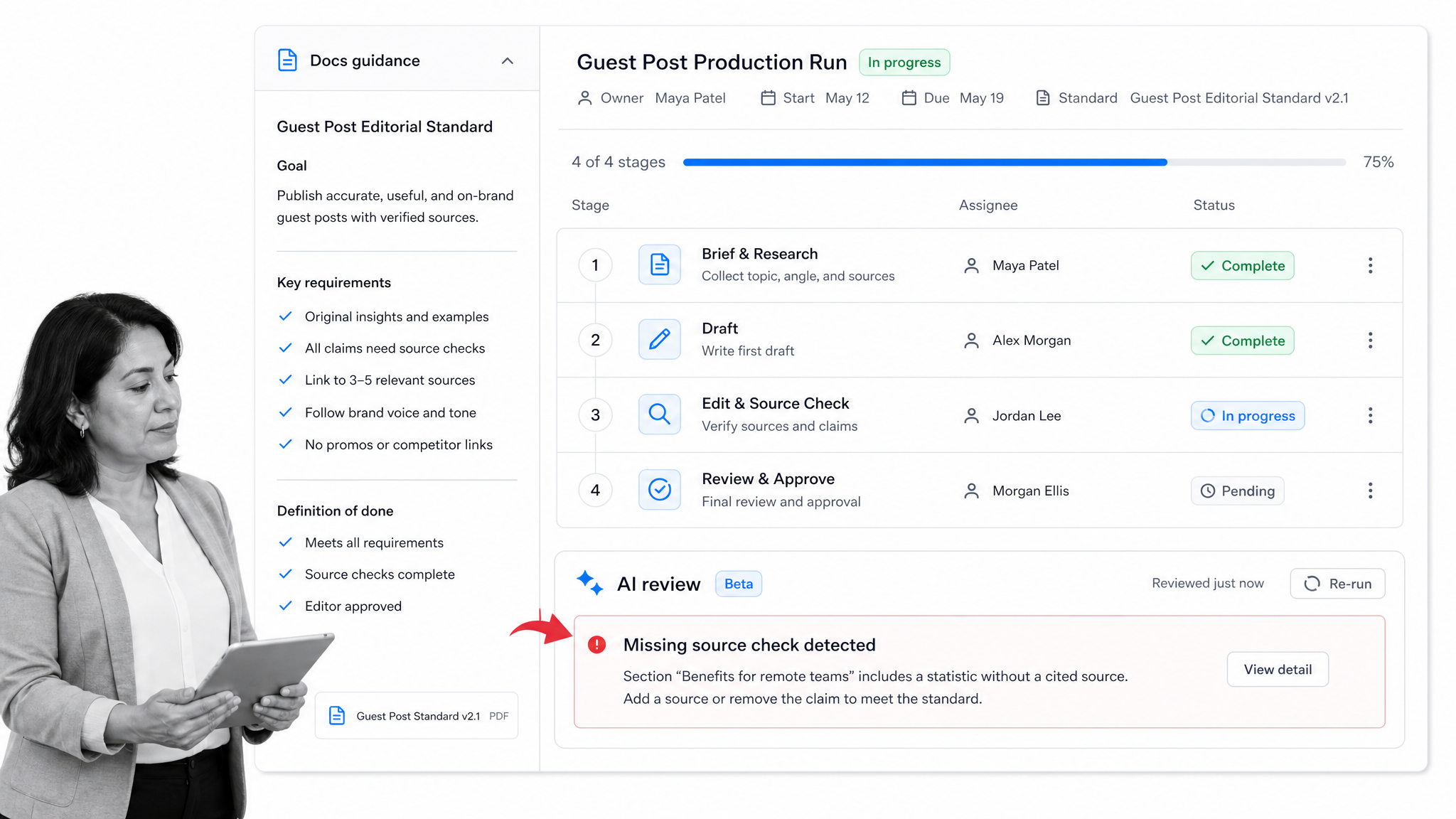
The Process Street guest-posting story began with one person on the content team: Ben Brandall. The work was largely undocumented and depended on the time, judgment, and relationships one writer could bring to it.
From individual relationships to recognized bylines
Ben was posting on the sites he read regularly to establish his own authority and, by proxy, Process Street’s. It was through Ben’s constant relationship-building, post-pitching, and blog-commenting tactics that he built up his own prestige by guest blogging. That approach helped him earn bylines in places such as TechCrunch, where he wrote about what UX designers can learn from 1990s Japanese video games.

The focus was a lot broader than it was on the Process Street blog, with posts about video games, operating systems from the 90s, interface design, and Karl Marx. It was what Ben needed to do to get work published in such well-known, respected publications. Although there was not a lot of content output, the bylines were impressive, especially without any kind of documented process to follow.
Shortly after, Ben Mulholland joined the content marketing team as its second content writer. After being onboarded, he was tasked to do the same thing as Ben Brandall: spread his name around the internet, like digital peanut butter, so people would be interested in his work and want more. Ben Mulholland earned bylines with publications such as Chargebee and Usability Geek.
The two writers were, in the team’s own phrase, spreading their names around like digital peanut butter. The image was playful, but the operating idea was serious. Each strong byline made the next conversation easier because an editor could see relevant published work instead of evaluating a stranger from scratch.
There was still no shared production picture. An editor’s preferences might live in one inbox, an outline in a document, and the publication status in a writer’s memory. That was manageable with a handful of opportunities. It became risky once several writers and dozens of publications were involved.
When another writer joined, the team had enough capacity to run its first coordinated guest-posting project and turn scattered practice into a defined campaign.
Launching the first coordinated campaign
The campaign supported a set of employee-onboarding resources. The team wanted to reach publications already writing about onboarding and give each one a distinct, useful angle.
Ben Brandall designed the campaign around a deep shared research base. Ben Mulholland assembled a master document that ran between 10,000 and 20,000 words, with possible titles, section ideas, quotations, statistics, and relevant sources. Writers could start from a consistent evidence set while adapting the final article to each publication.
Ben Brandall’s process for this project looked like this:
- Task Ben Mulholland with creating a 10,000 to 20,000-word master Google Doc to help the writers write guest posts. It included potential post titles, post headers, quotes, statistics, relevant links, and much more.
- Use BuzzSumo to find sites already writing about and focused on employee onboarding, then gather the contact details of these sites.
- Write a pitch email to roughly 50 to 100 sites at a time with a list of potential titles they could choose from.
- When a post title was accepted, assign a writer to write that post and make sure they pulled from the master Google Doc as necessary.
- Pitch another group of sites with a list of new potential titles, swapping out the titles that had already been taken.
- Repeat the pitches and the swapping of taken titles while tracking every acceptance.

The team published more than 100 off-site guest posts in roughly six months. That first-party result is not a universal benchmark, but it showed what coordinated research, clear ownership, and persistent delivery could achieve.
The approach was different from the earlier focus on individually interesting pitches. It favored repeatable campaign themes and shared research. It also exposed a risk: speed and scale can make outreach sound generic, and today’s standard should be stricter about relevance, personalization, consent, and editorial value.
At the time, batches of roughly 50 to 100 contacts received groups of available titles. Once an editor accepted one, the team removed it from the pool, assigned it to a writer, and offered different ideas in the next batch. The coordination worked, but the technique should be read as part of the team’s operating history, not as a recommendation to send high-volume pitches today.
Modern campaign design starts with a smaller qualified set. Each contact should represent a real editorial fit, each proposed angle should answer a gap in that publication, and every follow-up should respect the recipient’s response and preferences. The shared research asset is still useful. The indiscriminate volume is not.
Systemizing production and review
The first campaign produced a basic editing process. As the team added campaigns for remote work, business process management, and software integrations, the work needed a much stronger system for documenting, assigning, reviewing, and tracking every contribution.
The Guest Post Production process eventually included eighteen stages:
- Adding post details.
- Refining keyword research.
- Creating a post outline.
- Getting peer feedback on outline and keyword.
- Once the post had been written, fixing text formatting errors.
- Checking for filler words.
- Reading for evergreen language.
- Linking to related products only where useful.
- Citing text sources.
- Citing image sources.
- Adding relevant Process Street links.
- Using subheadings.
- Running spellcheck.
- Making sure it is easy to read.
- Submitting the post for review.
- Sending the post off.
- Iterating until accepted.
- Confirming the post’s details, such as its live link.

The detailed process gave writers a common quality floor. Behind it, the team connected Gmail, Airtable, Zapier, and Process Street to reduce administrative work. Airtable held opportunity records, Gmail labels captured accepted pitches, Zapier started a production run, and Process Street guided the writer through research, review, delivery, and confirmation.
This was what the writers worked through when writing a guest post. Behind the scenes, there was a massive system in place where Gmail was hooked up with Airtable via Zapier, Airtable was hooked up with Process Street, and vice versa. The connections moved accepted pitches into production and kept the opportunity record synchronized.
In the terminology used at the time, writers ran a Guest Post Production checklist. It was far more than a short to-do list. Reviewers checked spelling, grammar, readability, formatting, originality, citations, images, subheadings, and whether every link made sense for the host publication. The final stages covered the email handoff, requested revisions, acceptance, and the live publication record.
The work also separated content judgment from administrative state. A writer decided how to develop the argument. The system made sure the outline was reviewed, the sources were attached, the deadline was visible, and the final URL did not vanish in an inbox.
In terms of flow, it looked like this:
- Ben Brandall tracked each site he pitched to in Airtable as a record.
- He labeled an accepted guest post pitch as guest post in Gmail.
- Zapier then started a Guest Post Production run, automatically populating its title with the sender’s email and carrying in the full email thread for writers to work through.
- The record automatically updated from Idea to Start when the run was created.
- The writer began to work through the stages, completing the blank form fields and assigning themselves as the guest post author.
- Once the writer had team feedback on the guest post outline and keyword and completed those stages, Zapier updated the relevant Airtable record.
- When the post was sent and the associated stage was completed in Process Street, the Airtable record was updated again with the status Sent.
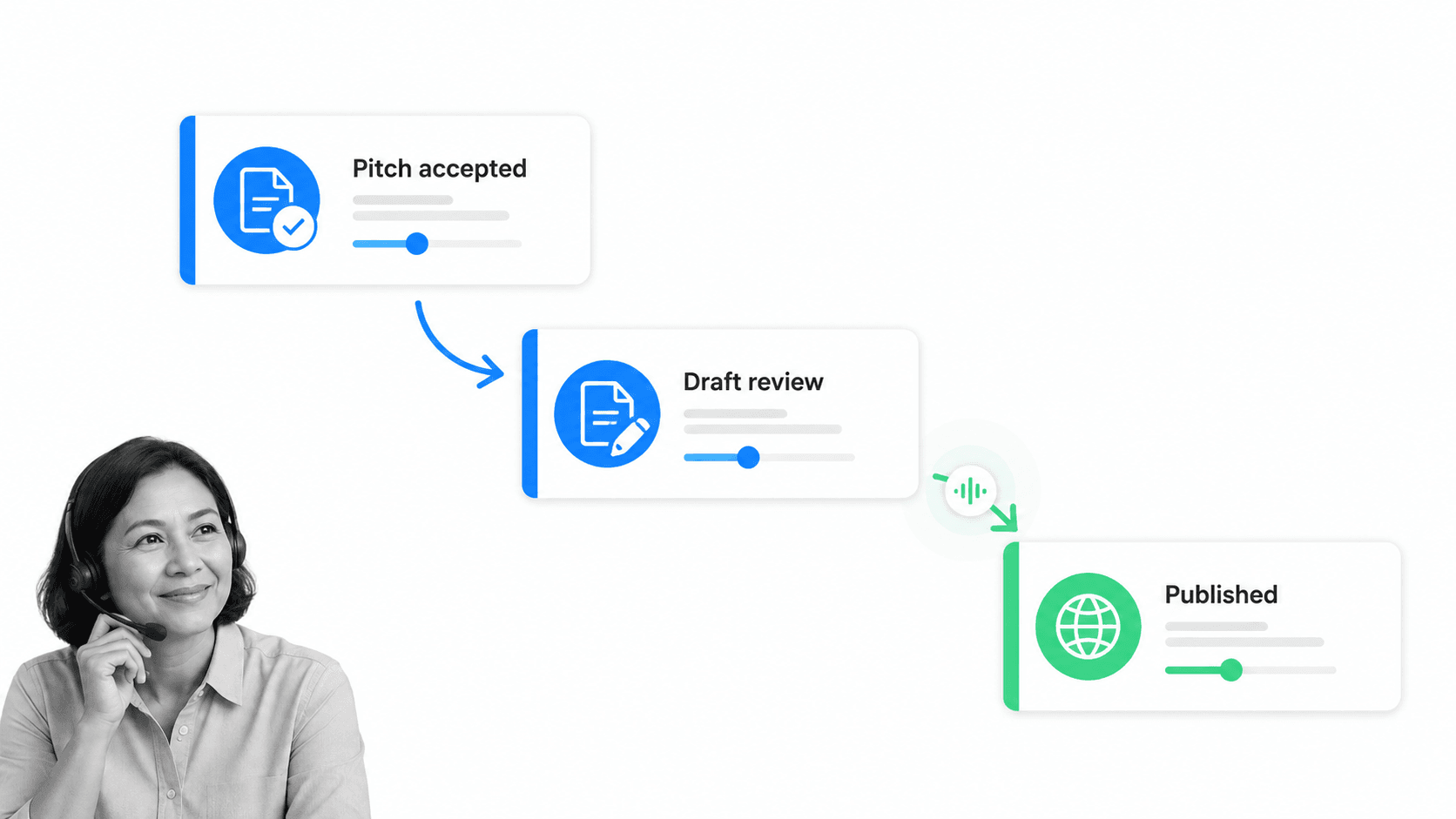
This was a large step beyond a loose checklist. The process linked the agreement made in an inbox to the work assigned to a writer and the evidence that the publication went live.
While the new system was a stark departure from how things had been done previously, and took some getting used to, it became pivotal in helping the team retain control over its mammoth guest-posting outreach and all the contributions it was crafting.
It also removed repetitive status work. When a writer reached a defined milestone, the corresponding Airtable record changed automatically. Campaign owners could see which opportunities were ideas, active drafts, sent pieces, or published articles without asking every writer for an update.
Automation did not make editorial decisions. It carried context between tools and made the next responsible person visible. That distinction kept the system useful even when a draft needed several rounds of human judgment before an editor accepted it.
The ownership failure that changed the system
When Ben Brandall left Process Street, Ben Mulholland took over the off-site program. He did not inherit all of Ben Brandall’s editor relationships or the full context behind every opportunity. He also had on-site writing, external submissions, editorial review, and publishing work competing for attention.
Guest-post output fell. The underlying problem was not simply capacity. Too much relationship context and ownership still lived with one person instead of inside the operating system.
Ben Mulholland also had to write on-site content, review work from other writers, publish incoming contributions, and handle a long tail of small editorial tasks. The process documented production steps, but it did not fully document the trust, publication preferences, and follow-up expectations that Ben Brandall had accumulated with individual editors.
Momentum returned when Farah Tash took ownership of communications and relationship management. The team expanded its use of research, contact qualification, and Close to manage follow-ups. In one follow-up campaign from that period, the team sent 646 emails, recorded a 64 percent open rate, and received responses from 19 percent of recipients. Those figures describe one first-party campaign, not a recommended outreach volume or a current performance benchmark.
Ben Mulholland’s addition to the guest-posting system included going into BuzzSumo and finding topics related to the campaigns the team wanted to run, finding and noting down a list of relevant companies, forwarding that company list to a content promotion team for vetting, and pushing qualified contact details through to Close for a specific upcoming campaign. Close then helped the team manage communications and follow-ups.
The follow-up campaign contacted 646 people, had a 64 percent open rate, and a 19 percent response rate. Those responses did not all include acceptances. Some people declined immediately, while others declined after a back-and-forth. Even so, the campaign acquired a number of guest-posting opportunities and gave the team a transparent picture of the funnel.
As team roles changed again, some accepted slots still fell through the cracks. Writers stopped using the original production process because it did not fit opportunities they had sourced themselves. Confirmed contributions were delayed or never delivered, and editorial relationships were damaged.
That failure exposed a common process mistake: a workflow built for one acquisition route can become invisible to people using another. Campaign-sourced titles entered the system automatically, while independent ideas could remain in personal notes and inboxes. The quality controls were strong only when the work entered the process.
What the mixed model taught us
The recovery was not to send more email. It was to make the process work for both campaign-driven opportunities and individually sourced pitches. The team added an independent route for writers to develop an idea, qualify a publication, pitch the right person, and bring an acceptance into the same governed review process.
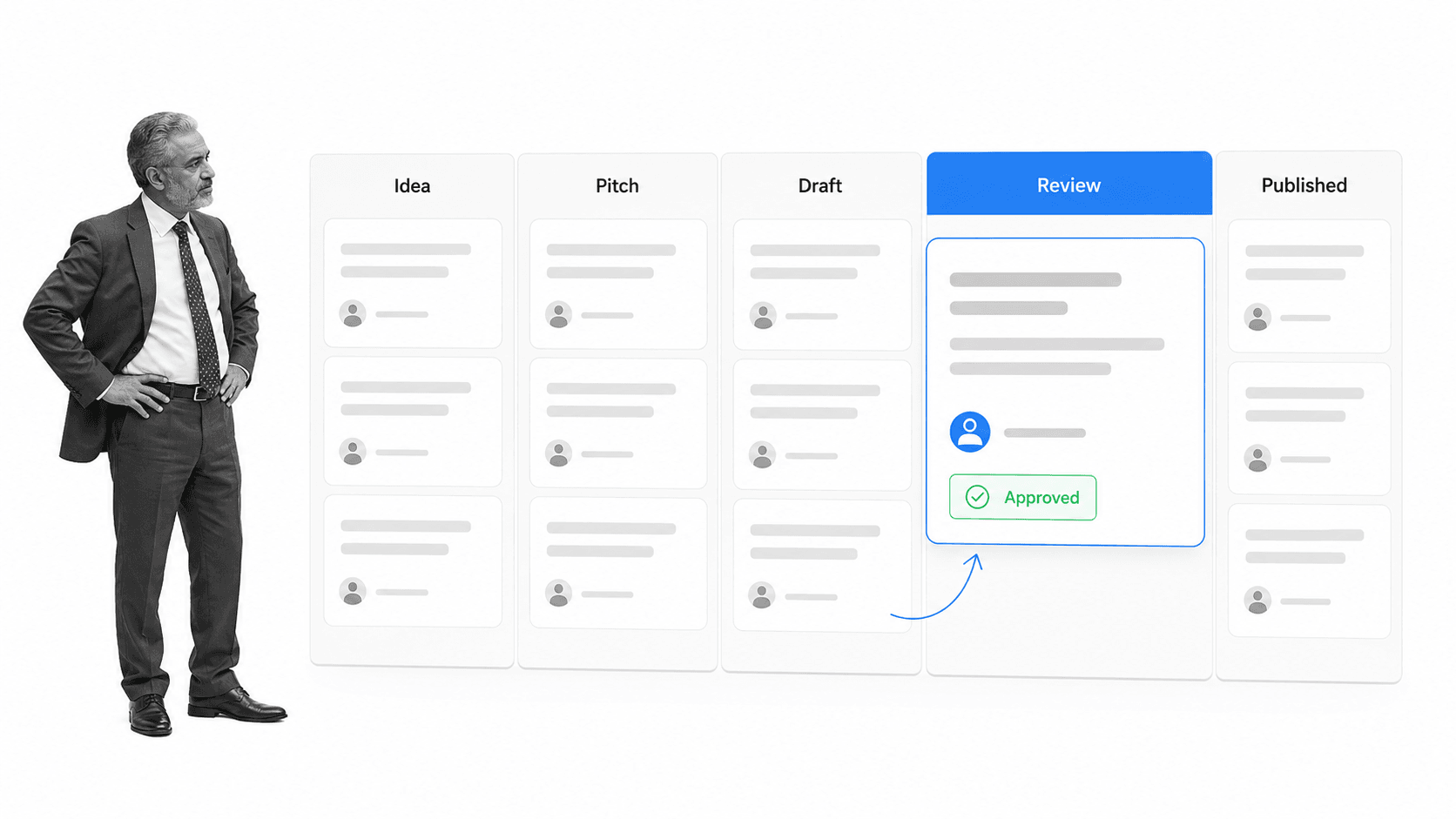
The production workflow also put more emphasis on reviewer ownership, evidence, and final publication details. Every accepted contribution needed a named writer, reviewer, due date, source check, decision record, and live URL. That stopped independent posts from bypassing the quality controls used by campaign work.
The revised path began earlier, at idea development. A writer recorded the proposed audience, publication fit, evidence, and pitch before making contact. If an editor accepted the idea, the same record moved into outline, draft, review, delivery, revision, and published states. No second spreadsheet or private checklist was needed.
Thom James Carter also went into the Guest Post Production workflow and amended it, adding more of a focus on the review stage. Independent contributions had been going out without sufficient checks from a reviewer and without the links the team expected. Making the same production path relevant for campaign titles and independent ideas led writers to use it for all their guest posts again.
The durable lesson is that a mixed model can preserve creative freedom without sacrificing accountability. Writers can pursue subjects close to their expertise, while campaign owners can coordinate coverage around important themes. Both paths should converge on the same standards for research, approval, communication, and tracking.
From a writer’s standpoint, the mixed model gives the team more agency and more freedom to write about topics close to their expertise, while still producing its bread-and-butter contributions on business process management, remote work, checklists, and related subjects. From a managerial perspective, it means all bases are adequately covered and every commitment enters the same operating system.
Process Street is a single Compliance Operations Platform. Docs governs the playbook and editorial standards, Ops assigns and runs each outreach workflow, and built-in AI helps research opportunities, tailor drafts, and catch missing checks. Every handoff, approval, and published result stays attached to the work.
Four essential guest blogging tips for writers and marketers

Guest posting can feel intimidating because it combines research, relationship building, editorial judgment, project management, and follow-through. The following four controls make the work manageable without turning it into a volume game.
Guest posting is often perceived as an incredibly scary, tricky, and cumbersome process. Like becoming a Jedi in the Star Wars films, it can appear to take years upon years to become a master and wield the force properly. It need not be so daunting when the underlying controls are visible.
These tips also carry direct editorial experience. Thom James Carter learned them while pitching to publications, working with editors and their vision for his pieces, and securing guest posts for The New Statesman, Insider, G2, Atlassian, and the Content Marketing Institute. He also applied them while writing, editing, and managing Process Street’s off-site guest posts.
Build relationships before you pitch
Start with a focused list of publications you genuinely read and can contribute to. Learn what each one covers, who edits the relevant section, which formats it accepts, and where your expertise fills a real gap.
A focused list also improves the writing. Reading twenty relevant publications closely teaches you more about the market than collecting two thousand unqualified domains. You can see which arguments are overused, which examples are missing, and which editor consistently commissions the kind of contribution you can deliver.
Social media can help, but it is only one channel. A useful comment, a thoughtful reply to a newsletter, a referral from a mutual contact, or a concise email can all begin a professional relationship. The point is to become familiar with the publication’s work before asking for space in it.
Begin by liking, sharing, and commenting on the work these sites publish when you have something constructive to add. A substantive comment can catch the attention of the writer or editor and start a conversation about the topic. This makes the original writer feel that their work is valued and gives the relationship more context than a cold pitch alone.
When pitching via social media, you put a face to both a name and a pitch. In other words, you show the editor there is a person with an online presence and relevant work behind the message. That can make the whole process more human, whether the eventual answer is an acceptance, a request to revise the idea, or a polite decline.
Current outreach guidance from Search Engine Land emphasizes relevance, the right contact, personalization, and support after publication. The same principles apply whether the pitch begins by email, on LinkedIn, on X, or through an existing partner.
In terms of hard numbers, Thom James Carter reported that he pitched ten pieces over Twitter alone, either as a direct message or a tweet sent to an editor. Out of those ten, he got eight responses and eight acceptances. Those acceptances led to long-form work being published and helped him forge new connections with editors who later accepted more work. That result, documented in his Compose.ly article, is a dated anecdote rather than a benchmark.
Follow every editorial guideline
Read the pitching and submission rules before drafting. A publication may specify audience, topics, length, structure, source standards, image rights, disclosure, author-bio format, or how many ideas to include.
It is easy to understand the frenzy that takes place when a team sets an internal goal to publish a certain number of guest posts each week, month, or quarter. In an attempt to meet that goal and make sure output is high enough, people can make silly mistakes: skipping the rules, skimming over guidelines, or not taking them all in.
These details are not bureaucratic obstacles. They tell you what the editorial team needs to review work efficiently. Ignoring them creates avoidable rejection and signals that the contributor may be difficult to work with.
Store the live guideline URL and the date it was checked with the opportunity. Recheck it when the editor accepts the pitch and again before delivery. Publications revise contributor programs, close sections, change disclosure rules, and update their preferred formats.
Requirements change. For example, Process Street writers once encountered a 2,500-word expectation when contributing to G2. G2’s current public contributor guidance describes a 2,000-word minimum and an editorial path that includes ideation, keyword research, outlining, writing, and editing. Check the live rules for each new pitch instead of relying on a previous experience.
Personalize the substance, not just the greeting
Real personalization is evidence that the idea belongs on that publication. Mention the relevant section, identify an audience question the site has not fully answered, and explain why your experience lets you answer it.
Editors, writers, and managers do not like to feel they have been sent the same email as thousands of others. This is particularly true when it comes to guest-posting correspondence. Reaching out individually makes personalization easier, but even a campaign needs a specific reason for contacting each publication.
A useful pitch can be short:
- Introduce yourself and the expertise relevant to the idea.
- Name the audience problem and why it fits the publication.
- Offer one to three specific angles, not a list of ten generic titles.
- Link to one or two strong writing samples.
- Ask whether the editor wants an outline or draft.
Do not fake familiarity, automate compliments, scrape addresses indiscriminately, or hide a commercial motive. If a pitch could be sent unchanged to fifty unrelated publications, it is not personalized enough.
The draft needs the same care. Use the publication’s examples and house style to shape structure, but bring original experience and evidence. A personalized subject line cannot rescue a generic article that adds nothing to the site’s existing coverage.
G2’s outreach guidance makes the same practical case: relevant research and rapport earn attention, while spammy anchors and undisclosed paid links create risk for both parties.
Document and track every commitment
Published drafts can disappear into an inbox. Accepted slots can be forgotten. A writer can leave, an editor can change roles, or a deadline can move. Without a shared system, the team loses the promise, the context, and the relationship.
Letting the ball slip can have massive ramifications for a guest-posting campaign. It can slow everything down and fundamentally harm the project. Document and track everything, especially when the team works remotely, team members change, and internal systems shift.
Track at least these fields:
- Publication, section, and editor.
- Relationship owner and writer.
- Proposed and accepted angle.
- Pitch date, response, and next follow-up.
- Editorial guidelines and source requirements.
- Draft, review, revision, and publication deadlines.
- Approval state and final live URL.
- Referral traffic, qualified leads, and relationship outcomes.
A spreadsheet can hold the fields, but a governed content workflow software system connects them to the actual work. The best setup gives each contribution an owner, clear stages, review evidence, due dates, and a durable record of what happened.
Measurement should match the campaign goal. Track referral visits and qualified conversions when acquisition matters. Track repeat invitations, editor responses, and partner introductions when relationships matter. Track branded search, newsletter growth, or assisted opportunities when authority and awareness matter. A backlink count alone cannot describe the value of the work.
That is how guest posting stays useful as people, priorities, and tools change. The relationship lives with the team, the editorial promise is visible, and a missed handoff becomes an exception instead of the operating model.
Guest posting can feel long-winded and time-consuming at points. The positives make up for the negatives when the work is targeted, editorially useful, and documented from the first conversation through the published result.
There you have it: a practical route from one good pitch to a governed guest-posting program. Keep the work relevant, follow the editor’s rules, personalize the idea, and track the commitment through publication.
Do that consistently and your guest-posting story is much more likely to end like one of Shakespeare’s comedies than one of his tragedies.
The post A Deep Dive Into How We’re Winning at Guest Posting (300+ Great Posts Published!) first appeared on Process Street | Compliance Operations Platform.


0 Commentaires