
The toolbox fallacy is the belief that you cannot begin meaningful work until you have a particular tool, condition, or resource. It sounds like, “Once I have X, I can do Y.” Sometimes X is genuinely necessary. Often it is a respectable-looking way to delay the risk of trying.
Consider the promise, “As soon as my Apple Watch arrives, I’ll start training for the 5K.” When the watch arrives, the next requirement may be a coaching app, the right shoes, or a better schedule. The equipment changes, but the pattern stays the same: preparation keeps replacing action.
What is the toolbox fallacy?
The toolbox fallacy is a form of self-deception. It turns a preference into a prerequisite and makes delay feel responsible. The tell is not simply wanting a better tool. It is refusing to test the idea, practice the skill, or take the first reversible step until everything feels ideal.
The toolbox fallacy exists because some of us find it easier to make excuses for not doing something than to run the risk of failure. It is a thought process that tells you that you can only accomplish your goals if you have the right tools, or when everything lines up and the moment is just right. Unfortunately, life does not quite work that way. There will always be more tools, and there is rarely a perfect moment.
The pattern appears in ordinary work as well as personal goals. A writer waits for a new laptop instead of outlining the first page. A manager waits for a complete dashboard instead of talking to five customers. A team waits for a perfect automation stack instead of running the process manually once. In each case, the desired tool may eventually help. It just cannot answer the most important early question: is the work useful enough to continue?
Real constraints still matter. A professional surfer needs a surfboard, a carpenter needs safe equipment, and a regulated process needs appropriate controls. But possessing the equipment does not create the skill. Original author Molly Stovold made the distinction memorably: buying her dream surfboard did not make her a professional surfer. She still managed to hit herself in the face with it. The tool made practice possible; it did not replace practice.
Whether it is surfing or launching your own business, you probably will not succeed immediately. Having better tools will not save you from failure, nor will they ensure success. Letting fear stop you from at least trying is the more consequential failure. To overcome the toolbox fallacy, you need to start, learn, and correct course.
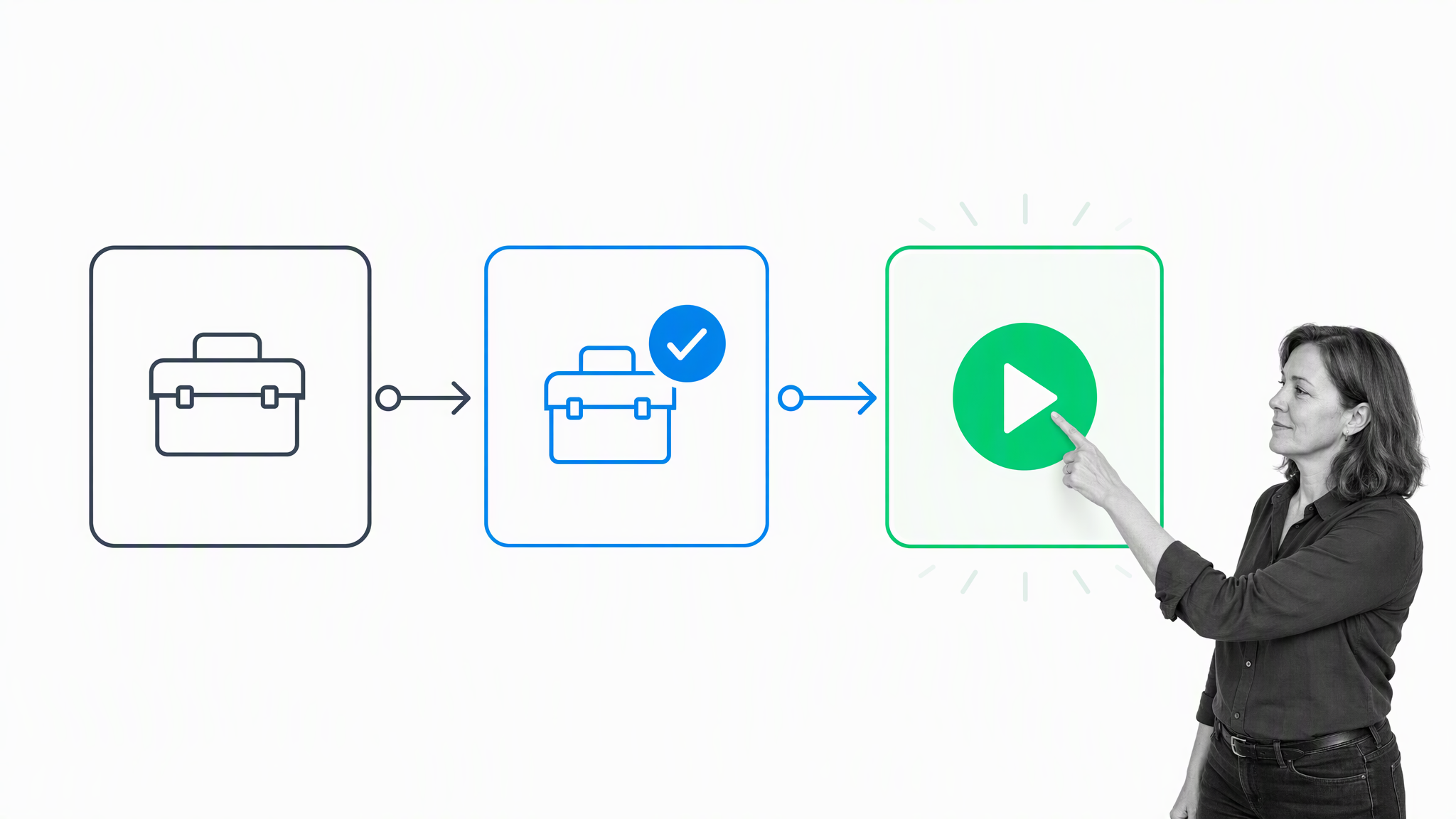
A useful diagnosis is the minimum viable tool test:
- Name the outcome. State what you are trying to accomplish without mentioning a product, app, or device.
- Name the claimed blocker. Be precise about what the missing tool prevents.
- Ask what is possible now. Look for a manual, smaller, or reversible version of the work.
- Run the smallest honest test. Produce evidence before spending more time optimizing the setup.
If the test truly cannot run without the tool, you have found a requirement. If a notebook, spreadsheet, conversation, or short trial can move the work forward, you have found an excuse. The goal is not to reject useful software. It is to choose the simplest adequate tool and earn complexity through actual use. A good catalog of time management tools can help once you know which behavior you need to support.
“Simplest adequate” is an important qualifier. Low-tech is not automatically better, and sophisticated software is not automatically wasteful. The right tool is the least complicated option that can perform the work safely, reliably, and at the required scale. A regulated approval process may need controls that a spreadsheet cannot provide. A one-hour discovery exercise probably does not need a six-month implementation.
The fallacy is especially tempting with AI. A team may wait for the perfect model, prompt library, integration, or governance layer when a small reviewed experiment could reveal whether the task is worth automating at all. Start with a bounded draft, keep a human reviewer in the loop, and let evidence determine the next investment.
Move fast without breaking things
Defaulting to action does not mean treating every decision as urgent. It means matching the decision process to the cost of being wrong. A reversible choice with a small blast radius should usually move quickly. A choice that affects customers, employees, safety, privacy, or regulatory obligations deserves broader input and stronger safeguards.
Ask two questions before choosing a pace: How much time and effort is this decision worth? and Who needs a voice before we act? Those questions prevent endless consensus-seeking on minor choices and prevent one person’s urgency from overruling people who will bear the consequences.
The move-fast mentality focuses as much on the time taken to make a decision as the decision itself. The process of making and remaking decisions can waste an enormous amount of time. Some decisions are harder than others, so the art of good decision-making lies in coming to a decision as fast as the evidence permits while ensuring that everyone involved has the opportunity to voice relevant concerns. This helps teams avoid rabbit holes, cover possible risks, and find solutions for them.
The concept of moving fast is not new, particularly in the SaaS arena. Speed can be an asset in product development because feedback arrives sooner. The mistake is treating speed itself as the result. A speedy approach is valuable only when it produces useful learning without transferring hidden costs to other people. A strong decision-making process accounts for social-cultural aspects before a product is shipped, rather than treating them as an afterthought.
Facebook historically used “move fast and break things” as a cultural motto. The phrase captured the value of rapid iteration, but it also became shorthand for the harm that can follow when speed is separated from responsibility. Hemant Taneja’s minimum virtuous product idea adds the missing question: not only “Can we ship this?” but also “What should we protect as we do?”
Taneja argues that companies need to be aware of the effect of their offerings and guard against potential harm. It is no longer enough to simply move fast when delivering minimum viable products. The stronger standard is to identify the economic, social, and environmental effects that could grow with the product, then design appropriate safeguards before scale makes correction difficult.
That distinction matters to the toolbox fallacy because caution can be either necessary control or hidden avoidance. Before slowing a project, ask:
- Is the decision reversible?
- How many people could be affected if it goes wrong?
- Does the work involve sensitive data, safety, employment, money, or legal obligations?
- Who has relevant context and must be consulted?
- What is the cheapest test that would reduce uncertainty?
Smaller teams can often decide with fewer approval layers, but size alone does not make a team fast. Clear ownership, a time limit, and an explicit appetite for risk matter more. Basecamp’s Shape Up method treats projects as capped bets. Teams decide how much time a problem deserves, shape the work, and use a circuit breaker when the bet no longer makes sense. Process Street previously used the method to shorten a development cycle, as described in its Shape Up case study. The durable lesson is not that every project must ship. It is that a bounded bet creates action without pretending uncertainty has disappeared.
The same logic applies to a missing tool. Set an appetite for researching or configuring it. Decide what evidence would justify more investment. When the time box ends, make an explicit choice: proceed with the simplest adequate option, fund the better tool, or stop the work. Do not let evaluation continue by default.
When moving fast, certain obstacles can slow you down: a lack of dedicated time to complete a project, team members holding one another up, or a desired tool holding the work back. A system such as Shape Up helps distinguish decisions that are actually worth more time from those that are not. Its appetite sets a limit before the team disappears into an open-ended project.
A framework to overcome the toolbox fallacy
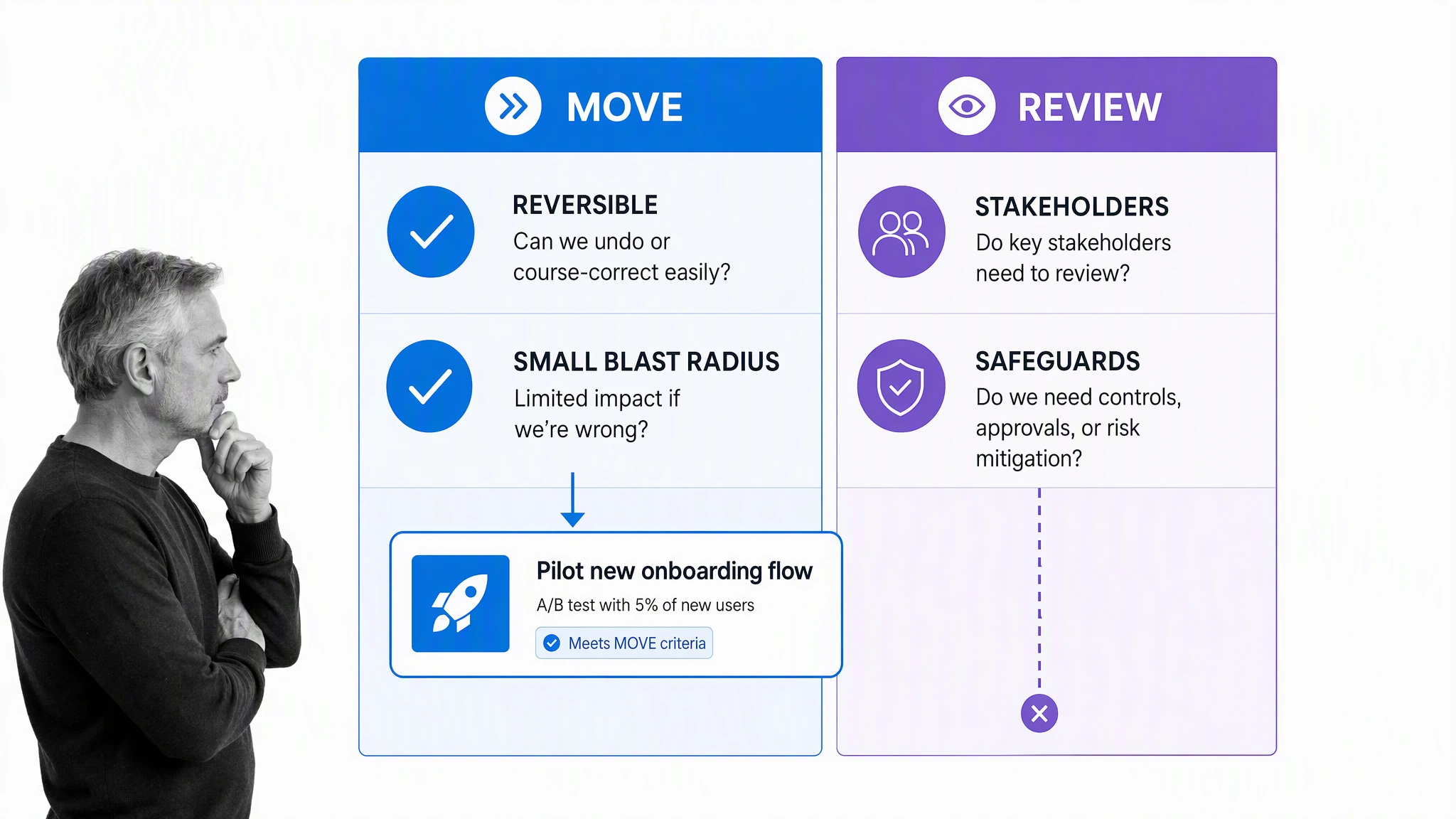
Use the following sequence when a team keeps waiting for the right setup. It combines Jaleh Rezaei’s practical guidance on faster marketing decisions with the responsibility test above.
The framework has two jobs. The first is to bring speedy structure into workflows without allowing a desired tool to hold the team back. The second is to add virtue into the equation by considering the stakeholders a product impacts. Use the questions as a decision aid, not as a checklist that must be completed at the same depth for every project.
Name the outcome
Write the result in observable terms. “Improve onboarding” is vague. “Help a new customer complete the first controlled process without support” is testable. A specific outcome makes it easier to see whether a missing tool is actually blocking progress.
Separate the outcome from the mechanism. If the objective contains the name of a product you have already decided to buy, rewrite it. This keeps the team open to a simpler route and reduces the chance that procurement becomes a substitute for problem solving.
Run a black-hat premortem
One way to tackle large problems or projects is the black-hat technique. Rezaei recommends asking one really tough question: assume it is one year from now and the team has failed a key goal. What went wrong? The aim is to activate the team’s problem-solving mentality and avoid overly optimistic thinking that can lead to oversight. End with a list of five to ten major assumptions implicit in achieving the long-term goal. The exercise converts vague anxiety into risks that can be tested, assigned, or accepted. It also exposes when “we need a better tool” is standing in for an unresolved assumption.
Do not turn the premortem into another delay ritual. Give it a fixed time box, rank the risks, and assign only the actions that would materially change the decision. The point is to make the next move safer, not to prove that no failure is possible.
Choose what you need
Do not optimize for the most impressive setup. Optimize for the next useful evidence. If a shared document and a weekly review can test the process, start there. Add automation when repetition, error risk, or scale makes it worthwhile. A no-code platform can reduce the cost of changing the system, but it still needs a clear job to do.
Be careful here. To avoid the toolbox fallacy, do not waste too much time or too many resources researching and investing in high-tech tools. Technology can be hugely important for getting projects up and running quickly, but the key is to choose tools wisely and get started as soon as possible. Make the investment proportionate to the requirement.
Set a downstream weekly target
Break quarterly goals into bite-size chunks and choose the goal furthest down the funnel that can still be impacted every week. If a quarterly target is 12 new premium customers, aim to secure one premium customer each week rather than 12 in the last week. Use weekly evidence to adjust the message, workflow, and tools while there is still time.
Weekly targets also expose capacity constraints early. If a team repeatedly misses a target because a manual step consumes hours, that is evidence for automation. If the team has not completed enough real work to observe the constraint, more tooling is still a hypothesis.
Build a learning cadence
Hold a short review every one or two weeks and ask what team members have learned that they did not know two weeks ago. A useful learning meeting should change a decision, close an assumption, or identify the next test. Status recitation is not learning.
Add the virtue gate
Before expanding the test, review affected stakeholders, likely failure modes, safeguards, and accountability. The more consequential or difficult to reverse the action, the stronger this gate should be. Speed and care are not opposites; the right controls make responsible speed possible.
For higher-impact work, extend the virtue gate with six questions:
- What systemic or societal change do you wish to create? Consider how other technologies, trends, and stakeholders map their vision for the future.
- How will you sustain the virtue of the product? Anticipate and prevent realistic worst-case scenarios rather than treating launch as the finish line.
- How will you drive the greatest impact at an individual level? Make the benefit useful to narrower slices of customers, not just impressive in aggregate.
- What growth rate can the organization support? Account for hiring, service complexity, capital intensity, market maturity, and operational capacity.
- How will the company evolve with regulation? Engage affected stakeholders and policy questions before an avoidable failure invites blunt correction.
- How will you define and promote diversity in the context of the business? Translate the stated value into ownership, review, and observable practice.
Not every small experiment needs a committee. These questions matter when a product or process can create substantial social ramifications. The decision record should show why the team moved quickly, why it slowed down, and which safeguards made the chosen pace responsible.
The aim is not to predict every consequence. It is to anticipate the most credible harm, make accountability visible, and keep the organization able to respond as technologies, trends, regulation, and stakeholder expectations evolve. As a product grows more omnipresent or difficult to understand, the cost of ignoring that work grows with it.
How goals help teams default to action
Specific, challenging goals can improve task performance under appropriate conditions, according to Locke and Latham’s foundational review of goal-setting research. Objectives and key results, or OKRs, turn that principle into an operating rhythm: the objective says what the team wants to achieve, and the key results describe measurable evidence of progress.
The “O” is the objective that helps everyone understand what the team is aiming for. The “KR” is a key result that determines how success will be measured. Individuals or teams set ambitious goals for a defined time frame, then use the key results to see whether the objective has been achieved.
A good objective creates direction without prescribing every action. A good key result measures an outcome rather than a pile of activity. “Run 20 demos” may be useful as a leading indicator, but it is not the same as helping qualified customers reach value. This distinction keeps the measurement system from becoming another shiny toolbox.
Google has long used OKRs. A useful 2019 sales case study from Sameer Rane and Noelia Fernandez Arroyo shows both the value and the danger of measurement. One objective asked sales teams to adopt machine-recommended opportunities. Another made upselling part of the operating model. The first exposed a human trust problem; the second produced reporting and incentive problems when teams optimized for the metric. The complete case is preserved in the canonical Google sales OKR analysis.
For the machine-recommended opportunities objective, the key result sought to increase the review rate from X to Y. Most of the sales team did not trust the machine-generated opportunities as much as expected. The measurement made a human behavior problem visible: improving the recommendation alone would not create adoption.
For the upselling objective, the key result sought incremental quarterly revenue. Reliable reporting depended on sales teams tagging each upsell opportunity consistently, but people misspelled or omitted the tag. A more substantial challenge appeared when teams underreported actual sales and reclassified components as upsells to show success against the OKR. The goal did not merely measure behavior; it changed behavior.
The lesson is not that OKRs automatically prevent the toolbox fallacy. A goal system is also a tool. Its value comes from making assumptions visible and prompting better decisions. If a metric encourages gaming, slow down and redesign it. If a result is safe, reversible, and informative, move.
Use the review cadence to compare intent with behavior. Did the team learn, or merely report activity? Did the metric improve while the customer outcome deteriorated? Did a supposedly essential tool remove the real bottleneck? The answers tell you whether to continue, correct course, or stop.
Setting goals encourages action only when the measures remain connected to the objective. Clear OKRs can help a team decide when it is appropriate to move fast and when it should slow down. Some tasks and goals have social impact and some do not. The trick is to identify each task that may have social ramifications and deal with it strategically rather than applying the same pace to everything.
Use Process Street to turn decisions into action
Process Street is a single Compliance Operations Platform with Docs and Ops capability areas plus built-in AI. Teams can document the standard, run the work, assign ownership, collect evidence, and build approvals into the same operating system. That matters when the problem is not a shortage of ideas but the gap between a decision and repeatable execution.
Use Docs to define the minimum acceptable process, including required safeguards and decision criteria. Use Ops to run that process, capture structured information, route work, and make exceptions visible. Built-in AI can help draft, classify, or summarize where appropriate, while the workflow keeps review and accountability explicit.
The point is not to add another tool for its own sake. It is to give the work a clear path from “we should” to “we did.” Start with one bounded workflow, learn from real runs, and expand only when the process earns it.
For example, a team can begin with one approval flow: document the policy, name the approver, define the evidence required, and set an escalation rule. After a few runs, the team will know which step needs automation and which exceptions deserve a human decision. The system grows from observed work instead of imagined requirements.
Toolbox fallacy FAQ
What is an example of the toolbox fallacy?
Waiting to begin 5K training until you own an Apple Watch is a toolbox fallacy when you could start walking or running safely with what you already have. The watch may help later, but it is not the first action.
How do you know whether a tool is truly necessary?
Name the exact outcome, then identify what the missing tool prevents. If no safe manual or smaller test is possible, the tool may be a real requirement. If you can gather useful evidence now, begin with the simplest adequate setup.
Is defaulting to action the same as moving recklessly?
No. Defaulting to action means moving quickly on reversible, low-impact choices and adding review when a decision affects safety, privacy, money, employees, customers, or legal obligations.
Can software cause the toolbox fallacy?
Yes. Teams can spend so long evaluating, configuring, or replacing software that the underlying work never begins. Define the job first, test it with the smallest adequate tool, and automate after the process proves useful.
The post Default to Action & Overcome the Toolbox Fallacy first appeared on Process Street | Compliance Operations Platform.


0 Commentaires