
Value capture is the whole point of an acquisition. Companies will spend more than $2 trillion on M&A this year, and most of that capital will fail to do what the deal memo promised. Harvard Business Review puts the failure rate at 70 to 90 percent. Deloitte’s 2025 M&A study found 47% of executives admit their last deal underperformed expectations. The work that separates the winners from the losers is not the deal. It is the four operating decisions that follow it.
When the strategy is wrong, the cleanest version of acquisitions like Daimler Chrysler and Sprint/Nextel stick to a balance sheet for a generation. When it is right, you end up looking like the Apple of acquisitions: dozens of quiet bolt-ons, a clear thesis, and compounding value year after year. The difference comes down to four levers that drive roughly 80% of the value capture in successful deals.
Four things. None of them are difficult. All of them are routinely skipped.
So in this Process Street post, here is the rundown of the four levers to prioritize during an acquisition, and exactly why each one moves the outcome:
- Pursuing the ever-elusive value capture
- Lever #1: Utilize your functional teams early in the acquisition process
- Lever #2: Complete your commercial & operational due diligence before closing
- Lever #3: Assess the revenue & cost synergy potential of the deal
- Lever #4: Develop a realistic strategic operating model design
Let’s get to it.
Pursuing the ever-elusive value capture
Most M&A transactions destroy value rather than create it. Harvard Business Review reports that more than 60% of transactions actually destroy shareholder value, and up to 90% miss their original investment thesis. Bain finds that only 30% of deals achieve their announced synergy targets.
The specific reasons are myriad, but they all collapse into a single failure mode: missing the trees for the forest.
That is not how the saying goes, but it is appropriate.
Executives focus on the wrong things during deals. They stare at the balance sheet, skip the operational risk assessment, or simply romanticize the deal until they will close at any price.
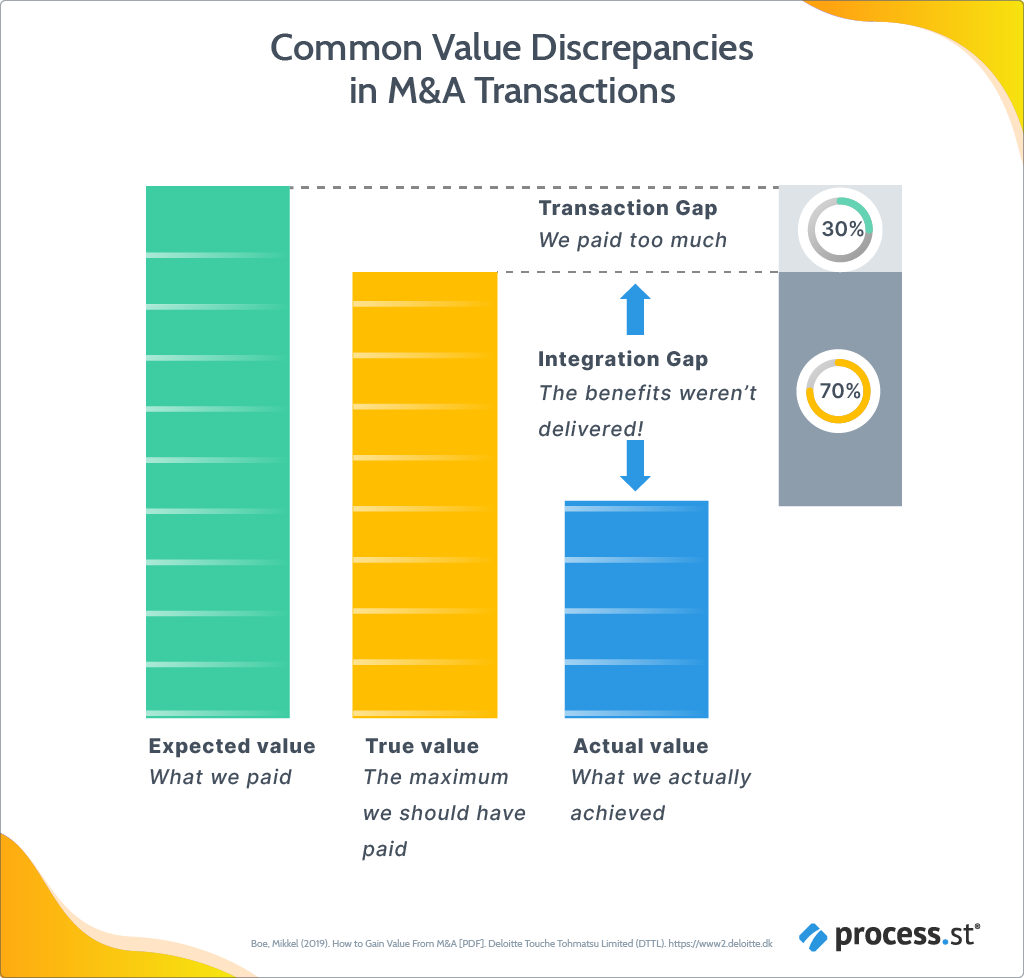
Look at the graph above. There is a clear discrepancy between the expected value, the true value, and the actual value at closing. The drivers of the transaction gap and the integration gap are well documented in Deloitte’s M&A research, and every one of them traces back to a lack of attention to detail.
Without disciplined planning, accurate information, and detailed analysis, getting to closing is an uphill battle. Surviving the post-acquisition integration is harder still. With that in mind, here are the four primary levers that drive value capture during an acquisition.
Further reading on value:
Lever #1: Utilize your functional teams early in the acquisition process
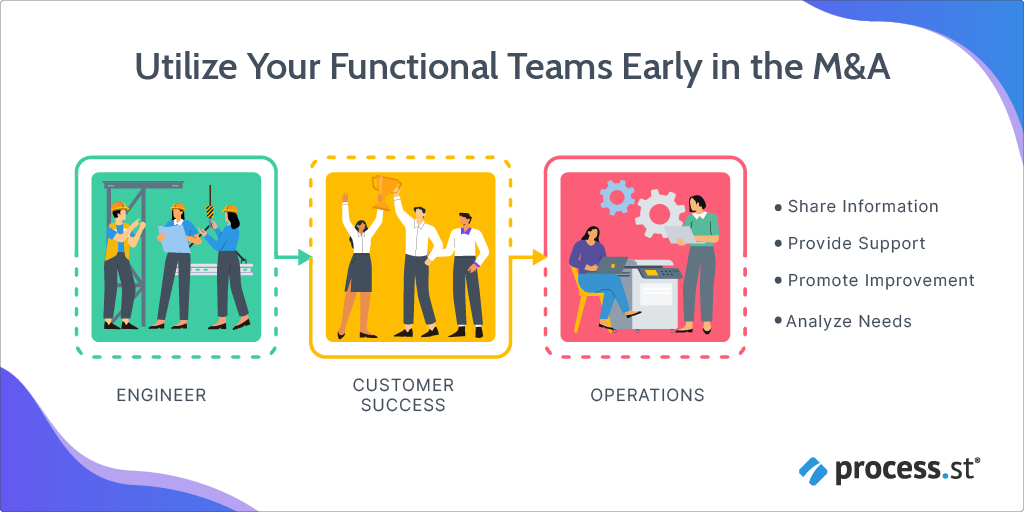
A quick search for “functional teams” returns mostly content on cross-functional teams. Cross-functional teams have a place, but in a process as detail-heavy as an acquisition, dedicated functional teams are the higher-leverage asset.
The advantage is specialization. Functional teams know their domain inside and out, from the smallest detail to the broader strategy. To plan how to onboard employees into the new organization, talk to the HR manager, not the engineer who shares an office with them.
This is the point of functional teams. Only the HR department knows what HR needs in terms of strategy, due diligence, and integration. Only the engineering team knows what engineering needs. Acquisitions reward expertise, so put the experts on the front line as early as the deal allows.
In tense, high-risk situations like an acquisition, executives instinctively reach for the wheel. With functional teams, the right move is the opposite. Team leaders know their roles. They know what needs to be done, how it needs to be done, and by when. They know who should own each task. Micromanagement only slows them down.
The principle is simple: the people doing the work usually know how to do it better, given the right support. Give them the support, then get out of the way. When the deal closes, the integration team will be glad you did.
Functional teams now have an additional accelerant. 86% of organizations have integrated generative AI into their M&A workflows, and the highest-value applications sit inside the functional teams themselves: HR using AI to model culture risk, finance using it to flag anomalies in the target’s books, legal using it to surface contract obligations buried in thousands of pages. Functional teams armed with AI move 30 to 50% faster on the same diligence work.
Further reading on team communication:
- Why You Should Unleash Team Collaboration and How to Do It
- Communication Plan: How to Prepare for (and Prevent) Disaster
Lever #2: Complete your commercial & operational due diligence before closing
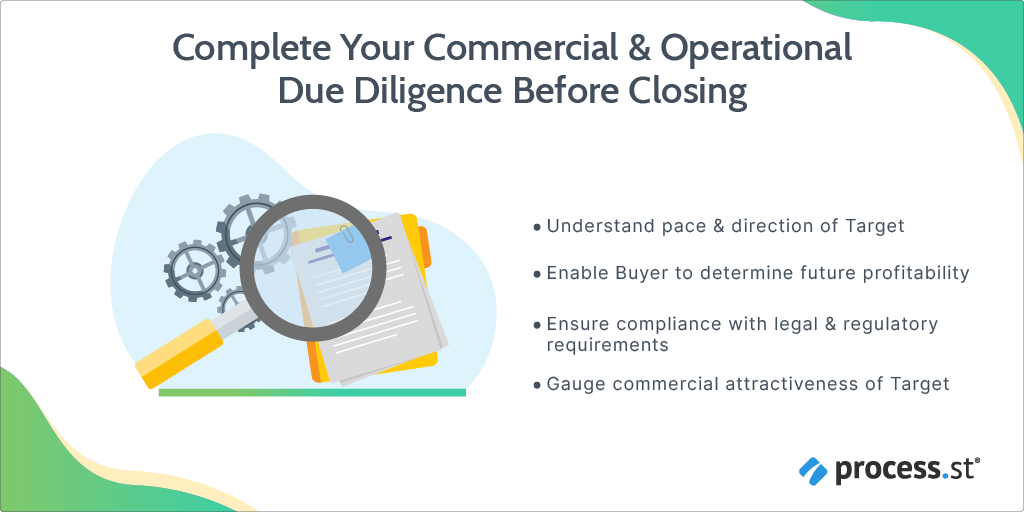
“You would hope these companies have done their due diligence, although that isn’t always the case.” – Martin Sikora, editor of Mergers & Acquisitions: The Dealmaker’s Journal
Proper due diligence sounds like a no-brainer. There are at least three different points during and after the deal where some form of diligence is required. So why does every M&A post-mortem still come back to it?
Because, often, people don’t actually do it. More than 40% of respondents to a McKinsey survey reported their deals suffering from inadequate due diligence. Inadequate diligence is consistently among the top three reasons deals fail, alongside overpaying and weak post-merger integration.
Commercial diligence usually gets done, and gets done reasonably well. Everyone wants to defend the financials, so the numbers get reviewed. Operational diligence is where deals quietly fall apart. When the financial picture looks attractive enough, the operational review gets thinned out, deferred, or skipped.
That asymmetry is the problem. A disproportionate share of pre-close attention goes to financial planning. Not enough goes to the technological and human integration that actually has to work after the wire transfers clear. Deloitte’s 2025 study shows acquirers are now deploying generative AI heavily on the diligence side, with 35% of GenAI-using teams applying it specifically to target screening and due diligence to close that gap.
Operational compatibility is just as important as a solid financial plan. If you cannot integrate operations, or if the underlying infrastructure cannot support them at scale, the integration becomes a slow, expensive grind. If the systems are too incompatible and the discovery happens after closing, the acquirer ends up writing off millions in assets it cannot use.
Do the research. Know the facts. Be prepared.
Further reading on due diligence practices:
- What is an Enterprise Document Management (EDM) System? How to Implement Full Document Control
- Why You Need a Risk Management Process (+ Free Template)
⏩ Click here for a preview of the M&A Due Diligence Checklist
Operational knowledge is the backbone of every process. Get your team’s official processes documented and accessible by the right people, all in a single location.
With features like Role Assignments, you can assign specific tasks to different users in various roles on your team. Approvals streamline handoffs and ensure nothing moves ahead without proper authorization. Process Street’s Compliance Operations Platform empowers operators to share knowledge and enforce execution at the point of work.
Click here to add the workflow to your free Process Street account.
⏩ Click here for a preview of the Risk Management Process workflow
This workflow lets you train your team with detailed instructions, delegate tasks effectively, and enforce a consistently high level of quality.
The template is pre-built and ready to use, or you can fully customize it to match your organization. Add integrations through Zapier, or use Process Street Automations to connect to DocuSign, Salesforce, and the rest of your stack.
Click here to add this workflow to your free Process Street account.
Lever #3: Assess your revenue & cost synergy potential of the deal
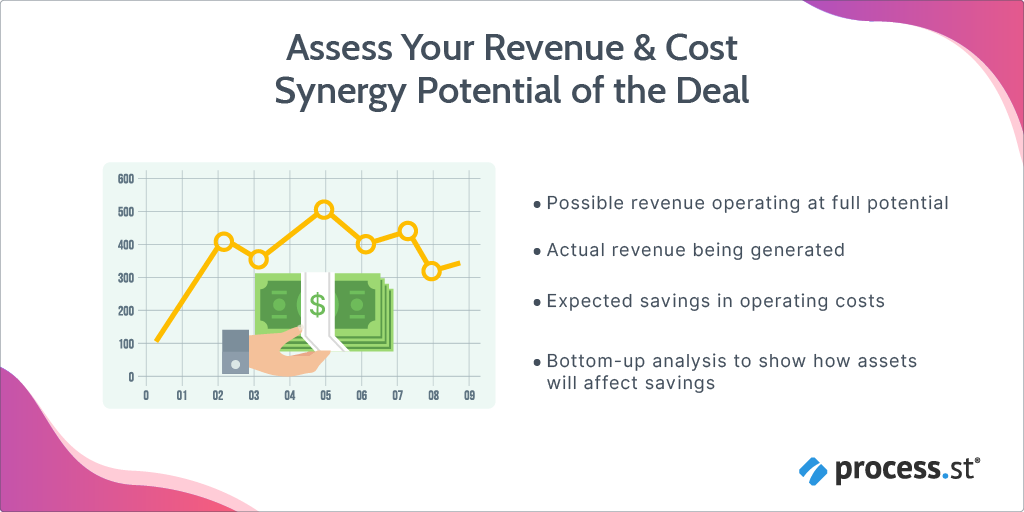
Depending on the deal thesis, synergies may not be the headline benefit, but they always shape the math. Even in an acqui-hire, the cost and revenue picture post-close is what determines whether the acquisition was a good investment.
You scoop up genuinely strong talent. If the cost of acquiring them is not offset by incremental revenue down the road, the deal does not pencil. You target a piece of technology to fold into the product. If the codebase will not link up cleanly, the integration burns more efficiency than it creates.
These are questions that will surface during diligence, but they need to be modeled independently as well. What exactly is being gained? What are the long-term effects on the product portfolio and the operating model?
The blunt question to keep returning to: do the numbers add up?
Per Bain, only about a third of acquirers actually hit the synergy targets they announced at signing. Acquirers using AI to model synergy scenarios pre-close are now closing that gap by stress-testing assumptions before they harden into a board-deck commitment.
Acquisition processes are complex. Synergy analysis is where that complexity catches up.
Further reading on revenue and procurement:
- Average Revenue Per Daily Active User (ARPDAU): What It Is and How It Can Increase Your Revenue
- 7 Steps To Procurement Management To Optimize Processes Responsible for ~70% of Revenue
- What Is CX? Increase Revenue by 8% With Optimized CX Flows (+ Free Checklists)
⏩ Click here for a preview of the Financial Audit Checklist workflow
Form fields are an effective way to capture data within workflow runs and pass it to other parts of the workflow using variables, or to other platforms via Automations and Integrations.
User permissions let you control who sees what, keeping data secure while staying transparent with the people who need it.
Click here to add this workflow to your free Process Street account.
⏩ Click here for a preview of the Financial Planning Process workflow
Processes need to adapt as new information emerges during execution. These workflows include features that make them dynamic. The File Upload feature lets users upload documents specific to a workflow run. You can also embed rich media like videos or images for context.
Click here to add this workflow to your free Process Street account.
⏩ Click here for a preview of the Annual Financial Report Template workflow
Some tasks involve compiling multiple resources or completing several small steps. Subtasks let you build a small list of items inside a task. Make Subtasks a required field to enforce that all steps are completed before moving forward. Combined with the Stop Task feature, this is a powerful way to make sure every step happens in the right order.
Click here to add the workflow to your free Process Street account.
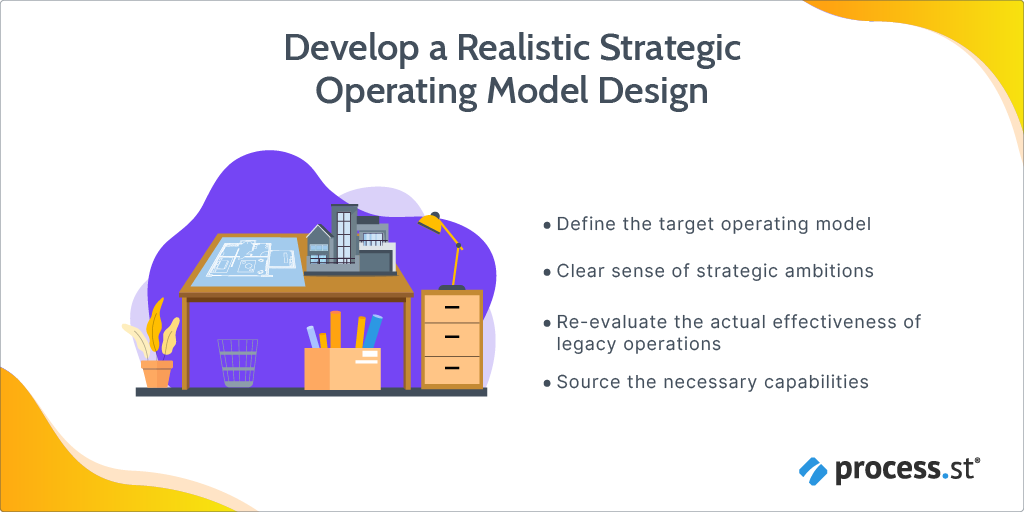
Lever #4: Develop a realistic strategic operating model design
The fear of change.
Everyone has it, from minor things like a new hairstyle to larger decisions like moving to a different city. The higher the stakes, the more anxiety attaches to the change. Acquisitions are about as high-stakes as change gets.
It is not just fear of change that trips executives up when they design the post-deal operating model. People get used to running things a certain way, and it becomes hard to imagine running them differently. The methods and processes already in place feel like the best possible option because they are the familiar option.
In an acquisition, ego has to come off the table. There is a real chance that someone in the other organization has more experience, more skill, or a better mental model than the acquirer’s existing leadership, and it is worth listening.
The biggest mistake companies make when designing their new operating model is making the new model too similar to the old one. Whether the deal is structured as a full integration or as a subsidiary, the post-close company is not the same company as before. New people. New assets. New culture. New systems. The operating model has to absorb all of those, and that is impossible while clinging to the old framework.
A modern operating model is also an AI-aware operating model. Cleared compliance lines, agentic execution layers, and instrumented workflows determine how fast the combined company actually integrates. Acquirers that wait until post-close to think about AI in the operating model design are already behind the deals that bake it in pre-signing.
Acquisitions require true transformation, and that transformation requires conviction, determination, and discipline.
Further reading on developing operating procedures:
- What is an SOP? 16 Essential Steps to Writing Standard Operating Procedures (With Templates)
- Simple SOP Format Guide: How to Write Standard Operating Procedures
- 30+ Free and Easy SOP Templates & Sample SOPs to Record Standard Procedures
Value capture: White whale or golden fleece?
Acquisitions come with risk. A lot of risk. Entire companies, both acquiring and acquired, have collapsed as a result of a failed deal. There are no guarantees that an acquisition will create value. The base rate is roughly a coin flip, and the four levers are how acquirers tilt the coin.
The four levers in this post account for roughly 80% of the value capture available in an acquisition. The order of operations matters: empower functional teams early, finish operational diligence before closing, model synergies independently of the deal narrative, and design an operating model honest enough to absorb the new company.
If you rush or skip anything, do not skip these.
Pro tip: do not rush anything in an acquisition.
Treat the acquisition holistically. Focus on value creation as much as integration. Done well, you end up among the elite minority of acquirers who actually walk away with the gold(en fleece).
Do you agree with these levers? Is there another part of the process you think is more integral to value capture? Tell us in the comments.
The post The Top 4 Levers That Drive 80% of Value Capture in Successful Acquisitions first appeared on Process Street | Compliance Operations Platform.


0 Commentaires