Business Process Management BPM helps teams turn messy recurring work into processes they can see, run, measure, and improve. The benefits of BPM show up in lower costs, faster handoffs, better customer experiences, stronger compliance, and fewer surprises when operations change.
That matters because BPM is no longer just a diagramming exercise. Modern BPM connects process mapping, workflow automation, approvals, integrations, AI support, and audit trails so teams can prove work happened the right way.
Pauline Farris contributed reporting and examples for this article. She is a translator who speaks Portuguese, English, Spanish, and Italian.
A brief primer on Business Process Management (BPM)
Business Process Management is the practice of discovering, modeling, analyzing, improving, and optimizing business processes. A process might be customer onboarding, invoice approval, employee training, quality control, vendor review, incident response, or any recurring workflow that has owners, steps, handoffs, and evidence.
The simplest way to think about BPM is this: task management helps people remember what to do next, while BPM helps the business design how work should happen in the first place. A good BPM system makes the process visible, assigns responsibility, routes work, records decisions, and improves the process with real execution data.
Market demand reflects that shift. Fortune Business Insights projects the global BPM market to grow from $21.25 billion in 2025 to $91.87 billion by 2034. Grand View Research points to process modeling, automation, and cross-department collaboration as major drivers.
For a deeper category guide, see our complete guide to business process management. If you are comparing platforms, start with business process management software.
For the implementation sequence, read The Business Process Management Life Cycle.
The 9 benefits of BPM: How to boost your business
The best BPM programs do not stop at documentation. They connect process maps to everyday execution, then use real work data to make each process cheaper, faster, safer, and easier to improve.
Within each business, every business area either works with information or materials, sometimes both. That data or materials is transformed: raw materials may be manufactured into a sellable good, and data may be transformed into a report. Every business area could be responsible for a significant number of processes, which is why business process management analyzes each of these processes individually and then looks at how the different processes impact one another.
Projects are often the result of business process management. Business process management could identify redundancies in the order placing process at an online retailer, for example. That could lead to a project that involves researching and selecting a new software package, and that project would be divided into a series of tasks.
1. Business Process Management can help businesses reduce costs
Cost reduction is one of the clearest benefits of BPM. When you map a process end to end, you can see duplicate work, unnecessary approvals, slow handoffs, missed steps, rework, and manual data entry that quietly drain money.
That is where BPM becomes practical. Teams can identify which steps create value, which steps create waste, and which steps should be automated or removed. This is the same logic behind lean ideas like Muda, the seven wastes that show up as defects, waiting, excess motion, over-processing, and unused talent.
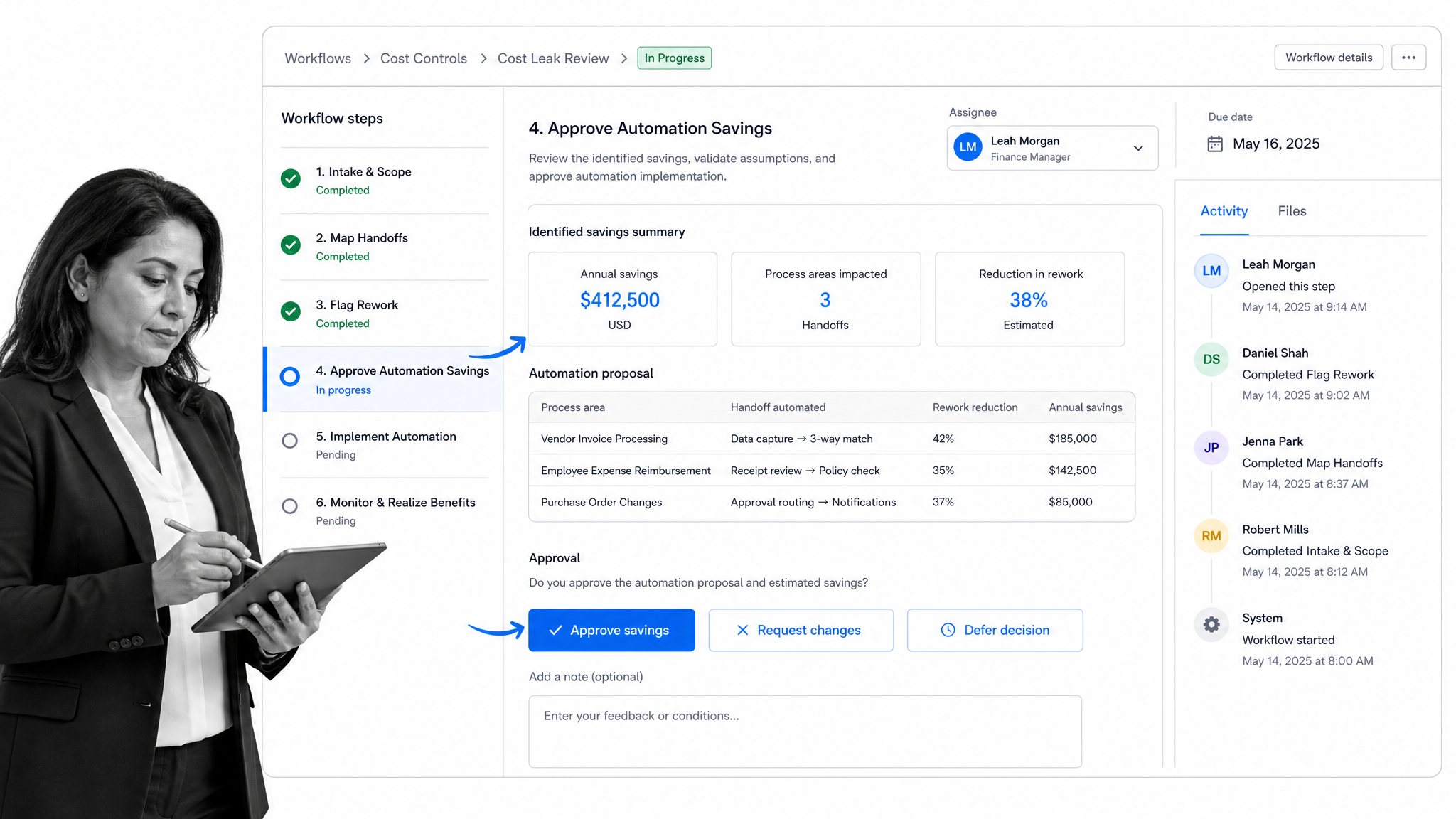
Process Street helps teams turn those discoveries into workflow runs, forms, assignments, approvals, and automations. Instead of writing a recommendation in a slide deck, the improved process becomes the way work actually runs.
You can reduce labor and operational costs by adopting business process outsourcing for work that should not stay in house. The benefit of business process outsourcing is that it can turn fixed labor costs into variable labor costs, so you pay for the service that you need instead of carrying the whole function internally.
Other advantages of BPO include focused work, expertise, fewer equipment costs, and efficiency. Since you are hiring employees with a specific skill set to do specific tasks, the employees are focused on those tasks. If they have already been doing similar work for a while, then it means that they are already experts in their fields. Since outsourced workers use their own equipment, they are already familiar with the hardware and software and can be more efficient at their jobs.
It is important to remember that business process management begins with understanding. In many cases, that means identifying each business process, putting those basic steps in action, and seeing how they operate in the wild. Once this mapping process is complete, it is much easier to identify where costs can be reduced by eliminating redundancies, identifying quality control issues, and highlighting excessive materials and labor costs.
In order for businesses to succeed, they must be able to react to changing economic times. That means identifying the processes that are mission critical and should stay in house. By outsourcing other processes, they remain lean and agile.
2. Business Process Management can help businesses recognize and respond to new customer demands
Customer expectations change faster than most internal processes. BPM gives teams a way to capture feedback, route it to the right owner, change the workflow, and measure whether the new process is working.
That matters because poor experiences directly hit revenue. Zendesk reports that 73% of consumers will switch to a competitor after multiple bad experiences, and more than half will switch after only one. Qualtrics XM Institute estimates that poor customer experiences put nearly $3 trillion of global sales at risk in 2026.
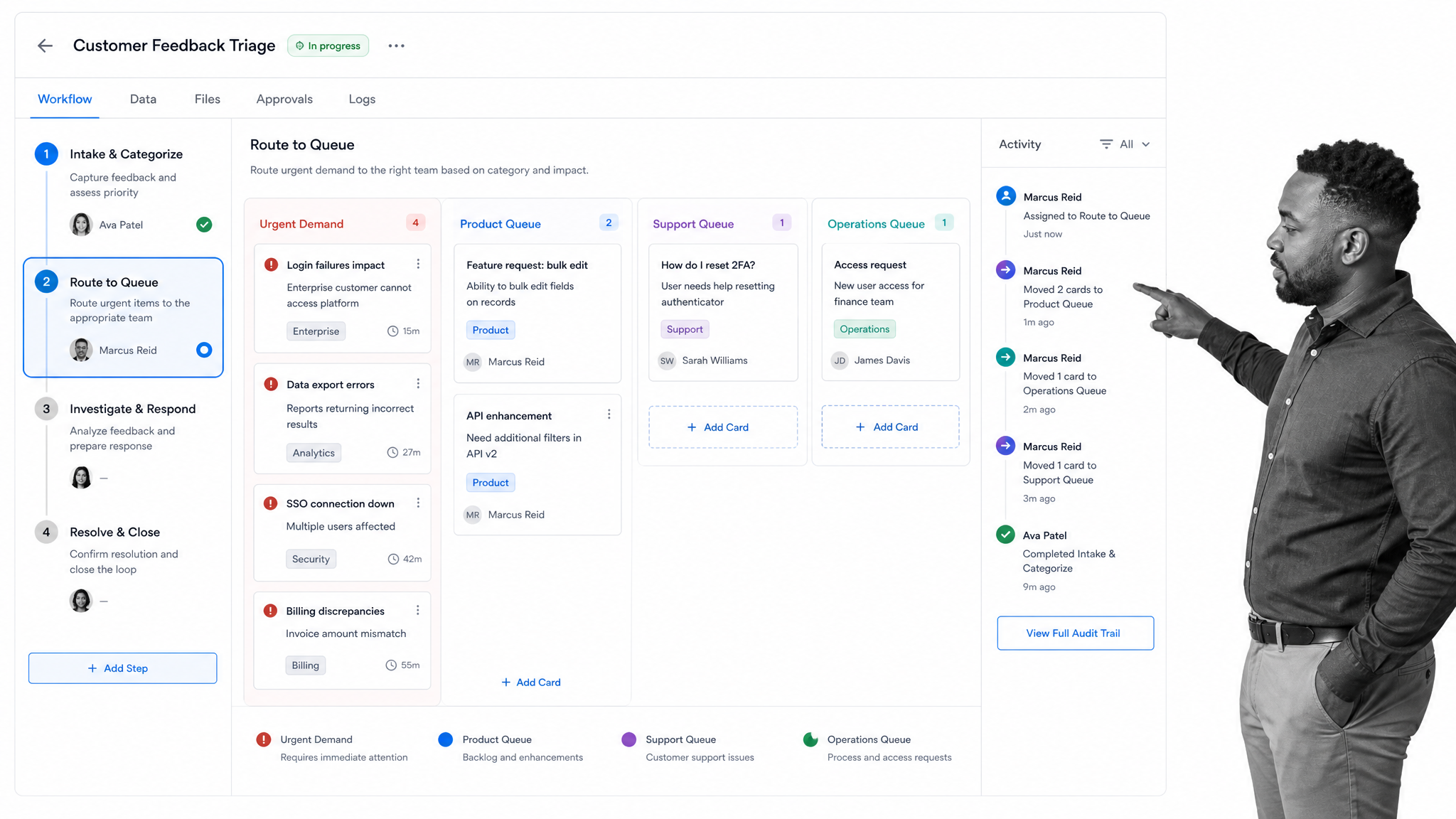
Customer-facing BPM is not abstract. A customer support process can route urgent issues, capture context, require follow-up, and escalate stalled work before the customer has to repeat themselves.
Successful businesses must be responsive. They must be able to recognize changing customer demands and preferences and react quickly. This is another area where a successful BPM strategy can really help because it forces decision-makers to pay attention.
One useful shift in the way we view process management is that processes themselves become more customer-focused and less centered around productivity alone. Rather than only asking how to get a product out quickly and more efficiently, stakeholders can improve processes to better meet the customer needs. That has a direct impact on metrics such as customer satisfaction and retention, and it often leads to better productivity and efficiency too.
- Meeting customer needs often leads indirectly to improved productivity.
- Processes become more flexible to help meet changing needs.
- It encourages a solution-based approach.
- Processes can be re-engineered with a new or additional goal of improving customer experiences.
- Innovation is encouraged.
3. Companies are increasingly finding that their old business models are no longer effective
Business models break when the work underneath them cannot change. New regulations, new software, new customer expectations, and new AI capabilities all force teams to redesign how work gets done.
BPM gives leaders a controlled way to adapt. Instead of asking every team to improvise, the business can update the process, version the procedure, route approvals, train the team, and measure whether the change improved execution.
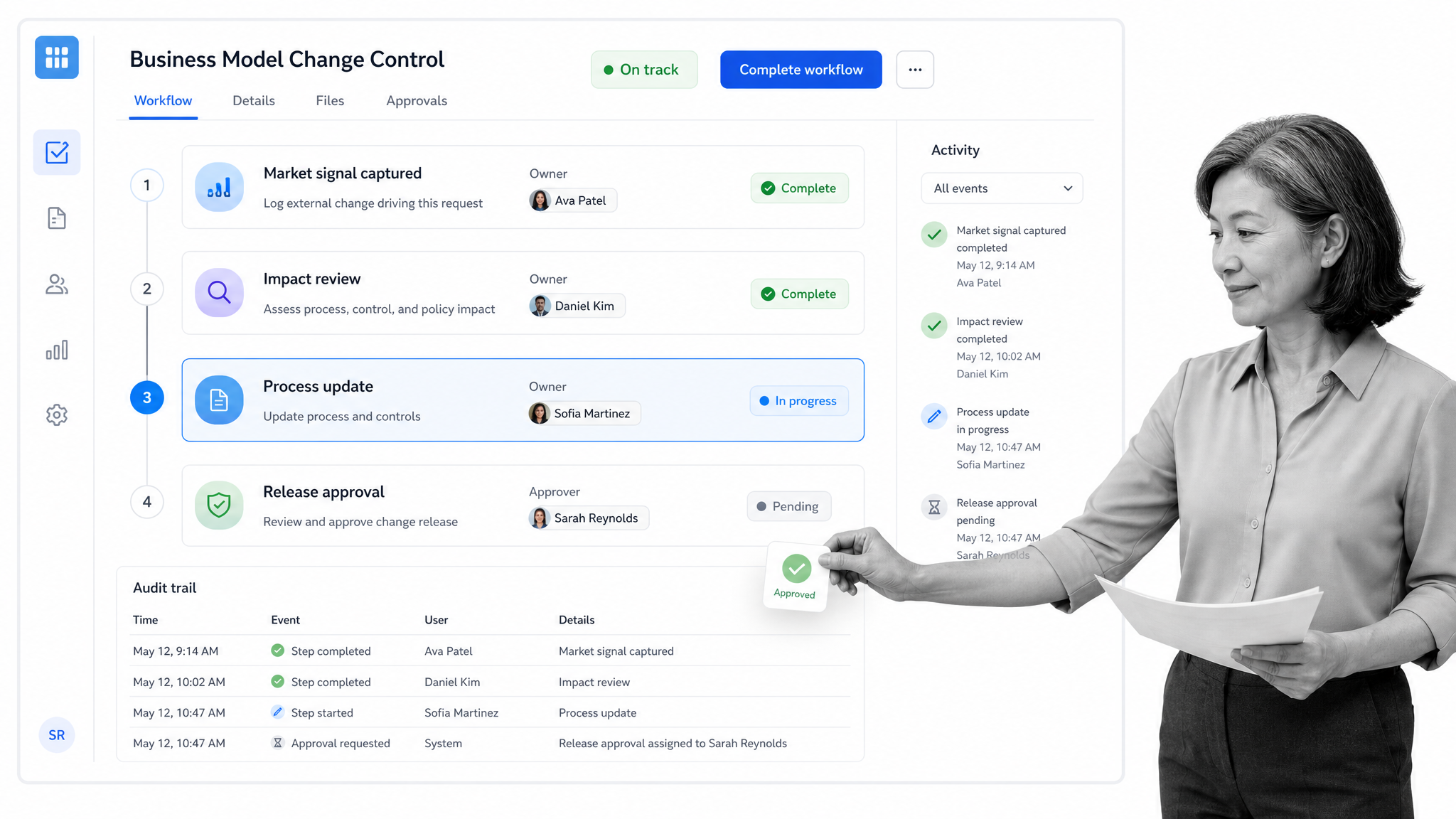
This is where BPM and continuous improvement meet. Process mapping shows the current state. Workflow execution proves what happened. Reporting shows whether the change reduced cycle time, errors, risk, or customer friction.
If your company has been working according to an outdated business model, you will not get very far. It is time to make changes today, not at some point in the future. You cannot ignore the changes happening around you: technology, people, customers’ habits, and changing socioeconomic conditions all contribute to a rapidly changing landscape. If you fail to make the right changes at the right time, competitors are likely to outdo you.
It is important to identify where a business is in terms of business process management, not just overall, but for each upcoming project. Whether or not a project succeeds can depend on whether an effective BPM solution is already in place and whether weaknesses have been identified so that the organization has the capabilities it needs moving forward.
4. Business Process Management can lead to increased productivity
Productivity improves when people stop hunting for instructions, chasing approvals, and rebuilding the same checklist every time work repeats. BPM gives teams a standard path through recurring work so they can spend more time on judgment and less time on coordination.
Good BPM also reveals the bottlenecks that hide inside everyday operations. If a process stalls at legal review, manager approval, evidence collection, or customer handoff, the team can see it and fix the process instead of blaming the person who happens to be waiting.
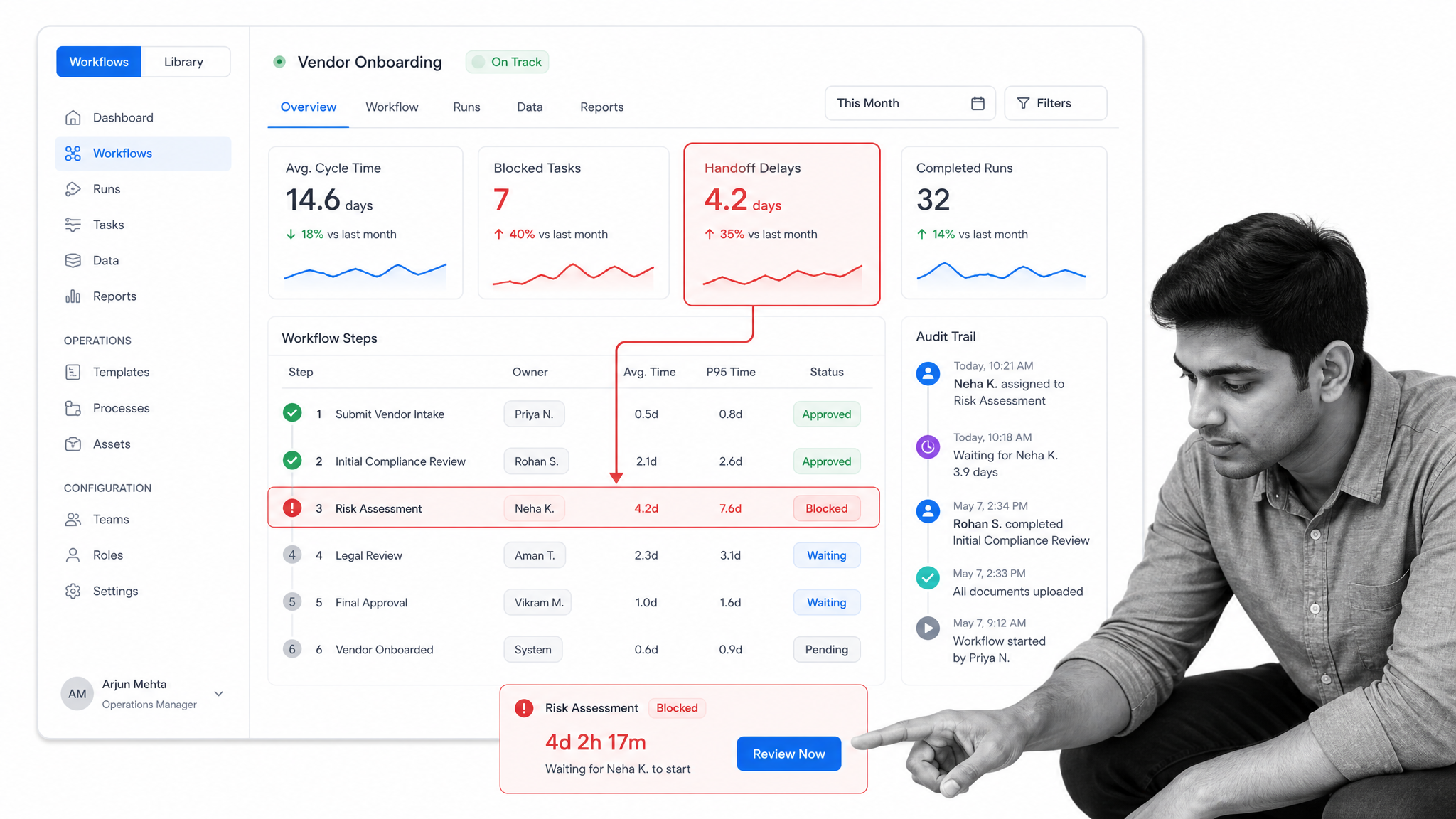
The productivity benefit is not just speed. It is fewer dropped balls, less rework, clearer ownership, and better use of the people already on the team.
BPM can help increase productivity and enable companies to give customers more. Adidas, for example, went through a major process overhaul that helped reduce the lag time between order placement and visibility of orders in the system. That led to orders being filled faster and more efficiently. Objective analysis is what made the inefficiency visible in the first place.
5. Companies that use Business Process Management have a better chance at remaining competitive
Competitive companies learn from their own operations. They do not just document how work should happen. They compare the planned process against the real process and keep improving it.
That loop is powerful. A team can test a new approval route, shorten a handoff, automate a repetitive update, or remove a low-value step, then measure whether the change helped. Over time, small process improvements compound into faster delivery and better customer outcomes.
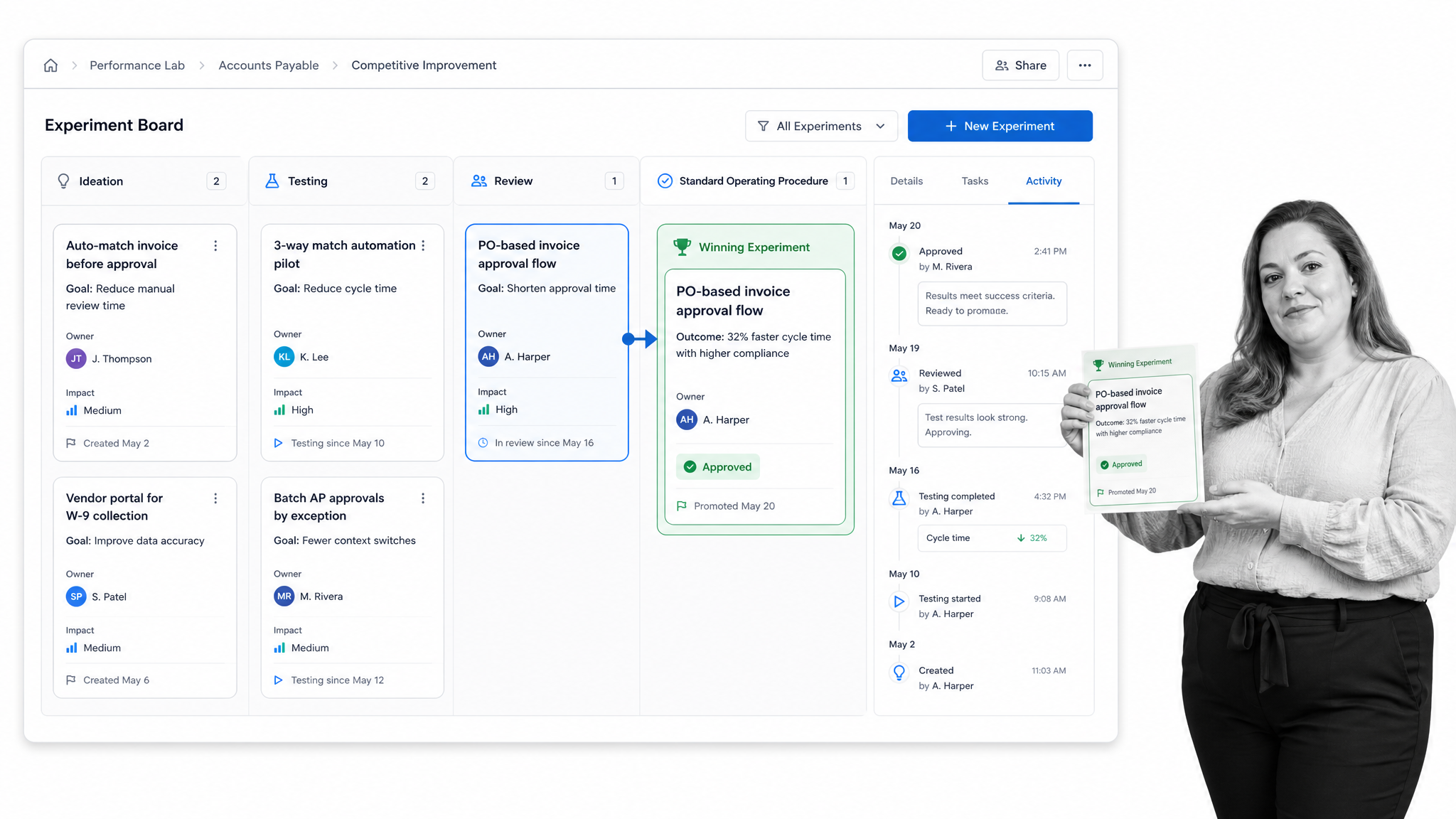
Older BPM case studies, including the Adidas global process example, showed the same principle years ago: when teams standardize and measure work across locations, they can improve productivity and coordinate change at scale. The tools have changed, but the advantage is the same.
When processes are repetitive and inefficient they become filled with waste, which means you do not have time to focus on research and development or other steps that make your company better able to stave off the competition. Without streamlining your business processes, your focus will always be operational; that limits innovation and allows waste to accumulate, further slowing you down.
When business processes are reliable and efficient, your business has more resources to dedicate to growth and development.
6. Business Process Management makes it easier to retain customers
Customer retention depends on consistent execution. Customers remember whether onboarding was smooth, whether support had context, whether promises were followed through, and whether problems were resolved without internal confusion.
BPM improves retention by turning those moments into controlled workflows. Renewal reviews, account escalations, support follow-ups, onboarding tasks, and handoff approvals can all run from a shared process instead of scattered inboxes.
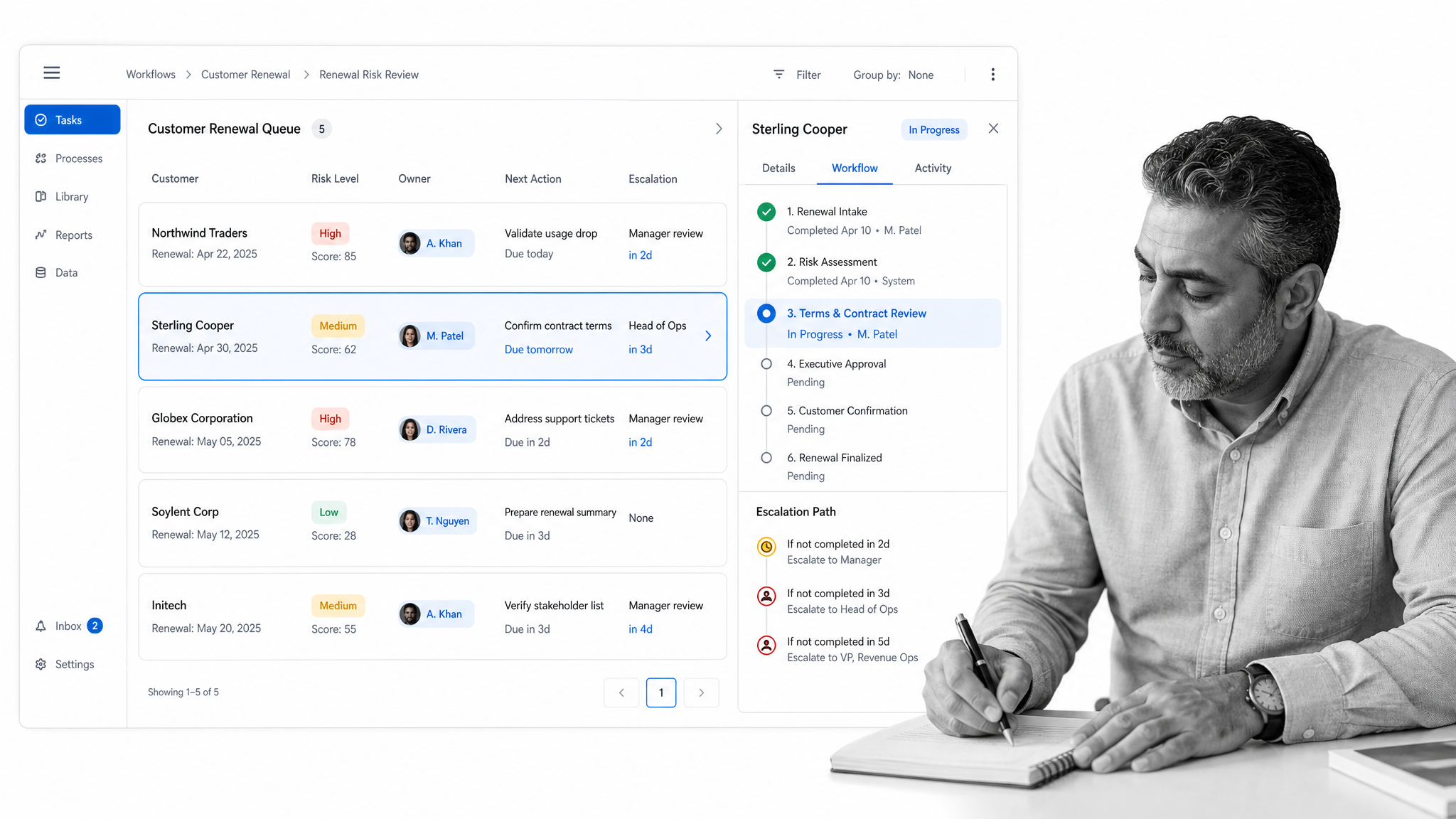
For SaaS teams, retention workflows often include upsell and expansion motions too. The key is to make the next best action visible, owned, and auditable.
It is difficult enough to gain new customers, and retaining them can be even more of a challenge. However, retaining customers has a much bigger ROI than converting new ones: it costs less to do so, and existing customers offer more profit over time. When you improve metrics such as productivity and innovation, customers are more likely to be satisfied with your business. If you align your use of BPM to create better customer experiences, you will reap the rewards.
You can build on that even further by tying customer support, success, and service provisions into the rest of your company activities through an integrated BPM approach.
7. You can standardize your processes with BPM
Standardization is one of the biggest BPM wins. When every team runs the same process differently, quality becomes unpredictable and training becomes harder than it needs to be.
With BPM, a team can define the standard operating procedure, assign owners, require fields, attach documents, schedule recurring workflow runs, and track whether work was completed. That standard becomes especially valuable for onboarding, quality management, finance, HR, security, and compliance-heavy operations.
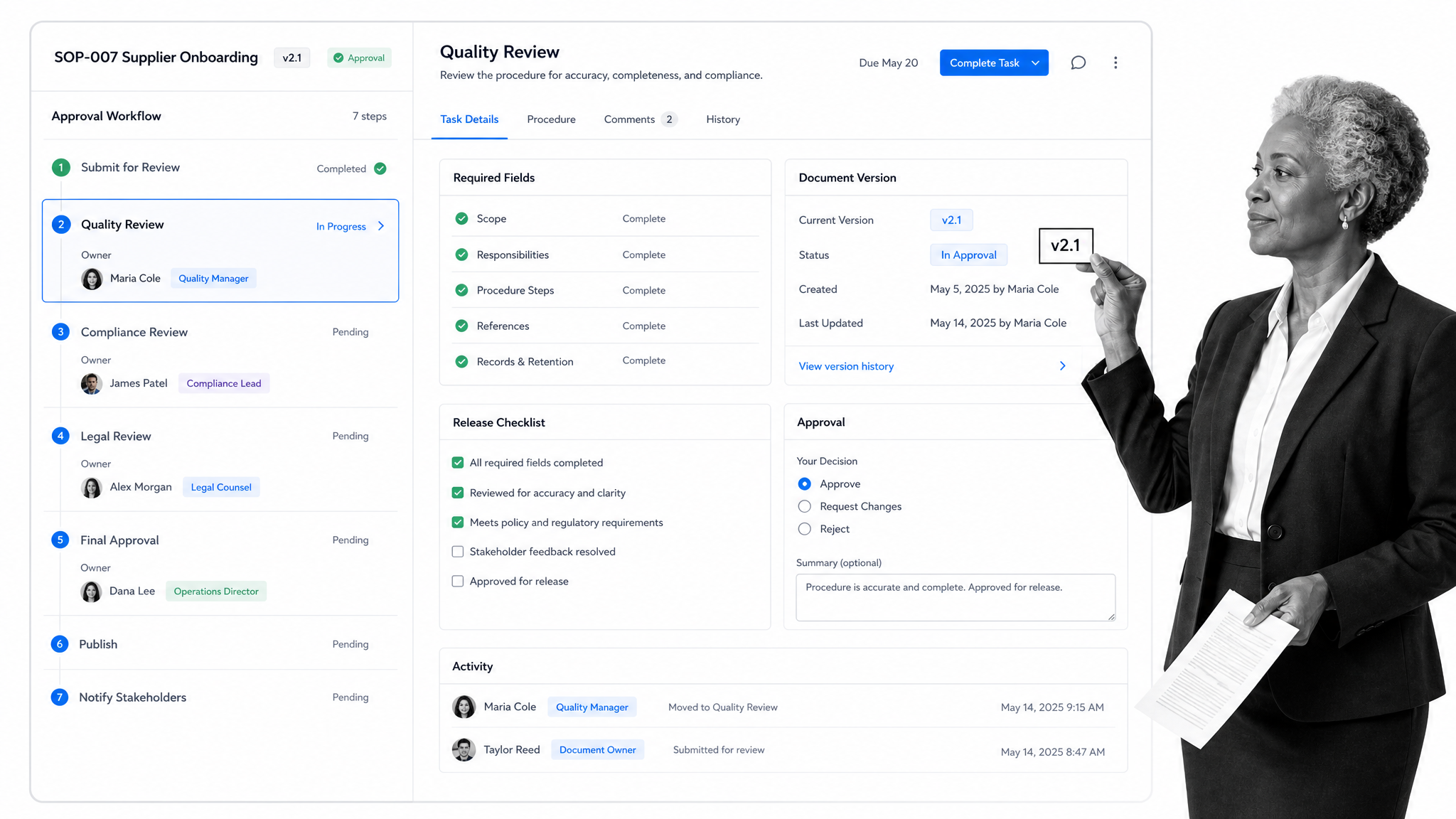
Process Street supports this with workflows, task assignments, conditional logic, approvals, scheduled workflow runs, and Docs for governed procedures. You can connect procedures to execution instead of letting SOPs sit in a folder nobody opens.
It is important for a company to have a clear, strategic plan of how things are done. BPM helps you standardize the processes within your company. When processes are not standardized, quality control among other things becomes difficult.
Onboarding is much easier with standardization. New hires can all be taught the same thing, and employee transfers or other lateral moves become easier too. When operational processes are standardized, there is significantly less need to retrain employees in new methods.
When you have standardized processes, you can begin to schedule those processes to run at the times you know they will be needed. Standardizing processes helps you understand and pre-empt the actions of your own business.
8. Business Process Management leads to cross-department collaboration
Most important processes cross team boundaries. Customer onboarding may involve sales, customer success, finance, legal, and operations. Vendor approval may involve procurement, security, legal, and the budget owner.
BPM makes those handoffs explicit. Each department can see what it owns, what it is waiting on, what evidence is required, and what happens next. That shared process reduces the status meetings and one-off messages that usually fill the gap.
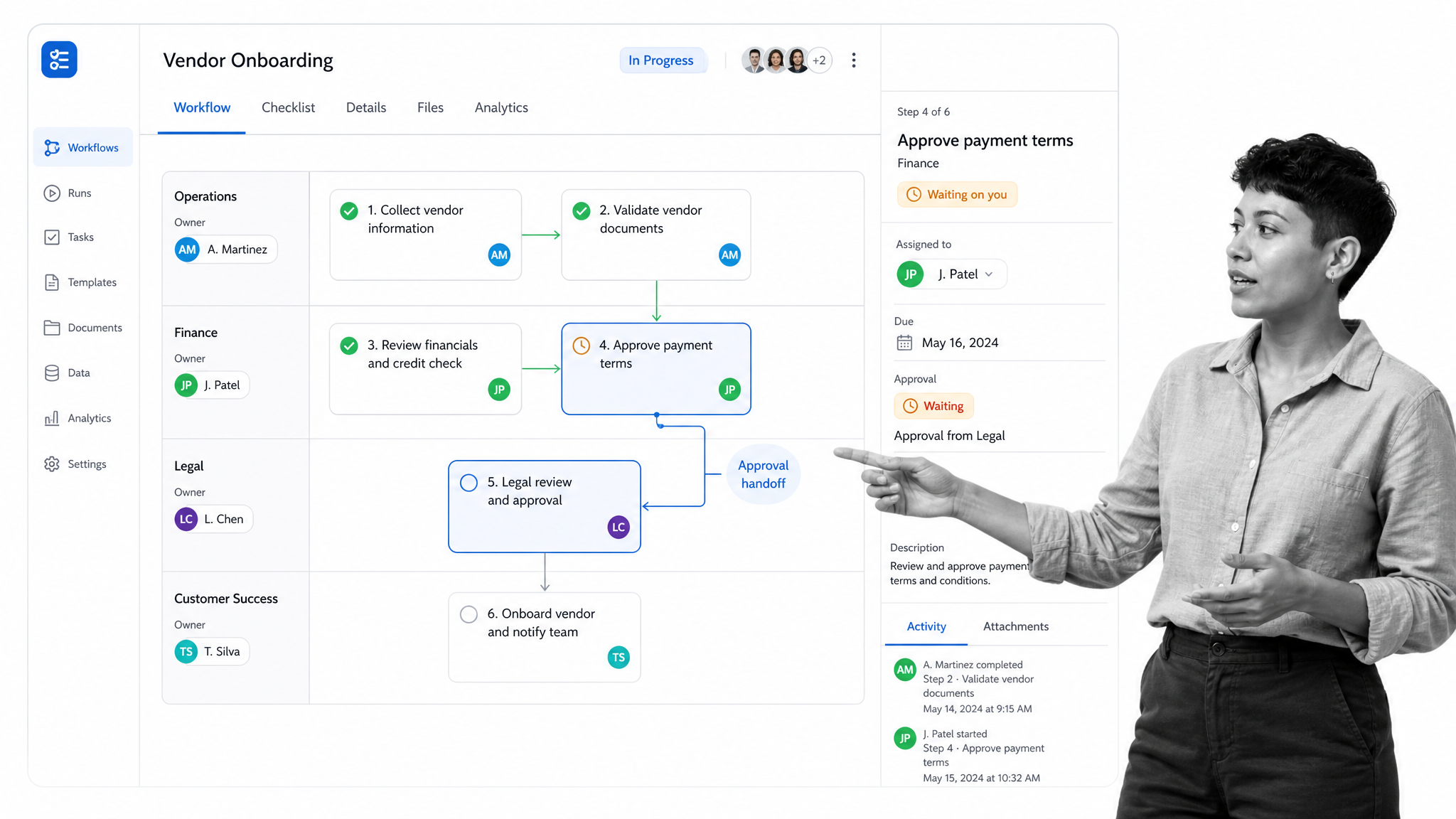
Modern BPM works best when it connects to the systems teams already use. Process Street has direct, universal integrations to 5,000+ systems. Need a new one? An AI agent builds it on the fly.
BPM helps improve cross-department collaboration, which brings immense benefits to the company. Without business process management, different business areas may be entirely unaware of how their processes relate to or conflict with one another.
First, during the process mapping and standardization phase, different business areas and teams must communicate with one another. They must identify processes that are shared, determine where redundancies exist, and learn where shared information and expertise may be beneficial. This collaboration is fostered moving forward as the strategies created through business process management continue to be implemented.
9. Business Process Management improves safety, security, and compliance
Compliance fails when policy and execution live in different places. A document says one thing, a team does another, and nobody can prove what happened until the audit arrives.
BPM closes that gap by embedding controls inside the workflow. Required steps, approvals, role assignments, evidence collection, version history, and activity logs become part of the way work gets done.
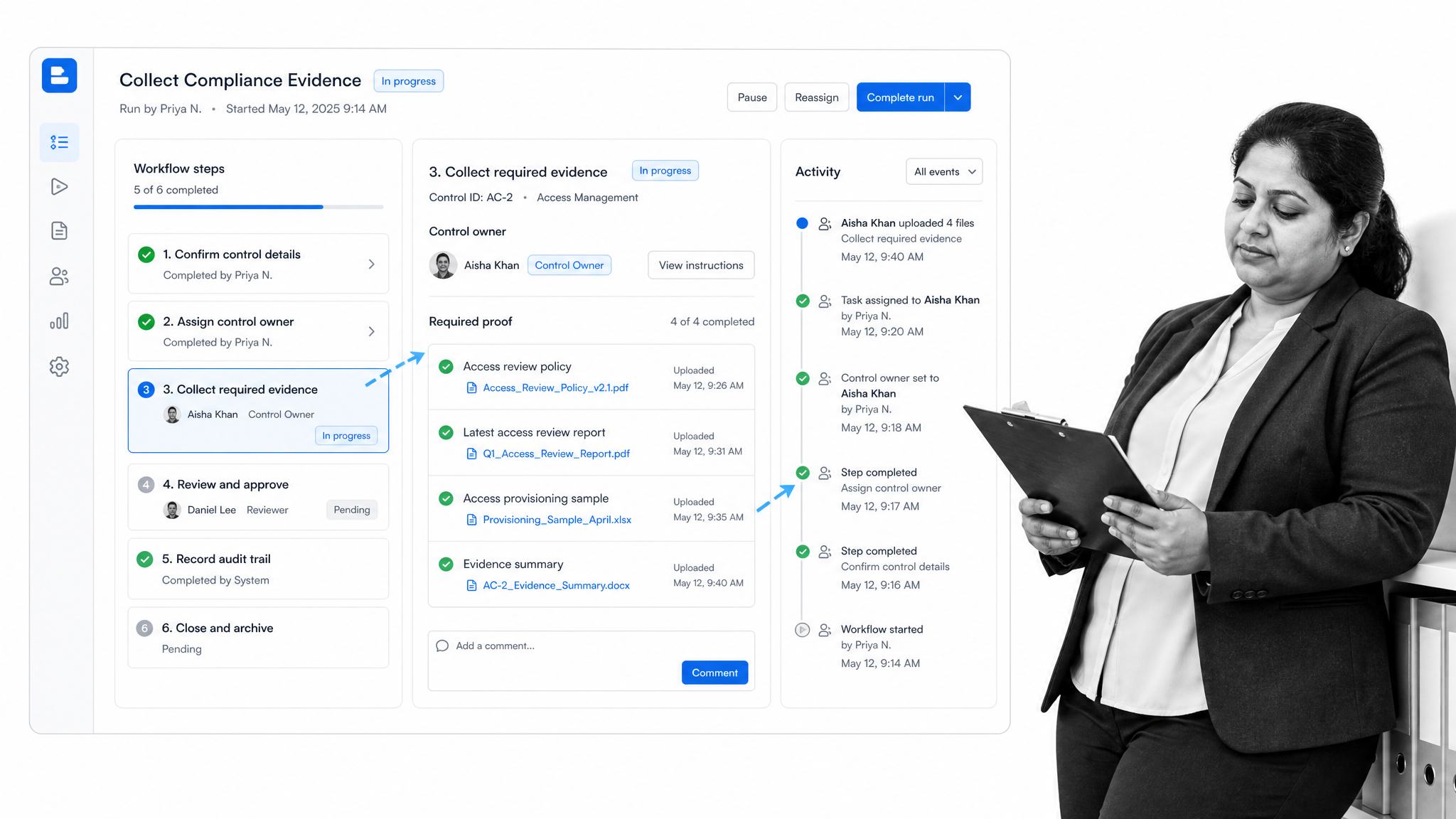
This is where Process Street is strongest. It is a Compliance Operations Platform that brings together Docs for governed SOPs, Ops for execution-by-default, and built-in AI that monitors and optimizes operations in real time. Compliance is built into how work gets done, not bolted on after the fact.
An important task controlled by one business area may not get the oversight it should. Later, it could be revealed that the processes in place to complete that task are in violation of compliance standards, or perhaps unsafe. As a result, the company could find itself afoul of laws or standards set by various governmental organizations or licensing bodies.
Instead, stakeholders should be made aware of compliance issues, stay up to date regarding changes, and ensure that all processes meet safety, compliance, and security standards both internal and external.
How to measure BPM benefits
BPM benefits are easiest to defend when you measure them before and after the process change. Useful metrics include cycle time, cost per transaction, rework rate, SLA compliance, missed-step rate, audit findings, approval time, onboarding time, customer resolution time, and employee handoff count.
Do not measure everything at once. Pick the process that matters, choose two or three metrics, run the improved workflow, and review the results. BPM becomes a management system when the process data feeds the next improvement cycle.
How you can get started and reap the benefits of BPM today
The easiest place to start is one recurring process that already causes pain. Choose a workflow with missed steps, slow approvals, customer friction, compliance risk, or too much manual coordination.
Map the process, identify waste, define the standard, automate the repeatable steps, and run it in a system that records ownership and evidence. Then improve it based on what actually happened.
Process Street gives you one place to document, run, automate, and improve recurring work. You can build governed procedures in Docs, execute them through Ops, use built-in AI to generate and improve workflows, and integrate with the tools your team already uses.
Sign up for Process Street and start with one process that should never be missed again.
Everyone knows what a checklist is, and many industries employ checklists because they are an effective way of making sure a task is carried out the same way every time. That basic building block sits at the center of business process management: a workflow can become a template that teams run as a checklist, assign to anyone in or outside the team, and adapt with conditional logic depending on the information entered into it.
You can also connect Process Street with 5,000+ other apps and webapps to automate actions in those products or have those products automate things inside Process Street. Need a new integration? An AI agent builds it on the fly.
FAQs about BPM benefits
What are the main benefits of BPM?
The main benefits of BPM are lower costs, faster execution, clearer ownership, better customer experiences, stronger standardization, cross-department collaboration, improved compliance, and a repeatable way to improve operations over time.
How does BPM reduce costs?
BPM reduces costs by exposing waste, removing duplicate work, automating repetitive steps, reducing rework, and making handoffs visible before delays become expensive.
How does BPM improve compliance?
BPM improves compliance by turning policy into required workflow steps, approvals, owner assignments, evidence collection, and audit trails. The control is part of the process, not a separate spreadsheet after the work is done.
How is AI changing BPM?
AI is making BPM faster to build and easier to improve. Teams can generate draft workflows, summarize execution data, find bottlenecks, suggest process changes, and connect workflows across systems with less manual configuration.
The post 9 Benefits of Business Process Management (BPM) and Why You’ll Love It first appeared on Process Street | Compliance Operations Platform.


0 Commentaires