Teaming is the practice of bringing people together quickly across roles, disciplines, or organizations to solve a problem, learn as they go, and adapt as membership changes.
Unlike a stable team that builds routines over time, teaming depends on fast knowledge sharing, clear roles, psychological safety, and processes that keep company knowledge available when the people doing the work change.
“It is largely determined by the mindset and practices of teamwork, not by the design and structures of effective teams. Teaming is teamwork on the fly.” – Professor Amy Edmondson, Teaming: How Organizations Learn, Innovate, and Compete in the Knowledge Economy
I spend a surprising amount of time writing about teams, talking about them, thinking about them, and participating in them. It was only a matter of time before I ran into “teaming.”
The concept was developed by Amy Edmondson, a professor at Harvard Business School whose research examines how people collaborate, learn, and speak up at work. When I first encountered the term, I was skeptical. When has that ever stopped me before?
But teaming is useful. It describes the kind of rapid collaboration that happens during incidents, cross-functional projects, distributed work, specialist handoffs, and any situation where the group cannot spend months becoming a perfectly calibrated unit. This article explains what teaming is, what makes it work, how it helped rescue 33 trapped miners, and how documented processes help changing groups retain institutional knowledge.
- “Teaming on the fly”
- Successful teams, teaming, and a Chilean mine
- Teaming the Process Street way
- Frequently asked questions about teaming
Let’s team up.
“Teaming on the fly”
“Teaming calls for developing both affective (feeling) and cognitive (thinking) skills. Enabled by distributed leadership, the purpose of teaming is to expand knowledge and expertise so that organizations and their customers can capture the value.” – Professor Edmondson, Teaming
Team dynamics can make or break a project.
If you have a strong team where the members communicate well, support each other, and maintain mutual respect, even complex work becomes manageable.
On the other hand, if information is not shared, members refuse to compromise, or one person ends up carrying more than their fair share, the chances of realizing the vision are pretty slim.
Harvard psychologist Richard Hackman described five conditions that improve a team’s chances of success, summarized by Harvard Business School in its overview of teaming:
- The group is a real team, with clear boundaries, interdependence among members, and enough stability to work together.
- The team has a compelling direction, with a clear and consequential purpose focused on ends rather than means.
- The team’s task, composition, and norms enable rather than impede the work.
- The surrounding organization provides the resources and support members need.
- Competent coaching is available at the points in the team life cycle when it can help most.
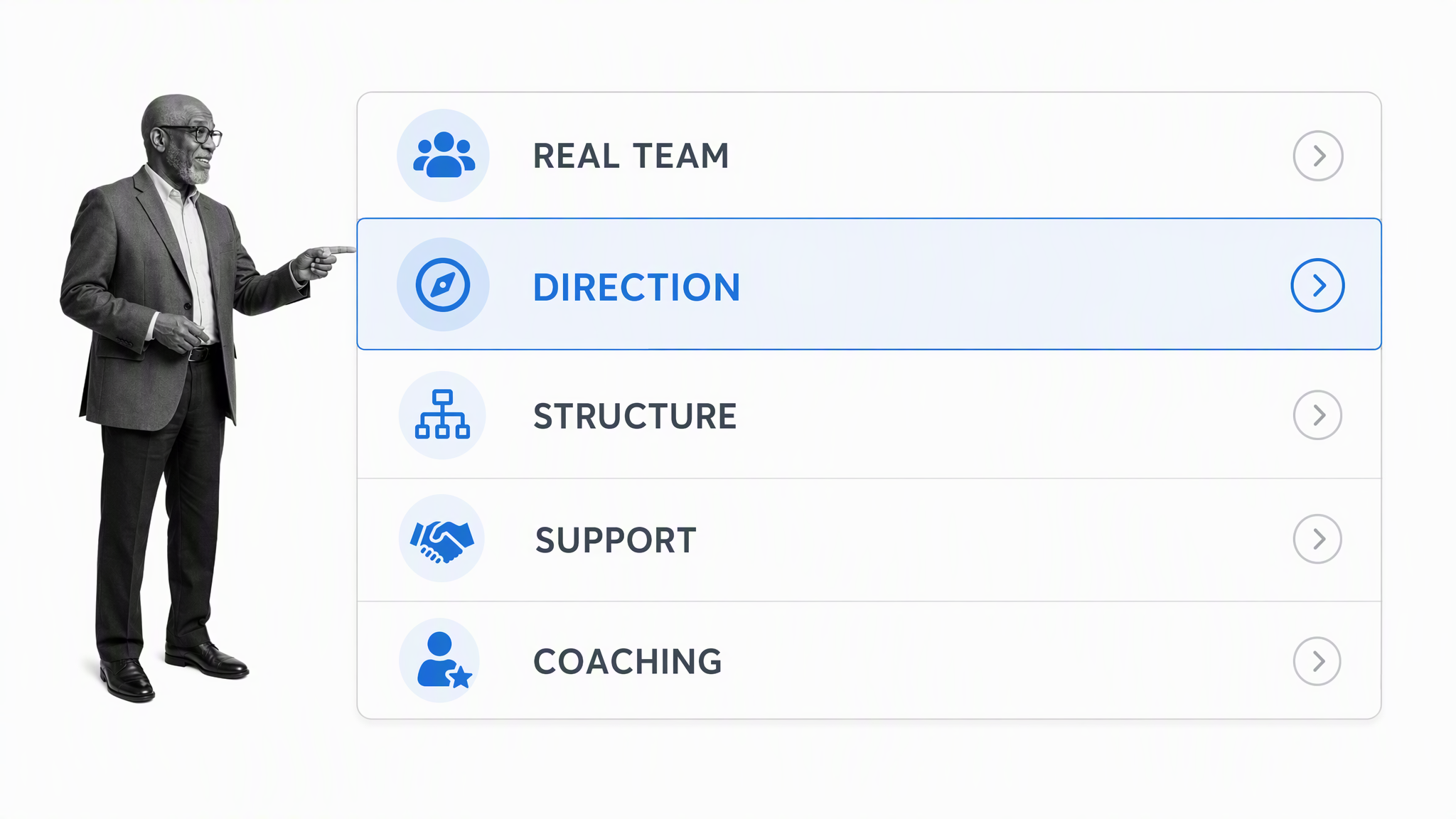
This model is effective for designing and managing teams when members and leaders have time to learn one another’s behavior and establish trust.
That is the caveat Edmondson identified. Fast-moving organizations do not always have the luxury of relying on groups that remain stable. They need people who can coordinate across shifting membership, unfamiliar expertise, and changing constraints.
These groups are not built only around specific individuals. They are also built around roles, responsibilities, and processes. Knowledge has to be communicated accurately enough that someone new can contribute faster, understand the context, and avoid preventable gaps.
This is, essentially, teaming.
For teaming to work, leaders need to build a culture in which questions, learning, and knowledge sharing feel normal. Edmondson highlights three important characteristics:
- Curiosity
- Passion
- Empathy
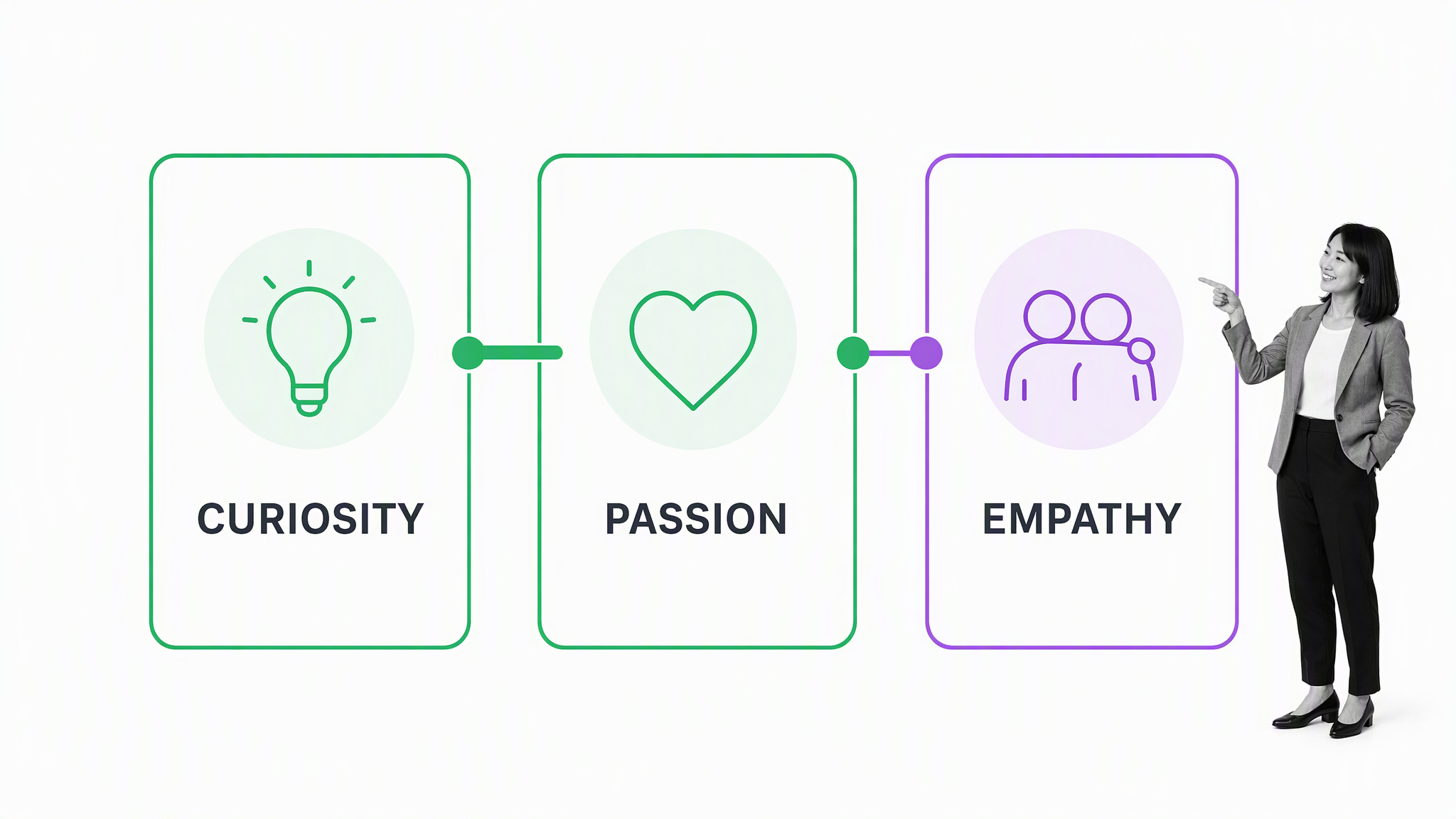
“Curiosity drives people to find out what others know, what they bring to the table, what they can add. Passion fuels enthusiasm and effort. […] Empathy is the ability to see another’s perspective, which is absolutely critical to effective collaboration under pressure.” – Professor Edmondson
If you model these characteristics as a leader, employees are more likely to follow. A leader who shows genuine interest in other people’s ideas makes it safer to share questions, uncertainty, and incomplete thinking. That psychological safety is essential for team learning because hidden concerns and unspoken assumptions cannot improve the work.
It also establishes knowledge sharing as part of the process. People learn from peers, understand how others reached a decision, and become better able to step into unfamiliar work. Some knowledge can be documented directly. Tacit knowledge often needs shadowing, mentoring, interviews, and debriefs as well.
As for passion, think about a task you dread. Do you put the same energy and attention into it as something you care about? Even a dedicated worker will sometimes hurry through work they are not invested in. Teaming works best when people understand the purpose and have a real stake in the outcome.
Successful teams, teaming, and a Chilean mine
Hackman has five conditions for a team’s success. I say there are nine practical elements: clear direction, open communication, defined roles, achievable goals, accountability, collaboration, a diverse exchange of ideas, trust, and creativity and innovation.
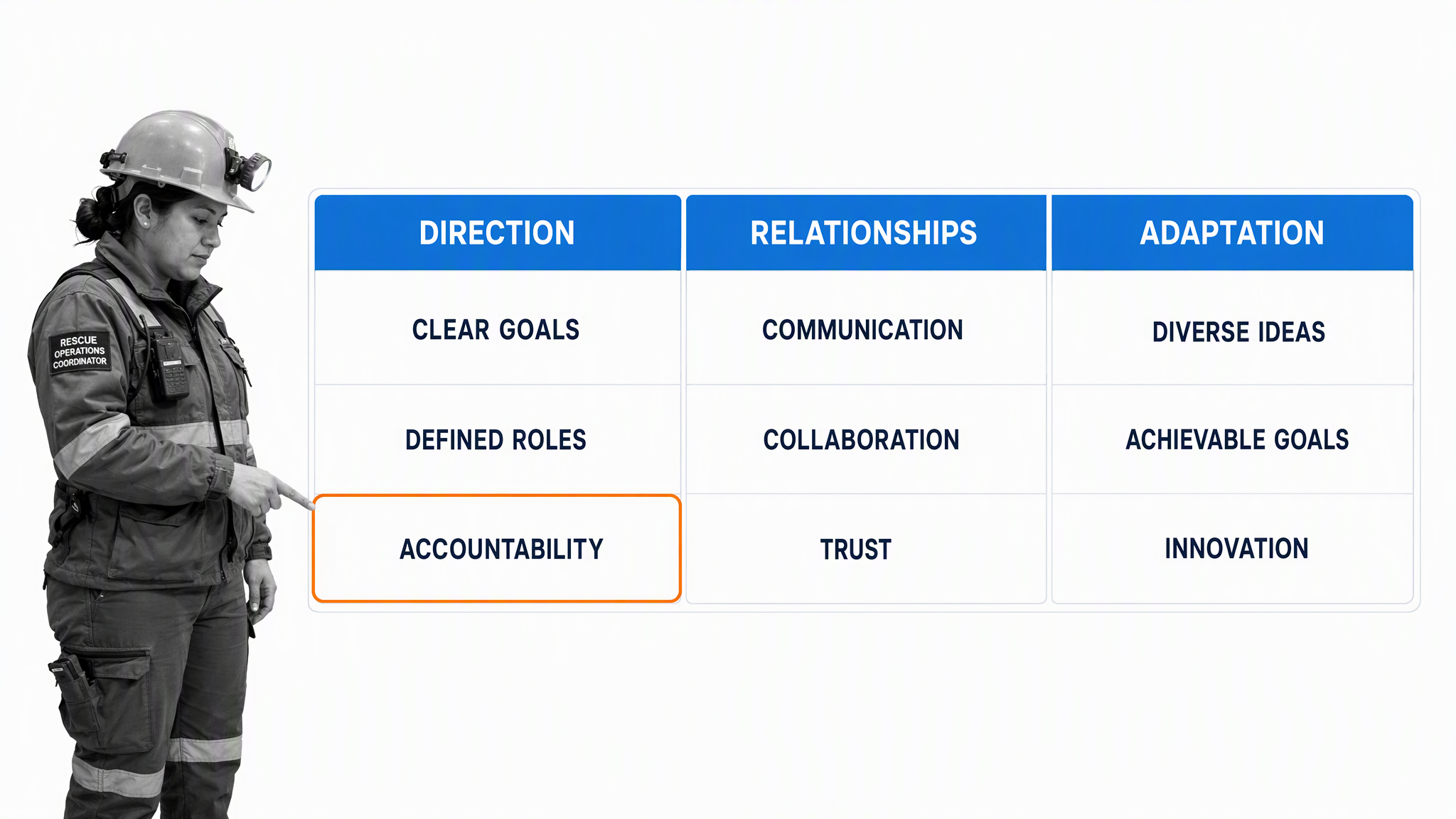
The vital part is that most of these elements should be in place before the group faces its hardest test. If a team has no clear direction, defined roles, achievable goals, or built-in accountability, that is the first problem. You cannot have a successful team without a shared understanding of who will do what, why it matters, and what result everyone is working toward.
You also need different perspectives, experiences, and insights. Vehicle safety testing offers a vivid example. For years, the commonly used “female” crash-test dummy relied heavily on scaled male data. Current NHTSA work on the THOR-05F dummy uses female-specific data and more sensors to represent small female occupants more accurately. The lesson for teams is simple: when important perspectives are absent, the design can miss risks that are obvious to the people affected.
The final three elements are open communication, collaboration, and trust. Open communication and successful collaboration are entwined, and both depend on trust.
I do not mean trust in terms of shared bank details or deciding whether to pull the plug if you are in a coma. In teaming, you need confidence that each member understands the role, will surface problems, and will do the work they committed to. That level of reliability is often established very early in the collaboration.
Possessing all nine elements is a strong indicator of success. The fewer that are present, the more likely the group is to become ineffective and fractured, unable to coordinate even simple decisions.
Coordinating the rescue of “The 33” from the San Jose mine
I know what you are thinking. You have been a dedicated reader of my posts for a while and know exactly how much management gurus and their clever buzzwords irk me.
So why am I drinking Professor Edmondson’s Kool-Aid?
Because teaming, as a verb, makes sense.
Think about it. When was the last time you built a team that stayed exactly the same? No one left. No one took on a new role. No one new joined later. Everyone added on day one remained on day 492.
That rarely happens. There is always some shifting of individuals, responsibilities, tasks, or goals. Edmondson’s model, where participants may change from one day to the next, is often a closer description of modern work than a stable team nurtured slowly over time.
On August 5, 2010, a collapse at the San Jose copper mine in Chile left 33 miners trapped 700 meters beneath half a million tons of rock. Initial estimates put the chance of finding survivors at only 10 percent. The danger grew after another rockfall days later.
Sixty-nine days after the initial collapse, all 33 miners returned to their families alive.
What began with President Sebastián Piñera and Minister of Mining Laurence Golborne reaching into their networks became an example of extreme teaming. Hundreds of experts crossed geographic, cultural, organizational, and professional boundaries to solve a problem no single group could handle.
Rescuers organized three primary workstreams:
- Locate the miners.
- Keep them alive once contact was established.
- Find a safe way to bring them to the surface.
Those groups formed specialist subteams, tested ideas, and communicated failures and discoveries to one another. Harvard Business School’s account, How Teaming Saved 33 Lives in the Chilean Mining Disaster, shows why the rescue depended on rapid learning across boundaries.
“No one person, or even one leadership team, or one organization or agency, could have successfully innovated to solve this problem.” – Professor Edmondson
By establishing efficient ways to communicate, rescuers achieved what initially looked unfeasible despite differences in language, culture, time zone, profession, and organizational affiliation. Most were strangers who would never have worked together without this extraordinary incident.
Teaming the Process Street way
Process Street is a fully remote company, so we have had to get serious about asynchronous communication. Groups form and change as new needs emerge. Some work together for years. Others collaborate for one project. We are teaming all the time.
One of our company values is to overcommunicate. When I first started at Process Street, I assumed that meant redundant conversations and meetings. I was wrong.
Overcommunication means not being stingy with context. That matters when people work at different times and cannot resolve every missing detail in a live conversation.
For example, our graphic designers are often on the other side of the world from me. When I request an image, I need to include what the image is for, what it needs to communicate, how it should look, the required source information, and useful references. If I leave out a key detail, a five-minute question can turn into a full day of delay.
A new teammate should not have to discover that process through trial and error. The knowledge belongs in the way the work is run.
Process Street is one Compliance Operations Platform. Docs and Ops are capability areas within that product, supported by built-in AI. Docs helps teams govern procedures and preserve decisions, owners, and context. Ops turns that knowledge into assigned workflows with conditions, approvals, deadlines, and an audit trail. Built-in AI can help draft and improve processes while people retain control over what is approved and executed.
That combination supports teaming because explicit knowledge stays connected to action. A workflow can prompt the next contributor for the context a downstream teammate needs, route exceptions to the right owner, and record what happened. Judgment that cannot be reduced to steps still needs mentoring, shadowing, and debriefs, but the repeatable part no longer lives in one person’s memory.
Someone joining the work can understand the purpose, see the current procedure, follow the required handoffs, and contribute with fewer information gaps. When the process changes, the governed source and the execution flow can change together.
The TL;DR: Don’t be stingy with the information
Teaming works when knowledge is easy to find, safe to question, and tied to the work people actually perform. Capture the explicit steps and decisions. Pair them with shadowing, coaching, interviews, and debriefs for the tacit judgment that does not fit neatly into a document.
A practical knowledge-transfer loop is simple: identify critical knowledge, capture the context and decision points, test the instructions with another operator, store them where the work happens, assign an owner, and improve them after each exception. For a broader system, use these enterprise knowledge management practices to make institutional knowledge findable and maintainable.
When people join, leave, or switch roles, the goal is not instant perfection. The goal is faster ramp-up, consistent handoffs, fewer preventable errors, and a reliable record of how the work should run. That is how company knowledge survives while the team keeps moving.
Frequently asked questions about teaming
What is teaming?
Teaming is rapid collaboration among people who may not have worked together before. They coordinate across roles or organizations, learn during execution, and adapt as the work or membership changes.
How is teaming different from teamwork?
Traditional teamwork often assumes a relatively stable group that develops routines over time. Teaming is designed for changing groups, unfamiliar specialists, urgent problems, and cross-boundary work where coordination must begin immediately.
How does teaming preserve company knowledge?
Teaming preserves company knowledge when teams document decisions and repeatable steps, keep that information connected to execution, and use mentoring or debriefs to transfer judgment. Clear ownership and regular review keep the knowledge useful as people and conditions change.
The post How Process Street Facilitates Teaming and Retains Company Knowledge first appeared on Process Street | Compliance Operations Platform.


0 Commentaires