SIPOC stands for Suppliers, Inputs, Process, Outputs, and Customers. It is a one-page framework for defining a business process end to end: who feeds it, what goes in, what happens inside it, what comes out, and who receives it.
A SIPOC diagram is the fastest way to pull a fuzzy process into focus. You draw five columns, fill them in, and suddenly the hidden dependencies, missing handoffs, and unclear ownership are on the page where you can fix them. It is the default starting point for most Six Sigma, Lean, and business process management work, and it has become even more useful in the AI era, where you cannot hand a process to an agent until the inputs, outputs, and boundaries are spelled out explicitly.
This guide walks through what SIPOC is, why it still matters in 2026, and exactly how to build one using Process Street‘s free SIPOC Template. If you want to skip the theory and go straight to the template, it is right here:
- What is SIPOC?
- SIPOC Template
- Why SIPOC still matters in 2026
- How to build a SIPOC diagram with the template
- Worked example: SIPOC for a content team
What is SIPOC?
SIPOC is a process mapping technique that summarizes a process in five columns:
- Suppliers: the people, teams, systems, or vendors that feed the process
- Inputs: the materials, data, or information they supply
- Process: the core steps that transform inputs into outputs
- Outputs: what the process produces
- Customers: who consumes each output
A finished SIPOC diagram reads left to right as a single flow, from upstream sources to downstream consumers. That is why teams use it to:
- Give new stakeholders a high-level overview of a process on one page
- Reorient people whose understanding of a process has drifted
- Scope a new process before designing it
- Identify internal and external suppliers and customers
- Expose weak handoffs between inputs and outputs
SIPOC has been in use since the late 1980s as a quality management tool. Today it sits inside Six Sigma, Lean manufacturing, and modern business process management programs as the standard Define-phase artefact. The Six Sigma Institute and ASQ both recommend it as the first artefact to produce when you start defining or improving a process.
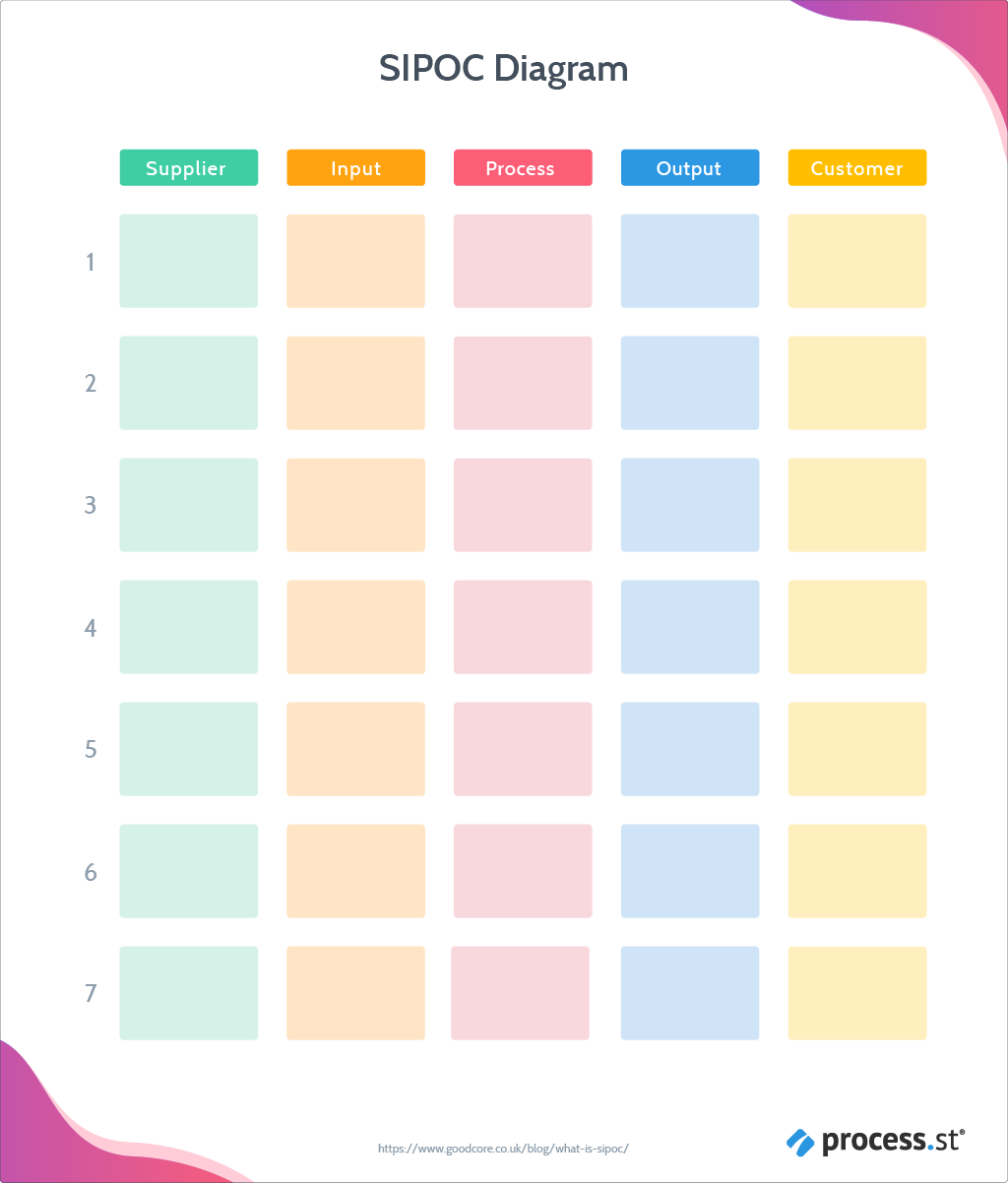
Here is what an empty SIPOC diagram looks like before you fill it in:
SIPOC Template
Process Street’s free SIPOC Template is the easiest way to fill in the diagram above. It is a guided checklist that walks you through identifying suppliers, inputs, process steps, outputs, and customers, then compiles your answers into a results view that maps cleanly onto the five SIPOC columns.
Use it to:
- Identify the overall processes in a working system
- Get a clean, one-page view of a business process
- Support the definition, scoping, and structuring of complex work systems
- Surface problems and weak handoffs inside the process
Why SIPOC still matters in 2026
The classic reasons to build a SIPOC have not changed:
- It reveals the basic shape of a process on one page
- It gives new employees a shared reference for what the process actually does
- It surfaces updates and exceptions cleanly when the process changes
- It kicks off structured problem solving by naming the real suppliers, inputs, customers, and output specifications
- It produces the scoping artefact most improvement frameworks expect next
Two benefits are worth pulling out.
SIPOC is the foundation for a full process map
A SIPOC is the one-page version of a process. A process map is the zoomed-in version: the step-level flowchart of how work actually moves. You almost always build SIPOC first, because it forces you to agree on scope, boundaries, and customers before you start drawing boxes and arrows.
When you are ready to go from SIPOC to process map, run the SIPOC Template first, then use Process Street’s Creating a Process Map from Scratch template to build out the detail:
Open the Creating a Process Map from Scratch template.
SIPOC is the entry point to Six Sigma DMAIC
DMAIC is Six Sigma’s five-phase improvement cycle: Define, Measure, Analyze, Improve, Control. SIPOC is the first real artefact you produce in the Define phase. Without it, the rest of the cycle has no shared definition of what is being improved.
If you are running a Six Sigma program, these guides extend SIPOC into the rest of the methodology:
- The 7 Core Six Sigma Principles to Build Your Business Around
- DMAIC: The Complete Guide to Lean Six Sigma in 5 Key Steps
- DFSS: How Design For Six Sigma can supercharge your business
- 14 BPM and Six Sigma courses to become a systems expert
SIPOC is how you get a process ready for AI agents
The new reason SIPOC matters in 2026: if you want to hand a process to an AI agent, a vendor, or a cross-functional team, they need an unambiguous contract. What inputs are expected. What outputs count as done. Who supplies what. Who receives what. Where the boundary is.
A SIPOC is exactly that contract. Teams that treat SIPOC as a quality-era ritual get a compliance artefact. Teams that treat it as an agent-ready process definition get a document they can hand to a person, a team, a vendor, or a Process Street AI workflow, and get the same result.
If you are already running processes in Process Street, the SIPOC you build here plugs directly into the checklist, role assignments, approvals, and conditional logic you use to execute the work day to day.
How to build a SIPOC diagram with the template
Process Street’s SIPOC Template is a guided checklist. You answer a series of questions about the process you are mapping, and the template compiles your answers into a results summary that maps cleanly onto the five SIPOC columns. The template takes roughly 20 to 30 minutes for a process of moderate complexity.
Open the SIPOC Template and follow the worked example below.
Worked example: SIPOC for a content team
To show the template in action, this section walks through a real SIPOC for a content creation editing process.
Step 1: Document the underlying process
Before you can build a SIPOC, you need a rough description of the process itself. If the process is already documented in Process Street as a workflow, you are done. If it lives in someone’s head, write it out as a sequence of tasks first.
In Process Street, a workflow can include:
- Stop tasks to enforce task order
- Dynamic due dates so deadlines track the workflow automatically
- Conditional logic so the workflow adapts to the situation
- Role assignments for clean delegation
- Approvals so decision-makers gate the right steps
For this example, the content team documented three processes:
- Content Creation Editing Process
- Content Creation Pre-Publish Checklist
- Content Planning Process
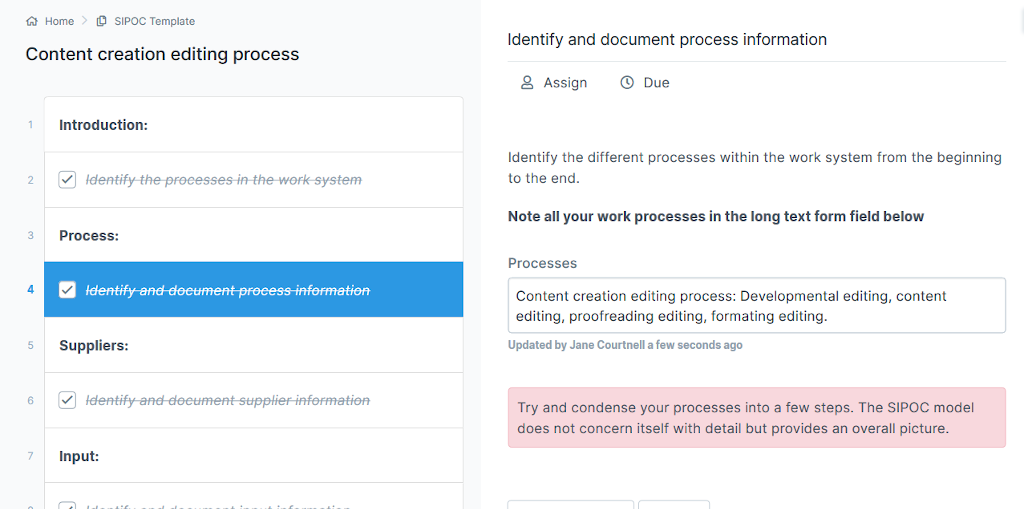
Step 2: Condense the process into a short step list
SIPOC only needs the process shape, not every task. Pull the task titles out of your workflow and condense them into a short list. For the Content Creation Editing Process, the condensed step list looks like this:
Step 3: Identify suppliers
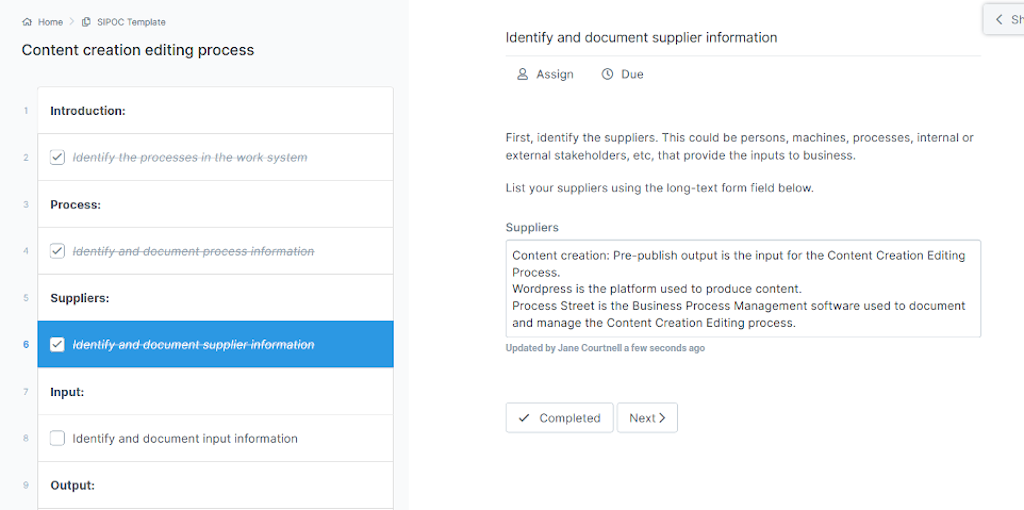
For each process step, list the suppliers: people, teams, systems, or other workflows that feed this step. External vendors and internal teammates both count. So do upstream Process Street workflows and connected tools such as a CMS, an analytics source, or a shared drive.
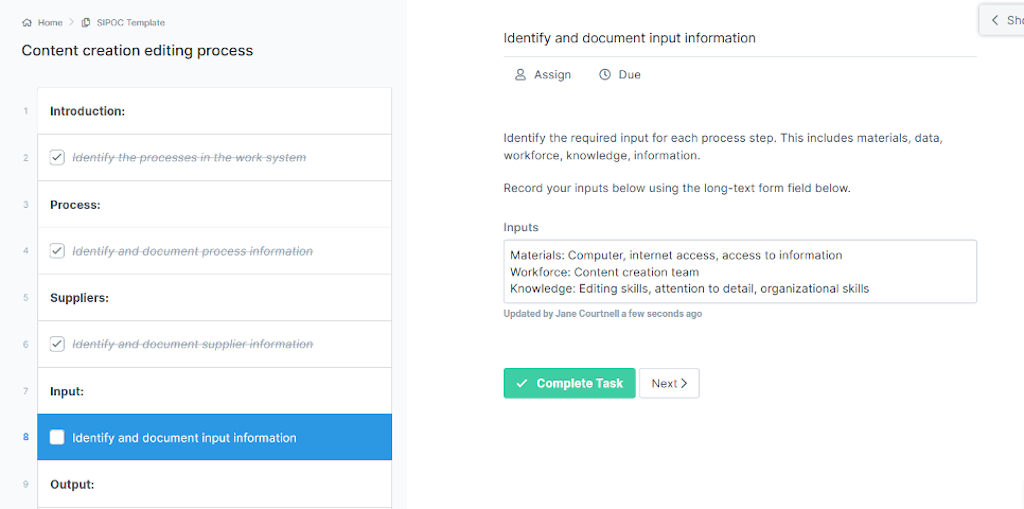
Step 4: Identify inputs
For each supplier, list the inputs they provide: source material, briefs, data, research, approvals, assets, or context. The goal is to name what the step actually consumes, not just who is upstream.
Step 5: Identify outputs
For each process step, list the outputs: the published article, the reviewed draft, the distribution asset, the analytics report, the approval decision. An output only counts if someone downstream actually uses it.
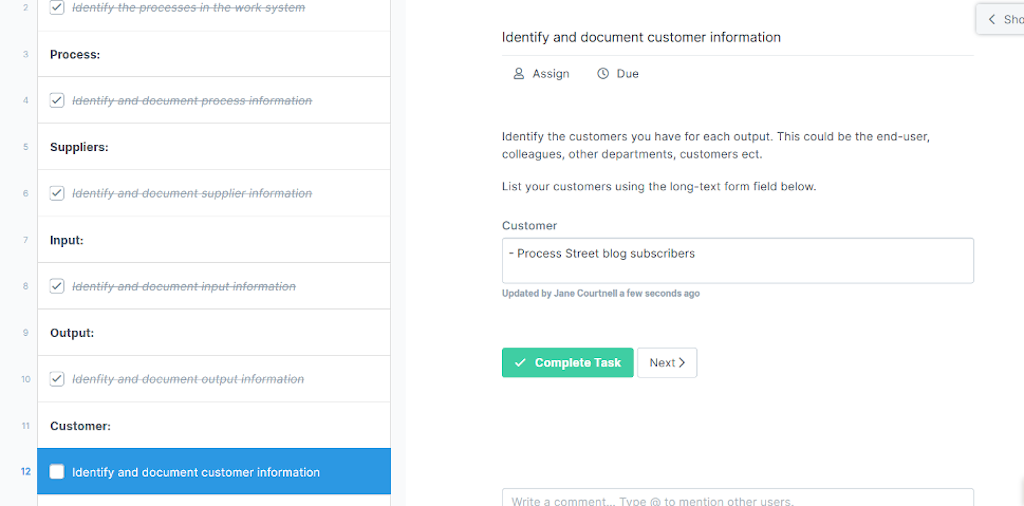
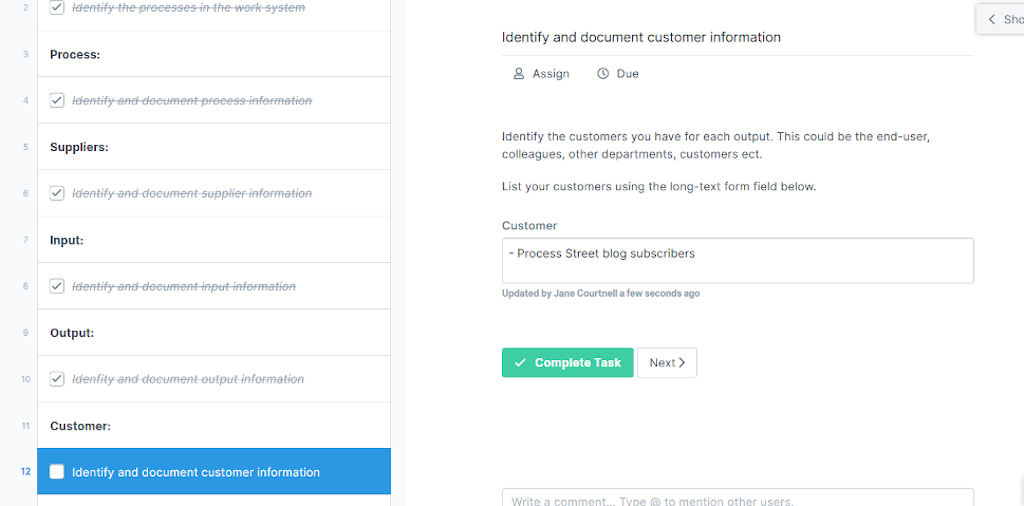
Step 6: Identify customers
For each output, name the customer. That can be an end user, another team, a department, a specific role, or a downstream workflow. Writing customers down forces you to ask whether every output has a real consumer. Outputs without customers are usually waste.
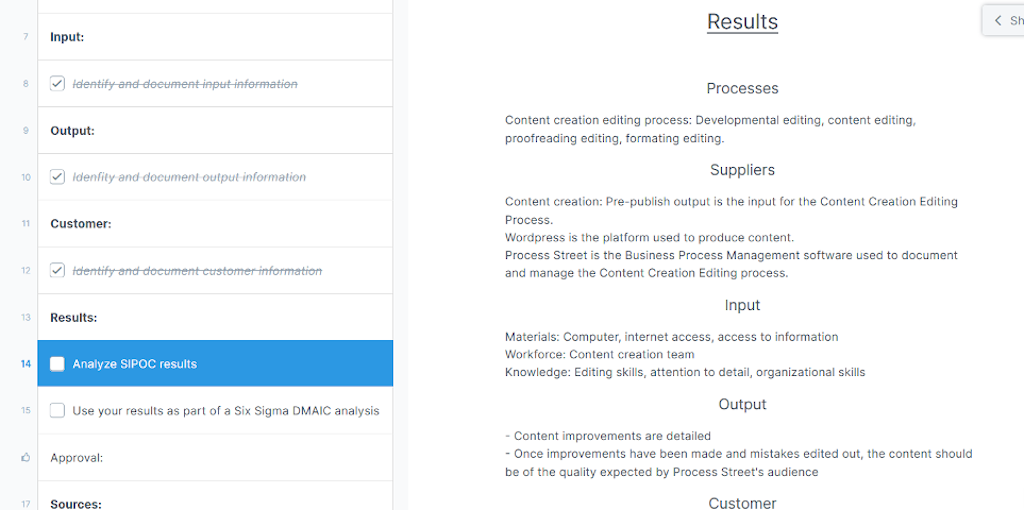
Once you complete all six steps, the template compiles your answers into a single results view:
Drop those results into the SIPOC diagram and you get the finished artefact:
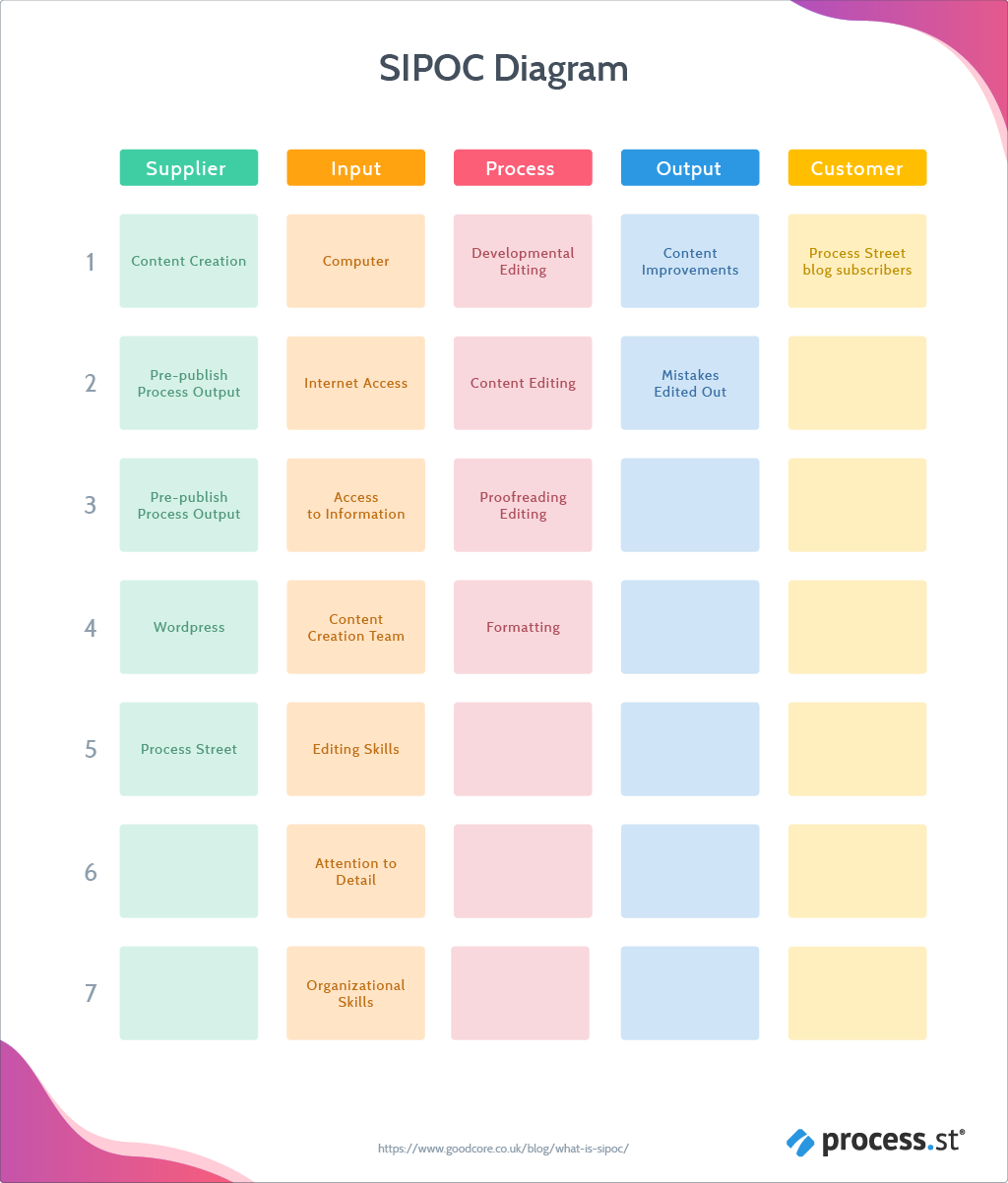
That is the whole SIPOC workflow. Run the template, transfer the results, and you have a defensible one-page definition of the process that any stakeholder, new hire, vendor, or AI agent can pick up.
From SIPOC to running processes in Process Street
A SIPOC is only useful if it connects to the work. The value comes from taking what you defined, the suppliers, inputs, steps, outputs, and customers, and running it as a real workflow with owners, due dates, and approvals.
Process Street is built for exactly that. You take the process you mapped, turn it into a workflow, assign it, schedule it, and track it. The SIPOC becomes the permanent definition the workflow is built against.
Start with the SIPOC Template, then bring the result into Process Street as a running workflow.
The post What is SIPOC? How to Create a SIPOC Diagram (Free SIPOC Template) first appeared on Process Street | Compliance Operations Platform.


0 Commentaires