A HACCP plan is a written, site-specific system for identifying significant food safety hazards, setting critical limits, monitoring controls, and recording corrective action and verification.
A fish may be at home in water, but getting seafood safely from the water to a customer’s plate takes disciplined control. The same is true for every food operation. The CDC estimates that foodborne illness affects roughly one in six Americans each year, which is why hazard prevention must be planned rather than improvised.
HACCP stands for Hazard Analysis and Critical Control Points. The approach helps food businesses identify where biological, chemical, or physical hazards could enter a process, then establish controls that prevent, eliminate, or reduce those hazards to an acceptable level.
This guide explains what HACCP means, how the system developed, the benefits of using it, and how to create a practical HACCP plan. It also includes free templates from Process Street that you can use to document procedures, run checks, capture evidence, and respond when a critical limit is missed.
- What is HACCP, and what is a HACCP plan?
- The incredible history of HACCP
- The benefits of HACCP and having a HACCP plan
- Use Process Street for HACCP and food safety
- HACCP plan FAQs
What is HACCP (and what is a HACCP plan)?
HACCP is a preventive food safety management approach. Instead of relying only on end-product inspection, a HACCP system studies the flow of food and focuses attention on the steps where control matters most. It is systematic, science-based, and designed around the conditions of a specific facility and product.
The acronym HACCP stands for Hazard Analysis and Critical Control Points. It is an approach to food safety that attempts to minimize food risk as much as possible by analyzing and controlling biological, chemical, and physical hazards. This approach concerns raw material production, receiving, processing, storage, distribution, and the product’s final consumption. For seafood, for example, the chain can begin when the fish is captured and continue until somebody eats it.
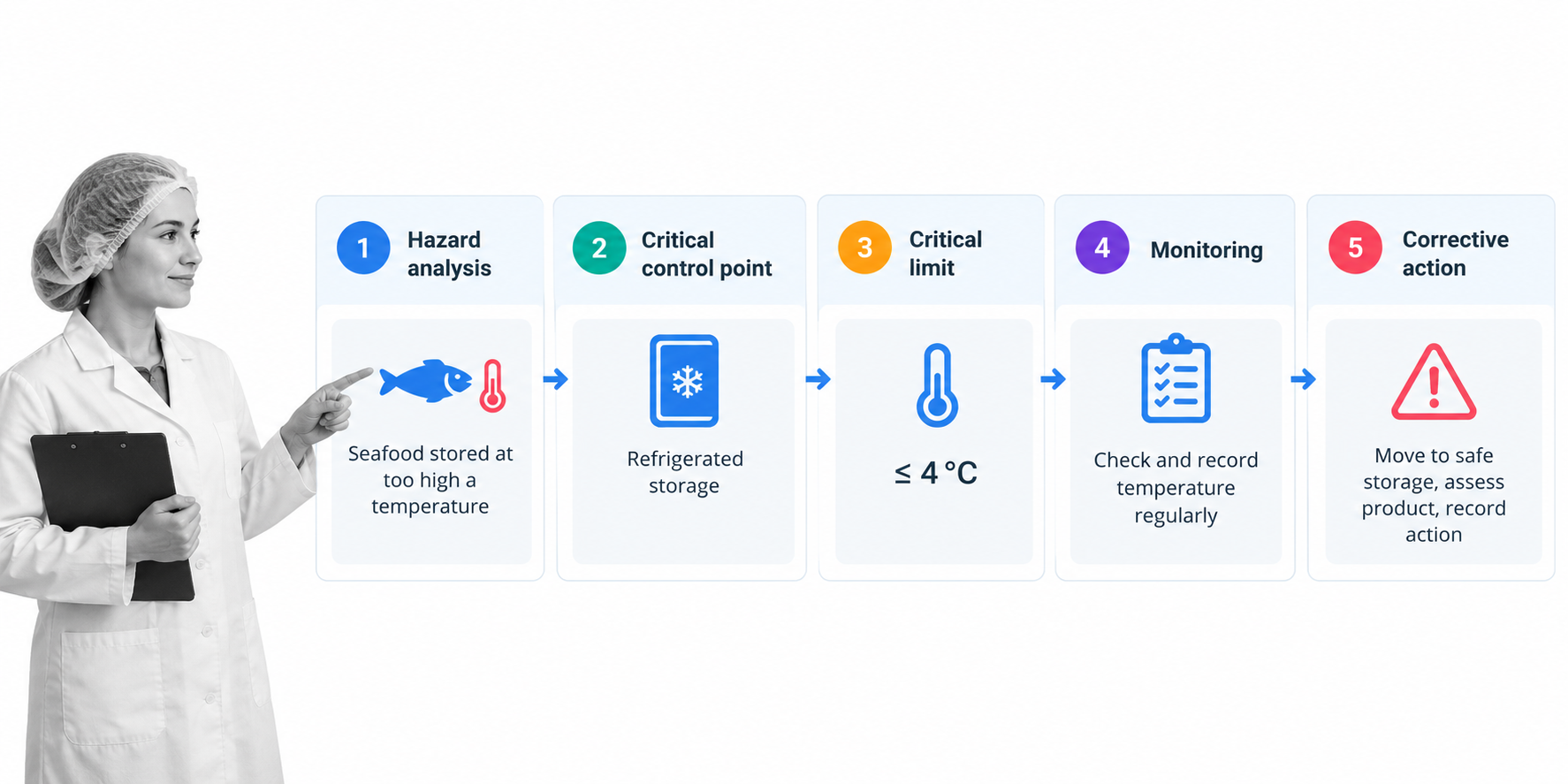
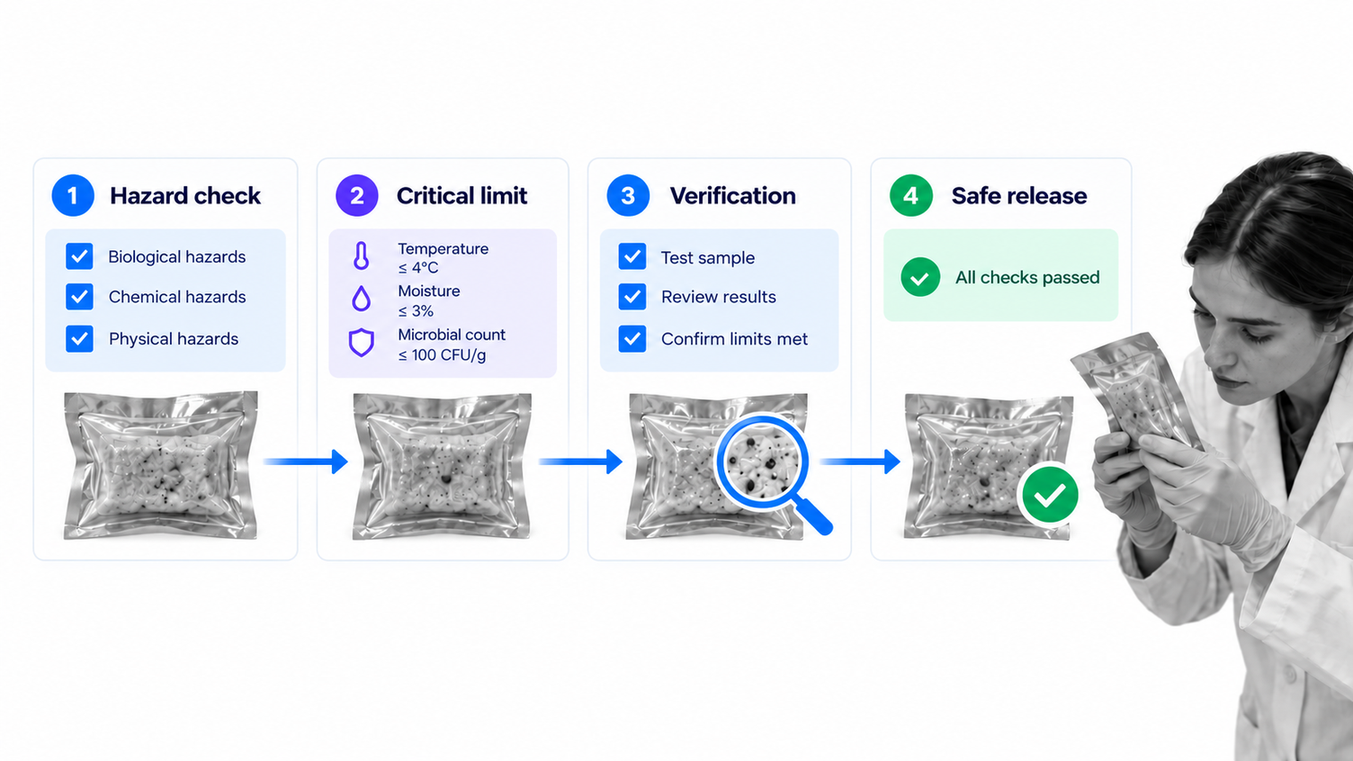
A hazard analysis considers three broad categories. Biological hazards include bacteria, viruses, parasites, and other pathogens. Chemical hazards can include cleaning agents, allergens, pesticides, or unsafe concentrations of additives. Physical hazards include materials such as glass, metal, hard plastic, or bone fragments that could injure a consumer.
The FDA describes seven HACCP principles:
- Conduct a hazard analysis. Map the process and identify reasonably likely hazards at each step.
- Determine the critical control points. Identify steps where control is essential to prevent, eliminate, or reduce a significant hazard.
- Establish critical limits. Set measurable boundaries such as time, temperature, pH, water activity, or concentration.
- Establish monitoring procedures. Define what is checked, how it is checked, how often, and by whom.
- Establish corrective actions. Decide what happens to affected product and how control will be restored when a limit is not met.
- Establish verification procedures. Confirm that the plan is scientifically sound and that the system operates as intended.
- Establish record-keeping and documentation procedures. Keep the evidence needed to demonstrate that controls were performed and exceptions were handled.
In shorthand, the principles include conducting a hazard analysis, identifying the Critical Control Points, establishing critical limits, monitoring CCP, establishing corrective action, verification, and record-keeping. The exact verbs are useful because each principle calls for an observable activity and a record. Hazard Analysis is not a one-time brainstorm, and Critical Control Point monitoring is not an informal glance. Both need defined methods and accountable owners.
What is a HACCP plan?
HACCP is the overall approach. A HACCP plan is the documented application of that approach to a particular product and process. It normally identifies the HACCP team and product, describes intended use, maps the process flow, records the hazard analysis, and defines each critical control point with its limit, monitoring method, corrective action, verification activity, and records.
Before applying the seven principles, the Codex framework uses five preliminary tasks: assemble the HACCP team, describe the product, identify its intended use and consumers, construct a flow diagram, and verify the flow diagram on site. This preparation prevents the plan from becoming a generic document that misses real conditions on the floor.
To create a HACCP plan, begin with one product or closely related product family. Walk the process from receiving through storage, production, packaging, distribution, and service. Ask what could go wrong at every step, how likely and severe the harm would be, and which existing prerequisite programs already control the risk. Those prerequisite programs can include sanitation, supplier approval, allergen management, pest control, calibration, training, traceability, and recall procedures.
A critical control point, or CCP, is not simply any important task or any failed standard operating procedure. It is a step where control can be applied and is essential to prevent or eliminate a food safety hazard, or reduce it to an acceptable level. A cooking temperature, metal detector sensitivity, or acidification target can be a CCP when the hazard analysis supports that decision.
Where does HACCP begin and end? To avoid confusion, it’s best to think of HACCP as a food safety approach that can operate within a larger food safety management system. While it can function as a focused management system in itself, HACCP can also be a part of a larger food safety management system such as ISO 22000. The HACCP plan informs people of the necessary food safety-related procedures that should be followed to manage hazards. In practical terms, the plan tells the team what needs to be done, what must be measured, what record must be kept, and what to do when the result falls outside the limit.
U.S. regulatory requirements vary by product and operation. FDA HACCP regulations apply to seafood and juice, while USDA FSIS requires HACCP systems for federally inspected meat and poultry establishments. Many other FDA-regulated facilities operate under the Food Safety Modernization Act preventive controls rule. Use the FDA HACCP overview, USDA FSIS HACCP guidance, and the FDA preventive controls rule to determine which framework applies. When in doubt, involve a qualified food safety professional or the relevant regulator.
Use this free HACCP Process template to structure the work:
Open the HACCP Process template.
The incredible history of HACCP
HACCP grew from the space program. In the 1960s, NASA needed food for astronauts that would be safe without depending on destructive end-product testing. The Pillsbury Company worked with NASA and the U.S. Army Natick Laboratories to build a preventive system based on identifying hazards and controlling the points where failure would matter most.
What’s HACCP got to do with space? A lot. NASA, the Pillsbury Company, and the Natick Research Laboratories came together to work on a project for minimizing food risk. They wanted to ensure food safety for astronauts going out into space, where a foodborne illness would be extraordinarily difficult to manage. The challenge demanded more than sampling finished products. The team needed a way to build safety into production.
The team adapted ideas from engineering methods such as failure mode analysis and emphasized process control over inspection alone. Pillsbury presented the system publicly at the 1971 National Conference on Food Protection. The approach later spread through government guidance, industry codes, and international standards. NASA’s account of the space-program origins of HACCP captures why the method was such an important shift: safety had to be built into the process.
The National Conference on Food Protection was backed by leading food safety and food regulation organizations, including the Food and Drug Administration and the American Public Health Association. The HACCP concept gained attention because it combined Hazard Analysis with Critical Control Points in a solid and robust way of ensuring quality. Looking at and overcoming control-point issues had already helped NASA test the reliability of engineering systems. In a food context, the same preventive logic offered a more reliable way to stop quality and safety issues from occurring.
That preventive logic still defines HACCP. Monitoring provides timely evidence that a critical control point remains within its limit. Corrective action protects consumers and controls affected product when the limit is missed. Verification checks that the system is valid and functioning. Records make the system reviewable by managers, customers, auditors, and regulators.
The takeaway is that HACCP has been around for a long time and was developed by some of the most forward-thinking organizations on Earth. Its continued place in modern food safety standards shows that HACCP is here to stay, even as regulations, equipment, and documentation systems evolve.
HACCP also supports broader food safety management systems. ISO 22000 combines HACCP principles with management-system requirements, and FSSC 22000 adds scheme-specific requirements and prerequisite-program specifications. The current ISO 22000 standard provides the formal international framework, but each organization still needs hazard controls grounded in its own products, processes, and operating environment.
Clear standard operating procedures help turn a plan into repeatable daily practice. The following template can be used to define purpose, scope, responsibilities, instructions, records, and revision control:
Open the Standard Operating Procedure Template Structure.
The benefits of HACCP (and having a HACCP plan)
A well-designed HACCP plan gives an operation a shared, evidence-based method for controlling food safety. It connects scientific limits to daily responsibilities, so employees know what to check, managers know when to intervene, and auditors can see what happened.
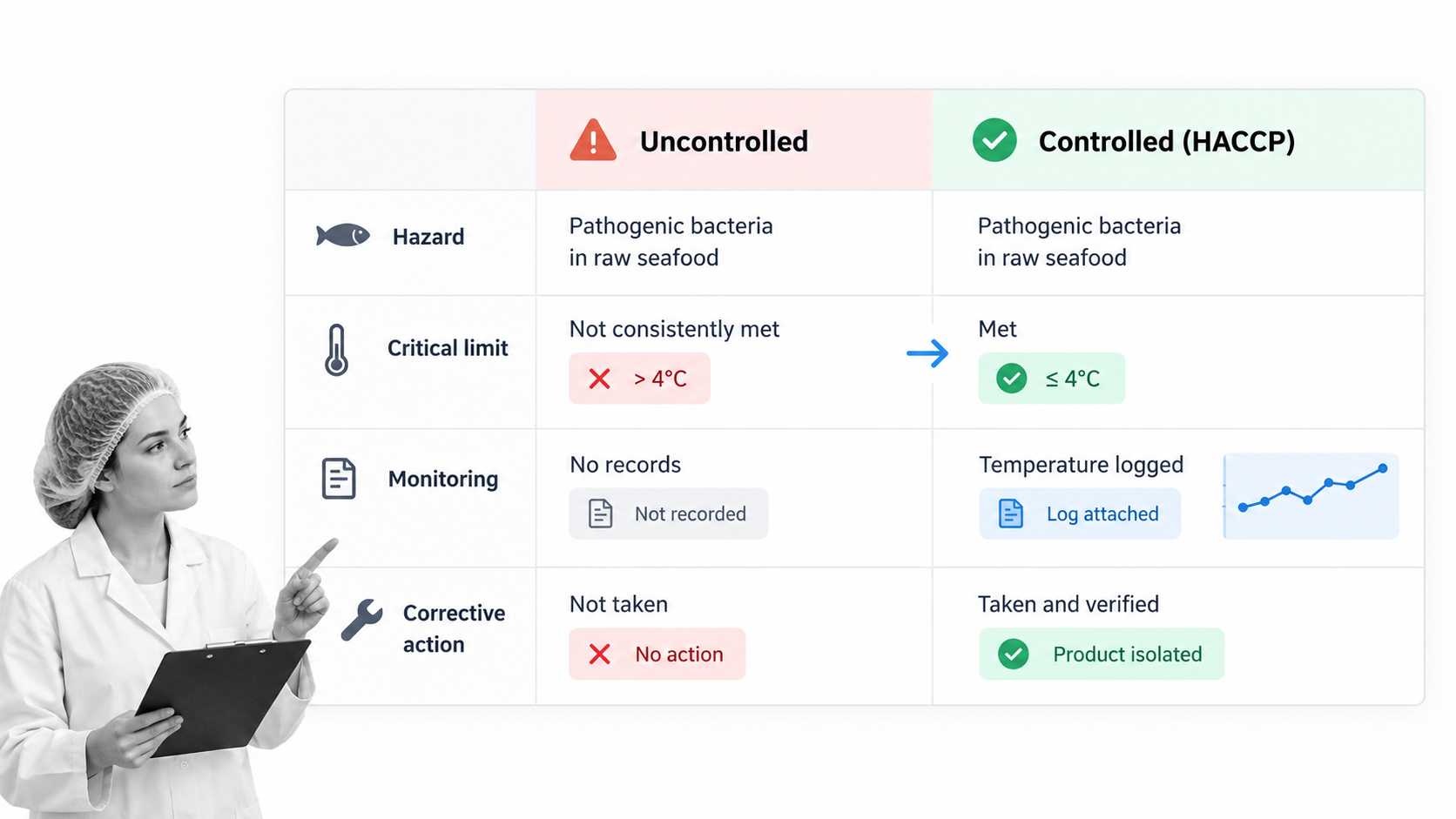
HACCP protects food safety. The main benefit is prevention. A hazard analysis prompts the team to think through raw materials, equipment, people, environment, storage, transport, and intended consumers before an incident occurs. Critical limits convert that analysis into measurable conditions. Monitoring then provides early warning while corrective action contains a deviation.
HACCP supports regulatory compliance. Where HACCP is required, the plan and its records are core evidence of compliance. Where another preventive-controls framework applies, HACCP methods can still strengthen hazard analysis, monitoring, corrective action, verification, and record keeping. A plan does not guarantee compliance on its own, but it makes responsibilities and evidence visible.
HACCP builds market and customer trust. Retailers, food-service customers, certification bodies, and export markets often expect documented food safety controls. A maintained HACCP plan helps suppliers answer due-diligence questions with evidence rather than assurances. It can also support certification and customer requirements that incorporate HACCP principles. Being able to say that you use the HACCP approach to food safety can go a long way when it comes to international trading and showing the rest of the world you mean business.
HACCP improves process control. At its core, HACCP is all about minimizing food risk. That means ensuring food-related processes and procedures are up to scratch and continue to improve. HACCP makes variation easier to see. Defined checks can reveal calibration problems, recurring temperature drift, supplier issues, delayed responses, or gaps in training. Teams can then improve the process instead of repeatedly correcting symptoms. By using the HACCP approach and having a HACCP plan to guide the team, an operation can take control of its relevant food processes.
These benefits reinforce one another. Protecting customers helps protect a brand’s reputation and reduces the risk of a costly food contamination event. Following the applicable law supports compliance. Documented controls make it easier for other companies, brands, suppliers, and customers to work with the operation on a long-term basis. Reliable records also give managers the evidence needed to improve decisions rather than depend on memory.
Use Process Street for all-things HACCP and food safety!
Process Street is a Compliance Operations Platform for building, running, and governing recurring operational work. It is one product with Docs and Ops capability areas plus built-in AI. For a HACCP program, that means procedures and control logic can stay connected to the workflow runs, assignments, evidence, approvals, and records that prove the work happened.
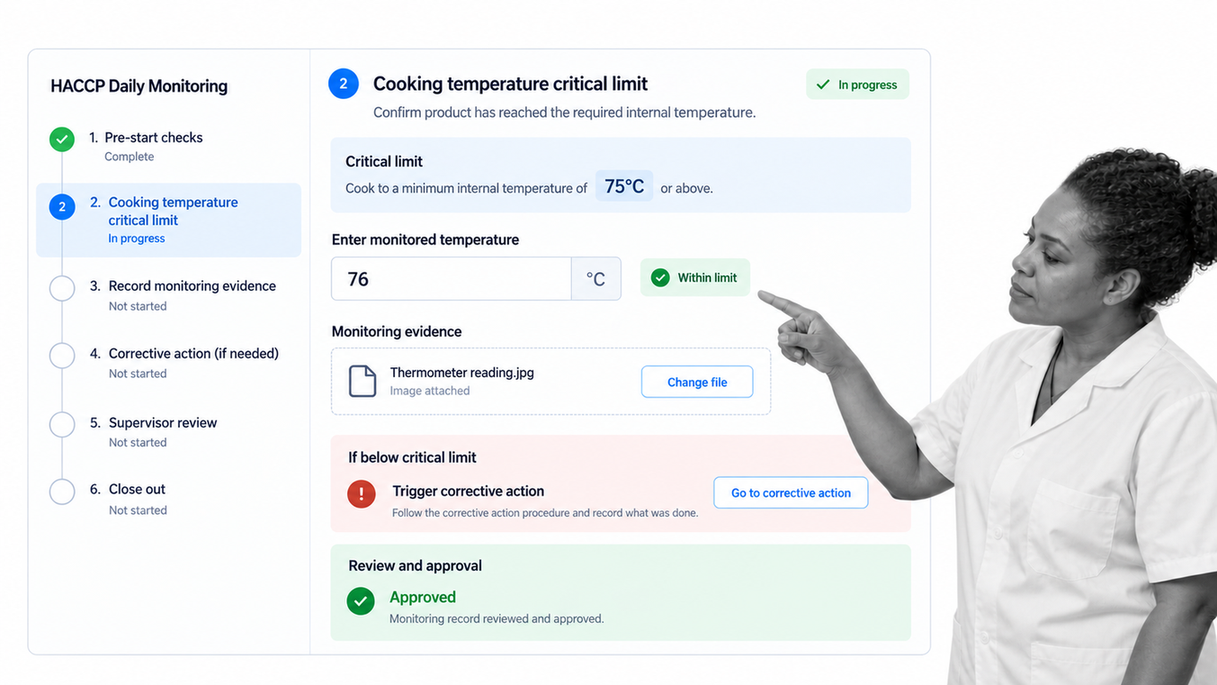
Docs can hold controlled HACCP plans, policies, work instructions, and standard operating procedures. Ops can turn those documents into assigned workflows for receiving checks, cooking or chilling controls, sanitation verification, calibration, allergen changeovers, and corrective action. Form fields capture readings and evidence, conditional logic routes the right response, due dates keep checks on schedule, and approvals give accountable reviewers a clear decision point.
This operating layer matters because a HACCP plan only works when people execute it consistently. A paper form may show the required limit, but a managed workflow can also notify the responsible person, stop progress when required information is missing, preserve an audit trail, and escalate an exception before it disappears into a filing cabinet.
Built-in AI can help teams turn approved source material into usable procedures, summarize an exception, or draft a corrective-action path for human review. The food safety team remains responsible for the hazard analysis, scientific basis, critical limits, validation, and final decisions. AI should support controlled work, not substitute for qualified judgment.
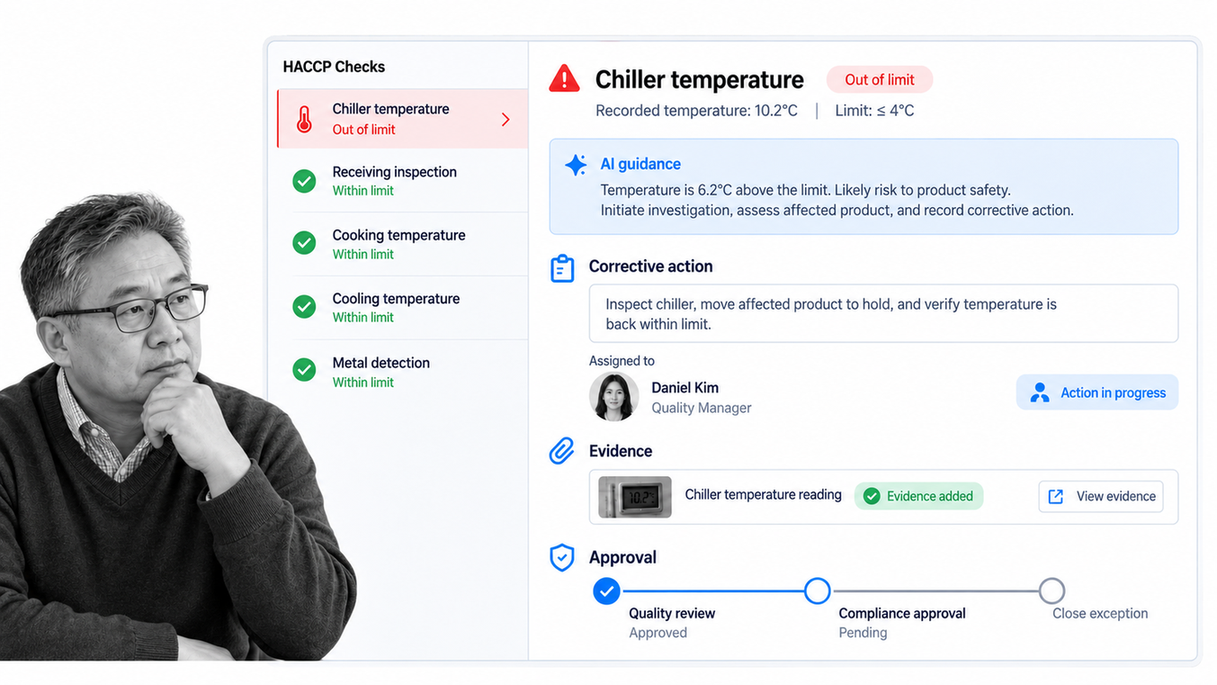
Start by documenting how the operation works today, then connect each significant hazard to its control, evidence, owner, and escalation path. Process Street’s approach to quality systems helps unify those controls across departments without splitting policy, execution, and proof into separate tools.
A practical operating cycle follows Plan, Do, Check, Act:
- Plan: define hazards, controls, limits, responsibilities, and required records.
- Do: run the procedures and monitor critical control points.
- Check: review records, verify controls, analyze exceptions, and audit the system.
- Act: correct deviations, investigate causes, update training, and improve the plan.
Put another way, plan what needs to be done and write this down. Do what you planned to do to maintain food safety. Check that the operation is doing what it planned, and write down what was checked and when. Act to correct food safety problems, and record what was done about the problem and when. This turns the HACCP Process template from a static document into a repeatable management loop.
The following checklist helps a team examine whether its HACCP system covers prerequisite programs, product and process information, hazard analysis, CCP controls, verification, documentation, and review:
As an internal audit checklist, it helps evaluate compliance with HACCP requirements across hazard analysis, critical control points, monitoring procedures, corrective action, verification procedures, cleaning procedures, pest control, and training. Assignments and permissions clarify ownership, conditional logic can expose the right response, and approvals make the review decision explicit. Webhooks and integrations can pass approved evidence to connected systems when that is part of the controlled design.
Useful workflow automation features include stop tasks, dynamic due dates, conditional logic, task permissions, task assignments, role assignments, webhooks, the embed widget, and approvals. These controls are not substitutes for food safety expertise. They help ensure that recurring tasks are completed efficiently and effectively, required information is captured, and the correct person reviews an exception before the workflow moves forward.
Open the HACCP Compliance Checklist.
Good HACCP management is not a one-time documentation exercise. Review the plan whenever ingredients, suppliers, equipment, layout, packaging, intended use, scientific knowledge, or regulations change. Reassess it after a deviation or food safety incident. Verify records routinely and validate that the controls can achieve the intended food safety outcome.
The fish at the start of this guide belongs in water, but safe food belongs inside a controlled system. A clear HACCP plan, supported by repeatable procedures and reliable evidence, helps keep it there from receiving to release.
HACCP plan FAQs
What does HACCP stand for?
HACCP stands for Hazard Analysis and Critical Control Points. It is a preventive approach that identifies significant food safety hazards and controls the process steps where action is essential.
What is the difference between HACCP and a HACCP plan?
HACCP is the food safety methodology. A HACCP plan is the site-specific document that applies the methodology to a product and process, including hazards, critical control points, limits, monitoring, corrective action, verification, and records.
What are the seven HACCP principles?
The seven principles are hazard analysis, determination of critical control points, critical limits, monitoring procedures, corrective actions, verification procedures, and record-keeping and documentation.
Is HACCP required for every food business?
No single U.S. HACCP rule applies to every food business. Requirements depend on the product, process, regulator, and jurisdiction. Seafood, juice, meat, and poultry have specific federal HACCP requirements, while many other facilities follow preventive controls rules. Customer and certification requirements may also call for HACCP-based systems.
The post HACCP Plan: What It Is, Why It’s Important, & How to Do It (Free Templates) first appeared on Process Street | Compliance Operations Platform.


0 Commentaires