
The 5 Whys is a root cause analysis technique that follows a problem through successive “why?” questions until the team reaches an evidence-supported cause it can act on. Five is a useful rule of thumb, not a quota: some investigations stop sooner, while others branch or need a broader method.
This guide explains the technique, walks through a practical example, and shows how to turn the result into a corrective action. You can also use the free Process Street 5 Whys template to record evidence, assign owners, approve countermeasures, and verify that the fix worked.
- 5 Whys definition and method
- The history of 5 Whys
- Benefits of the 5 Whys process
- How to utilize Process Street’s 5 Whys template
- Improving and taking control of your business with Process Street
- 5 Whys FAQs
5 Whys definition and method
5 Whys is a structured questioning technique for tracing a visible problem back through its cause-and-effect chain. State the problem clearly, ask why it happened, check the answer against available evidence, and use that answer as the basis for the next question. Continue until the team reaches a cause that is specific, supported, and practical to address.
The number five is not mandatory. The method is successful when it produces a credible explanation and a useful countermeasure, not when a team has filled five boxes. A simple operational issue may take three questions. A complex failure may produce several causal branches and require a fishbone diagram, failure mode and effects analysis, or another deeper investigation.
A practical 5 Whys example
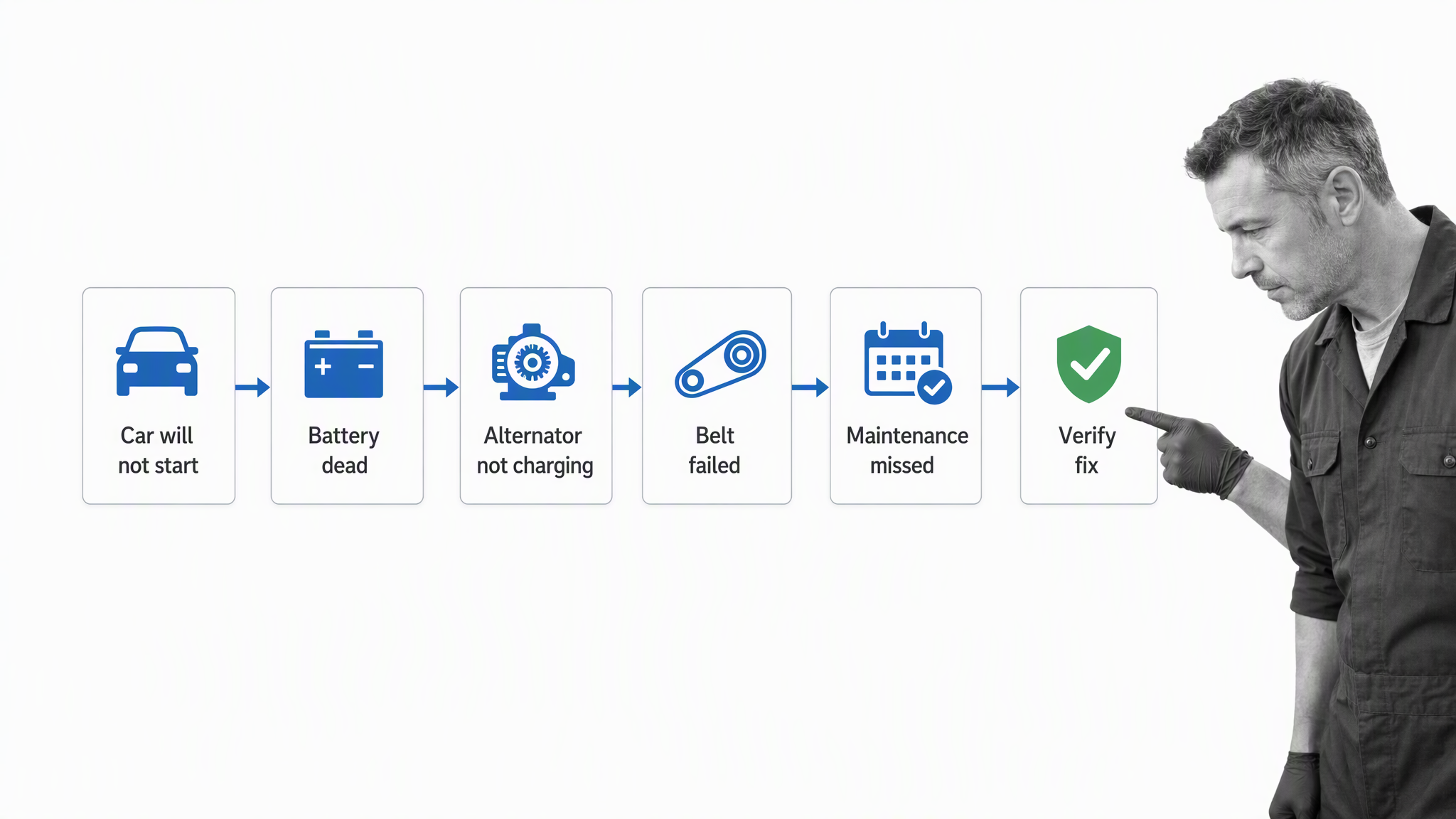
Taiichi Ohno’s well-known example begins with a car that will not start:
A version of this example also appears in Stephen Spear’s book The High Velocity Edge. It is memorable because it shows how a team can uncover a maintenance-system failure without stopping at the obvious dead battery. The point is not the exact number of additional questions; it is being able to follow the evidence from the visible fault to a condition that can be changed.
- Why will the car not start? The battery is dead.
- Why is the battery dead? The alternator is not charging it.
- Why is the alternator not charging it? The alternator belt has broken.
- Why did the belt break? It had been used beyond its service life.
- Why was it not replaced earlier? The vehicle was not maintained according to the recommended schedule.
Replacing the battery would address the immediate symptom. Restoring a repeatable checklist system for scheduled maintenance addresses the process failure that allowed the symptom to recur. The team should still verify each answer with inspection records, service data, or direct observation rather than accepting the first plausible story.
A useful 5 Whys analysis ends with more than a sentence labeled “root cause.” Record the countermeasure, an owner, a due date, the evidence that will show whether the action worked, and a review point. If the same problem returns, reopen the chain and test the assumptions again.
In practical terms, you state the issue or problem you are facing and ask why it occurred. Then you ask why again in response to the last answer you gave. The iterative series shows the relationship between the initial problem and its root cause, so the team can clearly see how every step interacts with another. That full picture matters because an immediate symptom can look persuasive even when it does not explain how the problem transpired.
In the car example, the battery is dead because the alternator is not functioning; the alternator is not functioning because its belt has broken; the belt failed because it was well beyond its useful service life; and the vehicle was not maintained according to the recommended service schedule. That final answer points to a repeatable maintenance failure rather than a one-time component replacement. Inspection and service records should still support every link.
Before a session, agree on the scope and gather the people closest to the work. Bring the records that describe what happened, such as timestamps, photos, customer reports, production data, or audit evidence. Keep the problem statement narrow enough to investigate. If the team starts with “our service is poor,” different participants may answer different questions. A statement such as “three priority support requests missed the four-hour response target last Tuesday” gives everyone the same event to examine.
The history of 5 Whys
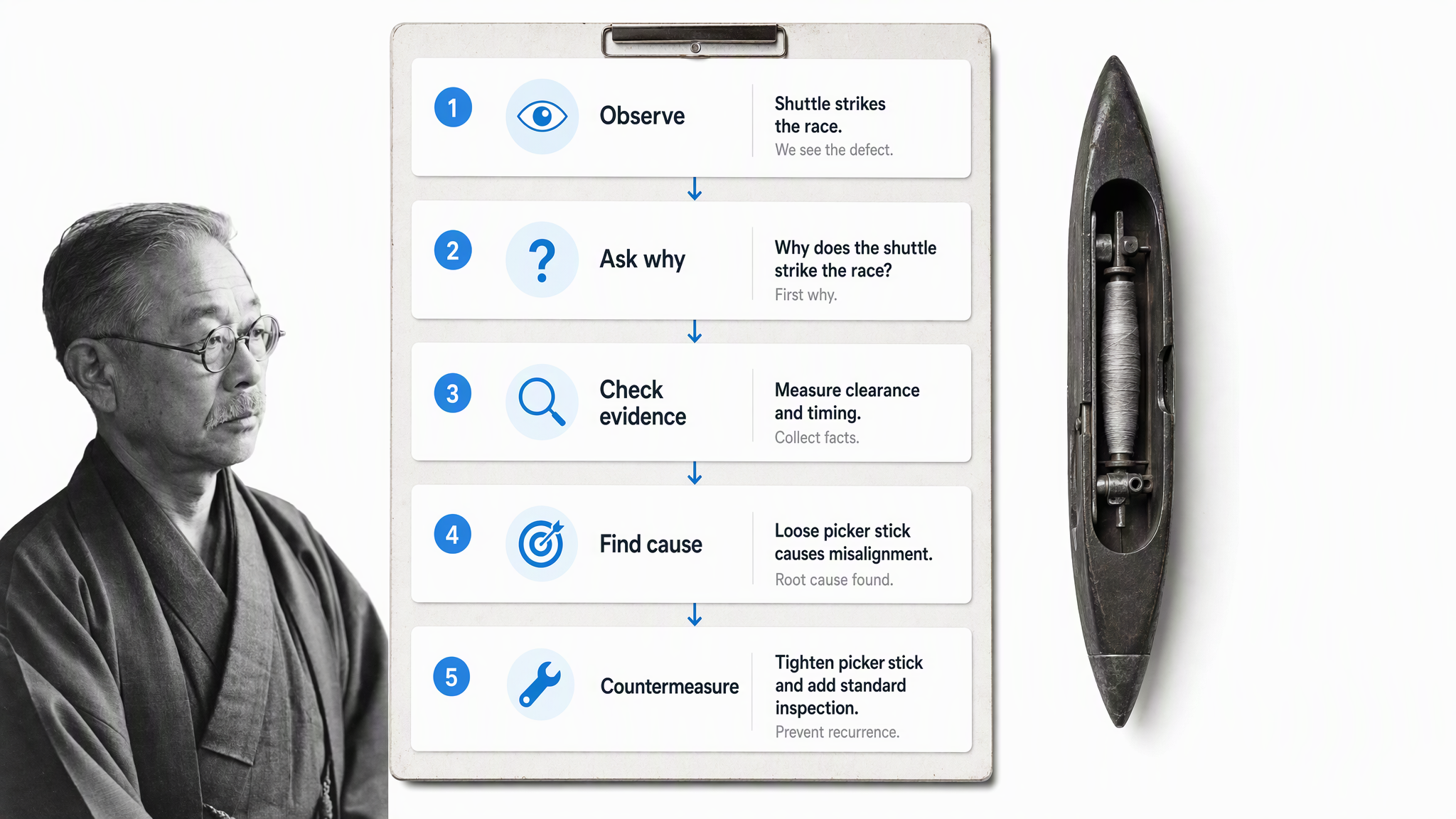
The technique is associated with Sakichi Toyoda, the Japanese inventor and industrialist whose work helped shape the company that became Toyota Industries. Toyota later embedded persistent root-cause questioning in the Toyota Production System, where Taiichi Ohno taught teams to investigate what was happening at the worksite instead of treating a symptom from a distance.
Sakichi Toyoda’s questioning practice is often traced to the 1930s. Taiichi Ohno, later known as an architect of the Toyota Production System, helped introduce the method internally and in a widespread way. Toyota was also evolving its manufacturing methodologies while competing with Nissan and Honda in Japan and Ford and General Motors in Western markets. Those circumstances explain why a lightweight method for exposing defects and implementing countermeasures was valuable, but they do not prove that 5 Whys alone produced Toyota’s later performance.
Toyota’s history also shows why evidence matters. The company faced a severe management and financial crisis around 1949 and 1950, when labor conflict, restructuring, and scarce financing put the business under intense pressure. It would be inaccurate to credit one technique with Toyota’s later success. The durable lesson is narrower: disciplined observation and repeated questioning help operators learn from failures and improve the system.
That mindset also appears in Kaizen, lean manufacturing, and Six Sigma. Each approach asks teams to define a problem carefully, separate evidence from assumption, and connect improvement work to measurable outcomes.
Ohno emphasized going to the place where work happens and looking at the condition directly. That remains useful well beyond manufacturing. A software team can inspect logs and deployment records. A finance team can trace an approval through timestamps and handoffs. A customer support team can listen to the conversation and review the knowledge available to the agent. The technique is strongest when questioning and observation happen together.
The method became a prominent and permanent fixture within Toyota because it gave operators opportunities to move from recurring defects to countermeasures. In the contemporary business world, 5 Whys is still widely used on its own or in conjunction with other frameworks, techniques, and practices. It has passed the test of time not as a complete explanation for Toyota’s global success, but as a disciplined way to tackle issues head-on and learn from the conditions that produced them.
Although the approach originated nearly a century ago, it has certainly passed the test of time. Toyota narrowly avoided bankruptcy during its postwar crisis and later became one of the world’s best-selling car brands, but multiple elements contributed to that recovery. Production design, financing, leadership, marketing strategies, and the ability to produce reliable cars all mattered. The careful conclusion is that 5 Whys helped teams expose and tackle business-related problems; it was not an absolute or standalone cause of success.
Benefits of the 5 Whys process
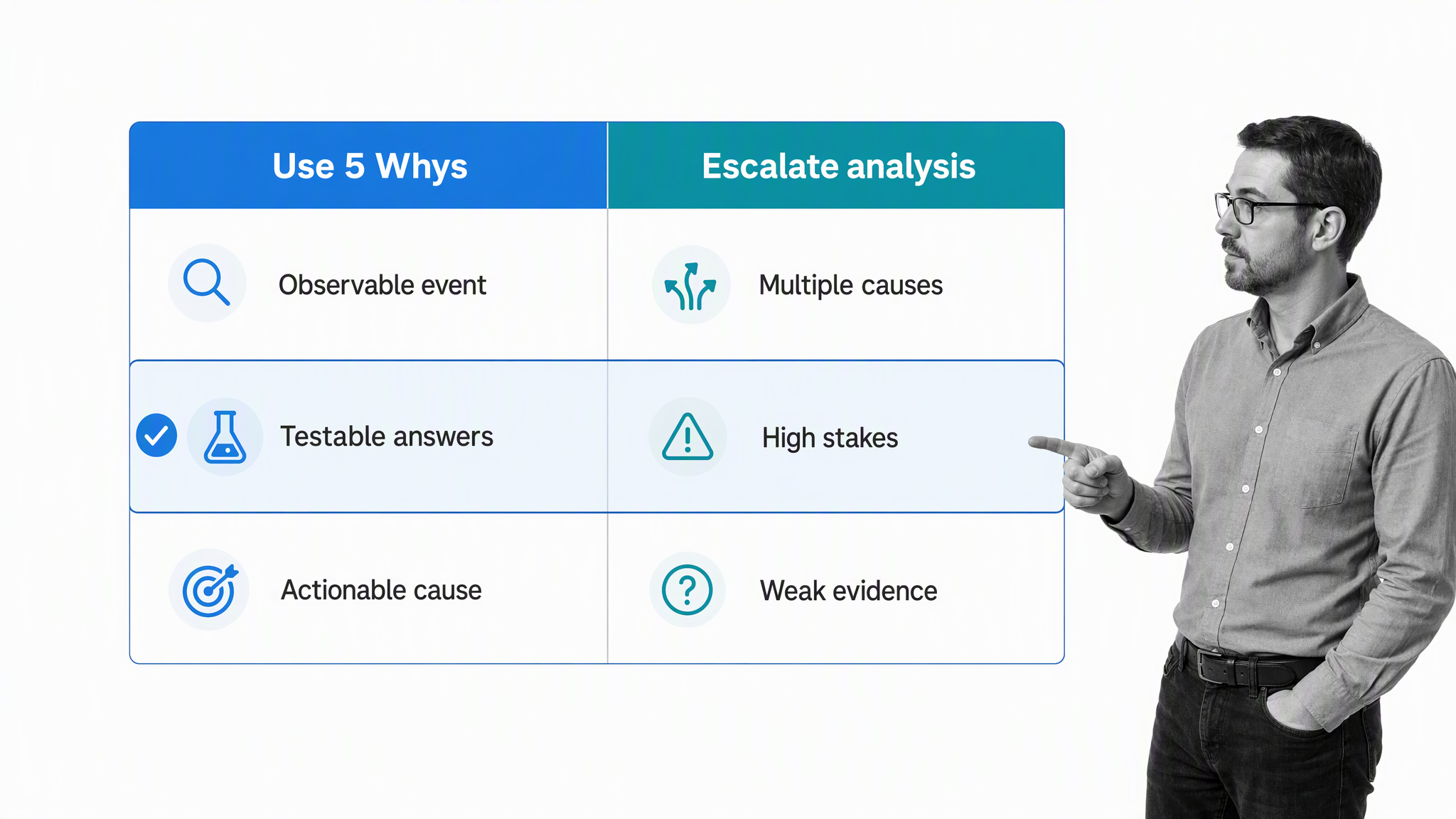
5 Whys is fast enough to use in a team discussion and structured enough to prevent an immediate jump from symptom to solution. It works especially well when the problem has a reasonably clear sequence, the people involved can observe the process, and the team can test each answer.
- It turns a vague complaint into an investigable chain. “Orders are late” becomes a series of specific handoffs, delays, and missing controls.
- It keeps the discussion connected to action. Each answer can point toward a countermeasure, owner, and verification step.
- It is easy to repeat. Teams can use the same question structure in operations, customer support, quality, IT, HR, or finance.
- It makes assumptions visible. Writing down the chain helps reviewers challenge weak links before the organization invests in a solution.
The biggest benefit is that 5 Whys helps people get to the bottom of roadblocks instead of staring at a screen for hours, wondering why an issue keeps returning. It uncovers the relationship between a problem and its cause, which makes the chain easier to explain and challenge. The technique is also easy to learn whether someone is in a managerial role or is an intern working closest to the activity.
It is a highly repeatable process rather than an exercise a team does once and never undergoes again. Whenever a cause and countermeasure are unclear, the same structure can be used immediately when a problem crops up or during a scheduled review of lingering issues. Repetition turns the questions into a practical improvement habit, while written answers create a record that later reviewers can compare with the outcome.
When 5 Whys is not enough
Real failures are not always linear. A missed deadline may involve staffing, unclear requirements, software, training, workload, and approval design at the same time. For complex, safety-critical, or high-stakes problems, use 5 Whys as an entry point and combine it with methods such as FMEA, a fishbone diagram, fault-tree analysis, or DMAIC.
Do not use the method to push toward a person as the cause. “The operator made a mistake” should open another question about the system: Was the instruction clear? Was the training sufficient? Did the interface make the wrong action easy? Was the workload reasonable? Psychological safety matters because people will hide useful evidence if the exercise feels like a search for someone to blame.
Allow branches when the evidence points to more than one cause. A root cause analysis template should make uncertainty visible, not force a clean chain where none exists. Mark unverified statements as hypotheses and assign follow-up work to confirm or reject them.
The method is also valuable as a communication tool. A written causal chain lets a manager, reviewer, or auditor see how the team moved from the observed problem to the proposed action. Reviewers can challenge a weak link without restarting the entire discussion, and the team can compare the expected result with what actually happened after implementation.
How to utilize Process Street’s 5 Whys template
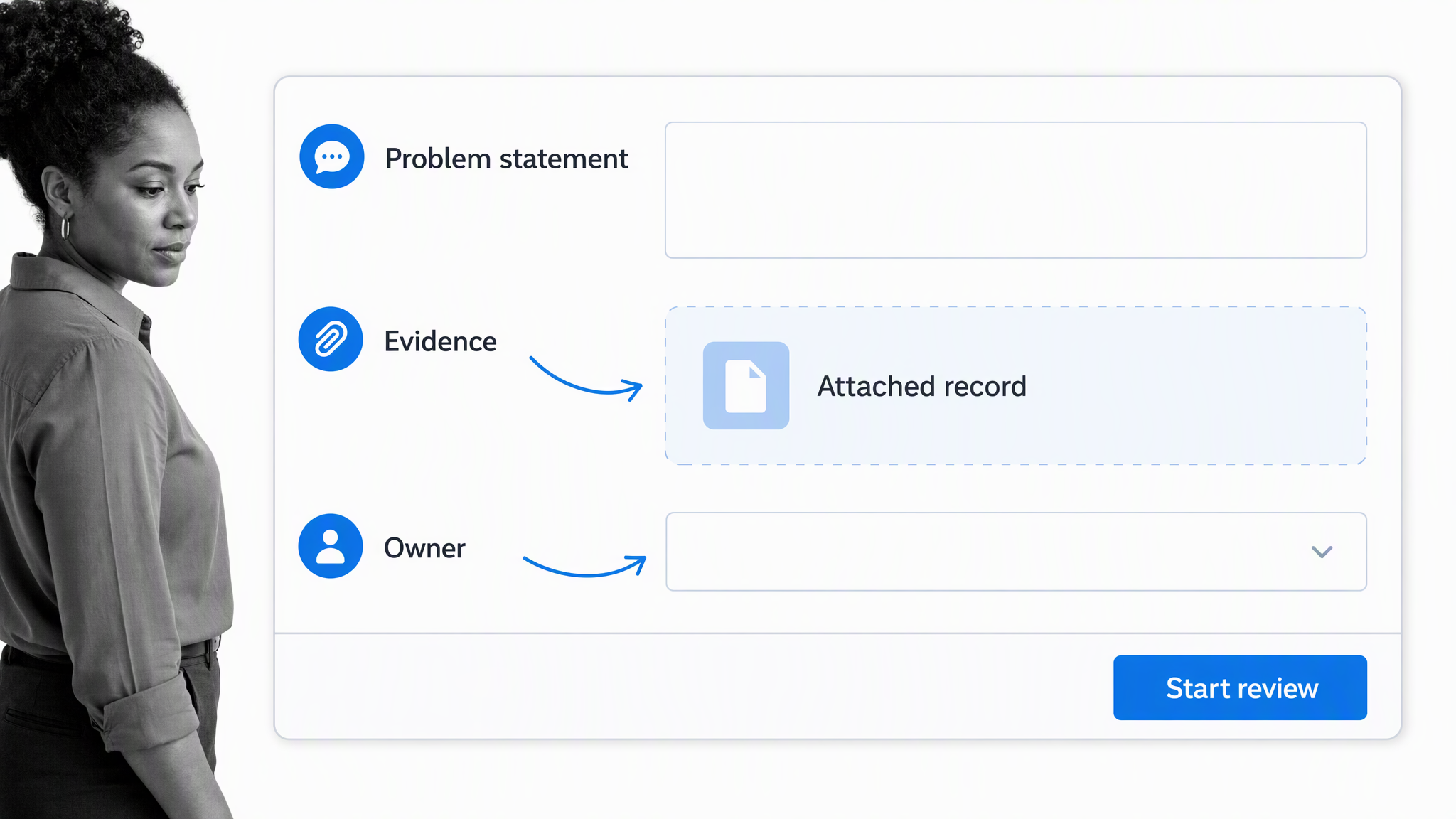
Begin by describing the problem in observable terms. Record what happened, where and when it happened, who or what was affected, and the evidence already available. Avoid a statement that assumes the cause. “The invoice approval missed the customer deadline by two days” is more useful than “Finance was too slow.”
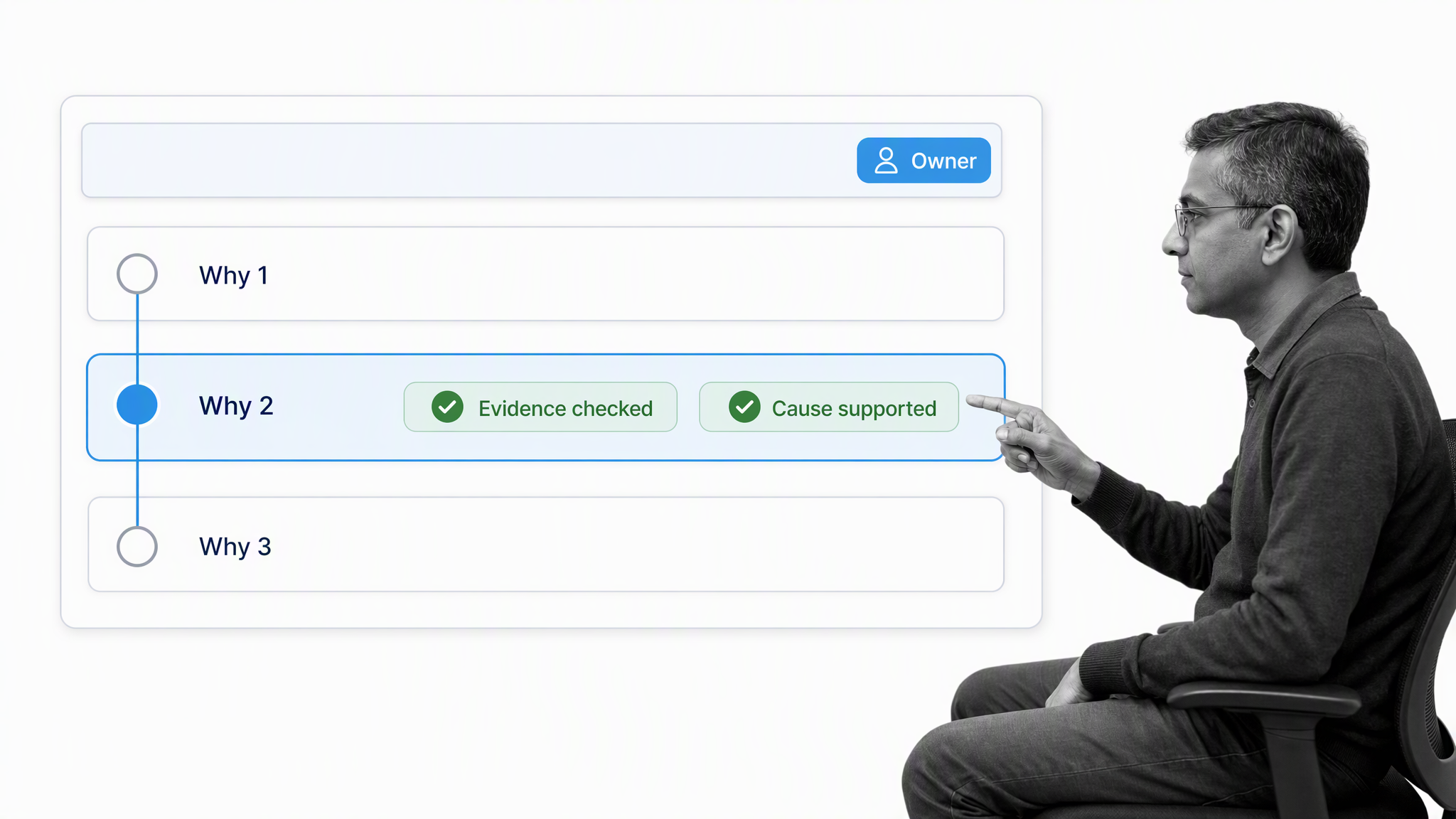
Ask the first why and record the answer. Before moving on, note what supports it: a timestamp, an error log, a conversation with the people who perform the work, a photo, a system record, or direct observation. Use each supported answer to frame the next question. If the chain branches, record the branches rather than discarding one to preserve a tidy sequence.
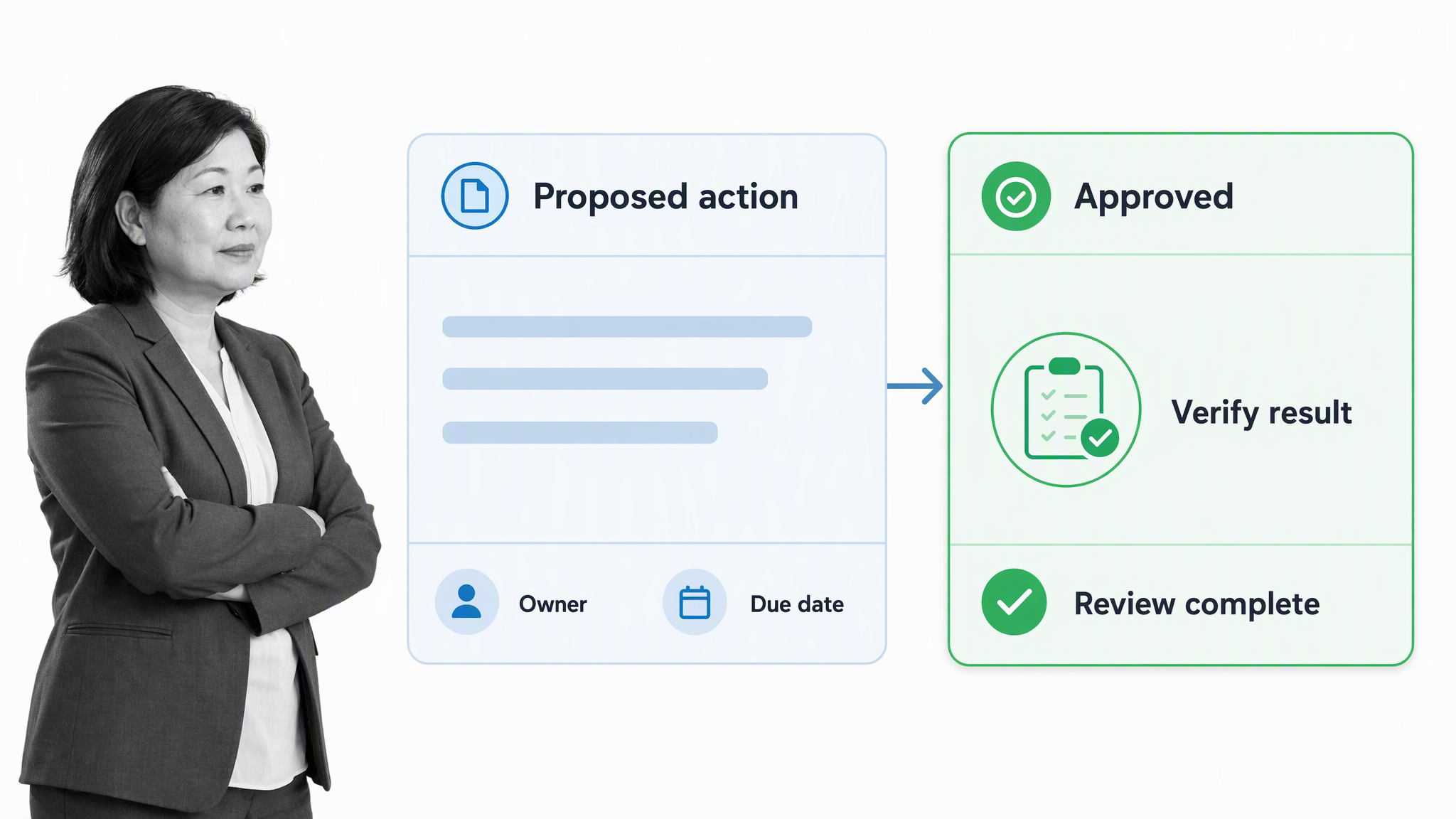
Once the team reaches an actionable cause, propose a countermeasure and send it to the appropriate reviewer. Assign an owner and due date, identify dependencies, and define how the team will verify the result. A completed action is not the same as a solved problem. The original measure must improve, and the improvement should hold over time.
Choose countermeasures that change the conditions that produced the failure. A reminder may help briefly, but a clearer intake rule, an automated validation, a better handoff, or a redesigned approval path is easier to sustain and audit. If several actions are possible, compare their expected impact, implementation effort, risk, and reversibility before selecting one.
Use the free 5 Whys template to run the investigation in a consistent format. The workflow keeps the problem statement, evidence, questions, countermeasure, approval, and follow-up review connected in one auditable record.
The template begins with basic information: the issue at hand, the people involved, and the person responsible for reviewing the proposed response. Its guided tasks help the team work through the iterative whys efficiently and effectively. Once the root is supported, the team can suggest several countermeasures, consider both short-term and long-term effects, and send the chosen response for approval.
If the countermeasure is rejected, return to the evidence, think through alternatives, and resubmit it for approval. When it is approved, assign the work and put the action into practice. Then review the result rather than assuming that a completed task solved the original problem. This loop preserves the useful logic of the original checklist while making verification explicit.
A strong run records who is leading the investigation, who needs to approve the countermeasure, and exactly what issue or problem is at hand. The guided workflow can pull the problem statement and supported root cause into the decision step so reviewers can properly consider appropriate countermeasures. If the first proposal is rejected, the team goes back to the drawing board with the same evidence instead of losing context in email. Approval is followed by action, measurement, and a scheduled verification task.
The assigned reviewer can be automatically notified when the proposed countermeasures are ready. If they are rejected, the investigator can add alternative countermeasures and resubmit them for approval. If they are approved, the workflow moves forward without losing the earlier answers. This is beneficial for recurring investigations because the decision history, task assignments, and supporting records remain available in one account rather than being scattered across messages.
Improving & taking control of your business with Process Street!
Process Street is a Compliance Operations Platform that connects governed process knowledge with repeatable execution. Docs provides the governance layer for policies and procedures. Ops turns those instructions into assigned, trackable workflows. Built-in AI helps teams find information, support execution, and improve processes without separating guidance from the work itself.
For a 5 Whys investigation, that means the analysis does not disappear into a document after the meeting. Teams can capture evidence, route approvals, assign corrective actions, retain an audit trail, and schedule the follow-up that proves whether the countermeasure worked. The method becomes part of a controlled improvement process rather than a one-off conversation.
Teams can document workflows, business processes, and integral procedures in Docs, then run the recurring work through Ops. Assignments, dynamic due dates, task permissions, role-based responsibilities, forms, conditional paths, webhooks, and approvals help people complete the right work in the right order. These controls reduce human error while keeping the operating record connected to the governing procedure. Built-in AI can help people find the relevant instruction and support execution inside the same platform.
Conditional logic, dynamic due dates, task permissions, task assignments, role assignments, webhooks, embedded forms, and approvals are available to model the real operating path. These capabilities can keep human error at bay, notify the right participant, and show the next action without forcing every case through the same route. Teams can add controls where risk is higher while keeping a straightforward path for routine work.
The result is more than a run-of-the-mill checklist. A process owner can see whether tasks were completed, which countermeasures were approved, what evidence was attached, and whether the expected outcome held over the short term and long term. That makes a 5 Whys workflow useful for recurring quality work, audit preparation, incident follow-up, and continuous improvement across operations.
Related guides can help when the problem requires a broader method: use DMAIC for a measured improvement cycle, FMEA to anticipate and prioritize failure modes, or continuous improvement to build recurring review into everyday operations.
Additional root cause analysis resources
These additional resources are useful when 5 Whys reveals that the problem is larger than one causal chain. Choose the method that fits the decision, the available evidence, and the consequences of being wrong rather than forcing every situation into the same template.
Different problems call for different analysis tools. FMEA is useful when a team needs to identify possible failure modes before they occur. SWOT analysis can organize strategic strengths, weaknesses, opportunities, and threats. VRIO analysis examines whether resources are valuable, rare, difficult to imitate, and supported by the organization. SMART goals turn a chosen countermeasure into a specific, measurable commitment.
For more complex performance gaps, explore Six Sigma principles, Design for Six Sigma, the 8D problem-solving method, or gap analysis. Workflow analysis and business process analysis can also reveal handoff, ownership, and control problems that a single causal chain might miss.
5 Whys FAQs
The post How Asking ‘Why?’ 5 Times Can Potentially Save Your Business (Free 5 Whys Template) first appeared on Process Street | Compliance Operations Platform.


0 Commentaires