
Employee onboarding improvements matter because the first few weeks decide whether a new hire feels clear, supported, and able to contribute. If the onboarding process is scattered across emails, documents, manager memory, and last-minute reminders, the employee feels that friction immediately.
That friction is expensive. Gallup reports that only 12% of employees strongly agree their company does a great job of onboarding, and weak onboarding makes it harder to build the trust and role clarity new hires need.
This guide covers practical ways to improve your employee onboarding process, from pre-boarding and 30/60/90-day timelines to manager check-ins, feedback loops, and workflow automation in Process Street.
- What’s the problem with the onboarding process?
- What you get from improving the onboarding process
- How to improve the employee onboarding process
- Constantly improving helps you get better onboarding results
What’s the problem with the onboarding process?
Your onboarding program has the power to boost retention, decrease hiring costs, and increase productivity. When the process needs improvement, the damage shows up quickly:
The onboarding experience is the first operational promise your company makes after an offer is accepted. New employees are evaluating the company just as carefully as the company is evaluating them.
If the hiring process promised support, structure, and collaboration, onboarding has to prove those promises in the first days and weeks.
For example, you might have advertised a collaborative workplace community. However, once they arrive, they find themselves in an empty room with a stack of paperwork without any clear guidance and direction.
That kind of gap makes a new hire feel misled and demotivated, which is exactly what onboarding improvements are supposed to prevent.
What you get from improving the onboarding process
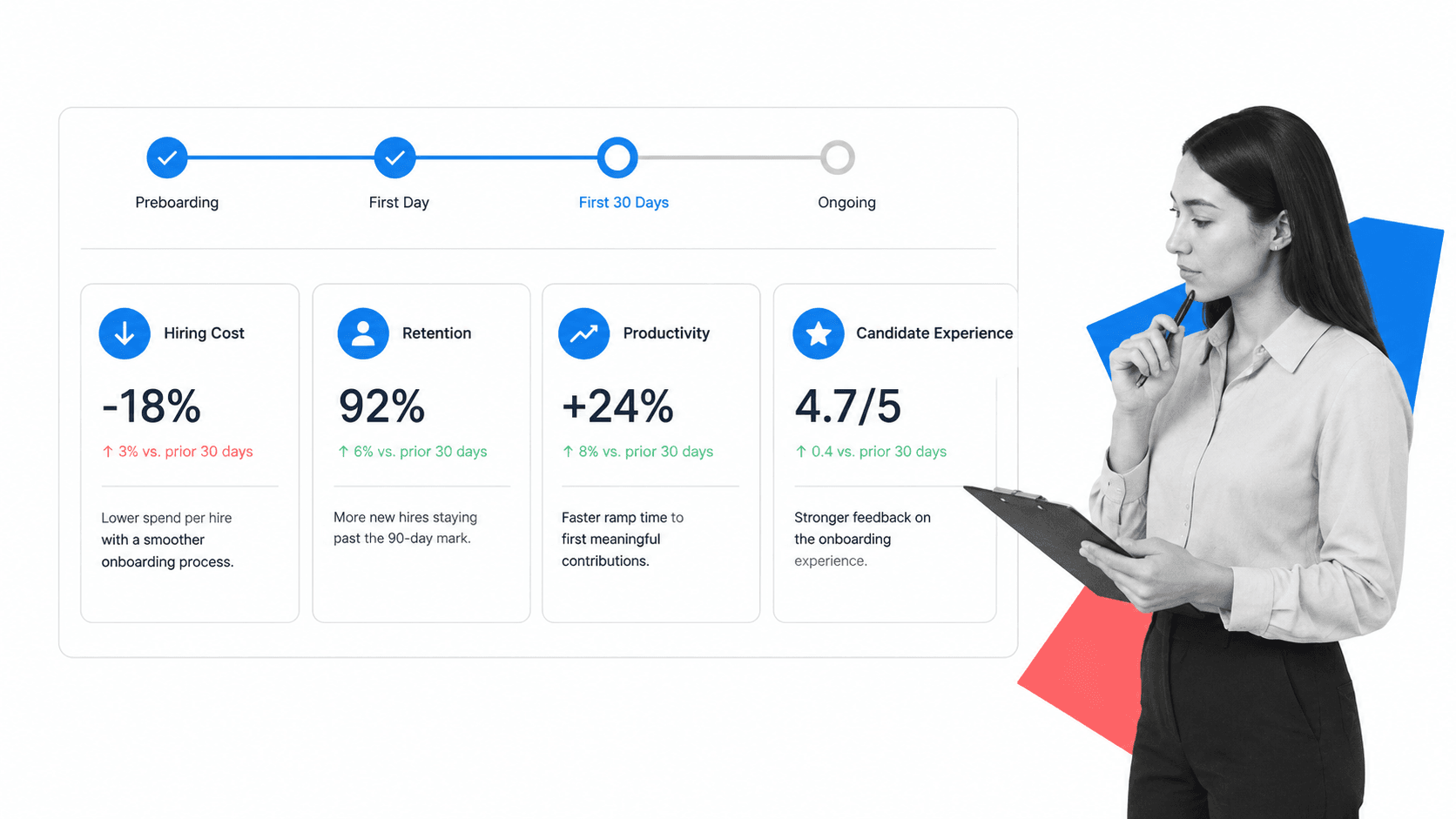
Onboarding improvements are an investment. Here’s what you can get from making these onboarding improvements:
Reduced hiring costs
Welcoming a new employee to your team is not cheap. SHRM puts average cost per hire at nearly $4,700 before you account for manager time, equipment, system access, and training effort.
But a new hire doesn’t only involve recruitment. Trainer and senior employee labor are included during the orientation and onboarding phase. HR effort is focused on getting new employees acclimatized to their new roles.
That’s a worthwhile investment if your new hire remains, but you can easily skyrocket your recruitment costs if this new employee quits after a short time.
When you provide an effective onboarding experience, you spend less time replacing people who left before they had a fair chance to succeed.
Enhanced employee retention
Turnover is expensive even before you count the lost knowledge, delayed projects, and manager time that comes with replacing someone. If employees do not have a positive experience early, they can quickly start looking elsewhere.
Improving your onboarding process can help increase employee retention rates. This is because a good onboarding experience helps them:
- Acclimate to their role;
- Understand the company culture;
- Feel comfortable and welcome.
One of the best ways to help an employee settle in is to offer a structured onboarding program. SHRM cites research showing new hires are 58% more likely to still be with the company three years later when they complete structured onboarding.
Quicker employee productivity
When a new hire starts at a company, they aren’t immediately productive in their new role. They need to get through the normal ‘newbie’ stuff, like meeting their colleagues and getting familiar with common company processes.
Between doing all of this, it can take a few months for a new employee to feel settled in their role and reach their full potential. By onboarding efficiently, employers can reduce this time to proficiency.
As a result, the new employee can become 70% more productive.
Easier candidate attraction
Potential job applicants typically browse through sites like Indeed and Glassdoor to grasp what it would be like working for a specific company. Reviews from satisfied current and former employees leave a fantastic first impression on candidates.
In contrast, you’re not going to attract many top talent candidates if you have negative reviews from former employees.
A poor onboarding experience also affects your employer brand. New hires talk about whether the company was organized, whether managers showed up, and whether the first week matched what recruiting promised.
Offering a good onboarding process to your employees can help you attract quality talent while also boasting long-term retention, benefiting the organization’s bottom line.
How to improve your employee onboarding process
You’ve seen how you can benefit from making onboarding improvements and offering a good experience to new hires. Now, let’s see how you can make these improvements to your onboarding process.
1. Pre-board your new hires
You should start preparing for your new hire’s arrival once they’ve signed on the dotted line.
If you’re not prepared for their arrival, they’ll lose faith in your organization’s ability to manage its workforce. It will show as a lack of effort and will leave a bad first impression.
This is a recipe for employee turnover disaster, which you want to avoid at all costs. You can do this by:
- Sending out announcements to your company welcoming a new employee;
- Sending a company handbook to the new employee detailing how they can prepare for their first day;
- Completing all paperwork before the new hire’s first day;
- Grant access to company accounts before they arrive;
- Asking for feedback on your recruiting experience.
2. Establish a timeline
You want your new employee to reach full proficiency quickly. However, that doesn’t mean you need to load them with tons of tasks to ensure they get down to their “real work” quicker.
A useful onboarding timeline gives each stakeholder a clear sequence: what HR owns before day one, what IT must finish before login, what the manager covers in week one, and what the employee should understand by day 30, day 60, and day 90.
Instead, you should establish an onboarding timeline for these hires to follow.
When doing this, you can easily monitor their progress with the help of a workflow management tool (like Process Street’s Dashboard) and check in during crucial time-based milestones. For example, their first week, month, and 3 months.
3. Engage new hires before their first day
Qualified candidates are likely to receive multiple offers. So, there’s no guarantee that they’ll take the position even if they’ve agreed to work at your company.
Ghosting employers for a different opportunity isn’t uncommon. 84% of job seekers ghost recruiters because they aren’t engaged before their arrival.
However, you can prevent this from happening by engaging with them before their start date. Your goal in doing this is to keep them excited about their new role before their arrival. In doing this, you make them feel valued and solidify that they’ve made the right decision by picking your company.
Here are some great ways to start engaging your new hires before their arrival:
- Provide a ‘what to expect’ handbook with their first-day itinerary, where they can park, and what they should wear.
- Send a welcome email with company account access details.
- Introduce them on company instant messaging platforms (like Slack).
4. Provide engaging training resources
You want to bring your new hires up to speed as soon as possible. Engaging training resources can do that.
This shouldn’t be a bunch of reading materials that are going to make your new hire want to pull their hair out strand by strand.
Short videos can help, especially for culture, tools, and process walkthroughs. They work best when they sit inside a structured onboarding workflow with tasks, due dates, and manager review steps.
Mix formats so the employee is not forced to learn everything the same way. Use videos for context, SOPs for repeatable steps, checklists for execution, and manager conversations for judgment.
Another excellent way to incorporate videos into your training is by using them to communicate your organization’s values and mission. You can use these videos to shed light on what your company culture is like and how it is to work in your organization. Employee testimonials are also a great introduction to a company.
5. Schedule one-on-one meetings
Almost 72% of employees believe that having dedicated one-on-one meetings with their managers is crucial to their onboarding success.
Don’t underestimate the power of spending personal time with your new employees and checking up on them regularly. During these meetings, you should let them know how they can progress in their careers and what’s expected of them during onboarding and in the long term.
6. Use mentoring programs
Employees need working relationships to truly flourish in an organization. Mentors and buddies help new hires learn how decisions get made, who owns what, and which norms are not written down in the handbook.
By providing mentoring programs to your new hires, you help foster these work connections and nurture future collaboration. Assigning a mentor to the new employee from their first day makes them feel part of the team almost instantly. With a mentor, they’re rapidly integrated into the company culture and set to feel more comfortable in their role.
7. Complete performance reviews
Checking in with your new hire isn’t enough. You also want to be getting a tangible report on the new hire’s progress.
When you conduct performance reviews, you gain more insight into how well they’re adapting to the company culture and their new role.
If you see any issues with their performance, you can implement an action plan immediately. This is far better than discovering one year into their employment when they’re unmotivated and unengaged.
Otherwise, you never find out because they left your company before you could assess their performance and find the issue.
8. Automate tedious tasks
The onboarding process has many repeatable tasks that should not depend on memory: sending forms, assigning equipment, routing approvals, scheduling check-ins, and collecting feedback. The automations offered with Process Street let you build those steps into a live workflow.
By adding automation to the onboarding program, HR spends less time following up and chasing progress reports. If you need a structured starting point, Process Street’s employee onboarding guide gives HR, IT, managers, and new hires one shared workflow model for the process.
Automated notifications can inform new employees when documents are due, when work has been approved, and when tasks are incomplete. You can also add approvals, role-based assignments, conditional logic, and feedback tasks so onboarding stays consistent without becoming rigid.
9. Ask for feedback
An excellent way to improve the onboarding experience is to ask new hires for their feedback. You gain valuable insight from those that have undergone the onboarding process.
One way to get this feedback is by sending out anonymous surveys. These allow new hires to be open and honest about their experiences without any backlash.
Plus, you get genuine feedback that you can act on. It’s a win-win. Even better, we have a workflow just for that right here!
10. Regularly review the process
No matter what you do, there’s always room for improvement. That’s why it’s a good idea to keep an eye on how your new employees progress through their onboarding.
Some tasks become redundant, some resources need updating, and some handoffs keep causing delays. Review the process with real onboarding data: task completion rates, time to productivity, 30/60/90-day feedback, manager comments, and early retention. That is how onboarding improvements compound instead of turning into one-off fixes.
Constantly improving helps you get better onboarding results
Onboarding is the foundation for any new hire in your company. A good onboarding experience will set them up for success.
However, the best onboarding process is never finished. Teams change, tools change, and new hires keep showing you where the process is unclear.
Maintaining a good onboarding process means continuously improving the workflow without breaking the experience for the people already in it.
Process Street is a Compliance Operations Platform that helps teams document the process in Docs, execute it in Ops, and use Cora to spot risks and improvement opportunities. Whatever changes you need to make to your onboarding process can be rolled into the workflow without rebuilding everything from scratch.
The best place to start is simple: pick one onboarding handoff that still depends on memory, turn it into a clear workflow, and review the results after the next cohort completes it.
The post 10 Ways You Can Make Employee Onboarding Improvements first appeared on Process Street | Compliance Operations Platform.


0 Commentaires