
GRI Standards are a globally used system for organizations to report their most significant impacts on the economy, environment, and people in a consistent and credible way. They help a business move from broad sustainability claims to evidence that stakeholders can examine, compare, and act on.
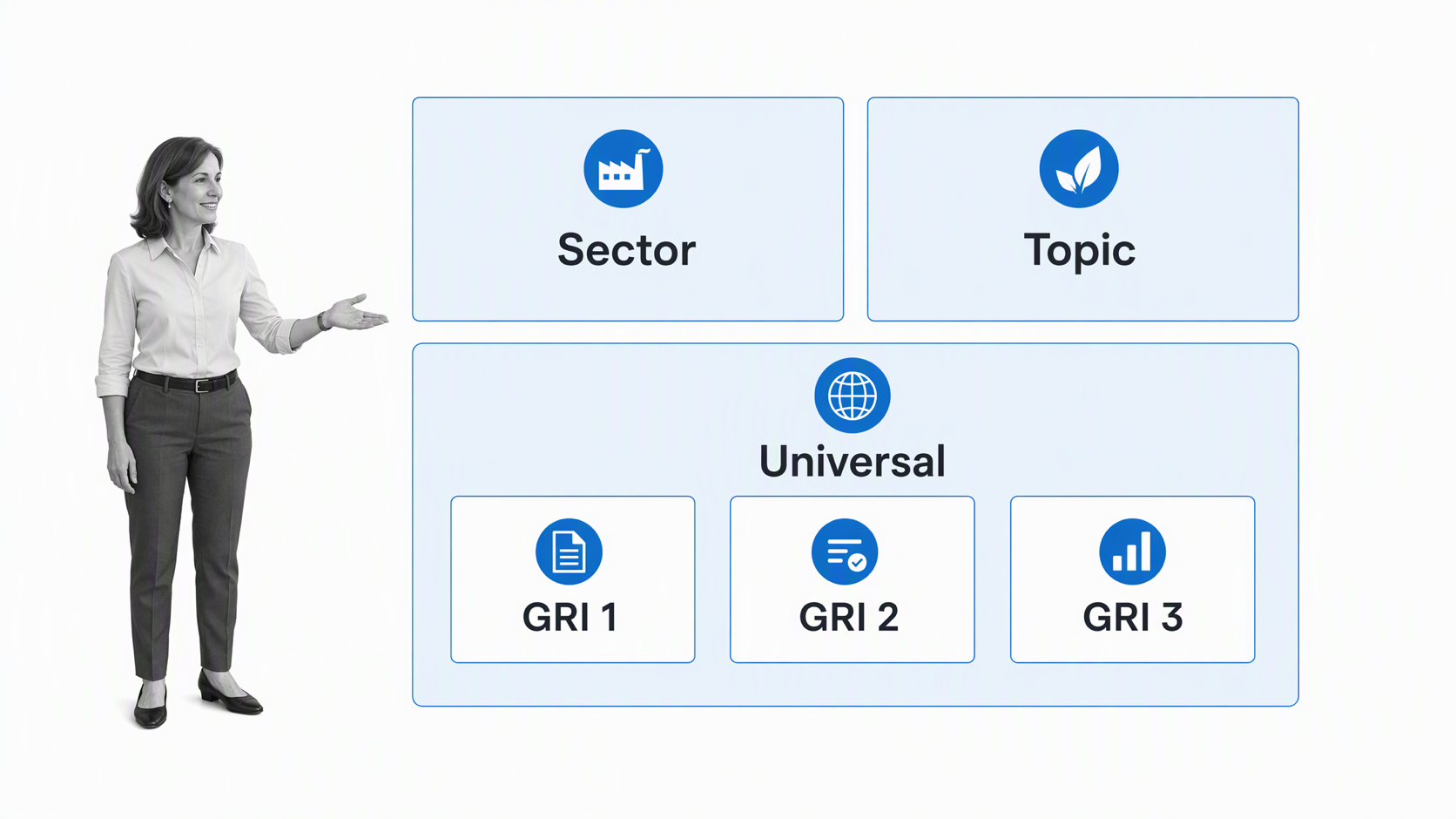
The current system is modular. GRI 1 sets the foundation and reporting requirements, GRI 2 covers general disclosures about the organization, and GRI 3 explains how to determine material topics. Sector Standards and Topic Standards then add the disclosures needed for a particular context and impact. This guide explains why that structure matters and how to operate GRI reporting as a controlled business process.
The need for a common sustainability reporting baseline
A polished sustainability statement can be persuasive while still leaving the reader unable to test the underlying claim. The problem is not new. A historical Viceroy cigarette campaign once framed smoking as compatible with dental health. Today, the evidence makes the contradiction obvious. Sustainability marketing can create the same gap when a company presents a green image without disclosing the impacts, methods, boundaries, and evidence behind it.
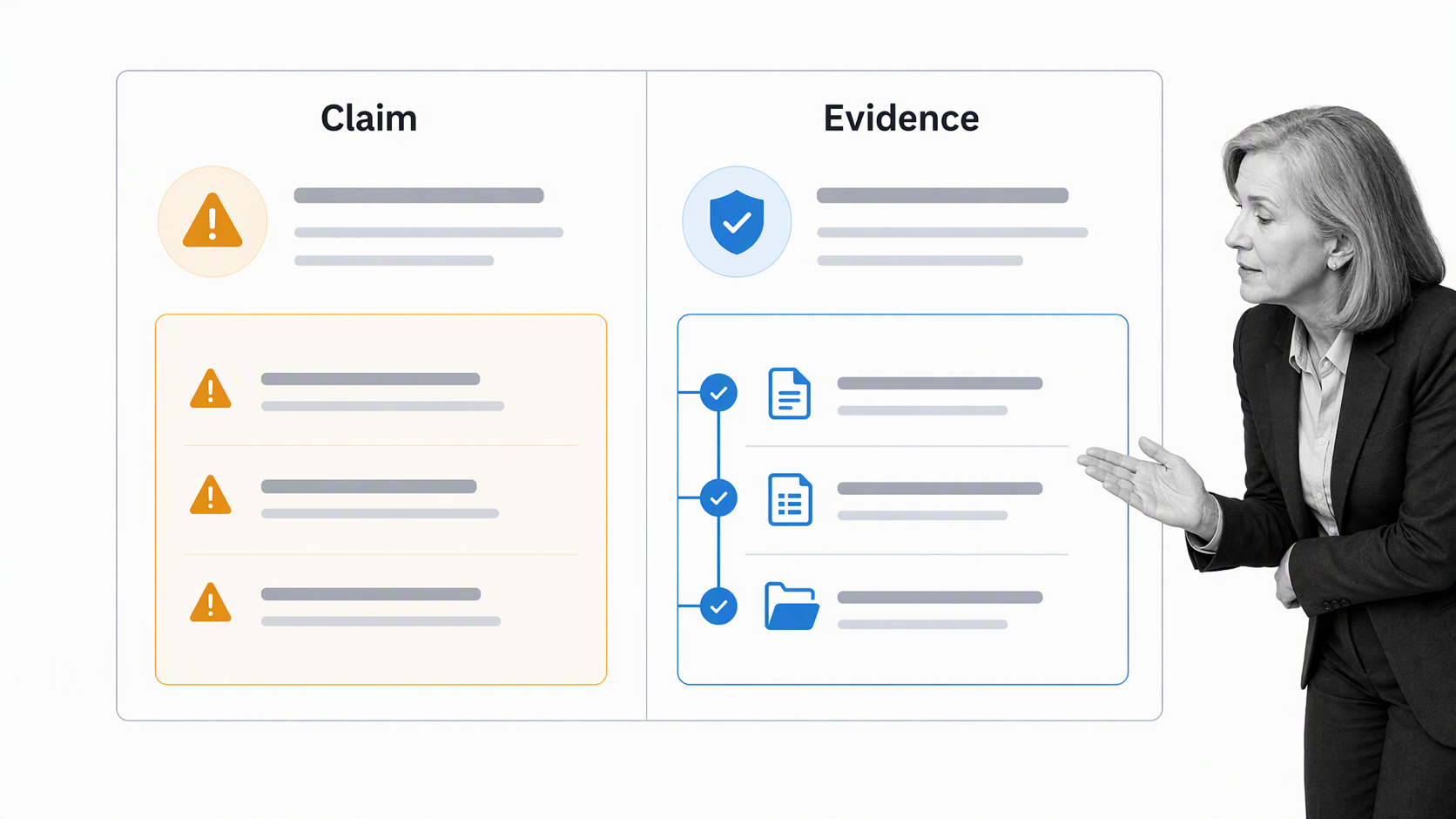
Consider that Viceroy campaign as an example of a false advertisement. It is only with today’s knowledge about the consequential impacts of smoking that the claim looks so outrageous. Smoking will never be prescribed by a dentist, and it is damaging to teeth and health. False advertisement via greenwashing can be just as detrimental because the harm is obscured by language that sounds responsible.
Greenwashing uses misleading or unsupported environmental claims to make a product, service, or organization appear more responsible than the evidence supports. The claim may be technically narrow, omit a material impact, use an irrelevant label, or rely on a target without explaining the baseline and plan.
The controversy does not always glow as blatantly as it does in an old cigarette advertisement. Peel away the green patina, however, and an advertisement’s claim to sustainability may be full of hot air and have little substance. Greenwashing is the practice of making an unsubstantiated or misleading claim about the environmental benefits of a product, service, technology, or company practice. It can make an organization appear more environmentally friendly than it really is.
An older Shell advertising campaign offers another useful lesson. The campaign described investment in future solutions while critics and regulators questioned whether the presentation accurately represented the company’s wider activities. The important point is not a dated statistic about one project. It is the durable distinction between a message and a disclosure. A message selects what an organization wants an audience to notice. A disclosure must define what is being reported, describe the significant impacts, and give stakeholders enough information to evaluate the result.
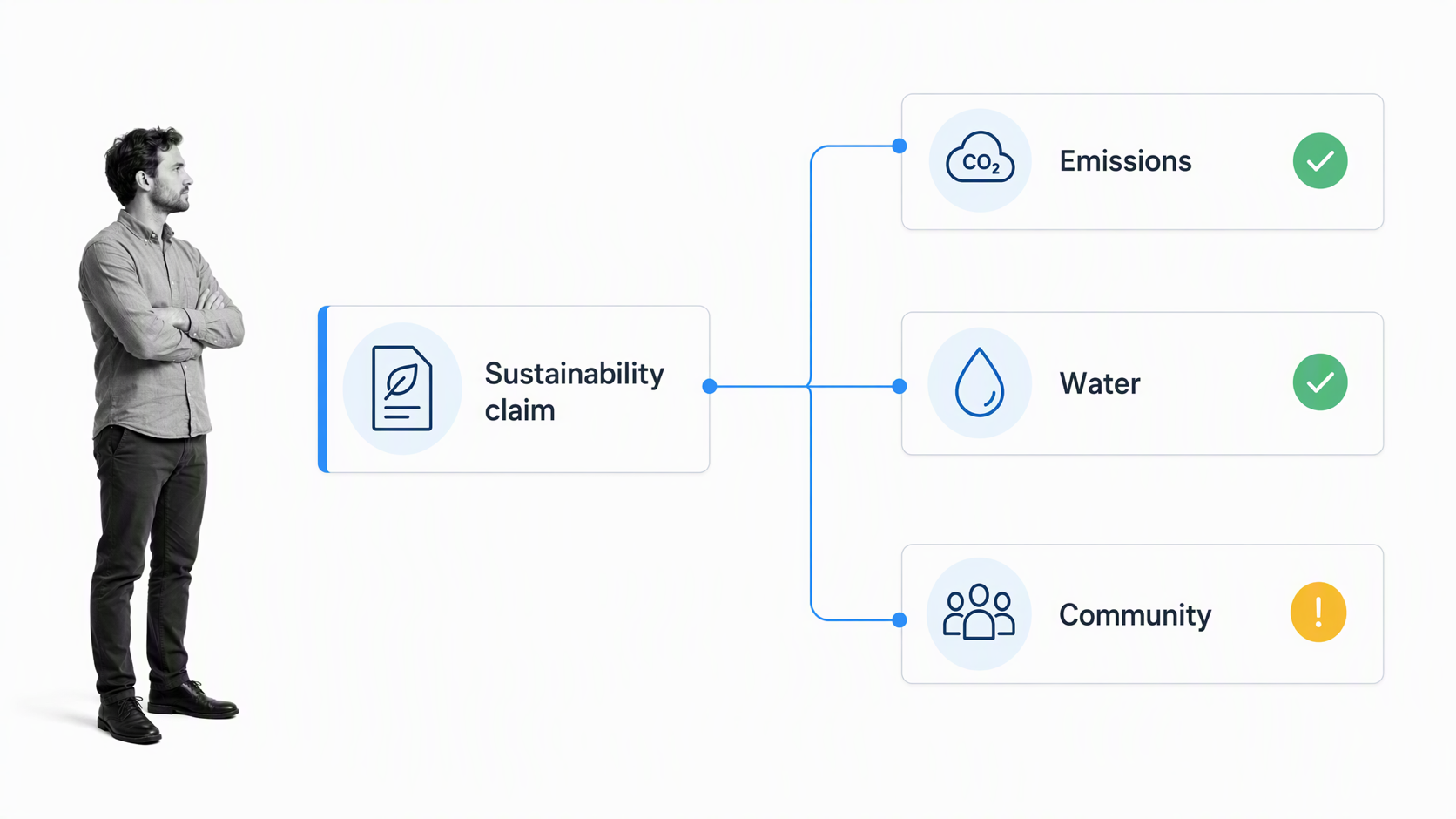
The original campaign was soon branded as greenwashing by the Advertising Standards Authority. That action was possible because an apparently positive environmental message could be compared with information about the activity it promoted. The comparison illustrates why disclosure matters. Without consistent information, a company’s sustainability efforts can be drowned under false claims of a green persona. With transparency of information, potentially damaging claims to sustainability can be recognized and questioned.
GRI reporting creates a common language for that disclosure. It asks the reporting organization to identify its impacts and explain how those impacts are managed. It also establishes reporting principles and requirements that make omissions, boundaries, estimates, and changes easier to see. That transparency does not guarantee good performance. It does make performance easier to scrutinize.
This is why the audience for a sustainability report is broader than investors alone. Employees, communities, customers, suppliers, regulators, civil-society groups, and business partners may all need to understand how the organization affects them. Their information needs help the organization identify impacts that a purely financial view could miss.
We all live under the same sky, so stakeholders need to know which impacts a business creates rather than be deceived by a false pretense of green business. GRI Standards help third parties assess an organization’s activities and the economic, environmental, and social impacts connected with them. That gives affected stakeholders a stronger basis for asking questions and deciding whether commitments and performance align.
The business value of structured GRI reporting
GRI reporting is all about disclosure of information in a set, standard way, so that information about an organization’s economic, environmental, and social performance can be quantified and compared. A systematic approach to reporting creates a shared structure for the reporting team, the specialists who supply data, the leaders who approve disclosures, and the stakeholders who use the finished report.
GRI reporting is the disclosure of information in a structured, repeatable way. The discipline can improve more than the final report. Collecting evidence from across the organization forces teams to define data owners, reporting boundaries, review criteria, and escalation paths. It can reveal where a policy is not being followed, where a target lacks a baseline, or where nobody owns a material impact.
- Improved sustainability performance: Track significant impacts, management actions, and progress with consistent evidence.
- Improved risk management and investor communications: Surface environmental, social, legal, operational, and reputational exposure earlier.
- Engagement with stakeholders and improved stakeholder relations: Give affected groups a clearer basis for questions and decisions.
- Motivated and engaged employees: Assign disclosures and evidence to responsible owners instead of relying on one reporting team.
- Stronger credibility as a committed and effective corporate citizen: Connect public statements to disclosed impacts, policies, actions, and evidence.
- Stronger internal data management and reporting systems: Standardize definitions, sources, controls, and review cycles across functions.
- Improved sustainability strategy and selection of performance indicators and targets: Use the reporting process to improve decisions as well as disclosure.
- A means to benchmark sustainability performance against self and others: Compare the organization with prior reporting periods and, where methods align, with peers.
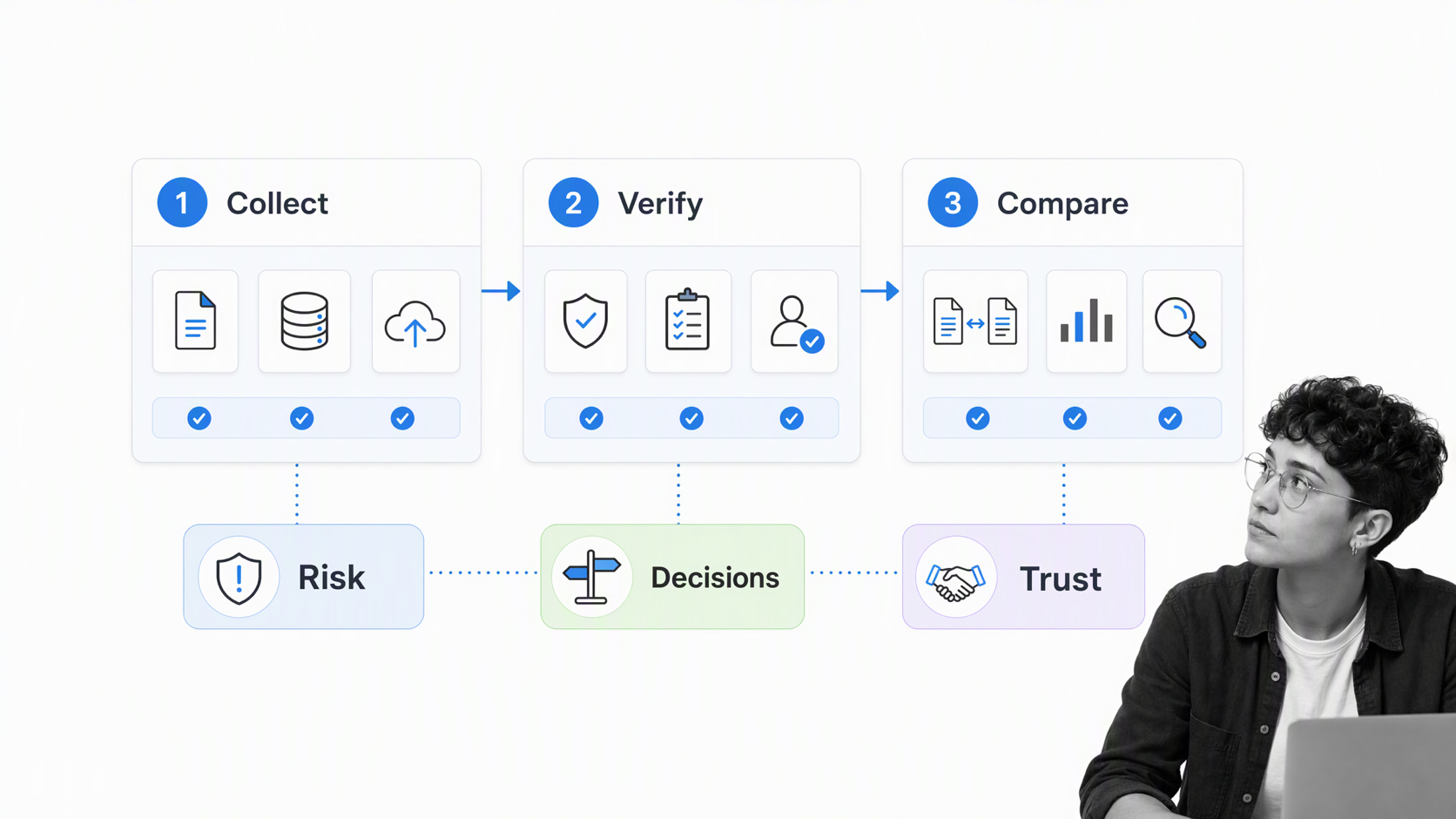
Those benefits depend on the quality of the process. A report assembled through last-minute email requests may reproduce the same inconsistencies every year. A controlled reporting system keeps the approved guidance, work instructions, evidence, review decisions, and audit history connected. That makes the next reporting cycle easier to run and easier to defend.
The current GRI Standards system
GRI began in the late 1990s and released its first sustainability reporting guidelines in 2000. The standards have evolved substantially since then. The current structure replaced the older 2016 Universal Standards identified as GRI 101, GRI 102, and GRI 103. For reporting today, the relevant Universal Standards are GRI 1: Foundation 2021, GRI 2: General Disclosures 2021, and GRI 3: Material Topics 2021. They became effective for reporting on January 1, 2023.
GRI Standards were produced to provide an international, standardized language that organizations could use to report on their sustainability efforts. They disclose information about corporate impacts, both negative and positive, on economic, environmental, and social conditions. In practical terms, the Standards help businesses produce a sustainability report so activities can be assessed and improved upon in pursuit of long-term business success.
The early work grew from a United States-based initiative involving Ceres, the Tellus Institute, and the United Nations Environment Programme. GRI later became an independent international organization. Its Standards operate worldwide, and their adoption has grown as the relationship between the environment, society, and the economy has become more widely understood. The history matters because GRI reporting was designed as a public-accountability system, not merely a marketing format.
Laws, stock-exchange rules, and sustainability disclosure requirements vary by jurisdiction and continue to evolve. An organization should confirm which rules apply to it rather than assume that GRI reporting alone satisfies every legal obligation. GRI also works toward interoperability with other reporting initiatives, helping organizations use impact information alongside investor-focused or jurisdiction-specific requirements without treating the systems as interchangeable.
Universal Standards
Every organization reporting in accordance with the GRI Standards uses the Universal Standards. GRI 1 explains the purpose and system of the standards, the reporting principles, and the requirements for reporting in accordance with GRI. GRI 2 contains disclosures about the organization and its reporting practices, activities, workers, governance, strategy, policies, and stakeholder engagement. GRI 3 provides the process for determining material topics and the disclosures for reporting how each material topic is managed.
Sector Standards
Sector Standards identify topics that are likely to be material for organizations in a particular sector. When an applicable Sector Standard exists, the organization uses it while determining material topics. It does not automatically make every listed topic material. Instead, it provides sector-specific context and a stronger starting point for considering impacts that might otherwise be overlooked.
Topic Standards
Topic Standards contain disclosures for reporting impacts related to a specific topic. Examples span economic, environmental, and social matters. The organization selects the Topic Standards that correspond to its material topics, then reports the required information or explains permitted reasons for omission in line with GRI 1.
The GRI Standards are structured as a set of interrelated modules that can be referenced and used together. After applying the Universal Standards, an organization looks at applicable Sector Standards and the topic-specific Standards needed for its material topics. This modular structure avoids forcing every organization to report every possible disclosure while still giving readers a consistent basis for understanding how the report was prepared.
A material topic is a topic that represents the organization’s most significant impacts on the economy, environment, and people, including impacts on human rights. This impact focus is important. GRI reporting is not simply a ranking of issues by their financial effect on the organization. It begins with the organization’s impacts, then documents how those impacts were identified, prioritized, and managed.
Running a controlled GRI reporting cycle
Producing a credible sustainability report involves recurring work across legal, finance, operations, procurement, people, environmental, risk, and communications teams. The reporting lead needs a reliable way to translate the standards into responsibilities and evidence without turning the process into a maze of spreadsheets and inbox threads.
Process Street is a Compliance Operations Platform that can connect that work in one product. Docs can hold governed reporting policies, definitions, methodologies, and disclosure guidance. Ops can coordinate recurring collection, review, approval, and exception handling. Built-in AI can help teams find approved knowledge, summarize submitted evidence, and flag missing information inside those controls.

Producing a sustainability report may initially seem daunting. Where do you start? What do you include? How do you make sure all key topics are reported on? The current Standards answer the reporting questions, while a controlled system makes their implementation actionable. Instead of static checklist templates tied to the former GRI 101, GRI 102, and GRI 103 editions, teams should build the workflow from the current GRI 1, GRI 2, and GRI 3 requirements and keep it aligned as the Standards change.
A practical workflow can assign every disclosure to an owner, require source evidence, route sensitive responses to the right reviewer, and preserve approval history. Conditional paths can account for entity, sector, geography, or topic differences. Due dates and escalations can keep the cycle moving, while the report owner maintains a clear view of outstanding evidence and unresolved decisions.
Required tasks can ensure task order and make sure no priority task goes incomplete. Conditional logic can apply the right disclosure path for a specific business and circumstance. Variables and standardized fields can condense information concisely, ease understanding, and enable a quick overview of the GRI Standards applied. These controls do not interpret the Standards for the organization, but they make the chosen interpretation and supporting evidence easier to review.
AI should support judgment, not replace it. A model can identify gaps or summarize evidence, but accountable people still need to determine material topics, validate calculations, approve disclosures, and decide whether the evidence supports the published statement. The controlled workflow should make that responsibility visible.
Putting the current requirements into practice
Foundation requirements in GRI 1
Begin by deciding whether the organization will report in accordance with the GRI Standards or use selected standards with reference to GRI. For an in-accordance report, work through the requirements in GRI 1 and apply the reporting principles. Define the reporting period, reporting boundary, contact point, publication timing, and approach to omissions before collecting disclosure text.
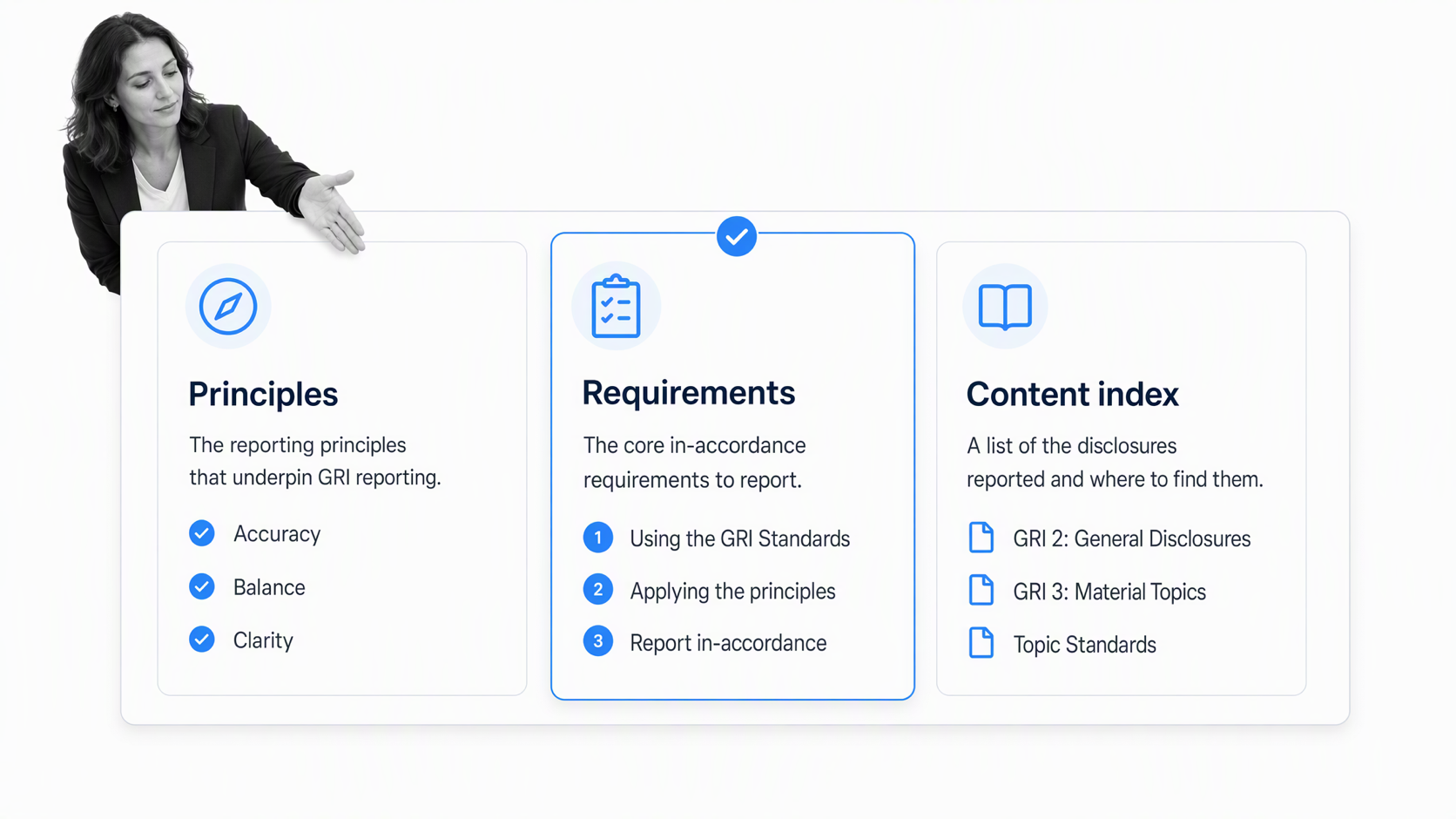
Create a content index as a controlled output, not an afterthought. It should show where each required disclosure appears and make omissions or reasons for omission easy to find. Record the version of every Standard used, including applicable Sector Standards, so reviewers can reproduce the basis of the report.
General disclosures under GRI 2
GRI 2 establishes the organizational context readers need to interpret the rest of the report. Evidence may come from corporate records, policies, governance materials, workforce systems, risk processes, procurement data, and stakeholder-engagement records. Assign each disclosure to the team closest to the source, then require a reviewer who understands both the evidence and the reporting requirement.
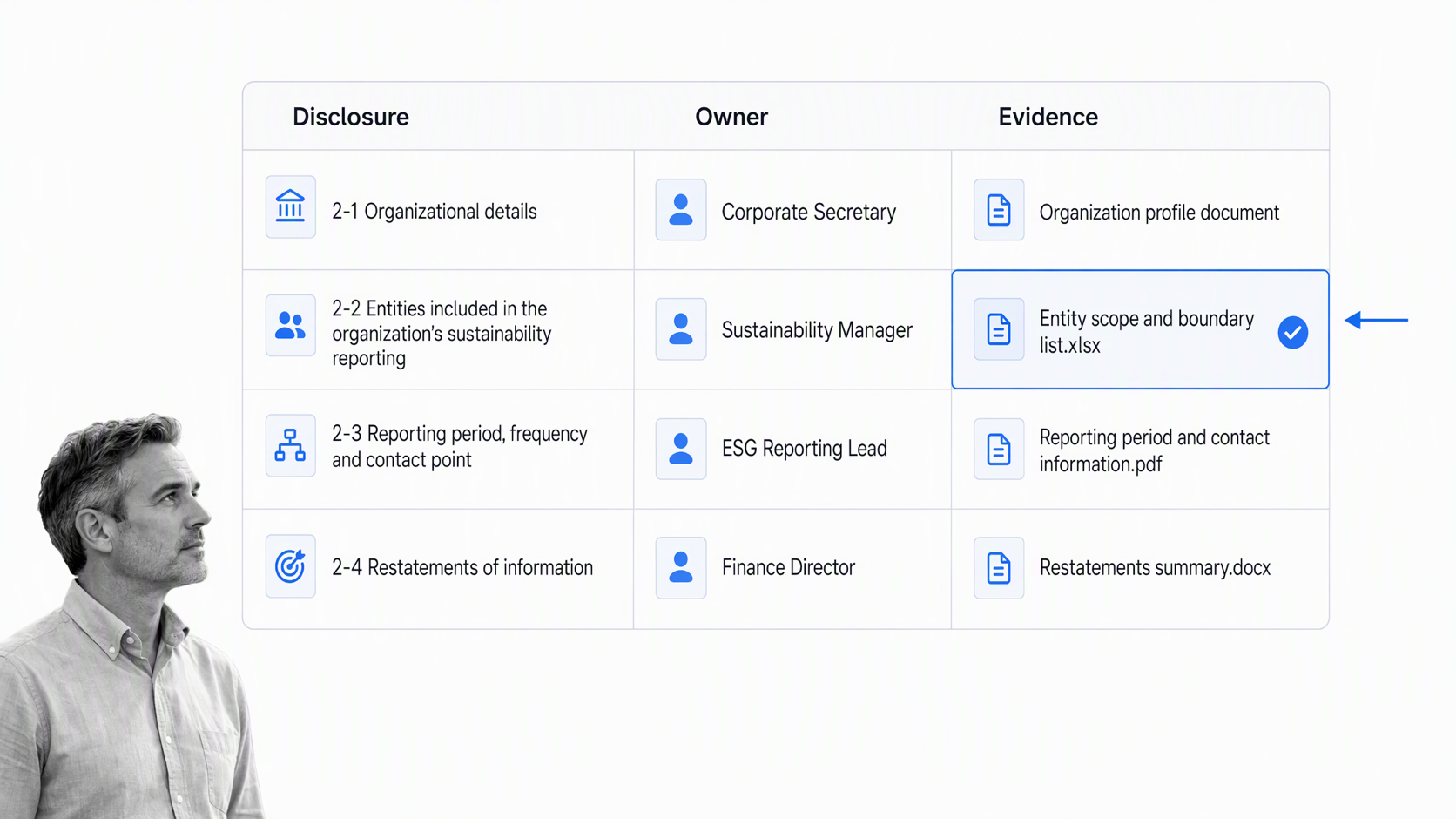
Use consistent definitions across the report. If the organizational boundary differs between workforce data and environmental data, explain the difference. If information is restated, document what changed and why. If a policy applies only to part of the organization, make that limitation visible rather than allowing a general statement to imply universal coverage.
Determine material topics with GRI 3
GRI 3 sets out a four-step process: understand the organization’s context; identify actual and potential impacts; assess the significance of those impacts; and prioritize the most significant impacts for reporting. The process should consider positive and negative impacts, short- and long-term impacts, intended and unintended impacts, and impacts connected to business relationships as well as direct operations.
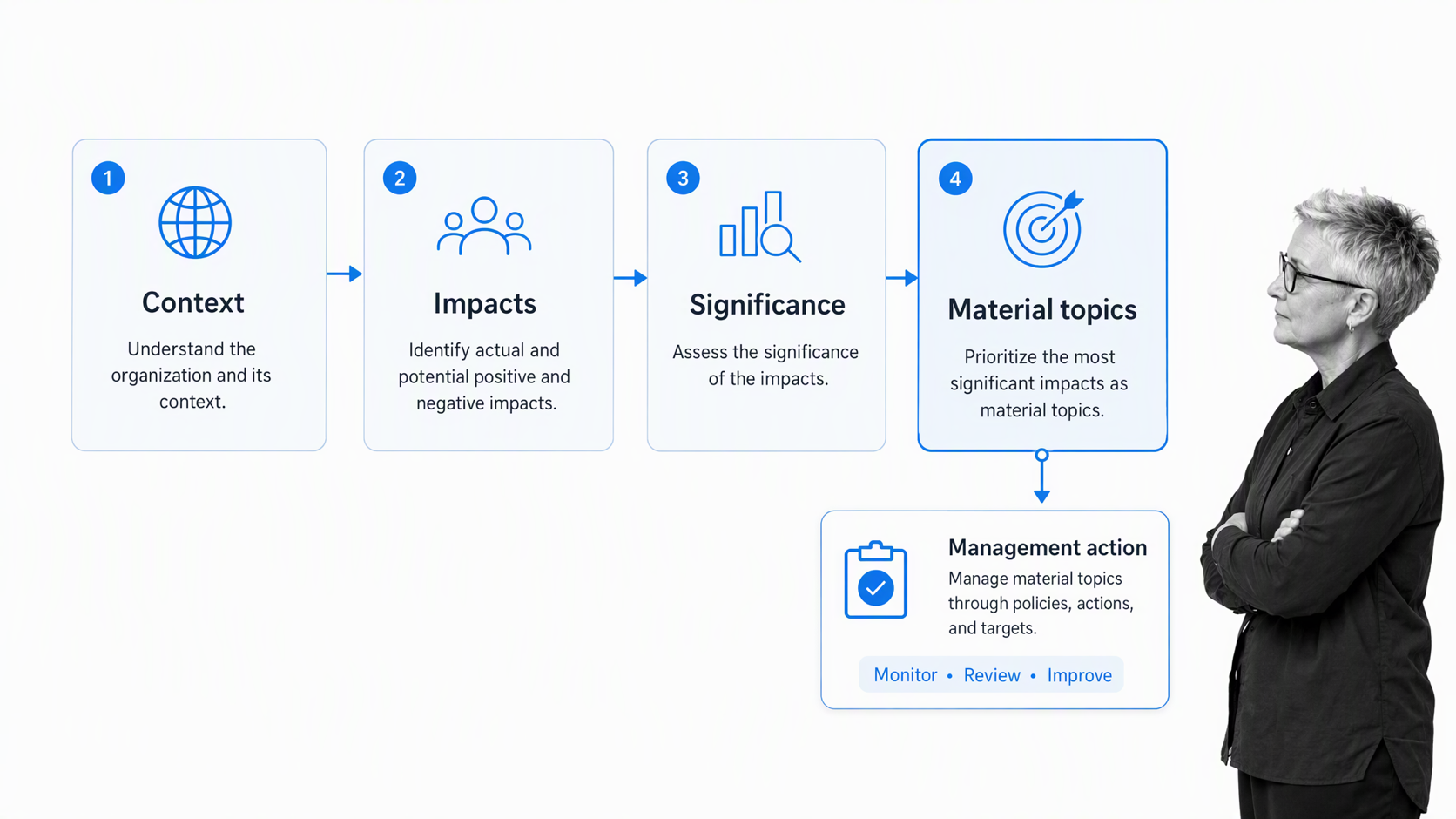
Stakeholder engagement and expert input inform the assessment, but management preference should not quietly remove a significant impact. Keep the criteria, evidence, participants, decisions, and approvals together. For every material topic, disclose how the organization manages the topic and use the relevant Topic Standard where one exists.
Build an evidence-ready sustainability report
A strong GRI report is not a collection of polished claims. It is the visible result of a repeatable system for identifying impacts, assigning ownership, collecting evidence, reviewing decisions, and explaining performance. Start with the current Universal Standards, use applicable Sector Standards to inform the material-topics process, and select Topic Standards for the impacts the organization has determined are material.
The report should also be understandable. Use precise language, define the reporting boundary, distinguish commitments from results, explain estimates and restatements, and connect every material claim to evidence. If the organization changes a method or target, preserve the decision trail so readers and future reporting teams can understand what changed.
That discipline turns sustainability reporting into an operating capability. Stakeholders receive clearer information. Owners know what they are accountable for. Reviewers can test the evidence. Leadership can see where performance, policy, and public claims do not yet align.
By creating a sustainability report that applies the current GRI Standards, an organization can assess its operations from a sustainability perspective. With that assessment, it can improve operations and adapt as a greener business while maintaining a record of the evidence and decisions behind the report. The value comes from combining disclosure with management action, not from treating publication as the end of the work.
Related sustainability resources
GRI reporting often connects with environmental management, internal audit, and integrated management systems. These Process Street resources can support adjacent work without replacing the current GRI Standards:
- ISO 14001 EMS Structure Template
- ISO 14001 Environmental Management Self-Audit Checklist
- ISO 9001 and ISO 14001 Integrated Management System (IMS) Checklist
- Environmental Accounting Internal Audit
- Hotel Sustainability Audit
- What is Environmental Management and How You Can Implement It?
- How You Can Create a Sustainable Business for Long-Term Business Success
GRI Standards FAQs
The post GRI Standards for Sustainability Reporting: What They Are and Why They Matter first appeared on Process Street | Compliance Operations Platform.


0 Commentaires