A freemium conversion rate is the percentage of eligible free users who become paying customers during a defined measurement window. Calculate it as paid conversions divided by eligible free users, multiplied by 100. For a useful result, keep the cohort, product surface, market, and time window consistent.
For self-serve B2B software, the 2026 ChartMogul and ProductLed conversion report places a good freemium conversion rate around 3% to 5% and a great one around 8% to 12%, measured across a six-month window. Spotify and Dropbox are instructive product examples, but their public user totals are subscriber-share ratios, not directly comparable cohort conversion rates.
That distinction matters. Spotify reported 300 million Premium subscribers and 777 million monthly active users in Q2 2026, so Premium subscribers represented about 38.6% of MAUs. Dropbox reported 18.19 million paying users in Q2 2026 and has described a base of more than 700 million registered users. Dropbox also warns that registrations are not unique users. The two denominators measure different things, so a clean Spotify-versus-Dropbox percentage contest would create false precision.
The historical comparison behind this article used 2015 figures of 26.6% for Spotify and 4% for Dropbox. That made Spotify’s ratio about 6.7 times Dropbox’s, not 667% higher in the strict mathematical sense. The durable lesson is not the headline arithmetic. It is how Spotify made free use feel valuable while steadily increasing the appeal of Premium.
| Public figure | Population | What it can show | What it cannot show |
|---|---|---|---|
| Spotify Premium share, 38.6% | Premium subscribers divided by monthly active users | Current paid share of the active audience | Conversion of a defined free-user cohort |
| Dropbox rough paying share, about 2.6% | Paying users divided by 700 million-plus registrations | Scale of paying accounts relative to reported registrations | A direct comparison with Spotify, because registrations are not unique active users |
| B2B freemium benchmark, 3% to 5% good | Eligible free users followed for six months | A directional benchmark for self-serve B2B software | A universal benchmark for consumer products |
What is a good freemium conversion rate?
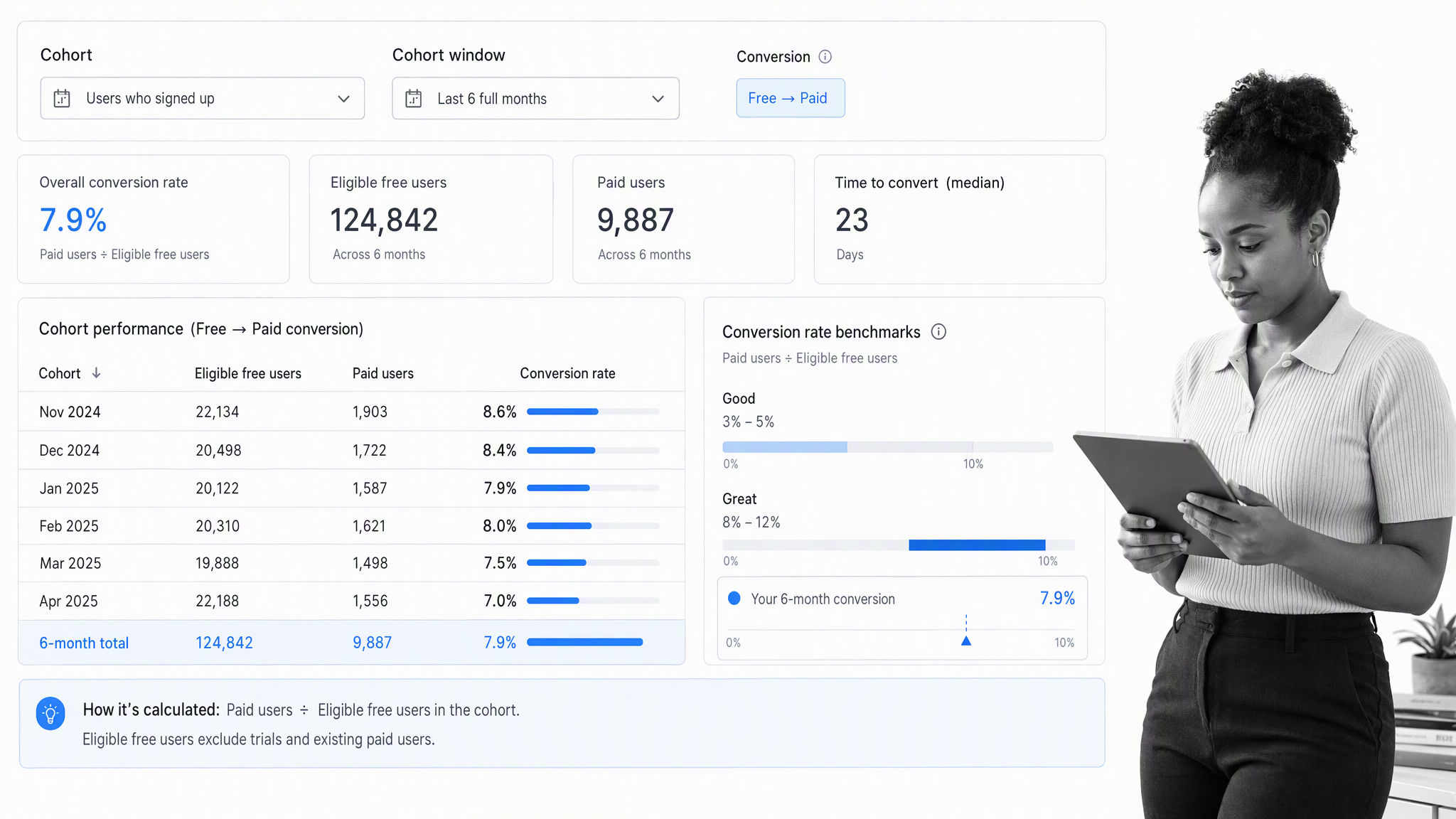
A benchmark is a diagnostic, not a universal score. Consumer products, developer tools, collaboration software, and products with sales-assisted expansion can all use different denominators. A conversion rate also changes when you count signups, activated users, monthly active users, or accounts that reached a paywall. State the unit before you compare the result.
A practical free-to-paid conversion rate report should name four things: the eligible cohort, the conversion event, the observation window, and the segment. For example, a product team might track new free workspaces that completed activation in August and upgraded within six months. That is much more useful than dividing today’s paid customer count by every signup the company has ever collected.
Benjamin Brandall originally tested Spotify with a fresh account and documented the moments that moved him toward Premium. His 11-day experience is best read as a product teardown, not a controlled conversion study. It still exposes a sequence that many freemium products can learn from.
Reduce sign-up friction
The first job is to get a user into a useful product state quickly. The original Spotify flow leaned heavily on Facebook. That is no longer a reliable current example because Spotify does not let users add Facebook as a new login method. The principle survives: offer familiar account options, ask only for information needed to begin, and move the user toward value before requesting extensive profile data.
Low friction does not mean no qualification. A free tier works when the product can identify which users reached the core outcome and which merely created an account. Activation events such as saving a playlist, completing a first collaborative workflow, or inviting a teammate provide a better foundation for conversion analysis than signup volume alone.
Make discovery immediately useful
Spotify’s discovery engine was the first reason the fresh account became useful. Brain Food supported focused work. Star Wars Headspace offered an unusually specific listening experience. Those examples mattered because the product did not make the listener build everything from scratch before it could help.
The whole point of Spotify is to get you to discover music, and it initially encourages you to do this through curated playlists. By choosing a playlist with a few songs you already know, or a theme that matches your taste, Spotify cycles through and mixes songs you know with songs you do not.
The natural reaction to a song you like but do not know is to explore the artist, album, and other playlists that feature it, something Spotify makes extremely easy and a focal point of the first screen you see. Brandall naturally developed a new, refined taste thanks to recommendations that felt spookily on point. He did not want to listen to every track from the Brain Food playlist, and there were particular tracks he wanted to hear from the Star Wars Headspace album.
The old Free experience was described as forced shuffle with a fixed number of skips. Spotify changed that experience in 2025, allowing Free listeners to search for and play songs directly. Product facts moved, but the strategic tension remains. The free experience must be useful enough to build a habit, while Premium needs benefits that become more valuable as intent deepens.
Match the user’s moment
Mood and situation playlists connect a product to routines that already exist. Music for concentration, dinner, exercise, or a late-night journey gives the listener a reason to return without inventing a new behavior. The product becomes a soundtrack to life rather than a catalog that must be searched deliberately.
Below the suggested playlists, Spotify presents moods, situations, and genres. As a music culture graduate, Brandall learned that a core reason people listen to music is to intensify their mood. The best music writers wrote criticism that acted as a companion to intensify the listening experience.
Spotify taps into the idea of music as a soundtrack to life by giving descriptive categories with hyper-focused playlists inside. It is easy to ignore the uninteresting material and identify with the music that speaks to you. Encouraging you to get acquainted with a playlist links the product to a tangible, existing habit in your life.
This is why the difference between recommendations and personalization matters. A generic list says, ‘People like this.’ A personalized surface says, ‘This fits what you are doing now.’ The more accurately the product recognizes context, the easier it is for a free user to reach value again.
Brandall, who came from a music-culture background, compared the experience with having a critic such as Lester Bangs nearby. The analogy is deliberately oversized, but it captures the emotional effect of discovery that feels informed rather than random.
Turn personalization into investment
Every saved track, followed artist, playlist, and listening session teaches the service something. That makes personalization a form of nonmonetary investment. A user who has spent time shaping a library has more to lose by leaving, even before the product imposes any hard limit.
Getting users to tailor an app to their own tastes is a time-tested retention tactic because the user has already made an investment. If they do not convert, they lose some of the time and effort put into creating a personal experience. Spotify does this by letting users save music to their account, build custom collections, and teach it about their tastes.
This is not a monetary investment to tie you down. Long contract lock-ins are not tolerated in the same way. It is more important and personal because it is an investment of time. Spotify lets you discover artists of your own accord, and when you find something by yourself, you feel more connected to it.
By leaving you to your own devices while generating custom playlists, the product does not need to demand an investment. Its suggestion algorithms can figure you out, and more often than not they are right on the mark. That gets you invested in the way you have taught your personal instance of Spotify about yourself.
Your Spotify can appear to understand your taste better than you do because it retains patterns that are hard to reconstruct manually. This accumulated value supports customer retention and makes the upgrade decision about continuity, not only extra features. The same mechanism appears in work products: history, templates, preferences, and team context can make an account increasingly useful.
The ethical version of this strategy keeps the investment visible and portable enough to earn trust. The goal is not to trap people. It is to let useful history compound so that staying and upgrading feel like rational extensions of value already received.
Use friction carefully
Free products still need limits. The best limits appear at moments of clear intent. Spotify can let a listener discover music for free while reserving benefits such as ad-free music, offline music downloads, play order, and unlimited skips for Premium. The user understands what the paid plan changes because the desire already exists.
Brandall described listening to Brian Eno while writing when an advert broke the atmosphere. That interruption is vivid because it lands inside an established job to be done. It should not be treated as proof that any particular ad caused a conversion, but it shows how a free-tier constraint becomes legible when it interrupts a valued outcome.
A key function of music is immersion. Some of the most popular playlists on Spotify help users do focused work, such as studying, writing, or something that involves intense concentration. Fifteen minutes into a chill Brian Eno soundscape, a glaringly out-of-place interruption can suddenly break the experience. When it finishes, the listener returns to something they wanted to hear, but the contrast has made the Premium outcome easier to understand.
Poorly timed friction feels arbitrary. Well-timed friction clarifies the relationship between the free outcome and the paid one. Teams should test frequency, context, and segment, then watch both upgrades and retention. A conversion lift that damages long-term engagement is not a durable win.
Let users experience the paid outcome
Trials can create loss aversion because the user experiences the complete outcome before deciding whether to keep it. Spotify promotions vary by market, eligibility, and time, so a fixed universal trial length is the wrong lesson. The important design choice is whether the trial gives a user enough time and the right prompts to experience the feature that matters.
There is nothing like the feeling of something you had being taken away to make a limit feel concrete. A longer trial can be enough time to build a collection, and Spotify makes that easy because discovery evolves with current tastes and habits. As soon as people receive offline listening privileges, many will save music for the situations where streaming is unreliable. That only gets them in deeper because the benefit is attached to a collection they chose themselves.
Offline listening is a clear example. A commuter who downloads albums or playlists for a journey can experience the paid benefit directly. When the trial ends, the decision is concrete: keep reliable offline music or return to the free constraints. The upgrade prompt describes a known outcome rather than an abstract promise.
Build the path from free to paid
Spotify combined hard and soft conversion pushes. A hard push appears when a user requests a Premium-only capability. A soft push keeps the paid value visible through restrained reminders, plan comparisons, or a trial invitation. The two work together when the product first establishes value, observes intent, and then presents the relevant next step.
Spotify has several moments in the user journey that either ask for conversion outright or hint that a feature is only available in Premium. The hard pushes are seemingly available features that reveal themselves to be Premium-only. The softer moments suggest that the experience could be better without preventing the free user from continuing.
That sequence can be applied to many products: reduce sign-up friction, help the user discover value, fit the product into a recurring moment, let history and personalization compound, introduce constraints in context, and make the paid outcome easy to experience. Measure each stage separately so a weak activation step is not mistaken for a pricing problem.
Process Street is a single Compliance Operations Platform with Docs and Ops capability areas plus built-in AI. Product and operations teams can use controlled workflows to run conversion experiments, document decisions, and keep follow-up consistent. The same discipline supports a stronger customer engagement tool strategy: define the desired outcome, assign the work, capture evidence, and review the result.
The real reason Spotify remains a useful freemium case study is not one public ratio. It is the design of a journey in which free users repeatedly reach value, build personal investment, understand the paid difference, and encounter upgrade moments that fit what they are trying to do.
The post Freemium Conversion Rate: Spotify vs. Dropbox first appeared on Process Street | Compliance Operations Platform.


0 Commentaires