
Qualitative research is the systematic study of meaning, experience, behavior, and context. It uses non-numerical material such as interviews, observations, documents, recordings, and open-ended responses to understand not only what happened, but how people experienced it and why it matters.
Chocolate makes the distinction easy to see. A survey can tell you that 50% of a group dislikes chocolate. A qualitative conversation can reveal whether the reason is taste, texture, allergies, cost, memory, or something nobody thought to include in the survey.
Jump to a section:
- What is qualitative research?
- A closer look at qualitative research
- Types of qualitative research
- Qualitative research in practice: The chocolate method
- Is qualitative research for you?
What is qualitative research?
Qualitative research investigates how people interpret their experiences and the conditions around them. Researchers collect rich, descriptive material and analyze it for patterns, differences, relationships, and themes. The goal is not simply to produce anecdotes. A sound qualitative study follows a documented research question, recruitment plan, data-collection method, analysis approach, and evidence trail.
Common forms of qualitative data include interview transcripts, field notes, diary entries, photographs, recordings, documents, and answers to open-ended questions. This material can capture tone, sequence, language, social setting, workarounds, and contradictions that a fixed-response survey may miss.
Qualitative research is useful for finding out more about complex situations. It allows a humanistic and insider viewpoint to be included in research, and the qualitative data collected can be based upon the participant’s world view rather than a world view created only by the researcher. Qualitative data can help interpret how people interact with constructs such as fear, identity, trust, or belonging, all of which are hard to quantify. The focus of a qualitative study can also be adapted mid-way when an unexpected but relevant issue emerges, provided the change is documented and remains ethically approved.
These advantages of qualitative research include the ability to address questions about human and social groups, uncover broad patterns behind the phenomenon being researched, and understand a particular problem in the language of the people affected. Qualitative data can support quantitative data by vividly painting a picture of the overall study, while numerical results establish scale.
Qualitative research is particularly useful when you need to:
- Understand a complex or poorly defined situation;
- Learn how participants describe an experience in their own words;
- Observe how behavior changes with context;
- Explore unexpected findings and refine later questions;
- Explain the mechanisms behind a numerical trend; or
- Develop a theory grounded in systematically analyzed evidence.
Qualitative vs. quantitative research
Qualitative and quantitative research answer different kinds of questions. Quantitative research measures variables and uses numbers to estimate frequency, magnitude, distribution, or association. Qualitative research examines meanings, processes, experiences, and context. Neither is automatically more rigorous; quality depends on whether the question, design, sample, data, and analysis fit together.
Suppose a school survey finds that 50% of students dislike chocolate. That percentage answers “how many?” Follow-up interviews can ask “why?” One student may dislike the bitterness of dark chocolate, another may avoid dairy, and another may associate chocolate with an unpleasant memory. The count identifies the pattern; the conversations explain its variation.
The same project can place quantitative evidence alongside qualitative evidence. In a mixed-methods design, a team might survey a large group, interview a smaller purposive sample, and integrate the results. The survey shows the reach of a pattern, while interviews help explain why the pattern exists and where the aggregate result hides important differences. Mixed-methods research is most useful when the integration is planned, rather than when quotations are added after numerical analysis.
How qualitative data is analyzed
Qualitative analysis is interpretive, but it should also be transparent. Coding allows researchers to categorize qualitative data, compare examples, group related codes into categories or themes, test alternative explanations, and connect the findings back to the research question.
Coding can be inductive, with codes developed from the data, or deductive, with codes informed by an existing framework. Many studies use both. A code such as “texture” might gather comments about smoothness, crunch, melting, or grit. A broader theme might connect texture with familiarity or perceived quality. Good analysis keeps the source material traceable so another reviewer can see why a passage supports a claim. Current qualitative guidance treats coding as an iterative analytic practice, not a mechanical word-counting exercise.
Analysis also requires attention to cases that do not fit the emerging pattern. If most participants describe chocolate as comforting but one describes it as socially uncomfortable, that exception may expose an assumption in the codebook or a context the research team overlooked. Researchers can revise codes, compare interpretations, and document why a theme changed. This makes disagreement a source of insight instead of noise to be discarded.
A closer look at qualitative research
Use qualitative research when the meaning of an experience matters as much as its frequency. It can help a product team understand why customers abandon an onboarding flow, a healthcare team learn how patients experience treatment, or an operations team see where employees improvise around a written procedure.
Qualitative methods are becoming increasingly established across an array of academic and scientific fields because they can add a new dimension that statistical measurements alone cannot provide. In psychological studies, researchers evaluate human behavior that cannot be reduced to a numerical score. In clinical trials, qualitative evidence can come from observational studies, interview studies, and documentary or textual analysis of written records. In health research, it can shape data collection and interpretation by showing how patients experience an intervention, providing a deeper understanding of health-related issues.
Interviews are only one option. Researchers may use focus groups to examine shared and conflicting views, observation to compare what people say with what they do, diary studies to follow an experience over time, and document analysis to understand how decisions or practices are recorded. A study can combine several collection methods when each contributes distinct evidence.
What makes qualitative research trustworthy?
Trustworthiness comes from deliberate research practice. Clear sampling logic helps readers understand whose experiences are represented. A transparent coding approach makes the path from raw material to findings visible. Reflexivity requires researchers to examine how their assumptions and position may shape collection and interpretation. Triangulation compares evidence across participants, researchers, methods, or sources. Searching for disconfirming cases prevents the team from keeping only the quotations that support its first idea.
Quality also depends on context. A study of eight carefully selected participants can answer a narrow, experience-focused question better than a much larger convenience sample. At the same time, a small qualitative sample should not be described as statistically representative of a population. The claims should match the design.
Consent, privacy, and responsible AI use
Participants should understand the purpose of the research, what participation involves, how recordings or quotations may be used, and how to withdraw. Consent is an ongoing agreement, not a formality. Teams should collect only the personal data they need, restrict access, set retention and deletion rules, and remove identifying details where possible. Practical guidance from the UK Government covers both informed research consent and participant privacy.
AI can speed up transcription, suggest candidate codes, or help organize a large set of notes, but it cannot take responsibility for interpretation. A human researcher must check outputs against the source material, protect confidential data, and decide whether a pattern reflects participant meaning. Never let an AI system invent quotations, silently rewrite a participant’s words, or process sensitive material in an unapproved tool.
Types of qualitative research
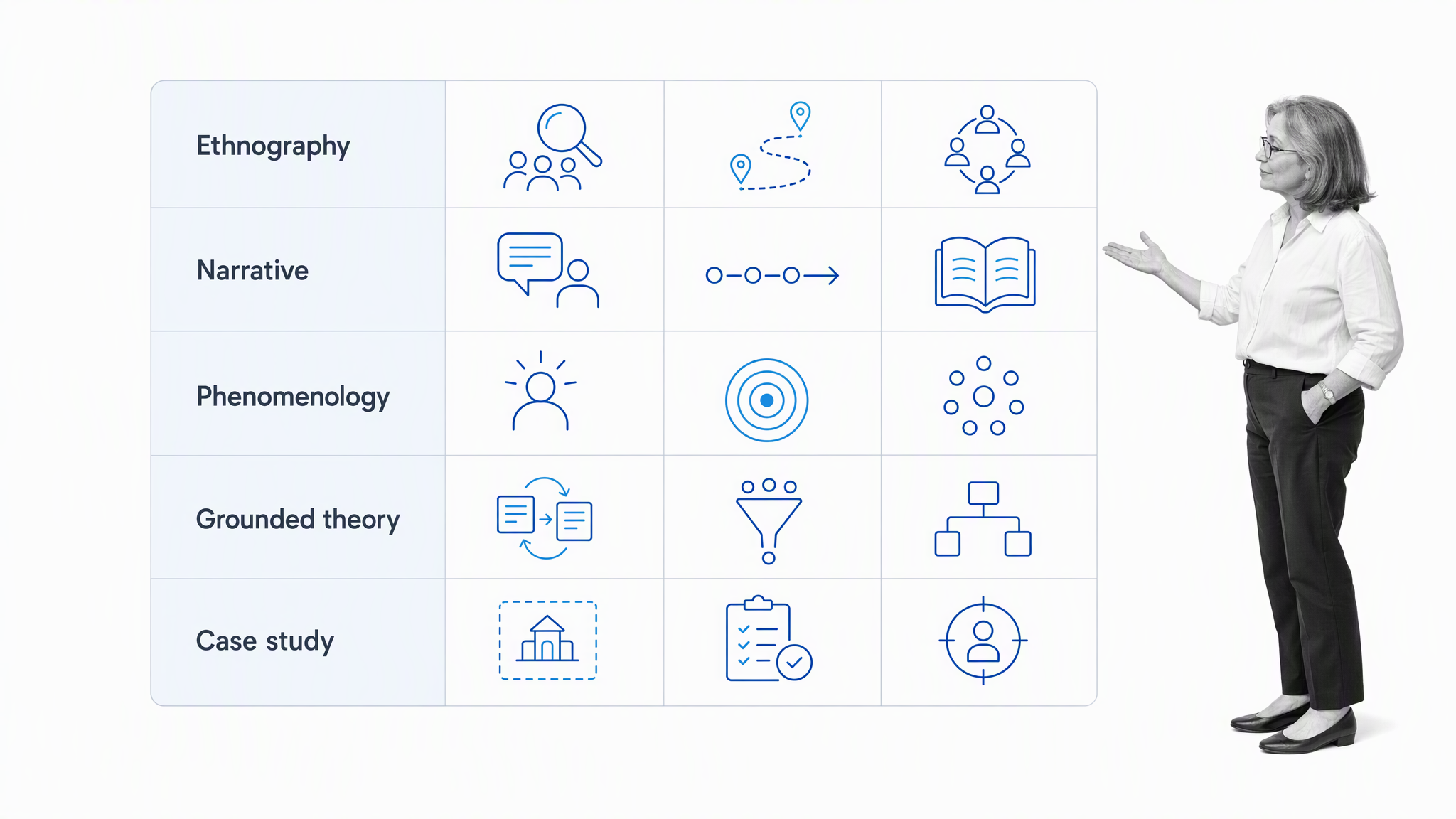
The word “method” is often used loosely. It helps to distinguish a research design from data collection, sampling, and analysis. Ethnography, narrative inquiry, phenomenology, grounded theory, and case study are designs or traditions that shape the whole inquiry. Interviews and observation are ways to collect data. Convenience and snowball sampling are recruitment approaches. Coding and thematic analysis are ways to analyze material.
The five designs below are commonly cited types, but they are not exhaustive. Each organizes the research question, evidence, and outcome differently. A recent open-access overview discusses these approaches together.
Ethnographic qualitative research
- Purpose: Understand behavior, culture, routines, and meaning in context.
- Outcome: A contextual description and interpretation of practices within a group or setting.
With roots in cultural anthropology, the ethnographic approach involves sustained engagement in the environment where activity occurs. Researchers observe routines, interactions, tools, language, and informal rules. Interviews may supplement observation, but the defining feature is attention to behavior and culture in context rather than reported opinions alone.
Narrative qualitative research
- Purpose: Understand how people organize experience through stories over time.
- Outcome: An account of sequence, turning points, identity, and meaning.
Narrative inquiry often focuses deeply on one person or a small number of participants. Researchers may combine interviews with letters, journals, photographs, or other records. They examine not only what happened, but how the story is structured, what the teller emphasizes, and how social context shapes the account.
Phenomenological qualitative research
- Purpose: Describe the lived experience of a shared phenomenon.
- Outcome: A careful account of how participants perceive and make sense of that experience.
A phenomenological study might explore what it is like to return to work after serious illness, adopt a new professional identity, or navigate a high-stakes service failure. Researchers use detailed participant accounts to identify essential features of the experience while remaining attentive to differences between participants.
Grounded theory qualitative research
- Purpose: Develop an explanatory theory grounded in systematically gathered and analyzed data.
- Outcome: A model of a process, relationship, or pattern supported by the evidence.
Grounded theory uses cycles of collection, comparison, coding, and theory development. Early findings shape later recruitment and questions. Researchers compare incidents and categories, look for variation, and refine an explanation until it accounts for the evidence well enough to answer the study’s purpose.
Case study qualitative research
- Purpose: Examine a bounded case in depth.
- Outcome: A detailed account of the case and the conditions that shaped it.
A case may be one person, family, team, organization, event, program, or community. Case studies often combine interviews, observation, records, artifacts, and quantitative evidence. For that reason, case study is best understood as a research design that can be qualitative, quantitative, or mixed, rather than as a single data-collection technique.
Qualitative research in practice: The chocolate method
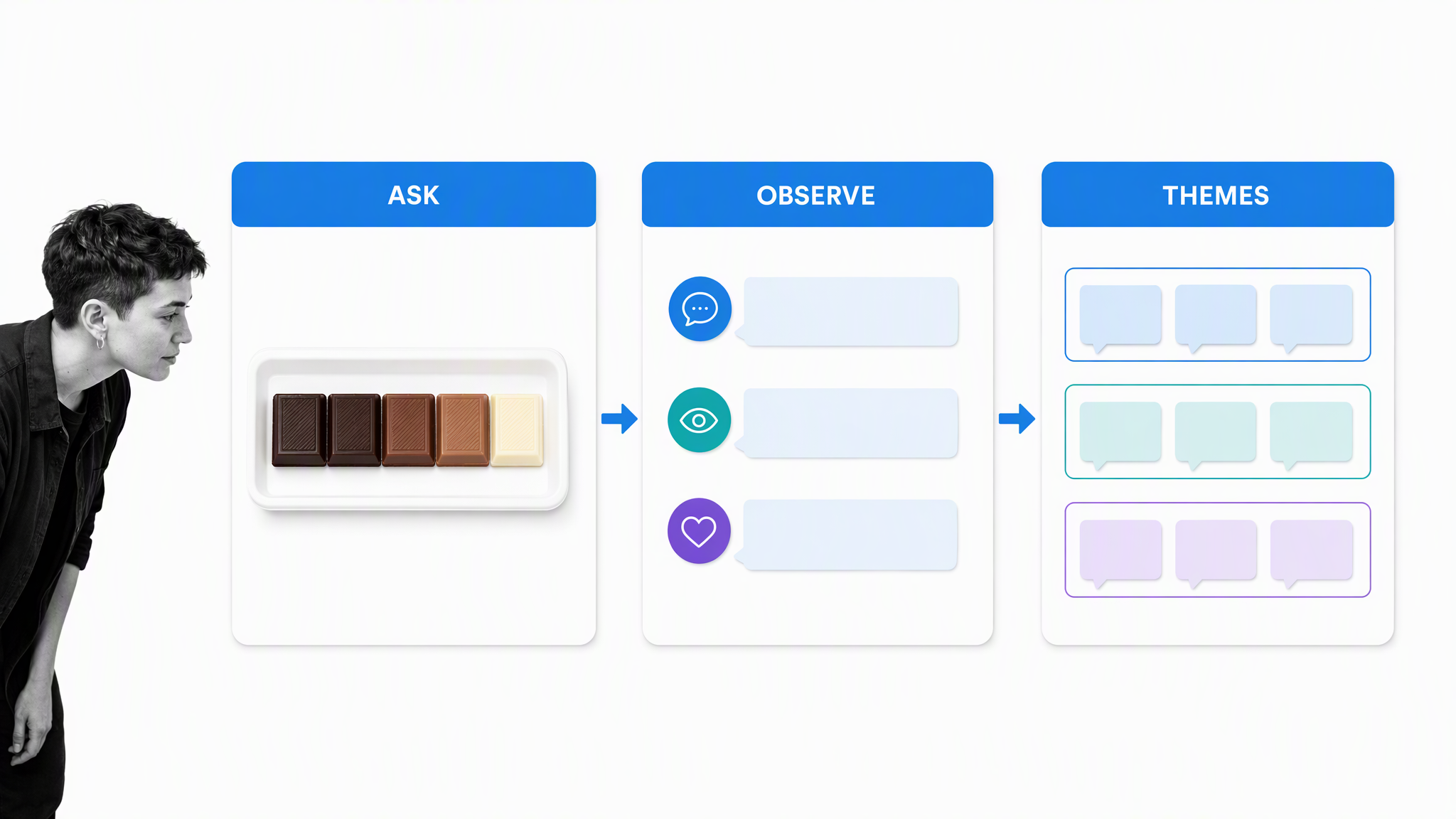
The chocolate exercise shows how recruitment, study design, analysis, and adequacy differ. The purpose is to identify students’ chocolate preferences and understand the reasons behind them. The exercise is deliberately simple, but the distinctions apply to customer research, healthcare, workplace studies, and many other settings.
Keep the question and recording format consistent across each pass so the contrast is meaningful. Write down what participants actually say before reducing their answers to labels, and note relevant context such as the sample they tasted or whether they normally eat chocolate. A short response can become analytically useful when the researcher follows it with neutral prompts such as “What makes you say that?” or “Can you give me an example?”
Convenience sampling
Convenience sampling recruits people who are readily accessible. In a classroom, that might mean starting with students in the front row. It is fast and useful for a demonstration or early exploration, but it can overrepresent people who are easiest to reach.
Ask the first student what they think about chocolate. Record the response in a short phrase: “love it,” “it’s okay,” “I’ll eat it,” or “chocolate is gross.” Ask another student and record the answer in the same format. As responses accumulate, group them loosely into positive, neutral, and negative reactions, while retaining the original wording.
This is analysis beginning alongside collection. The grouping helps the researcher notice early patterns, but it should not erase the reasons behind each answer. A neutral response caused by indifference is different from one caused by price, dietary restriction, or lack of access.
Continue the research by asking another student. Once you have asked the second student, record the data in the same fashion as you did with the first participant. Place the second student’s response beside the first, using another keyword or a tick beside the first keyword if the response is the same. Keep asking individual students in a quick-fire way, while recording enough detail to return to each answer.
Loosely group and sort the data from the students’ responses as you place each response on the board or flipchart. This illustrates, in a simple way, how researchers can analyze data as they go and begin to notice themes. After collecting a number of responses, review the gathered data and compare the positive, neutral, and negative responses. The categories are a starting point for deeper interpretation, not the final result.
Case study design
Start again and select one or two students as bounded cases. Hold a longer conversation about chocolate: When did you first try it? What does it mean to you? Who introduced it? Do you prefer dark, milk, white, nutty, or fruit-filled chocolate? Are there occasions when your preference changes?
The case study aims for depth rather than coverage. Researchers conduct in-depth interviews and may connect them with observation, a tasting diary, or other evidence. The case can reveal how memory, family, sensory preference, culture, and situation interact beyond a one-question survey.
Explore each student’s preferences within the general category of chocolate: dark, milk, white, nutty, fruity, or another type. Ask what happened before and after a memorable chocolate experience and what alternatives the student considered. A case study provides an opportunity for intensive analysis of details that a faster approach can overlook. It also gives the researcher room to compare several types of data about the same bounded case.
Saturation as an analytic concept
Saturation is not a sampling method and it is not a universal number of interviews. It is a concept used to judge whether continued collection is adding information relevant to the analysis. Its meaning depends on the research question, theoretical approach, sample, and type of claim. Methodological research on saturation cautions against treating it as a simple automatic stopping rule.
Again ask students where they get chocolate and record the responses. Early answers may include a supermarket, corner shop, vending machine, online store, or gift from family. If later interviews repeat existing categories, the researcher may have enough information for that narrow question. If a participant introduces a materially different route or meaning, more collection may be justified.
A credible report explains what kind of saturation the study sought, how the team assessed it, and what limitations remain. Repetition alone does not prove that every relevant perspective is represented.
To claim that enough data has been collected, report how, when, and to what degree researchers achieved data saturation.
Record the answers in the same way as the convenience-sampling exercise. Keep asking each student the same question and compare new responses with the already emerging categories. The supermarket, corner shop, and gas station may recur, but the researcher should also watch for new information about gifts, online purchases, travel, or dietary needs. When later responses add no relevant information to the defined analysis, collection may be approaching the chosen form of data saturation.
Quota sampling
Quota sampling intentionally recruits participants into predefined categories. In the chocolate exercise, the researcher might seek three people who love chocolate, three who think it is merely okay, three who will eat it without enthusiasm, and three who strongly dislike it.
The resulting sample guarantees that each preference category is included. That can make comparisons easier, but it does not make the sample statistically representative. The categories must serve the research question, and the researcher should explain how each participant was found.
Gather the students who gave similar answers in the first exercise. Group three people who stated that they “love it,” three who said “chocolate is okay, but it isn’t my favorite,” three who said “I’ll eat it,” and three who reacted with “chocolate… ew, gross.” This sample illustrates a deliberate balance between predetermined categories of interest within the study of chocolate.
Snowball sampling
The approach is called snowball sampling: existing participants refer other eligible participants when a group is hard to reach. The sample grows through social connections and becomes bigger like a snowball gathering snow.
In the classroom, ask each participant to introduce another student outside the class who meets the study criteria. Those referrals may generate further referrals. The approach can reach people the researcher would otherwise miss, but it can also reproduce the same social network and viewpoints.
Protect confidentiality during referral. Do not ask a participant to reveal sensitive information about someone else. Where possible, give participants a neutral invitation they can pass on so the referred person chooses whether to contact the research team.
For the exercise, put a numbered list of the participating students’ first names on the board. Explain that the study needs a larger sample and ask whether they know other students who may be eligible. The participating students can pass the invitation to people who are not in the class. Each new participant may then introduce another potential participant who fits the criteria, showing how an existing sample can connect the researcher with people who are otherwise hard to find.
The process makes the snowball analogy visible: the sample grows as it moves through participant networks. Researchers should record where referrals came from, consider how shared relationships may shape the data, and stop recruitment according to the study plan rather than simply allowing the chain to grow without limit.
Is qualitative research for you?
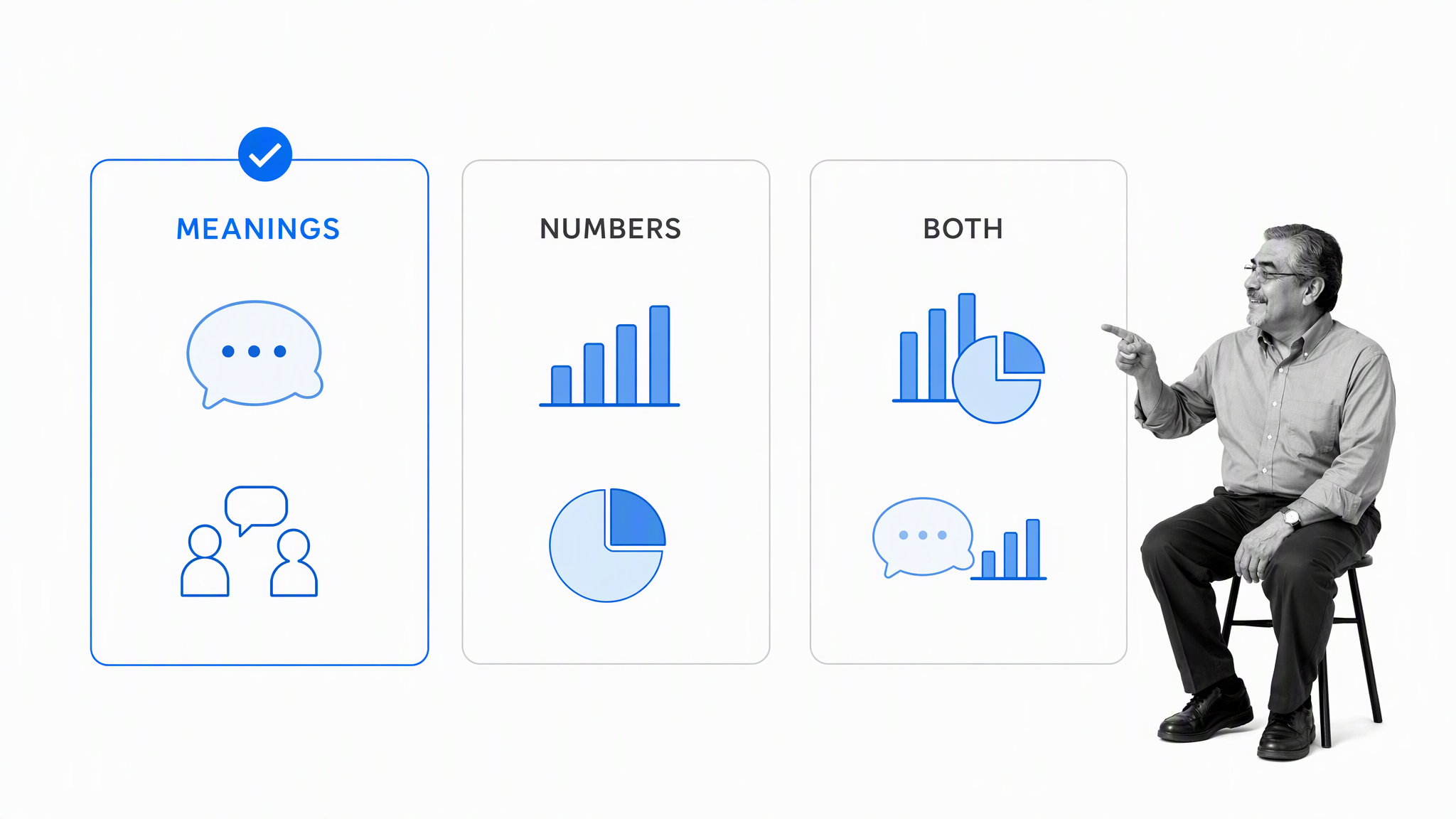
Choose qualitative research when your question is mainly about why, how, meaning, experience, behavior, or context. Choose quantitative research when you need to estimate how many, how much, how often, or whether variables are associated. Combine them when the decision depends on both magnitude and explanation.
Start with the research objective, not a favorite technique. A good plan states what decision the evidence will inform, who can speak to the question, how participants will be recruited, what material will be collected, how it will be analyzed, and what ethical safeguards apply. Then match the design to the claim you intend to make.
Operational discipline matters once research becomes recurring work. Process Street is a single Compliance Operations Platform with Docs and Ops capability areas plus built-in AI. A team can document its research protocol, run repeatable consent, interview, analysis, and review workflows, assign decisions, and retain evidence in one governed process. That same structure can support a wider customer engagement toolkit without turning qualitative judgment into a box-ticking exercise.
How many participants does qualitative research need?
There is no universal minimum. Sample size depends on the question, how diverse the relevant experiences are, the design, the depth of each case, and the analytic approach. Explain the sampling logic and ensure the scope of the claim matches the evidence.
What is coding in qualitative research?
Coding labels meaningful segments of data so researchers can compare examples and develop categories or themes. Codes may come from the data, an existing framework, or both. They support interpretation; they do not replace it.
When has a qualitative study reached saturation?
Saturation is reached only in relation to a defined analytic goal, such as whether new interviews are adding relevant codes or whether the dimensions of a category are sufficiently developed. Researchers should state which definition they used and how they assessed it.
Can AI analyze qualitative data?
AI can assist with transcription, organization, retrieval, and candidate codes when policy and consent permit. A human researcher must verify the source, protect sensitive data, evaluate context, and take responsibility for the conclusions.
The post How Chocolate Can Teach You All You Need to Know About Qualitative Research first appeared on Process Street | Compliance Operations Platform.


0 Commentaires