
Greenwashing is the use of vague, exaggerated, selective, or unsupported environmental claims that make a product, service, or company appear more sustainable than the evidence shows. The problem is not simply optimistic language. It is the gap between the impression a claim creates and the full operational impact behind it.
That gap matters to consumers and to businesses. The European Commission found that 53.3% of environmental claims in a 2020 review were vague, misleading, or unfounded, while 40% lacked supporting evidence. This guide explains what greenwashing looks like, how to test a claim, and how to build controls that keep sustainability marketing tied to documented work. It also includes a free template and six sustainability workflow templates that teams can adapt to their own operations.
“The obligation to endure gives us the right to know.” Jean Rostand, quoted by Rachel Carson in Silent Spring
The right-to-know principle gives this topic its practical edge. Environmental claims should help people make informed decisions, not hide tradeoffs behind broad words such as green, eco-friendly, or responsible.
- What is greenwashing?
- Sustainability templates
- Environmentalism: fashion or passion?
- Corporate greenwashing risks
- Greenwashing examples
- How to spot and stop greenwashing
- How credible green companies operate
- Build credibility with evidence
The definition of greenwashing

“help us save the environment, please re-use the towels“An innocent statement. Who could argue that reusing towels was not good for the environment? No-one. However, this towel re-use was spit in the wind considering Beachcomber Resort’s plans for expansion into the fragile surrounding habitats, including the drastically dwindling coral reefs. Why did the resort present themselves to be environmentally-conscious where the core business efforts were environmentally-crippling? The answer: marketing.
Greenwashing targets an environmentally aware consumer
Environmental concern influences purchasing decisions, but stated willingness to pay is not the same as observed buying behavior. A 2024 PwC global consumer survey found that 80% of respondents said they were willing to pay more for sustainably produced or sourced goods, with an average stated premium of 9.7%. Marketers should treat that demand as a reason for better evidence, not a license for broader claims.
The clearest claims identify the exact benefit, the part of the product or operation it covers, the comparison baseline, the measurement period, and the evidence behind it. A narrow claim that can be tested is more credible than an unqualified promise that an entire company or product is “green.”
Preventing greenwashing therefore requires two connected systems: real sustainability work and a controlled review process for how that work is described. The templates below help teams document the first. The prevention checklist later in the article helps govern the second.
The stakes extend beyond consumer preference. Environmental damage affects the ecosystems that support food, medicine, water, land protection, and economic activity. Damage to coral in the Great Barrier Reef, increasingly extreme weather, declining animal populations, and the displacement of plant and animal species are not branding problems. They are signals that human activities can push natural systems outside familiar rhythms. Marketing that conceals those impacts makes informed action harder.
An ecologically conscious consumer is not simply buying a pleasant image. People want to know what they are supporting and whether an alternative reduces harm in a material way. That is why accurate depiction matters. A business should first deploy sustainability efforts, then describe those efforts with the same care it uses to document any other core business process. The evidence has to be as visible as the campaign.
Sustainability templates to help you create a more sustainable business

Hotel Sustainability Audit
Although the Hotel Sustainability Audit has been specifically designed to meet to needs of the leisure industry, you can easily edit this template, whilst maintaining the core fundamentals, for a process unique to your trade. Click here to access the Hotel Sustainability AuditEnvironmental Accounting Internal Audit
Use this Environmental Accounting Internal Audit as a guide, supporting your small business accounting processes to attain and retain a sustainable focus. Click here to access the Environmental Accounting Internal Audit checklistEnvironmental Management Systems (EMS) Implementation Checklist Template
Use this Environmental Management System (EMS) Implementation Checklist Template to help you create a plan for the development and implementation of your Environmental Management System. Click here to access the Environmental Management System (EMS) Implementation Checklist TemplateISO 14001 Environmental Management Self Audit Checklist
Run this checklist to perform an internal audit on an Environmental Management System (EMS) against the requirements set out in ISO 14001:2015. Click here to access the ISO 14001 Environmental Management Self Audit ChecklistISO 14001 EMS Structure Template
Use this template to build and maintain the requirements and standard operating procedures for an Environmental Management System (EMS) mini-manual in line with ISO 14001:2015 specifications for environmental management. Click here to access the ISO 14001 EMS Structure TemplateISO 14001 EMS Mini-Manual Procedures
An ISO 14001:2015 compliant EMS mini-manual complete with requirements and standard operating procedures, created for Black Mesa Construction (a fictional construction company). Click here to access the ISO 14001 EMS Mini-Manual ProceduresEnvironmentalism, fashion or passion?

Environmentalism becomes performative when the image of concern matters more than measurable action. A campaign may be emotionally compelling and still omit the boundaries, tradeoffs, or operating data needed to judge the underlying impact.
The useful question is not whether a company sounds passionate. It is whether its policies, purchasing decisions, product design, supplier controls, emissions records, and corrective actions support the impression its marketing creates.
Greenwashing companies: What are they?
Greenwashing companies use environmentalism for corporate gain, often as a marketing tactic. To repeat what I said in my article titled How You Can Create a Sustainable Business for Long-Term Success, adopting a sustainable operating model can improve resilience, trust, and long-term performance when the underlying work is documented and independently testable. Greenwashing provides a superficial covering in an attempt to obtain a sales advantage, without the investment and time needed to re-invent the company’s business model to a sustainable one. Only through the careful evaluation of your marketing activities, can you identify greenwash in its tracks. This is where our BSR Greenwash Prevention Checklist comes in, but more on that later.Corporate greenwashing risks

- Human exposure to toxic, dangerous and environmentally damaging products.
- Legal conviction. The Federal Trade Commission (FTC) has strict guidelines, called Green Guides that address misleading claims.
- The continuation of unsustainable conduct with long-term operational and financial consequences. Research on 180 matched US companies found that firms with long-established sustainability policies performed differently from low-sustainability peers over the study period, but the result should be read as evidence about governance and execution, not a guarantee from marketing language alone.
- A tarnished reputation and brand causing negative consumer perspectives.
Greenwashing examples
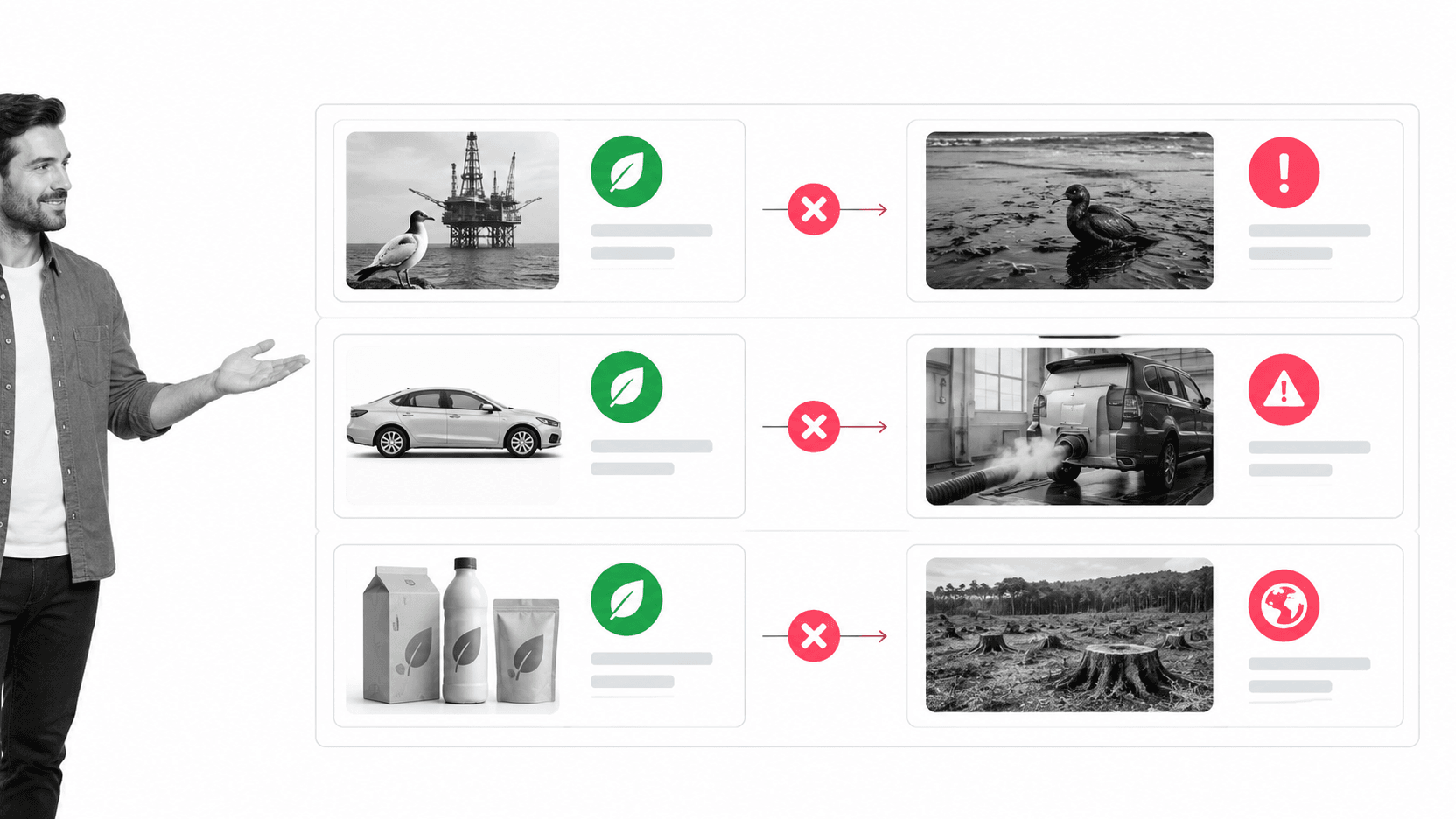
Greenwashing becomes easier to recognize when a claim is compared with evidence from the same period and scope. The cases below are historical examples. They show recurring patterns rather than a permanent judgment about every current activity of the companies involved.
Chevron and a nature campaign beside pollution disputes
Chevron’s People Do campaign used wildlife and conservation imagery while the company faced public scrutiny and litigation over pollution. Contemporary reporting described a multimillion-dollar annual campaign. The lesson is not that conservation activity never occurred. It is that a narrow initiative can create an impression about the whole business that the wider evidence does not support.
The campaign showed employees protecting bears, butterflies, and sea turtles, and it promoted environmental programs that were small relative to the cost of broadcasting them. One widely cited example was a butterfly preserve that cost about $5,000 per year while the advertising campaign cost millions. During the same period, Chevron faced Clean Air Act violations and an oil spill affecting a wildlife refuge. The contrast made the campaign a frequently discussed example of sustainability claims diverting attention from more consequential activities.
DuPont and environmental imagery beside a contested safety record
A 1991 DuPont advertisement paired marine imagery with double-hulled tanker claims. Labor and public-interest reports later criticized the company’s wider safety and environmental record. This example belongs in the article as a dated case: the image of environmental responsibility was broader than the evidence cited for one operational change.
The advertisement presented marine animals moving to Beethoven’s Ode to Joy, an emotionally powerful image of environmental care. At the time, Friends of the Earth described DuPont as a major US corporate polluter, and United Steelworkers later criticized gaps between the company’s public commitments and its safety record. A single improvement, even a meaningful one, does not establish the environmental performance of an entire company.
Volkswagen clean diesel claims contradicted by test manipulation
Volkswagen marketed “clean diesel” vehicles while using software designed to detect emissions testing and alter vehicle behavior. The US Environmental Protection Agency and Department of Justice documented violations affecting about 590,000 US diesel vehicles. This is an unusually clear example because the environmental claim and the contradictory technical evidence addressed the same product and pollutant.
The case also explains why proof must be reproducible. A laboratory result, certification mark, or product label is not enough when the tested behavior differs from ordinary operation. Reviewers need to understand the test method, the operating boundary, and whether controls can be bypassed. Similar allegations across the automotive industry reinforced the need to verify “green” product claims against real-world performance.
Across these examples, the warning pattern is consistent: a broad impression is built from a narrow activity, an important boundary is omitted, or evidence is manipulated. When reviewing a claim, compare its wording with the complete product lifecycle, the operational baseline, and independently verifiable records.
How to spot and stop greenwashing
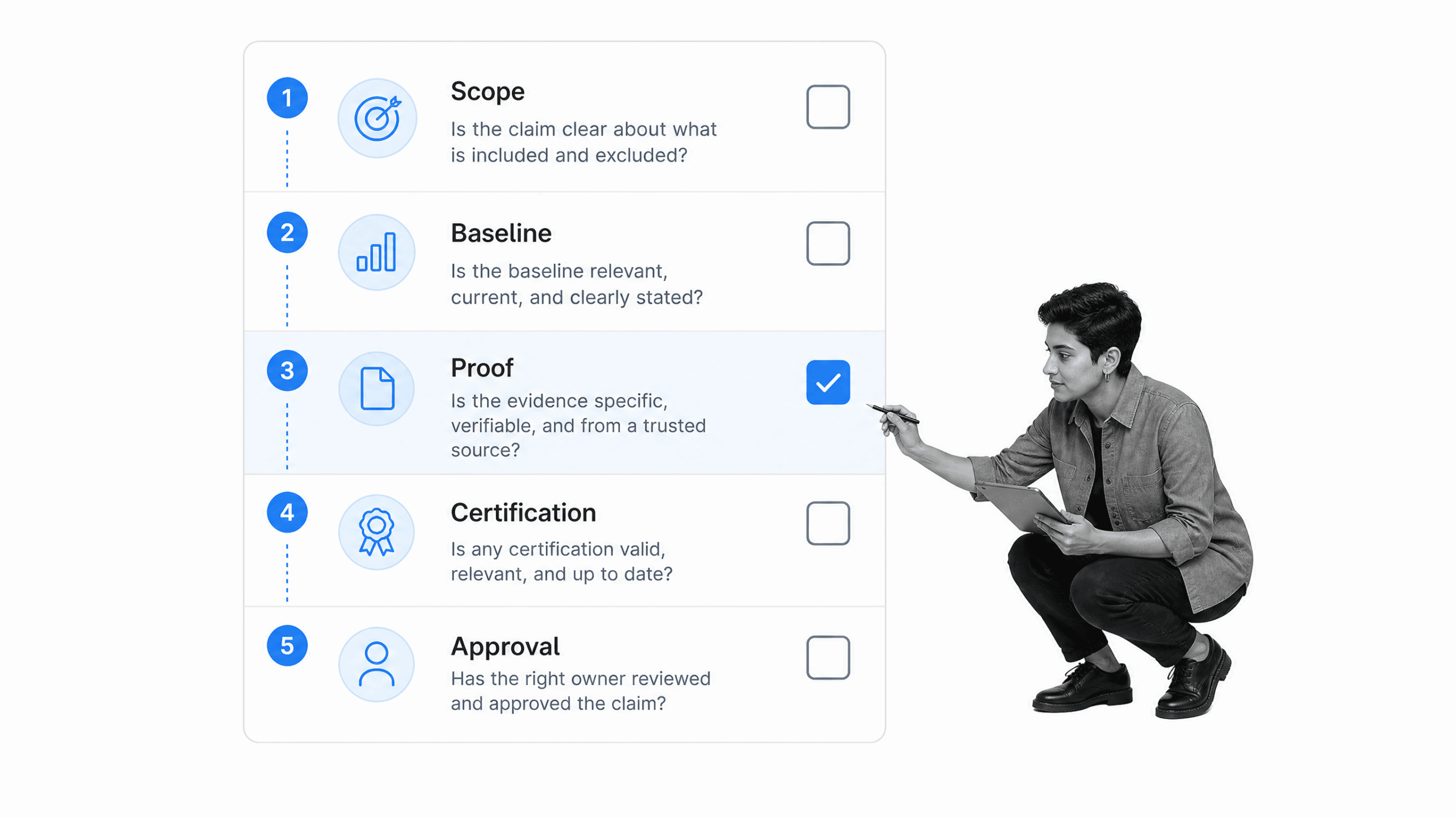
Greenwashing is not always obvious. A claim can be literally true and still mislead if it applies only to the packaging, uses an irrelevant comparison, or hides a larger tradeoff. Consumers can use the checks below, and businesses can turn the same checks into a formal approval workflow.
Greenwash is not always glaringly obvious. Where one person may consider a company to be engaging in greenwash, another may not. In subtle cases, the definitive lines marking a campaign or statement as greenwash can be blurred. A percentage reduction, for example, says little without the actual emissions, the starting year, the activities included, and the effect of business growth. The question is not only whether the goal sounds ambitious, but whether the above statement gives an accurate picture of total impact.
- Define the scope. Does the claim cover the product, the packaging, one facility, or the whole company?
- Find the baseline. “Lower emissions” or “less waste” compared with what period, model, or process?
- Inspect the proof. Look for methodology, measurement boundaries, dates, and evidence that another reviewer could reproduce.
- Check the certification. Confirm that a label is independent, current, and actually certifies the thing being claimed. ISO 26000 and GRI reporting guidance are not product certifications.
- Assign approval and ownership. Record who supplied the evidence, who reviewed the claim, and when it must be revalidated.
The FTC warns against broad, unqualified claims such as “green” or “eco-friendly” because they are difficult to substantiate. A credible statement is specific and bounded, such as identifying the percentage of recycled material, the part of the product it covers, and the comparison method.
How consumers can identify greenwash
Start with the small print. Surface-level statements often omit the part of the product, the measurement period, or the baseline that makes the claim meaningful. On packaged products, read the label and critically analyze every statement. Then separate branding from evidence. Earth colors such as blue, green, and brown can create a natural impression, but visual language is not proof of environmental performance.
Look for evidence that is relevant to the exact claim. An independent certification can help, but only when it is current, applies to the product or activity in question, and comes from a credible standard owner. ISO 26000 offers social responsibility guidance, GRI provides sustainability reporting standards, Green Seal certifies defined product and service categories, and the US Department of Agriculture governs organic labeling for qualifying agricultural products. These systems serve different purposes and should not be treated as interchangeable endorsements.
The same logic applies inside a company. A statement may look reasonable to the person who wrote it while still creating a broader impression for the customer. Marketing, sustainability, operations, legal, and compliance teams should therefore review the same evidence together. The review should ask whether the wording is accurate, whether important qualifications are prominent, whether a comparison uses a fair baseline, and whether the claim will remain true for the life of the campaign.
Use the Greenwash Prevention Checklist
The checklist below helps teams test environmental marketing against the work and evidence behind it.
The BSR Greenwash Prevention Checklist is designed to identify greenwash risks and provide key benchmarks. It cannot guarantee honest and accurate communication on its own. The evidence and the people approving the claim still matter. In a working review process, sequencing controls keep tasks in order, due dates prevent evidence from going stale, conditional logic routes higher-risk claims for extra review, role assignments make ownership explicit, and approvals record the final decision and any required comments.
Process Street is one Compliance Operations Platform with Docs and Ops capability areas plus built-in AI. Docs governs policies and claim standards. Ops turns those standards into assigned reviews, evidence requests, approvals, and audit trails. Built-in AI can help surface missing context, while accountable owners make the final decision. For a broader control framework, see this guide to compliance audit preparation software.
How credible green companies operate
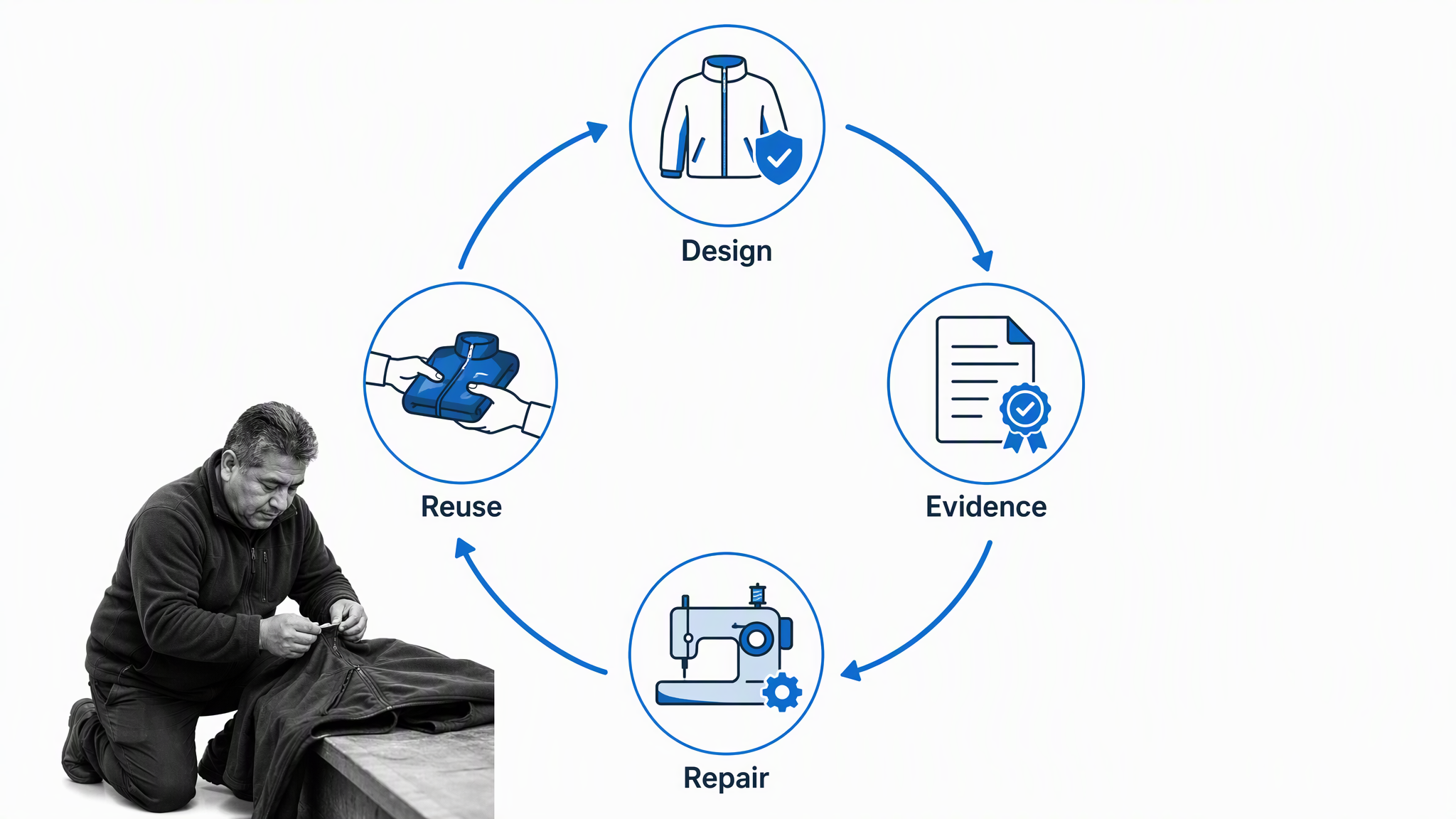
A credible green company treats sustainability as operating work, not a campaign layer. That means setting boundaries, measuring impact, assigning responsibility, documenting evidence, and correcting practices when the data contradicts the claim.
A green company is one that minimizes environmental damage by adopting a sustainable business model. Being green is not a decorative identity or a reason to stand out above other labels. It is reflected in business operations that are intertwined with the needs of nature and in the evidence used to evaluate those operations. The same standard should apply to a celebrated company and to a business just beginning its sustainability journey.
Patagonia uses repair and reuse as operating practices
Patagonia remains a useful example because programs such as Worn Wear make repair and reuse part of the customer experience. The company also publishes a current impact report, reports material choices, and continues its commitment to donate 1% of sales through 1% for the Planet. These activities are more useful than a generic “sustainable” label because each can be inspected separately.
The operating model includes repair and recycling services, products designed to last, and a reuse channel that keeps clothing in service longer. The company has also reported recycled materials, organic cotton programs, renewable energy work, supplier standards, and store-design choices intended to reduce environmental impact. Each practice is a separate claim with its own scope and evidence. Together they show how sustainability can be intertwined with operations rather than added as a campaign after the fact.
Examples reported over time include environmentally conscious construction, materials and fixtures for outlet stores, investment in renewable energy resources, and clothing made from recycled fabrics including nylon, polyester, and wool. The concept of fast fashion is rejected in favor of quality products built to last. These activities can support a credible case, but each still requires current data and a clearly stated boundary.
The same scrutiny still applies. No company becomes exempt from greenwashing risk because it has a strong environmental reputation. Credibility depends on the scope of each claim, current evidence, acknowledged tradeoffs, and visible progress against defined targets.
That is the useful lesson in revisiting a favored brand with greenwash in mind: do not be blindsided by what a company celebrates or by what it is doing right. Ask what remains outside the frame, including water use, greenhouse gas targets, supply-chain impacts, and the pressure created by continued growth. The boundary can be fuzzy, but the practical takeaway is clear: more can always be done, and each improvement should become a documented process rather than a rhetorical promise.
Build an evidence loop
- Document the policy and the exact claims it permits.
- Connect each claim to a source record, owner, period, and measurement method.
- Run operational workflows for supplier review, environmental audits, corrective action, repair, reuse, and waste reduction.
- Require legal or compliance approval for higher-risk public claims.
- Revalidate claims when a standard, supplier, product, or operating baseline changes.
The result is not perfect environmental performance. It is a governed system that makes claims narrower, evidence easier to find, and improvement harder to postpone.
Sustainability also requires balancing social, environmental, and economic factors. Innovation and technological improvement can reduce impacts, but only careful deliberation reveals whether a change solves a problem or moves it elsewhere. An accountable system records assumptions, captures supplier and operational data, and keeps corrective actions open until the underlying issue is addressed. That discipline lets a company improve without presenting every partial success as a complete transformation.
Businesses can assess their current operations and processes to address areas for sustainability improvements. With careful deliberation, innovation, technological improvement, and an open mind, advancement can always be made. The work should cover the activities that create the greatest impact, not only the activities that are easiest to promote. Above all, resources and checklists should support accountable decisions rather than substitute for them.
Build credibility with evidence, not greenwashing

Greenwashing hides risk behind an appealing surface. Credible sustainability work does the opposite: it names the boundary, shows the evidence, assigns responsibility, and makes gaps visible.
Businesses depend on the planet and its resources, and the foundations of industries from food and clothing to technology are supported by ecological processes and the services they provide. Unsustainable business practice creates operational, legal, financial, and reputational risk. Greenwash is only a temporary cover: it does not repair the underlying damage or prepare a company for changing standards, customer expectations, and physical constraints.
Once those resources are gone, where would a business go? The foundations of our industries, from food and clothing to technological businesses, are cemented by ecological processes and the services they provide. Unsustainable business practice is outdated because it weakens the systems on which future generations and businesses depend. Greenwash may provide short-term relief from scrutiny, but it does not heal the open wound or change the underlying operation.
Those risks are practical. People can be exposed to toxic, dangerous, and environmentally damaging products. A misleading claim can attract regulatory action under advertising law. Unsustainable conduct can continue because decision-makers are working from an inaccurate picture, while customers and employees lose trust when the gap becomes visible. A tarnished reputation is not separate from operations; it is often the delayed consequence of weak controls, poor investment in sustainability, and claims that outran the available evidence.
The alternative is not silence or perfection. It is accountability. Document the environmental objective, define the measurement method, retain the source records, name the owner, and record who approved the public wording. Make the review repeatable so that a new supplier, product design, facility, standard, or reporting period triggers another check. That turns sustainability from a collection of goals into managed work and gives the business a way to show progress without hiding the remaining gaps.
A strong environmental claim is not the loudest one. It is the claim a team can defend with current records, clear methodology, accountable approval, and operational follow-through. Build that control system first, then let the marketing describe what the evidence actually proves.
The post Greenwashing: What It Is and How to Stop It (Free Template) first appeared on Process Street | Compliance Operations Platform.


0 Commentaires