Hold music is audio played while a caller waits for a person, transfer, or queue. Good hold music reassures callers that the line is still active, makes the wait feel more deliberate, and gives a business time to share useful updates without pretending that music can fix an overloaded support operation.
My doctor has the worst phone setup I have ever encountered: waits run past 30 minutes, the lines clog after 10 a.m., and the hold track sounds like a distorted version of “Clocks” by Coldplay. If the call were not about my health, I would hang up. Most customers have that choice.
The only question is, what music and messages should you be using for your callers?
The best hold music is not simply the song your team likes most. It has to survive telephone audio, fit the caller’s context, loop without becoming punishing, and work alongside clear queue information. It also has to be properly licensed.
This guide covers:
- Where hold music came from;
- Why silence, music, and queue information create different waiting experiences;
- How to choose call hold music for your audience;
- How to prevent clipping and distortion;
- How to test phone hold music on the system callers actually hear.
The history of hold music
Waiting for a call to be connected was commonplace in the early days of telephone communication. Rather than being a result of busy phone lines and customer-service workflows, it was an unavoidable part of establishing the correct connection to put you through.
Being put on hold was expected, and even welcomed at first due to the new ability to have the connection in the first place. Think of it like the early days of the internet. Whereas waiting two minutes to connect once seemed a small price to pay, modern technology has trained us to notice every unexplained delay. A silent line stopped feeling normal and started feeling broken.
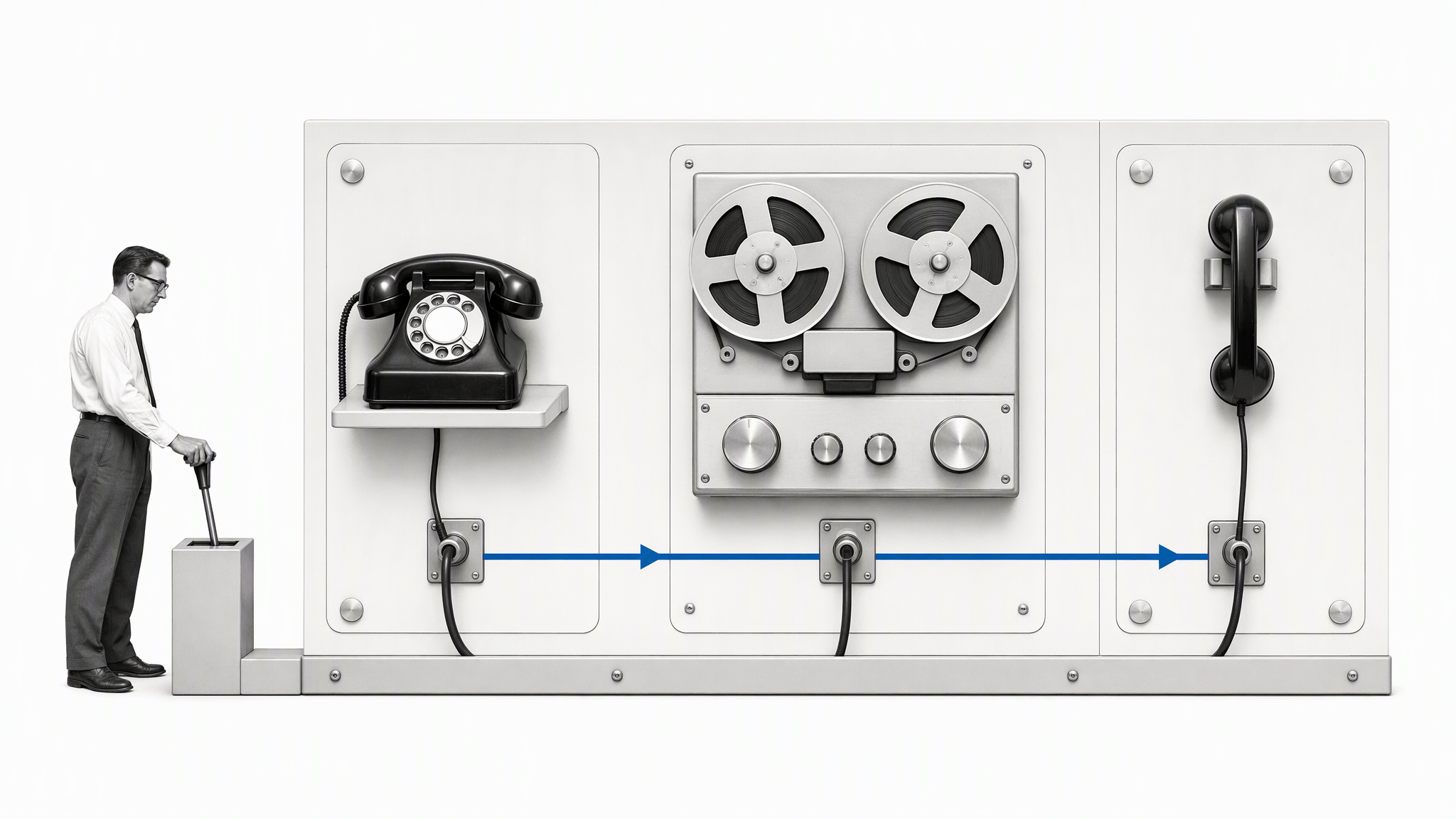
On March 26, 1962, Alfred Levy filed a patent for the Telephone Hold Program System. It is the first formal record of a system designed to feed program audio to a telephone line while a caller waited.
No one has proved exactly how Levy arrived at the idea. One enduring account of the origin says a loose wire touched a steel girder and carried a neighboring radio station through his company’s telephone system. Whether or not the story is exact in every detail, the invention solved a problem that still exists: silence creates uncertainty.
By the mid-1980s, businesses were mixing music with recorded messages. That added a second job for the hold channel. It could confirm that the call was still active and give the caller relevant information while they waited.
The same basic pattern survives in cloud phone systems. The storage medium changed from tape cartridges and dedicated hardware to uploaded audio files and streaming sources, but the design problem did not: the system has to switch a waiting call onto an audio source, keep the signal intelligible, and return the caller to an agent without a jarring transition.
Why use hold music?
Hold music matters because waiting is not only a question of elapsed time. It is also a question of uncertainty, attention, and perceived progress.
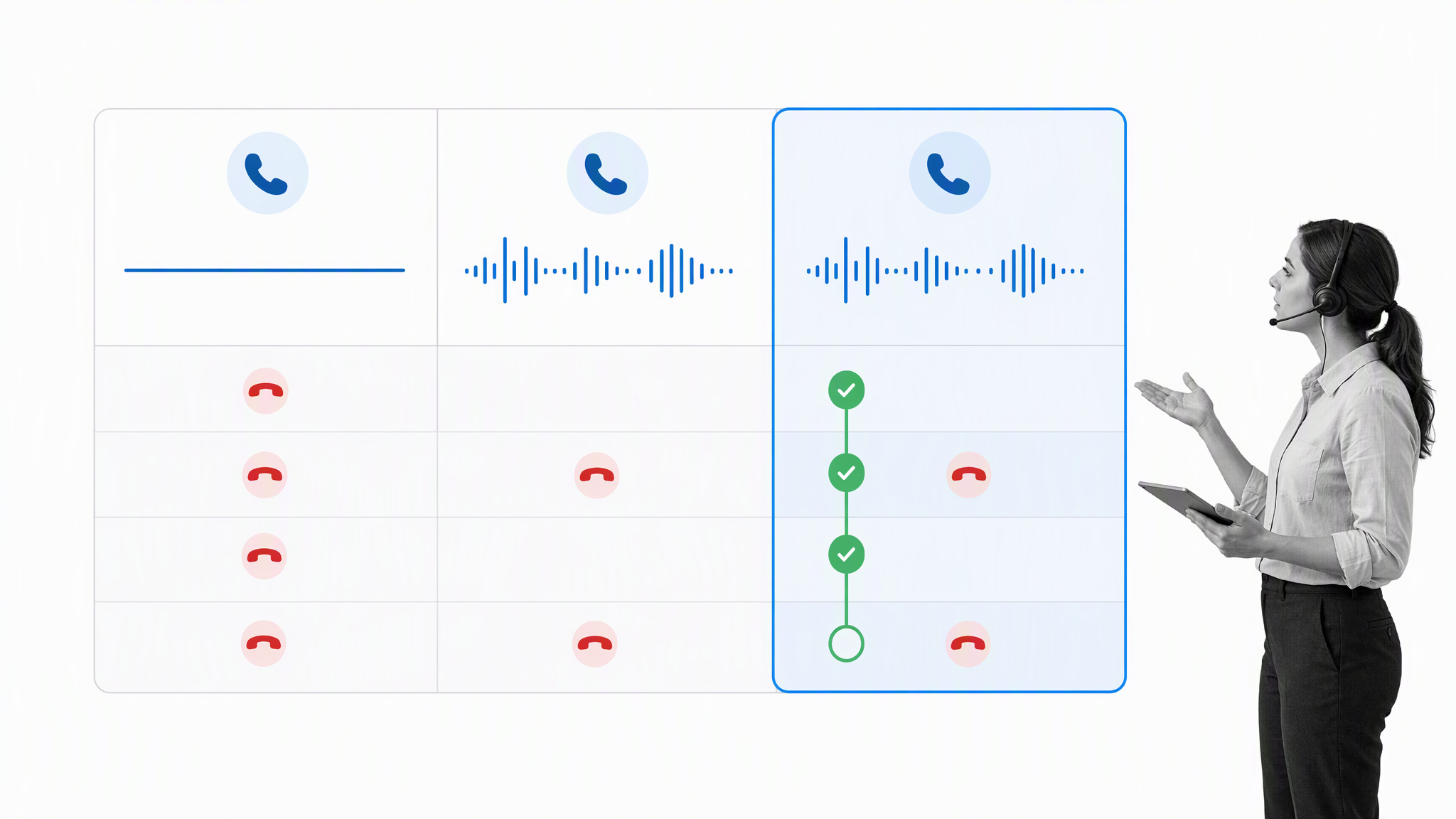
Research into telephone waiting has found that silence, music, and the ability to choose what to hear can change perceived wait and satisfaction with the company. The effect is not a universal percentage and it depends on the caller, the track, and the situation. The useful lesson is narrower: what callers hear while waiting changes how they experience the wait.
Information can be more valuable than entertainment. In a real-call study of queue fillers, queue-position information produced the lowest abandonment and the best caller evaluations among the conditions tested. That makes a strong case for pairing music with honest progress signals, wait estimates, callback choices, or concise service updates.
Use hold audio to do three jobs:
- Confirm the line is active. A caller should never wonder whether the call dropped.
- Reduce uncertainty. Queue position, expected wait, and callback options give the caller a decision to make.
- Protect attention. A steady, suitable track is easier to tolerate than silence, harsh repetition, or a loud sales pitch.
Measure the result on your own phone system. Track abandonment rate, callback uptake, repeat contacts, complaints, and qualitative feedback. Hold music is a design choice, not a guaranteed retention trick.
Interpret those measures together. A lower abandonment rate is not automatically good if callers wait much longer, call back repeatedly, or reach the wrong team. Compare outcomes by queue, time of day, and call reason. A billing queue may need a different message cadence from a medical scheduling line, while a short internal help-desk queue may need no music at all.
How hold music affects us
Music can influence mood, but broad genre rules are a poor way to choose an on-hold track. People do not respond to every jazz, rap, metal, country, or classical piece in the same way. Preference depends on the listener, the musical features, the context, and the reason for the call.
Almost everyone who has listened to music knows that it affects your mood in some way. Unfortunately, when trying to find the genre that will create the best hold music, it is hard to pin down the precise effects. It depends on what business you are running and what your target audience is like. It is a balancing act between music that is suitable for the majority of your audience and something that is still interesting.
Tempo, loudness, timbre, familiarity, and repetition can matter more than the genre label. A sparse piano recording and a dramatic orchestral piece may both be called classical, yet they produce very different waiting experiences. The same is true inside pop, jazz, electronic, and country music.
That is why the safest decision is not “classical is relaxing” or “pop appeals to everyone.” It is to evaluate a specific track against a specific caller journey.
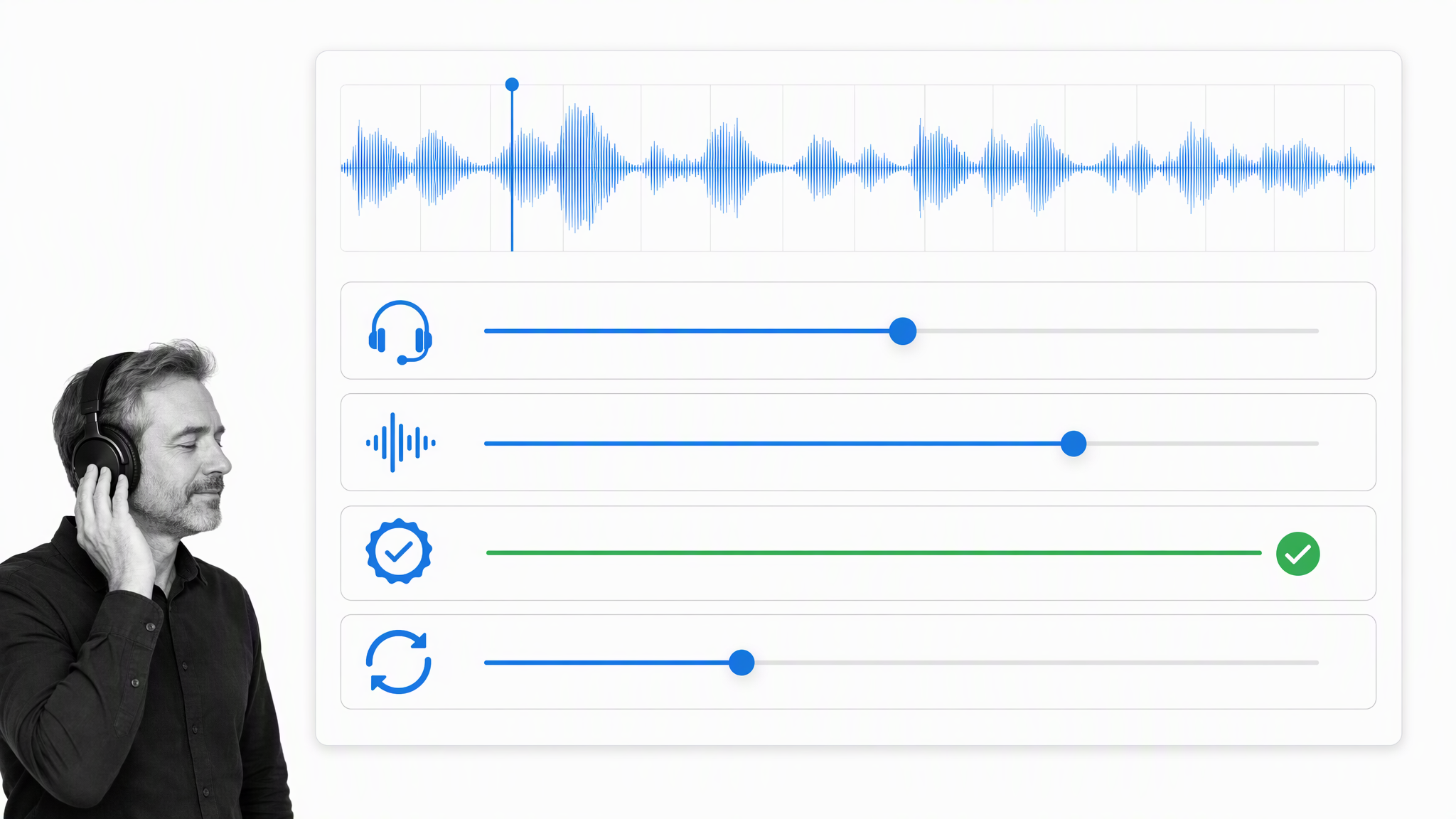
Score each candidate on four practical questions:
- Audience fit: Does the tone suit the people calling and the problem they are trying to solve?
- Audio clarity: Does the arrangement remain clean after the phone system compresses it?
- Rights clearance: Do you have permission for the composition and the recording in a music-on-hold setting?
- Repetition: Does the loop remain tolerable after several minutes and several calls?
Simple instrumental arrangements often perform well because they contain fewer competing elements and no lyrics that can clash with the caller’s problem. Muzak became shorthand for this approach, and its history as background music shows why restrained arrangements became common in public and commercial spaces.
There is no universal best hold music song. Shortlist several tracks, listen through the same phone path your callers use, and test the finalists with real customers.
When possible, test long enough to capture repeat callers. A loop that feels pleasant once can become grating after the fifth contact. Rotate a small set of compatible tracks rather than one short clip, but keep the sound consistent enough that the queue still feels like one service experience.
Hold music tips
The strongest music-on-hold setup combines a suitable track with useful information and a queue that respects the caller’s time.
- Use licensed music and confirm that the license covers music on hold.
- Choose simple arrangements with stable loudness and limited low-frequency detail.
- Use queue position, wait estimates, callbacks, or self-service routes when your phone platform supports them.
- Keep recorded messages short, useful, and spaced far enough apart to avoid repetition fatigue.
- Avoid lyrics that become insensitive or ironic in the caller’s context.
- Test the complete track for clipping, not just the first 20 seconds.
- Listen on real desk phones, mobile calls, headsets, and the codecs your system uses.
- Compare abandonment and satisfaction data before and after a change.
- Reduce queue time instead of asking music to disguise it.
General tips
Start with information architecture. Decide what a caller should hear at the moment they enter the queue, after the first minute, and when the wait becomes unusually long. A simple sequence might confirm the line is active, state an expected wait, offer a callback, and provide one relevant self-service option.
Write messages in plain language and keep them accurate. If a callback will preserve queue position, say so. If an estimate can change, explain that it is an estimate. Avoid announcing a one-minute wait every minute when the queue is not actually moving. Repetition makes inaccurate information feel worse, not better.
Do not fill every gap with an advertisement. Callers usually contact support because they need help, so the most valuable messages reduce uncertainty or move the problem forward. If you promote anything, make it directly useful to the reason people call.
A great way to complement a caller-choice system is to have your music selection on shuffle. Even if you only have three or four songs, this makes sure that people left waiting on hold do not hear the same tune on repeat. Also remember the value of mixing music with messages. You do not have to limit those messages to “thank you for waiting,” but every message should help the caller understand the queue or solve the problem.
Silence can work for some audiences and contexts, but it should be an intentional choice. Test it against music and useful queue information instead of assuming that one condition wins everywhere.
Consider accessibility and language coverage too. Give callers enough time to understand each message, avoid sudden level changes, and do not bury a critical option underneath music. If you serve callers in several languages, route them early instead of replaying every message in every language inside one long loop.
Licensing deserves its own check. A consumer streaming subscription or purchased track does not automatically grant the right to transmit that recording to callers. BMI maintains a specific music-on-hold licensing category, and businesses may also need to clear rights in the sound recording. Ask your music provider or legal team to confirm the permissions that apply to your use.
Music selection tips
Choose tracks for the call, not for the office playlist. A track with moderate tempo, a simple arrangement, and steady loudness usually survives telephone playback more gracefully than a dense production with heavy bass or sharp volume changes.
While I have already touched on this, it is worth stating again that Muzak-style arrangements, restrained classical pieces, and familiar light instrumentals can be fairly safe options when trying to appeal to a wide array of callers. The key is not to take these choices for granted. Measure the caller retention rates for each option, compare them against each other, and combine that data with user feedback.
Instrumental music is often easier to place because it does not compete with spoken queue updates. If you use vocals, leave enough separation between the song and the message inserts so callers can tell when important information begins. Avoid tracks with long quiet introductions, abrupt endings, or a hook that repeats every few seconds.
Avoid using lyrics that can sound sarcastic in context. A field experiment in a call center found that neutral popular music produced better outcomes than prosocial lyrics for caller anger and employee exhaustion. Songs such as “Help” or “Heal the World” may be well intentioned, but the words can remind a frustrated caller of the exact problem that put them in the queue.
Use a small test group before changing the live queue. Ask callers whether the track felt calm, repetitive, appropriate, or irritating. Then compare those answers with abandonment and callback data.
Test at the same loudness you will deploy. A track that wins in a quiet meeting room may fail through a mobile speaker on a noisy street. Include people who were not involved in selecting the music, because familiarity with a candidate can make the internal team more tolerant of it than callers will be.
The following overview provides a practical set of music-on-hold checks:
Clipping and distortion
Clipping and distortion make hold music harder to tolerate. Clipping happens when the signal exceeds the level the system can reproduce. Distortion can also come from aggressive compression, transcoding, or a track with too much detail for the available telephone bandwidth.
Clipping occurs when the music is too loud for the phone to handle, again distorting the sound. This can be easy to miss, as songs tend to vary in volume and often get louder in the final stretch. If you only listen to the start of the song to check the volume, be aware that it might get louder or quieter later and should be adjusted as such.
Combining those two problems, simple instrumental pieces with a consistent volume can reduce severe distortion and clipping on a phone line.
Nobody wants to ring a helpline only to have warped music layered with static deafen them while they wait. They will understandably hang up and be reluctant to call again. To stop this from happening, you need to know how the problems are caused. Distortion usually comes from the loss of quality when music moves through an average telephone system. The line cannot convey as much information as a full-range music system, so the track loses some of its finesse in translation.
Conventional narrowband telephony commonly focuses on roughly 300 to 3400 Hz, while wideband systems carry more of the audible spectrum. The exact result depends on the codec and phone system, so a studio-quality source is no guarantee of a clean call. The practical fix is to audition the final encoded file through the real system.
Simple piano, guitar, and light-percussion arrangements often work because the important parts sit in a range the phone path can reproduce. Keep loudness consistent, avoid deep bass that disappears, and leave enough headroom to prevent peaks from clipping.
Convert the file to the format your platform recommends rather than uploading the largest source available and hoping the service handles it well. Check whether the system expects mono or stereo, its sample-rate and file-size limits, and whether it normalizes loudness automatically. A clean mono export can outperform a complex stereo master after a phone platform folds and compresses it.
Listen to the whole loop. Songs often become louder in the final section, and a level that works in the opening can clip later. Test the loop transition too, because an abrupt cut becomes more irritating each time it repeats.
Notable examples
One memorable example came from UberConference, now called Dialpad Meetings. “I’m On Hold” was written and performed by Alex Cornell, who co-founded the company behind UberConference.
Cornell designed the song for the limitations of the phone line. The arrangement is simple, the important instruments sit in a range callers can hear, and the lyrics acknowledge the absurdity of waiting without mocking the caller. It shows how technical constraints can become part of the creative brief.
He knew about the problems with putting music through phone lines, so he chose a country song with acoustic guitar and light drums. Rather than fighting the limitations and having the track distort, the arrangement only needed elements the telephone line could reproduce clearly.
The example also has a clear identity. It does not sound like a random commercial playlist dropped into a phone system. The track was written for the waiting moment, which made the limitations of repetition, bandwidth, and caller attention part of the composition itself.
A second historical example is a Shopify support track based on “Yearnings of the Wind” from Chrono Trigger.
The arrangement is simple and steady, but the source material gives it an extra reward for callers who recognize the game. A Reddit discussion about the track shows how a thoughtful choice can become part of a brand story. Treat this as a historical anecdote, not proof that Shopify still uses the same music today.
It ticks the boxes you would want from a regular hold music track: a simple arrangement, little volume variation, and broad instrumental appeal. Being a cover from a classic role-playing game gave it an extra appeal for people in the know and helped the waiting music become memorable outside the call itself.
Hold music is no substitute for low queue times
Good hold music makes a necessary wait less confusing. It cannot make an unnecessary wait acceptable. Put simply, good hold music can help keep callers on the line, but it cannot rescue a queue that wastes their time.
Reduce the queue first. Use staffing forecasts, callbacks, self-service for simple requests, clear escalation rules, and better handoffs between teams. Then use music and useful messages to support the moments when a wait is unavoidable.
Review the queue as a process, not only as an audio setting. Look for repeat transfers, unclear ownership, missing customer context, and follow-ups that depend on memory. Those problems create the wait in the first place, and changing the soundtrack will not remove them.
Process Street is a single Compliance Operations Platform with Docs and Ops capability areas plus built-in AI. Support teams can use it to govern escalation procedures, run repeatable callback and follow-up workflows, review queue exceptions, and keep an auditable record that promised actions happened. The team remains responsible for the caller experience; the platform helps make the supporting process consistent.
The best result is not a caller who tolerates more waiting. It is a caller who understands what is happening, has a clear alternative, and reaches the right help sooner.
The post Hold Music: How to Keep Callers on the Line first appeared on Process Street | Compliance Operations Platform.


0 Commentaires