
Workflow improvement is the practice of running a repeatable process consistently, comparing its results, and changing the weak steps instead of relying on guesswork.
The day I adopted my dog, I learned a brutal and immediate lesson about myself and my daily habits. Nothing makes you analyze your life like a 60-pound furbeast jumping on your face at 6 in the morning, immediately after she decided to redecorate your living room with your latest bulk toilet paper purchase from Costco. The good stuff, might I add.
The first week of having this dog was hell. Little was known about her history, and she arrived anxious, energetic, and unimpressed by my remembered childhood training techniques.
Enter me: a bright-eyed bleeding heart who thought, “That little bundle of fur is going to be such a bundle of joy. What could go wrong?”
Everything. Everything could go wrong.
Training began immediately. Leia was almost completely unresponsive to everything. After a few weeks, however, I started drawing direct parallels between training this adorable Demogorgon and my daily work habits.
Why consistency makes workflow improvement measurable
Here’s the deal, world: I’m not the most consistent character on planet Earth. Little did I know that my newly adopted furbaby was about to expose exactly how much that mattered.
Much like dogs, workflows require consistency. When you run a workflow in your role, its success should be measured by the results and metrics it produces. You cannot compare those results when every run is improvised.
Consistent execution creates comparable evidence. Comparable evidence shows you what to improve.
Are customers happier? Are your numbers higher? Is one email campaign performing better than another? If the underlying process changes every time, you cannot tell whether the outcome changed because of your method or despite it.
Ever since I began at Process Street, my mind has been forced to adapt to a very process-driven lifestyle. Everything has a process. A useful process analysis then examines enough consistent runs to find the weak step, test one change, and compare the next set of results.
Consistency only works when exceptions stop
My dog was no different. A cue had to mean the same thing each time, and the reward had to follow the behavior I wanted. This lesson took me about a month to learn. The first two weeks were riddled with “Aww screw it, take the treat” or “Sit… no, stand… good dog.” Consistency was killing me.
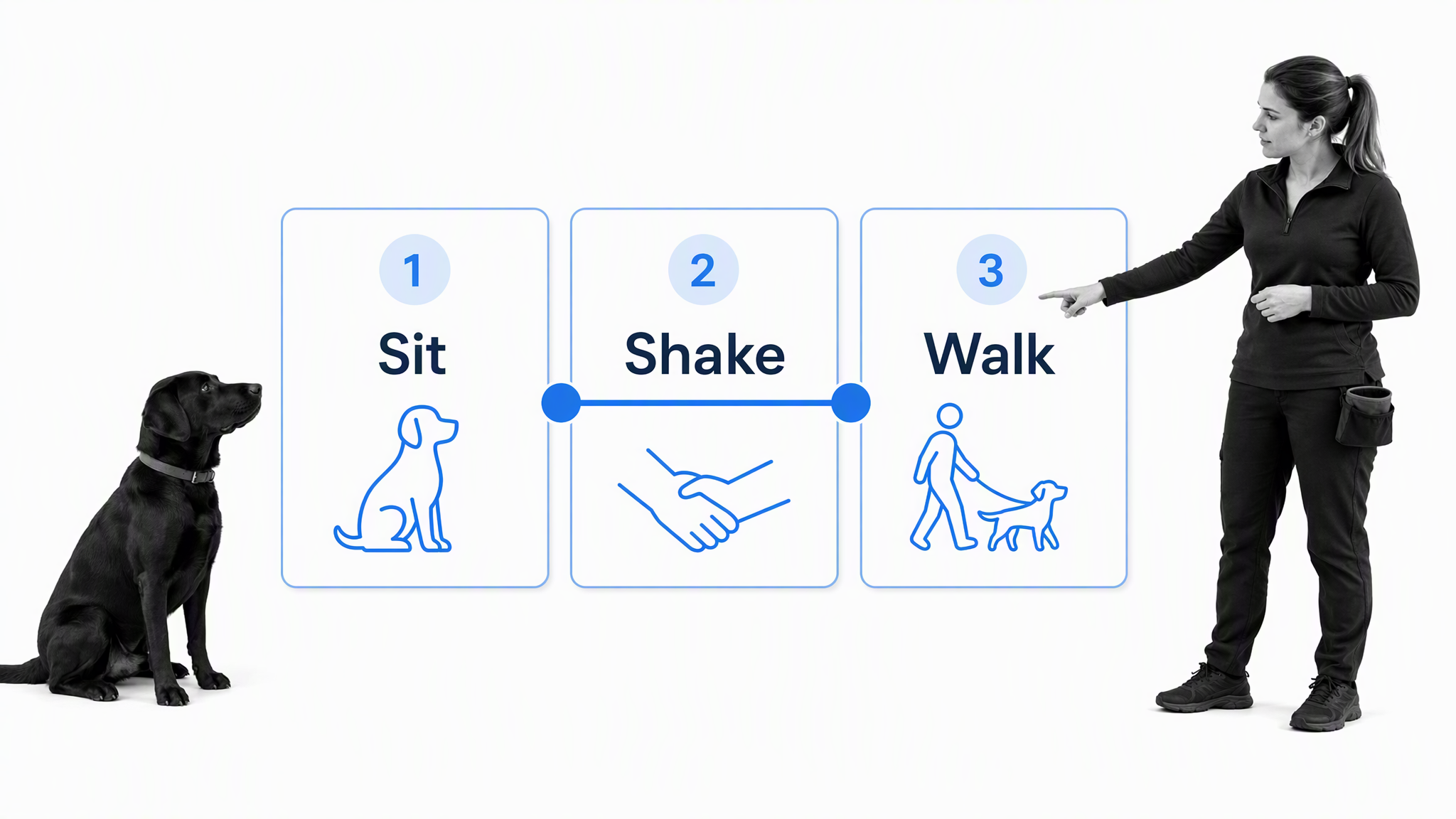
I had to stick to the game plan. Otherwise, I would get a dog that was all fur and no discipline, or a paycheck that was all paper and no dollar sign. So I replaced improvisation with a simple routine: use the same cue, reward the right response, and keep the household boundaries predictable.
Each time we came back inside after walkies, a word I can no longer say out loud without four paws sprinting like an Olympian for the front door, she slowly learned to respond to “sit,” “shake,” and “articulate Newtonian physics!”
One month and two days later, accidents were rare, the cat could relax, Leia gave me her paw for every treat, and she waited calmly by the front door before each walk. The routine was not exciting. That was the point: repeated steps made progress visible.
How I put the lesson into practice at work
In my day-to-day business life, I tried to implement the same idea. Instead of using short, unstructured calls to decide whether prospects were a fit, I followed a sales qualification process for every conversation.
The example below is a BANT-based sales qualification template. BANT is not the right framework for every sales team, but the template shows the essential principle: ask the same core questions, capture the answers in the same place, and make the next step explicit.
After a few weeks, the original pipeline looked completely different. What had been roughly 50 loosely qualified leads became a list of 20 prospects I could practically name on a first-name basis. That was one historical result from one pipeline, not a guaranteed benchmark. The durable lesson was that a repeatable sales process made qualification easier to inspect and improve.
The same principle applies across modern sales management tools: a CRM can store the record, while the workflow controls qualification steps, ownership, and handoffs. Improving workflow efficiency starts with enough consistency to reveal where a handoff stalls or a question fails to produce useful evidence.
Trusting only our professional experience and “natural ability” was not enough. The process was the doctrine.
Frequently asked questions
What is the first step in workflow improvement?
Choose one recurring workflow and run the same version several times. Record its completion time, exceptions, and outcome before changing a step.
Why does consistency improve workflow measurement?
Consistency reduces variation in how work is performed. That makes it easier to connect an observed result to a specific step and judge whether a change helped.
The post How My Dog Taught Me to Improve My Workflows and Make More Sales first appeared on Process Street | Compliance Operations Platform.


0 Commentaires