Corporate strategy sets the overall direction of an organization: which businesses and markets it will compete in, how resources will be allocated, how the portfolio fits together, and what tradeoffs leadership is willing to make.
Those choices matter because business can be tooth and claw. In tooth-and-claw corporate competition, strategy helps the organization win the war for focus without treating every tactical move as a separate battle. A strong strategy aligns structure, resources, and execution before competition exposes the gaps.
This guide explains what corporate strategy is, how it differs from business and functional strategy, the four pillars that support it, and how to turn strategic choices into repeatable execution.
- What is corporate strategy?
- The benefits of corporate strategy
- Corporate strategy process
- Using Process Street to implement the corporate strategy process
What is corporate strategy?
Corporate strategy is the portfolio-level plan that determines an organization’s long-term direction. It answers four connected questions: where the organization will compete, how its businesses fit together, how capital and people will be allocated, and how the parent organization will create more value than those businesses could create alone.
Corporate strategy definition
At the corporate level, leaders make choices about scope, structure, investment, acquisition, divestment, and shared capabilities. Business strategy then determines how an individual business competes in its market. Functional strategy turns those choices into plans for operations, finance, people, marketing, product, and other teams.
This distinction matters. Corporate strategy is not a collection of departmental goals. It is the system of choices that makes those goals point in the same direction.
The language of strategy came into business from military and political thought. The parallel is useful because both environments punish fragmented decisions, weak intelligence, and poor coordination.
Corporate strategy example, Custer’s Last Stand

Source: Edgar Samuel Paxson, Wikimedia Commons
The Battle of the Little Bighorn is a cautionary example of strategic failure. According to the National Park Service, Lieutenant Colonel George Custer underestimated the opposing force, divided the 7th Cavalry into separate elements, and attacked without the coordination needed to reunite them effectively.
Major Marcus Reno led one element into the valley. Captain Frederick Benteen led another to the south and west. Custer continued with roughly 210 men. The fragmented command structure, incomplete intelligence, and failed communication turned a difficult situation into a disaster.
The business lesson is not that markets are battlefields. It is that resources, timing, information, and coordination form one strategic system. Leadership cannot optimize each decision in isolation and expect the portfolio to hold together.
Corporate strategy example, scale versus customization

McDonald’s and Burger King have spent decades competing in the same broad category while making different operating and positioning choices. One strategic model can emphasize global scale, repeatability, and consistency. Another can emphasize customer choice, menu flexibility, and customization.
The point is not to declare a permanent winner from a revenue snapshot, follower count, or website score. Those figures age quickly and measure different things. The durable lesson is that a strategy becomes real through tradeoffs. A company cannot maximize standardization and unlimited customization at the same time without adding cost and complexity.
These examples show the same principle at different scales: corporate strategy aligns choices before execution begins.
The benefits of making good strategic choices
A Good strategy can bridge the difference between success and failure. However, what about the more subtle benefits?
A Good corporate strategy maintains correct direction and alignment
Firstly, the benefits of having a well defined corporate strategy increase as the organization scales. Although smaller companies may be able to just about get away with not defining strategic direction – although this isn’t advised – larger organizations can’t. Effort is required to maintain the correct direction and alignment of operations.
To stay on track, a corporate strategy must remain flexible and adaptable towards any roadblocks or errors that may come the organization’s way.
Good corporate strategy creates wealth
When devising your strategy, it is a good idea to look into diversification, as this can bring benefits under the umbrella term corporate strategy. For instance, joint ventures bring in alternative revenue streams. However, when involved in strategic diversification, it is important to weigh up the costs against the actual return.
Diversification includes entry into new markets, new products/product lines, and new services – all of which demand substantially different skills. To ensure the most value is obtained via corporate strategic diversification, an adaptive and flexible approach must be maintained. Consider the following two questions:
- What businesses should the corporation be involved in?
- How will the corporate office manage the array of business units?
Good corporate strategy can increase market share
A good corporate strategy that is diverse will increase market share by introducing new products, exploring new regions, or targeting new groups of customers.
However, diversification can expose an organization to new risks, increase the number of non-profitable activities, and can constrain the conglomerates reducing flexibility. It must be warned that diversification needs to be adequately planned for, as to truly grasp the benefits and avoid potential risks, a thorough corporate strategic plan is needed.
Good corporate strategy helps manage change
“It must be considered that there is nothing more difficult to carry out, nor more doubtful of success, nor more dangerous to handle, than to initiate a new order of things” – Niccolò Machiavelli, The Prince
Change is a given for business, and the need to respond effectively to change is set to grow with our increasingly turbulent environment, economic, and cultural forces.
To manage change, managers have to confront basic questions, such as:
- What business(es) should we be in?
- How should we be organized to accomplish our strategy?
- What kinds of people do we need, and how will they be acquired, developed, and rewarded?
These are the types of questions covered whilst establishing the corporate strategy.
To help you manage change in your organization, read: 8 Critical Change Management Models to Evolve and Survive.
Good corporate strategy can mitigate against risk
Business decisions almost always bring with them an element of risk. A Corporate strategy will help manage this risk by analyzing the decisions made and contemplate possible future scenarios for each decision. To help you manage risk for your business, why not incorporate Process Street’s Risk Management Process in your strategy.
Click here to access Process Street’s Risk Management Process!
How corporate strategy moves from choices to execution
 In this next section, you will learn the corporate strategy implementation process, a process you can easily implement and execute for your business. Before that though, it is important to understand how corporate strategy fits in regarding the different strategic business levels.
Comparing business-level and corporate-level choices
The business-level strategy has a customer focus, looking at how value can be provided to the customer. It is about meeting the needs of the customers and increasing operating profits.
Corporate-level strategy, on the other hand, looks at success from a higher level. Corporate strategy is focused on obtaining a mix of business units that allow the organization to succeed as a whole.
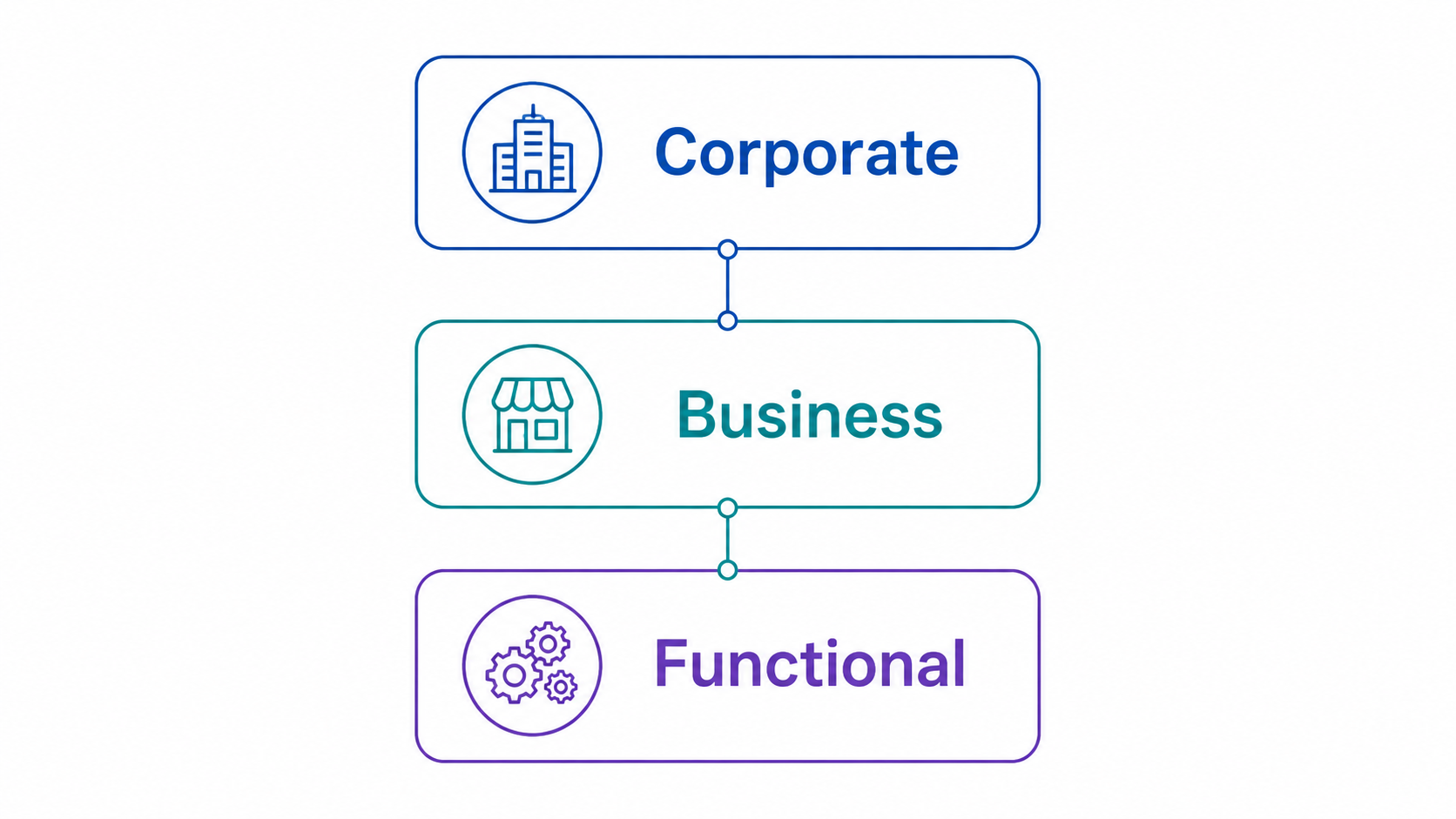
To explain further, the complete organizational strategy is divided into three distinct levels. These levels are separated based on the concerns and goals of the three hierarchical elements that make up an organization – at the corporate level, the business level, and at the functional level.
- The corporate strategic level: This is the top-level decision making that will determine how every hierarchical level of the organization operates.
- The business strategic level: This level takes the corporate-level strategic goals, and breaks down these goals so they are fine-grained and practical, based on business-level knowledge and experience.
- The functional level: The strategies and goals from the business and corporate level are turned into meaningful and measurable activities, such as specific projects and departmental objectives.
The level of focus for this article is corporate strategy.
Four pillars that support enterprise direction
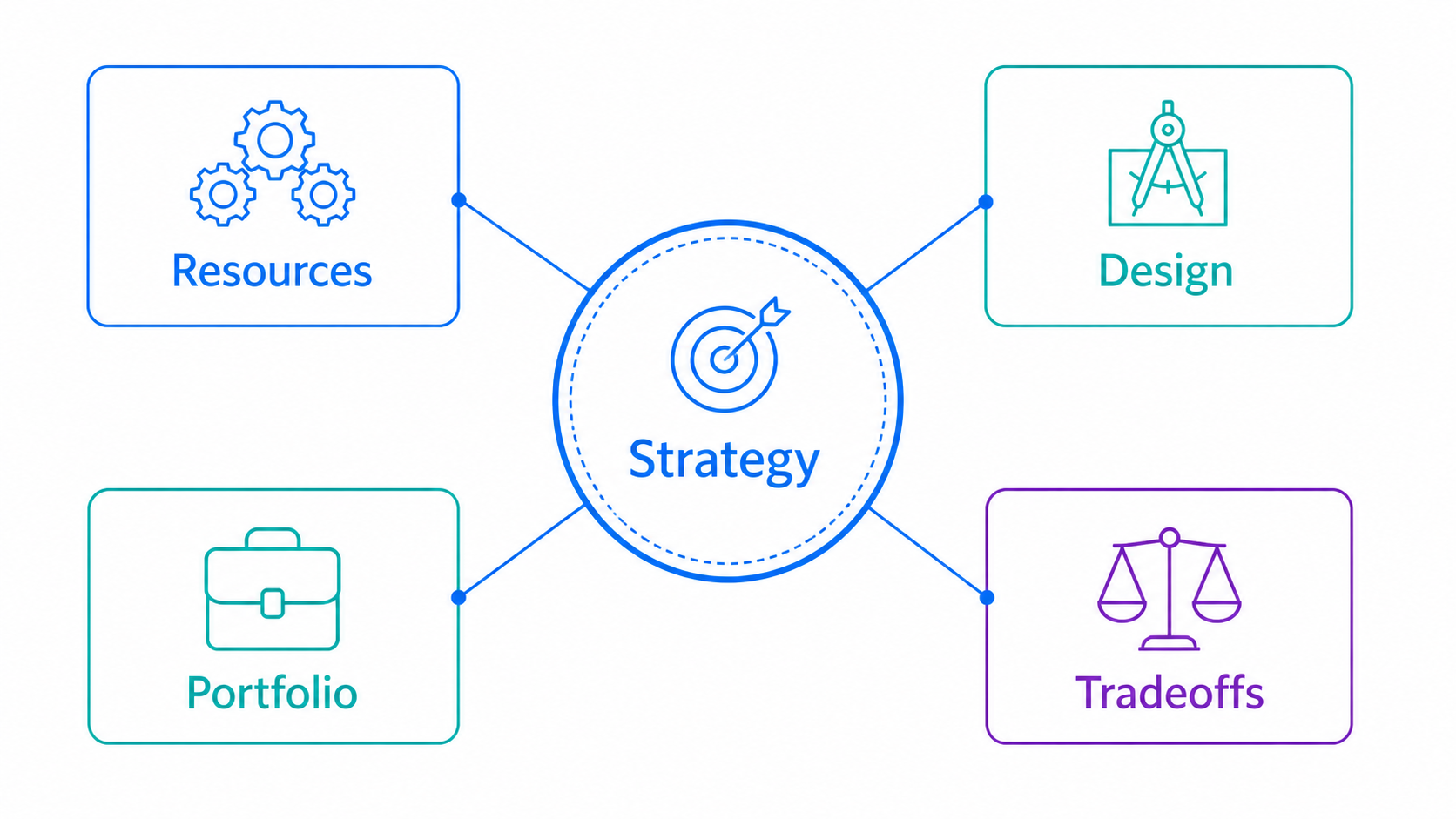
Although corporate strategy as a discipline is broad, there are several important components in need of focus. These components, as given by the Corporate Finance Institute, are as follows:
- The allocation of resources
- Organization design
- Portfolio management
- Strategic tradeoffs
Corporate strategic pillar one, allocation of resources
By resources, we are referring to 2 resources – people and capital. We want to maximize the capital of the entire firm and so leaders must determine how to allocate these resources to the various businesses or business units. This allocation can be thought of as a play-off, to devise the best combination for organizational success. Breaking down the factors related to the allocation of resources, we have:
People
- Consider leader and employee skills, and distribute them to the places that they are needed most and can deliver the most value.
- Ensure the appropriate talent is supplied and available to all businesses.
Capital
- Capital should be allocated so that it gives the highest risk-adjusted return.
- External operations should be analyzed (mergers and acquisitions) to allocate capital appropriately.
Corporate strategic pillar two, organizational design
The organizational design should be adapted to ensure the firm has the structure necessary and the related systems in place to maximize the value created. Factors to be considered include the role of the corporate office – is a centralized or decentralized approach taken? The reporting structure of the individuals and business units – is the structure vertical hierarchy, matrix reporting, etc?
Key factors related to the organization’s structure are:
Head office (centralized vs decentralized)
- Determine how much autonomy to give each business unit.
- Decide whether the decisions made are top-down or bottom-up.
- Think about the strategic influence of each business unit.
Organizational structure (reporting)
- Determine how large initiatives and commitments will be divided into smaller projects.
- Integrate business units and business functions such that there are no redundancies.
- Balance risk and return by separating responsibilities.
- Develop centers of excellence.
- Determine the appropriate delegation of authority.
- Set governance structures.
- Set reporting structures (military/top-down, matric reporting).
Corporate strategic pillar three, managing the portfolio
Portfolio management looks at the different business units with the question: How does each business unit support/work with the other/s? The management of an organization’s portfolio is referred to as portfolio management, and portfolio management decides how the organization plays.
Thinking about portfolio management with corporate strategy in mind, you must:
- Decide what business to operate in.
- Determine the extent of vertical integration your firm should have.
- Manage risk via diversification and reduce the correlation of results across businesses.
- Create strategic options via seeding new opportunities that could be invested in heavily.
- Make sure your portfolio is well-balanced about market trends via monitoring the competitive landscape.
Corporate strategic pillar four, strategic tradeoffs
A challenging aspect of corporate strategy is attempting to balance the tradeoffs between risk and return. As already mentioned, with most business decisions a degree of risk is incurred. If a holistic view is taken, however, an optimal level of risk vs return is pursued.
The main factors to consider when thinking about strategic trade-off are:
Risk management
- Firm-wide risk is dependent on the strategies the organization chooses to implement.
- Product differentiation is a high-risk strategy and can result in a market leadership breakdown.
- Copycat strategies should be considered, i.e. looking at what other companies have done and modifying this strategy slightly.
- It’s important to be aware of the strategies and the risks associated across a given firm.
- Some areas might require true differentiation – or cost leadership – but other areas might be better suited for copycat strategies.
- Business unit autonomy must be considered as this is important when managing business risk.
Generating returns
- Strategies that impose high risk, are often associated with higher returns.
- It is important to have an appropriate number of options in your portfolio.
Incentives
- Incentive structure plays a big role in how much risk and return is sought by managers.
- Separated risk management and risk generation will mean both are pursued to the desired level as separate entities.
- Manage overlapping timelines with risks and returns ranging from short-term/long-term, keep dispersion as appropriate.
Formulating and executing the direction
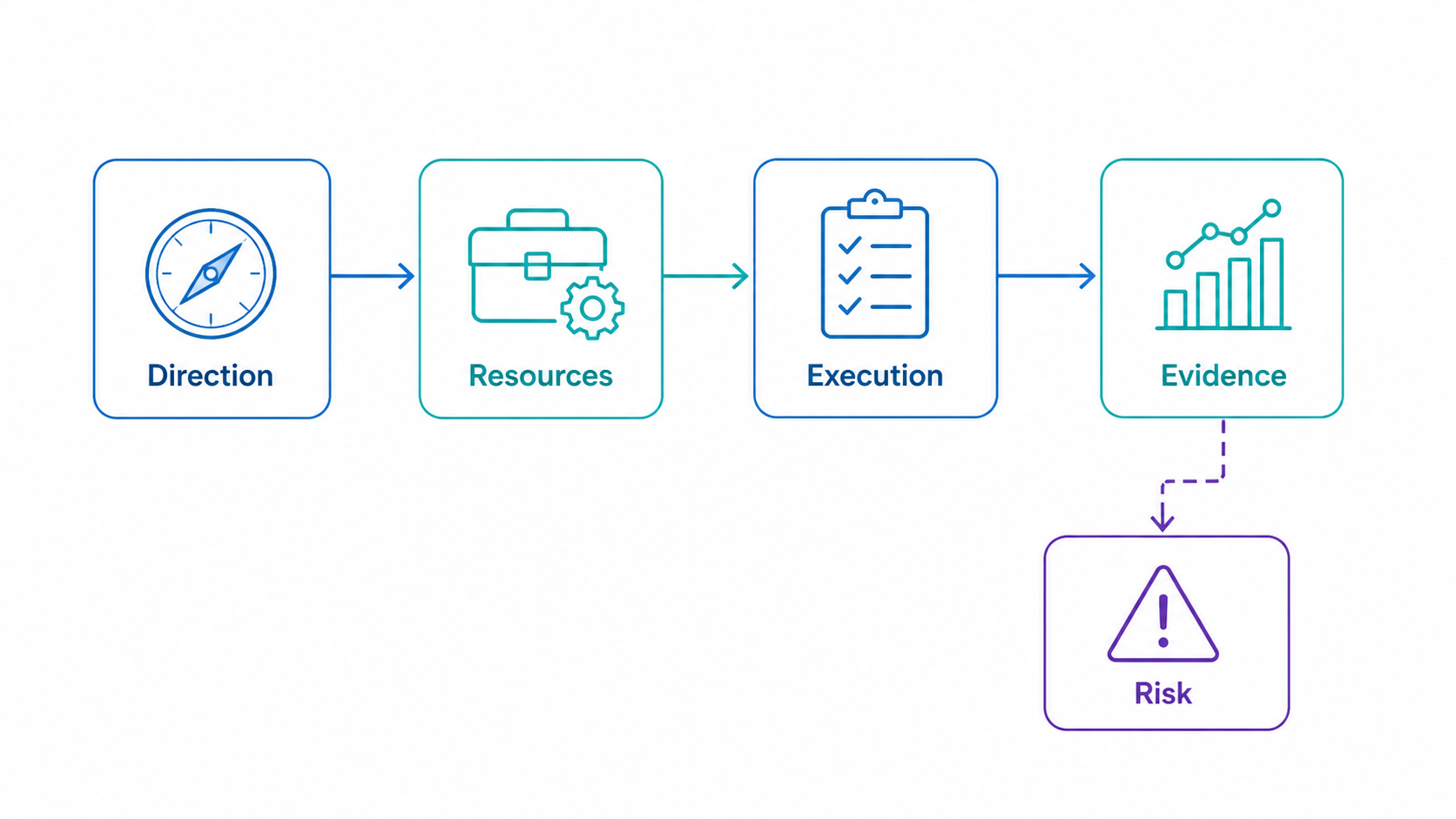
Corporate strategy is formulated by top managers. Responsibility is then passed down through the organization via the different departments. The entire set of activities is referred to as the strategizing process. I have summarized this process as follows:
- Step 1: The vision and mission statements are given. The mission statement lays out the organization’s purpose of being whereas the vision statement states based on that purpose, this is what we want to become. The vision statement is a future-orientated declaration and corporate strategy will flow directly from this statement.
- Step 2: Organizational values are set and shared within the organization.
- Step 3: The corporate strategy is then formulated into a strategic plan. The plan should allow for the achievement of the organization’s mission.
Strategic planning, together with organizing, leading, and controlling are sometimes referred to as P-O-L-C. At Process Street we have top free template resources you can jump in and use today to help you formulate your corporate strategy via the P-O-L-C process. I have detailed these templates below, along with a whistle-stop tour on how you can get started with Process Street.
Using Process Street to turn choices into governed work
Strategy only creates value when people can execute it consistently. Process Street connects controlled documentation with operational workflows, ownership, approvals, evidence, and built-in AI. It gives leaders a practical way to translate portfolio choices into governed work.
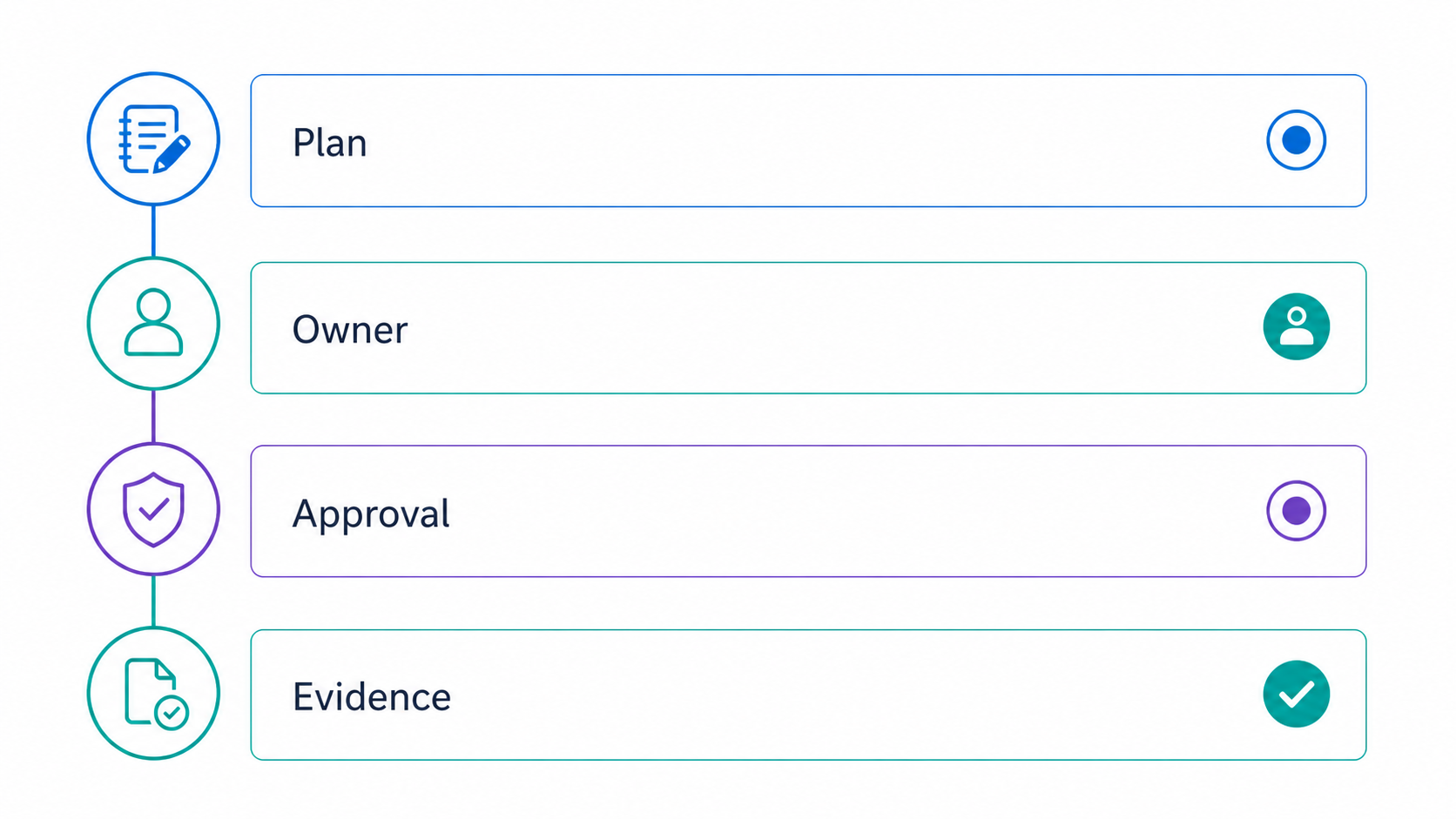
That implementation layer should connect strategy to the systems teams already use. Process planning software helps turn recurring strategic work into plans people can follow, measure, automate, and prove.
Planning and setting direction
Planning defines the mission, direction, priorities, constraints, and measures that will guide the organization. Use the Strategic Planning Template to make assumptions and decisions visible before work is assigned.
Organizing with a Work Breakdown Structure
Organization converts strategic priorities into owned work. Break outcomes into deliverables, assign responsibility, and make handoffs explicit so resources follow the strategy.
Leading through project execution
Leadership keeps execution aligned when conditions change. A governed project workflow gives teams a shared operating rhythm, while approvals and conditional paths keep important decisions under control.
Controlling strategic risk
Control does not mean freezing the plan. It means collecting evidence, monitoring exceptions, and responding before risk compounds. The Risk Management Process provides a repeatable structure for identification, ownership, treatment, and review.
Turning tooth-and-claw choices into repeatable work
Corporate strategy is the set of choices that keeps an organization from entering tooth-and-claw competition blind. It defines where to compete, how the portfolio creates value, where resources go, and which tradeoffs leadership will accept.
The final test is execution. Document the strategy, assign the work, govern the decisions, and collect the evidence that shows whether the plan is working. That is how strategy moves from the boardroom into daily operations.
The post Business Tooth and Claw, Corporate Strategy to Win the War first appeared on Process Street | Compliance Operations Platform.


0 Commentaires