
When you process 35,000 insurance claims a year, every minute spent on manual assembly is a minute of revenue left on the table. A mid-market healthcare practice running multiple locations discovered that firsthand, then cut their appeals prep time by 7x after moving to Process Street.
This is the story of how a multispecialty outpatient clinic replaced a fragmented stack of disconnected tools with a single HIPAA-compliant workflow platform, eliminating manual PHI handling and recovering thousands of hours a year.
The Problem: Fragmented Tools, Manual PHI Handling, No Compliance Guardrails
The practice offered rehabilitative and physical medicine specialties across multiple locations, with roughly 22 platform users managing 15,000 to 20,000 active patient records.
Day-to-day operations ran across a patchwork of disconnected tools: DrChrono for the EHR, Google Workspace for documents, Document Studio for layout, RingCentral for communications, plus manual spreadsheets and offshore admin labor to fill the gaps.

Three problems compounded:
PHI moved between systems through manual copy-paste. Patient data was re-entered by hand into each workflow. Provider data was maintained through manual CSV uploads. Every handoff was an exposure risk.
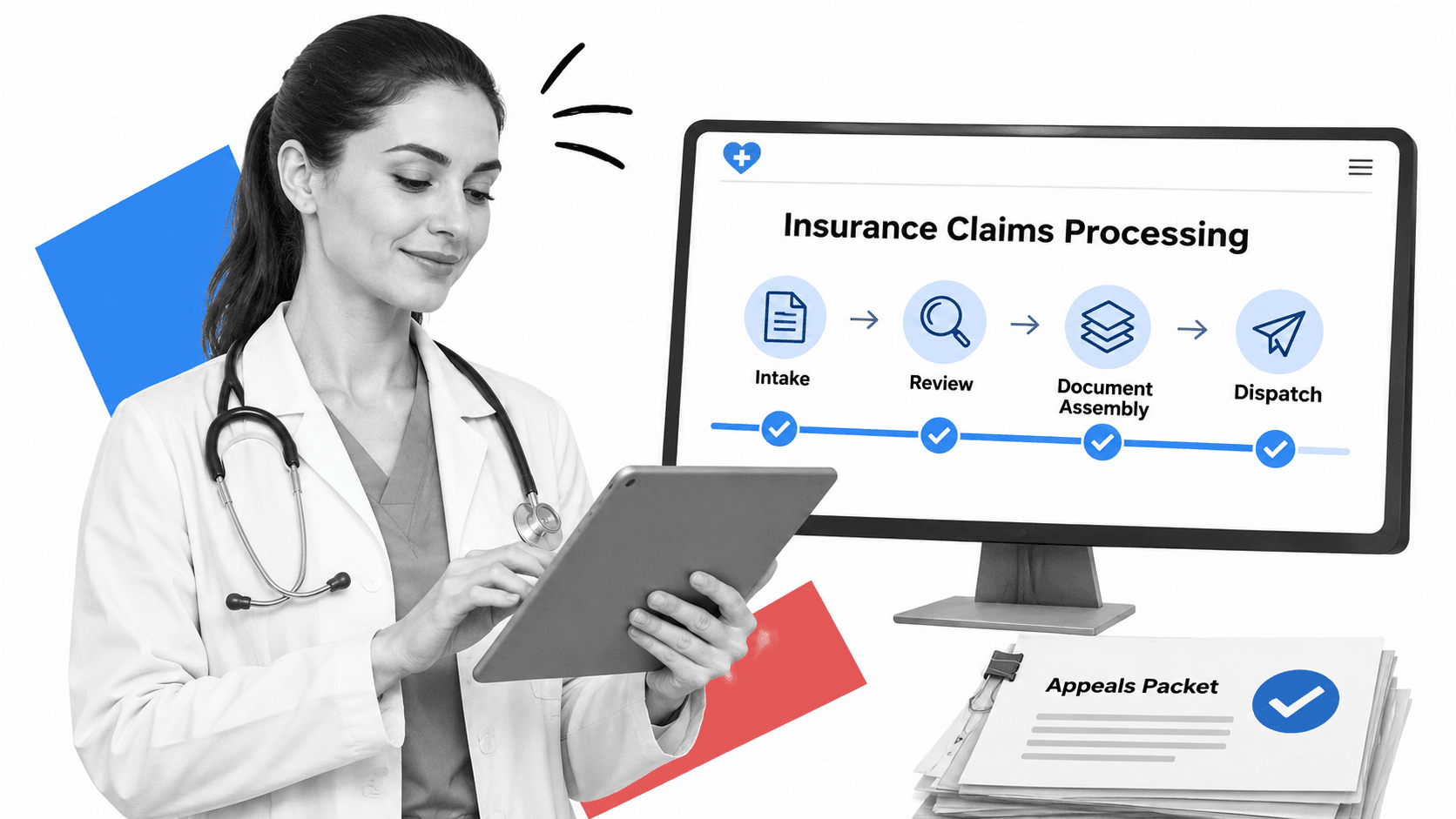
Insurance appeals packets took 10 to 15 minutes each to assemble. Staff pulled records from the EHR, copied them into a Google Sheet, laid them out in Document Studio, then dispatched the finished packet. Across 35,000 annual claims, the hours added up fast.
Most workflow tools couldn’t meet their compliance bar. The practice required a Business Associate Agreement and HIPAA-eligible architecture from any vendor touching patient data. Most modern workflow platforms either didn’t offer a BAA or gated it behind enterprise contracts the practice couldn’t afford.
The Solution: One Platform, Full HIPAA Coverage, Zero Manual Handoffs
The practice deployed Process Street as their single workflow automation platform, backed by a signed Business Associate Agreement and built on HIPAA-eligible infrastructure.
Three changes made the difference:
Automated data flow from the EHR
DrChrono now pushes patient and provider data directly into Process Street via webhooks. When a record updates in the EHR, every downstream workflow reflects the change automatically. No manual re-entry, no stale spreadsheets, no copy-paste between systems.
Workflow-driven appeals processing
Insurance appeals packets are now assembled inside Process Street workflows. The system pulls patient and provider data from data sets, hands off to Document Studio for rendering, and returns the finished packet to the workflow run for review and dispatch. What took 10 to 15 minutes now takes 1 to 2.
PHI bounded to BAA-covered systems only
Every system in the data flow is covered under a Business Associate Agreement: Process Street, DrChrono, Google Workspace Enterprise, and DocuSign. Integration paths that originally ran through non-BAA tools were redesigned to use native webhook integrations, ensuring protected health information never leaves compliant systems.
Built on AWS
Process Street runs on AWS using HIPAA-eligible services under the AWS Business Associate Addendum, which is why the practice chose it as the platform for workflows that touch protected health information. The key AWS services powering this implementation:
- Amazon S3 + AWS KMS for encrypted storage of PHI-bearing file uploads and rendered document artifacts
- Amazon RDS / Aurora for workflow data, data sets, and audit log storage with encryption at rest
- AWS Lambda + Amazon API Gateway for webhook processing and event-driven workflow triggers connecting the EHR
- Amazon CloudWatch + AWS CloudTrail for application metrics, request logs, and immutable audit trails used in HIPAA evidence collection
- AWS WAF + Amazon GuardDuty for perimeter protection and threat detection
AWS-native services covered under the BAA were chosen over third-party alternatives because the practice refuses to route PHI through any service not under a Business Associate Agreement. This architecture gives a mid-market practice enterprise-grade compliance posture without enterprise-grade infrastructure spend.
The Results: 7x Faster Appeals, Manual Entry Eliminated
The platform is fully operational with 17 active workflows, multiple data sets, and continuous webhook traffic between the EHR and Process Street.
Insurance appeals prep: 5 to 7x faster
| Before | Target | Actual |
|---|---|---|
| 10 to 15 min per packet | Under 3 min | 1 to 2 min (5 to 7x reduction) |
The workflow pulls records, renders the document, and returns a ready-to-dispatch packet. Across approximately 35,000 annual claims with a meaningful share requiring appeal documentation, the time savings run into the thousands of hours per year.
Manual data entry: eliminated
Patient and provider drop-downs that feed clinical and billing workflows are now populated automatically. Provider data updates from DrChrono propagate to every downstream workflow via webhook. The manual CSV upload and copy-paste reconciliation process is gone.
PHI exposure: closed
Protected health information is now bounded to BAA-covered systems with task-level permissions on sensitive content. The practice has a clear audit trail for every workflow run, every data access, and every document generated.
What’s Running Today
The practice runs 17 production workflows across five operational areas:
- Insurance claims and appeals processing with automated packet assembly
- Multi-step patient retention outreach with deterministic follow-up sequences
- Pre-service financial conversations standardized across locations
- Role-based employee onboarding with credential collection for practitioner licenses, malpractice insurance, and NPI
- Provider credential and location data management synced from the EHR
Why It Worked
The practice evaluated three alternatives before choosing Process Street: on-premise workflow tooling (rejected for lack of IT staff), general-purpose SaaS without a BAA (rejected because PHI can’t flow through non-BAA systems), and building a custom tool extending their internal practice management system (rejected for development and compliance maintenance burden).
Process Street was the only option that delivered a signed BAA, role-scoped task permissions, SSO, audit-ready logs, native EHR integration via HIPAA-compliant workflows, and a price point an independent practice could sustain.
For mid-market healthcare providers who need enterprise-grade compliance without enterprise-grade budgets, that combination matters.
The post How a Mid-Market Healthcare Practice Cut Insurance Appeals Prep by 7x first appeared on Process Street | Compliance Operations Platform.


0 Commentaires