Business process optimization is the disciplined practice of improving an existing process against a defined goal without breaking the constraints that keep the work safe, reliable, and compliant.
This guide explains what process optimization means, compares the methods teams use, shows a worked content-production example, and gives you free templates. It also shows where process management tools and Process Street support measurement, controlled execution, and continuous improvement.
- Process optimization basics: What you need to get started
- The business process optimization workflow
- How to work out the goals of your process optimization
- How to optimize processes with automation
- Process optimization resources to get started now
Getting started with process optimization
To kick off, let’s look at what process optimization means and doesn’t mean, with an example to help.
Process optimization definition
Process optimization is the discipline of adjusting a process so as to optimize (make the best or most effective use of) some specified set of parameters without violating some constraint.
Business process optimization meaning
In business operations, process optimization means improving an existing process so it reaches a defined goal more reliably. The goal might be faster cycle time, fewer errors, lower cost, stronger control evidence, higher throughput, or a better customer outcome.
The sequence matters: define the goal and constraints, measure the current state, find the bottleneck or root cause, test the smallest useful change, and verify that the result improved without creating a new failure elsewhere.
Process optimization examples
If we look at our content creation workflow, the one I’m using right now as I write this article, we can see the evolution of a process over time. We can also see how the improvement of that process creates a system around it via the addition of extra elements of automation and other useful tools.
In the past, we had a relatively short process used for Prepublish checks once a post was written. Our little content system involved using Trello to manage our writing tasks – once a task card was moved into a Prepublish Trello column, a Process Street checklist would run and an automation would post the URL of that process into the comments on the Trello card.
This is what that process looked like:
This process was good but we realized there were some minor issues:
- We weren’t always targeting good keywords
- The designer would often receive image requests too late
- Some posts had improvements to be made after being published
So, as well as switching over to Airtable from Trello, which allowed us to gather more data for our tracking and monitoring of both our tasks and content assets, we made a number of process changes:
- We added keyword research and concepting steps in the early section of the process to create an ideation stage
- We added the designer’s tasks into a follow up section after the ideation stage so that the designer was always able to work on the images before the writer begins the draft.
- We added editor steps in after the ideation stage to discuss the concept and keywords, and added editor steps at the end of the process to approve the post, make it live, and send out the email.
- We made sure that the tasks throughout the process were assigned to the right individuals and had due dates to make sure they were completed on time. We used the Process Street features Role Assignments and Dynamic Due Dates to deliver this.
There were extra additions made and some things removed, but you can see in general what we did to optimize the process.
We added extra detail to the process to improve output, while also broadening the scope of the process to add more participants to improve output via accountability, reducing errors in the process.
All of the assignments, due dates, data gathering, record keeping, etc., was automated so that the writers, editors, and designers only ever need to work out of the process.
The lesson was not that one tool solved the process. The process improved because the team connected ownership, deadlines, approvals, evidence, and automation to the failures it had observed, then kept measuring the result.
How business process optimization works
There is no one clear or defined systematic approach to process optimization that everyone agrees on.
There are a number of options or approaches you can take and I’ll cover a few below as examples, and then explain how you can tackle one of the most broadly applicable ones.
Process optimization methods
Here are 3 illustrative examples:
DMAIC
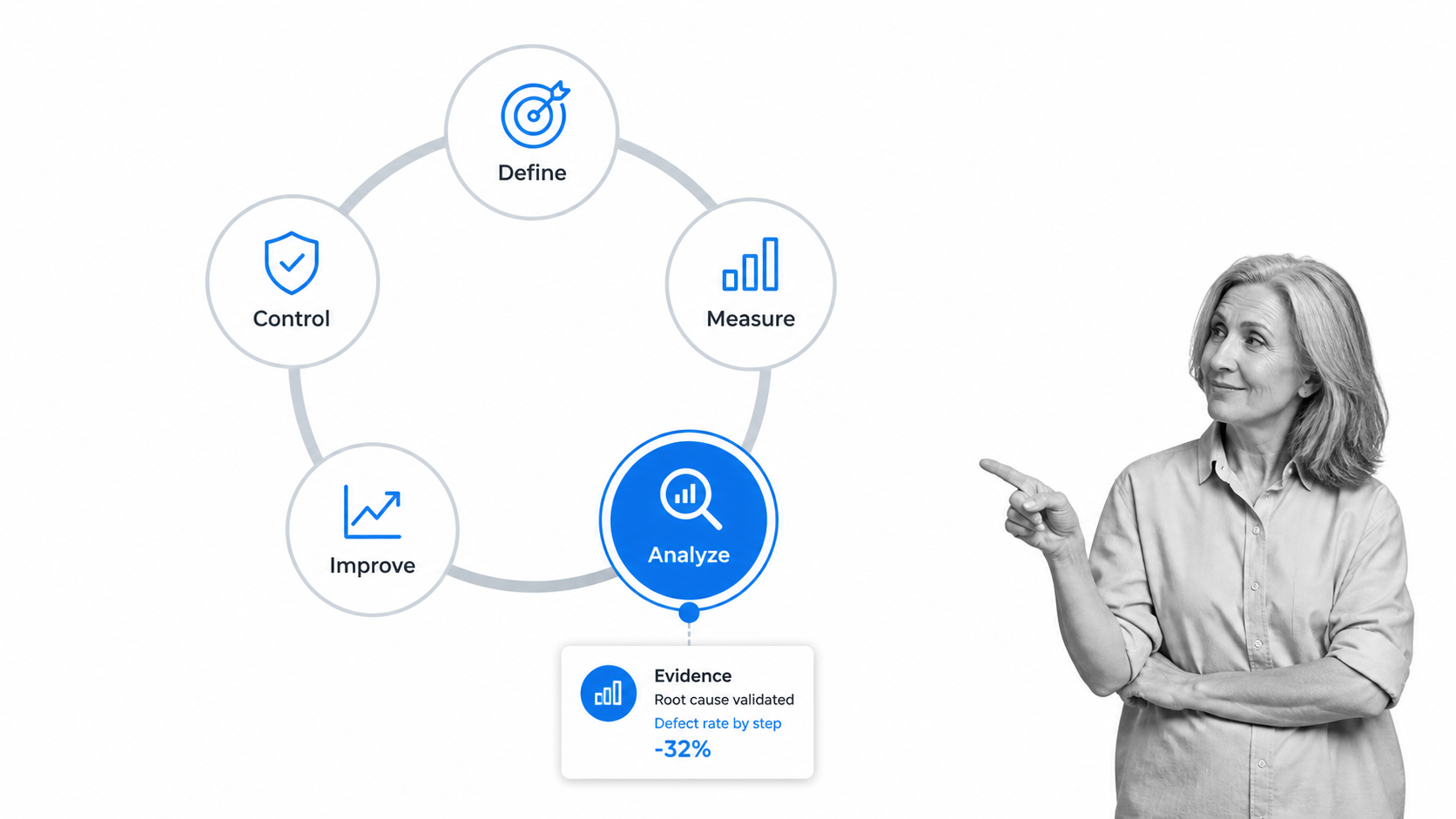
The DMAIC process is a Six Sigma process improvement technique which falls pretty squarely in the realm of process improvement and quality management.
It stands for:
- Define
- Measure
- Analyze
- Improve
- Control
It presents a strong data-driven approach to embarking on process optimization within a large organization and involving a series of stakeholders.
The goal of DMAIC within the context of Six Sigma is to locate output defects, trace those down to core process problems, and then find ways to improve the process to combat that problem, thereby reducing the defects in line with the Six Sigma method.
It’s kind of like a guide to running a whole study.
You can get the full breakdown of how to execute the DMAIC process in this article of mine here: DMAIC: The Complete Guide to Lean Six Sigma in 5 Key Steps.
Process Mining
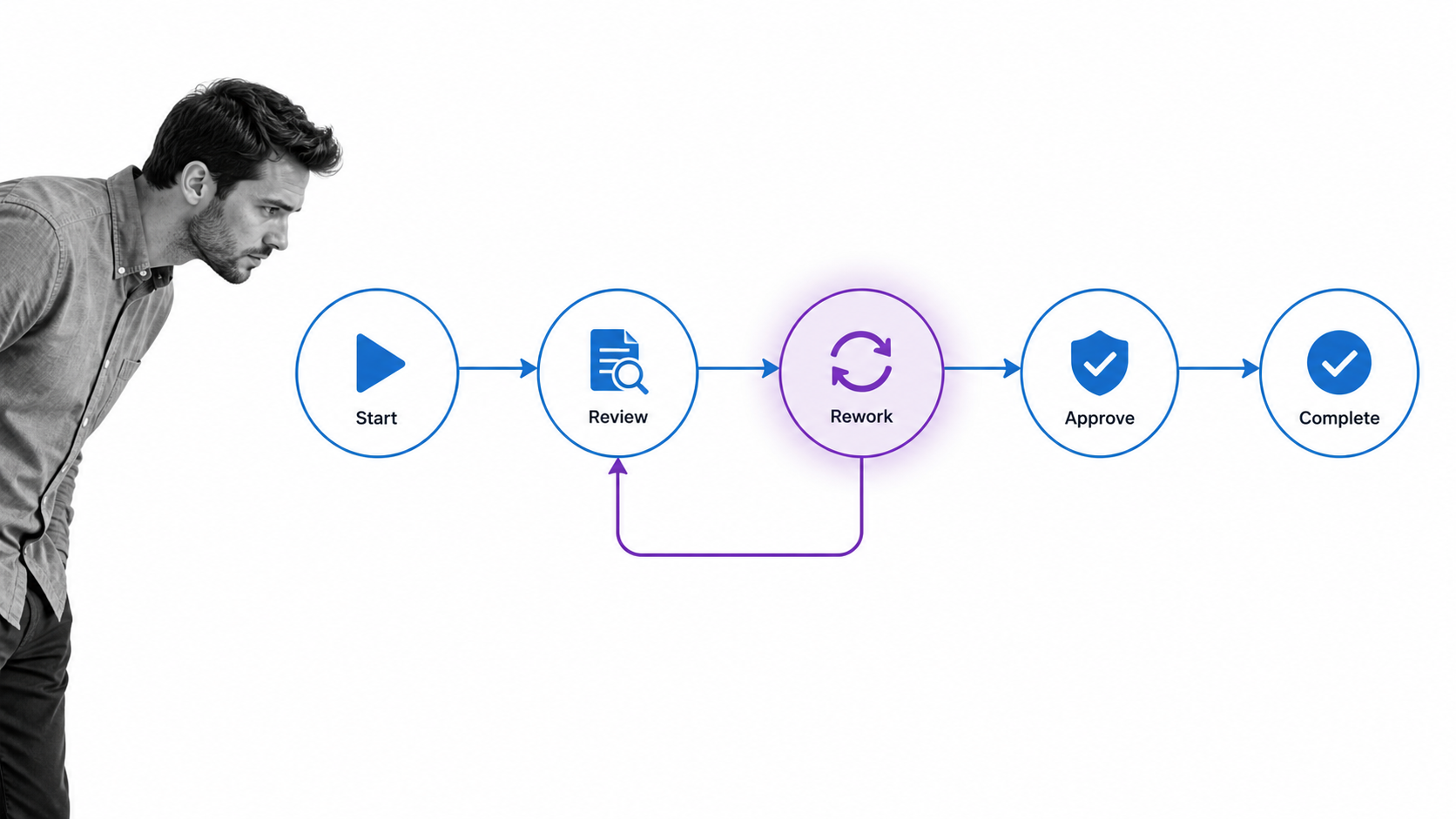
Process mining is obviously not a methodology on itself, but it is proving to be a very important part of modern process optimization methods.
One thing process mining can give you is a snapshot overview of what your current process actually is and how it operates. This is often called Automated Business Process Discovery.
You can basically give the process mining tool a big log of activity data and use the software to figure out what happens when, how, in what order, and by whom. You can map all of this out in loads of different ways which can then give you clear pictures of how your business processes exist in the wild.
You can also use things like conformance checking to map this activity data against your specified process model (the way things should be happening) to figure out whether the process is working as intended or not. This helps you identify whether staff are following the process – which also helps you begin to identify whether it’s the staff’s fault for not following it, or your fault for designing a process people can’t or won’t use.
All of this kind of stuff can be used as part of your process analysis from that data, and the vast amount of data means that with the right software you can map out projected process performance from tweaks in the model – allowing you to run basic tests on potential optimized changes before you implement them.
Process mining is only as reliable as the event data behind it. Missing timestamps, inconsistent case IDs, privacy constraints, and poorly understood variants can produce confident-looking maps that do not explain the real operating problem.
If you want to read more about process mining and check out how you can get started, you can read my piece on that here: What is Process Mining? 9 Tools to Optimize Your Process Management.
PDSA: Plan – Do – Study – Act
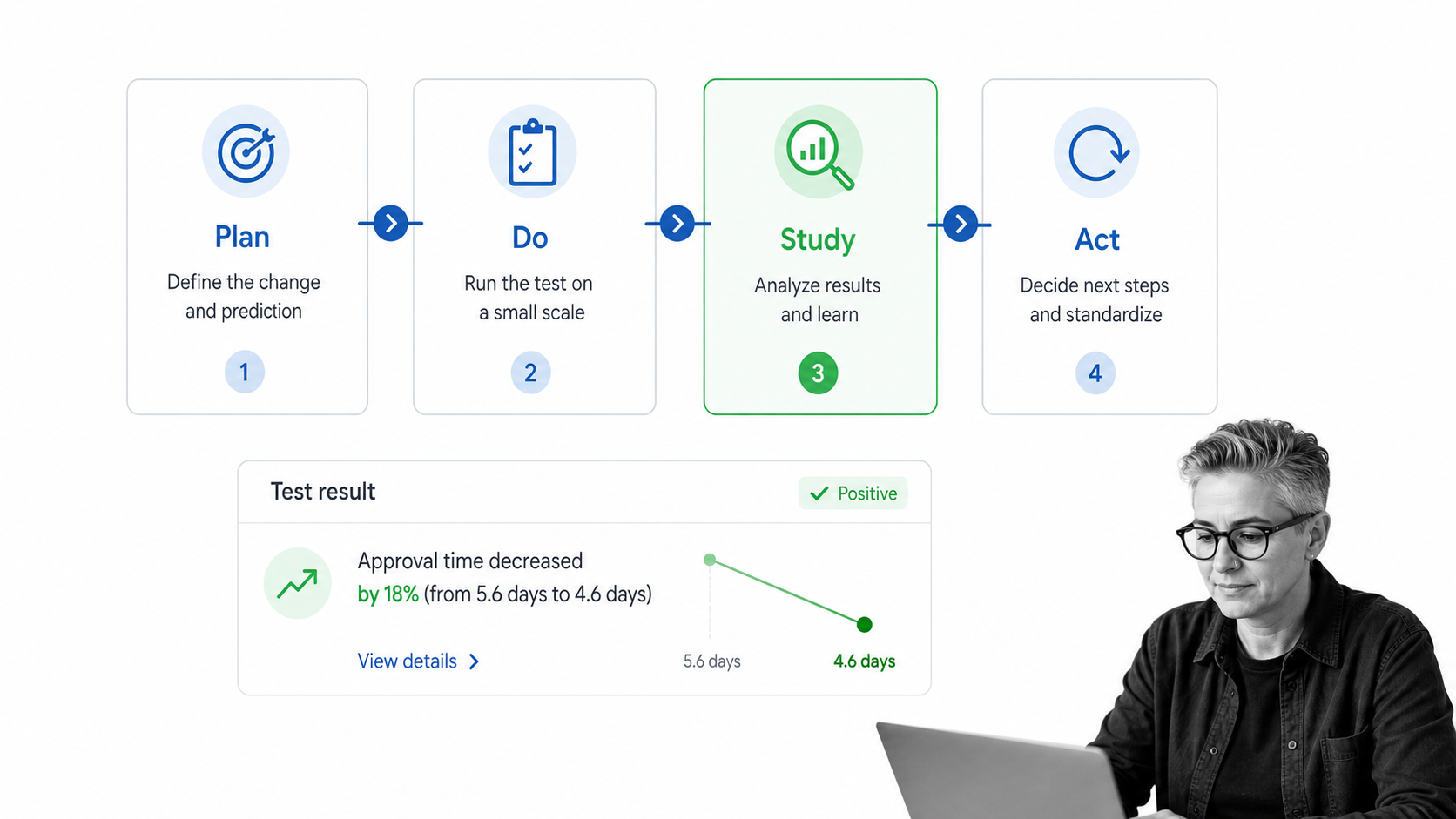
PDSA, or the Deming Cycle, is a 4 step process devised by Edward W. Deming in his efforts to bring scientific enquiry into the approaches of building and improving a business.
The theory fits well into discussions of process optimization as it centers around finding and improving the idea of quality throughout business operations. The idea of quality is central here as it expands much further than the Six Sigma idea of simply reducing defects.
The 4 stages are:
- Plan
- Do
- Study
- Act
In line with ideas of continuous improvement, the cycle begins again once it ends.
In the planning stage, you must determine your notion of quality as it applies to the process in question. Here you will identify the aspects of quality you wish to see improved and determine how you will quantify that improvement. Making predictions and being able to have accurate predictions is almost as important as achieving them as it shows you have a solid understanding of your business system.
The do stage is about implementing these improvements and doing so in a controlled manner. If you can use control groups or pilot studies then you will have better comparative data to understand the variables which impact on outcomes. Involving your team in the process is also an encouraged aspect of Deming’s school of thought.
The study stage differs to the PDSA variant PDCA. In PDCA you check whether your results are good; whether your output has gone up, waste has gone down, or some clear singular outcome. Deming rejects this in favor of the study of the outcomes – using the results to build up a theory of your business, akin to a scientific approach. In this stage you will want to measure as many aspects of the new process and its results as possible.
The act stage would be where you implement the new process improvements across a broader portion of your activities, perhaps with changes from the pilot study built on the new understandings you’ve gained from the experiment. You then plan further improvements…
You can read more about PDSA in another article of mine here: How to Use The Deming Cycle for Continuous Quality Improvement.
Setting goals for process optimization
This seems like a really obvious step in how to approach business process optimization.
Your goal is to improve your process, right?
Well, yes and no.
You could be improving your process at any point – is that improvement the same conceptually as the optimization we’re undertaking?
No.
If we take a little look at this quote from Business Process Analysis and Optimization: Beyond Reengineering by Vergidis, Tiwari, and Majeed:
A holistic approach toward business processes should capture a business process (business process modeling), provide the necessary means for bottleneck identification and performance analysis, and, eventually, generate alternative improved business process(es) in terms of specified objectives. But often this last part (business process optimization) is overlooked, if not completely neglected, in business process literature.
The point of business process optimization is that it comes at the point whereby you’ve reached the upper tiers of your business process maturity model (BPMM).
If we take a look at this maturity model below, which is a representation of the Capability Maturity Model developed by the US Department of Defense, you can see that the optimization stage is the top stage; the one which demonstrates your maturity levels should be bringing you close to peak performance.
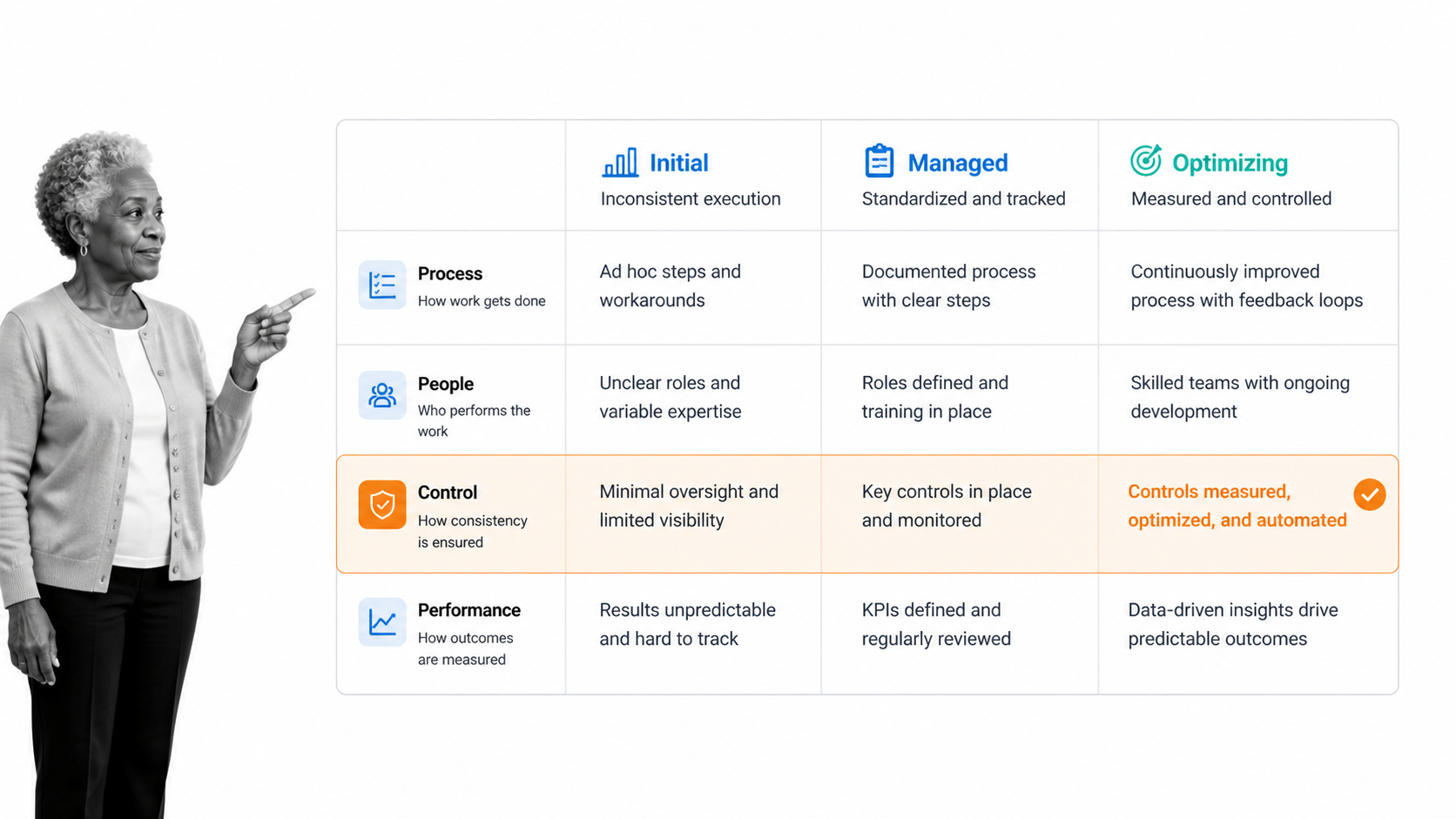
The above demonstrates nicely that there are certain things you need to achieve before you’re approaching true optimization of your processes.
Imagine it to be an organic process.
As you complete tasks, you document those tasks and then follow that documentation the next time you approach the same task. Over time you may begin to involve other people in those documented processes, gaining their feedback about the process and how it might work.
You’ll also start to understand what limits to the process appear in relation to scope, and in regards to the output of a specific process. The business goal and the evolution of the process are two features which exist in a dynamic relationship – impacting on each other.
At the point where you have a built-out process, you know the desired outcomes for the process, and you understand the limits of the process, then you’re in a position to be optimizing it. Only at that point can you understand your clear goals in advance.
Automation for controlled process optimization
Automation helps optimization when it removes repeatable friction without hiding ownership or weakening control. Start with the process goal and baseline. Then automate the handoffs, assignments, reminders, approvals, evidence capture, and system updates that are stable enough to run consistently.
Process Street is one Compliance Operations Platform with Docs and Ops capability areas plus built-in AI. Docs keeps governed procedures, approvals, and review cycles connected to the operating method. Ops runs the work with assignments, due dates, conditional logic, approvals, forms, evidence, and automation. Built-in AI can help turn existing material into workflows, draft or classify information, surface exceptions, and support ongoing improvement inside the controlled process.
- Schedule recurring work. Use scheduled workflow runs when a process needs to start at a fixed cadence.
- Route work to the right person. Use task assignments, Role Assignments, and dynamic due dates so ownership and timing follow the process.
- Adapt the path. Use conditional logic to show the right tasks for the facts of a specific run.
- Control decisions. Put approval gates and evidence requirements in the workflow instead of chasing decisions in email.
- Monitor execution. Use My Work for assigned tasks and Reports to inspect progress, exceptions, and workflow activity.
- Connect the systems around the process. Process Street has direct, universal integrations to 5,000+ systems. Need a new one? An AI agent builds it on the fly. Zapier and other integration partners remain useful secondary paths when they fit the system architecture.
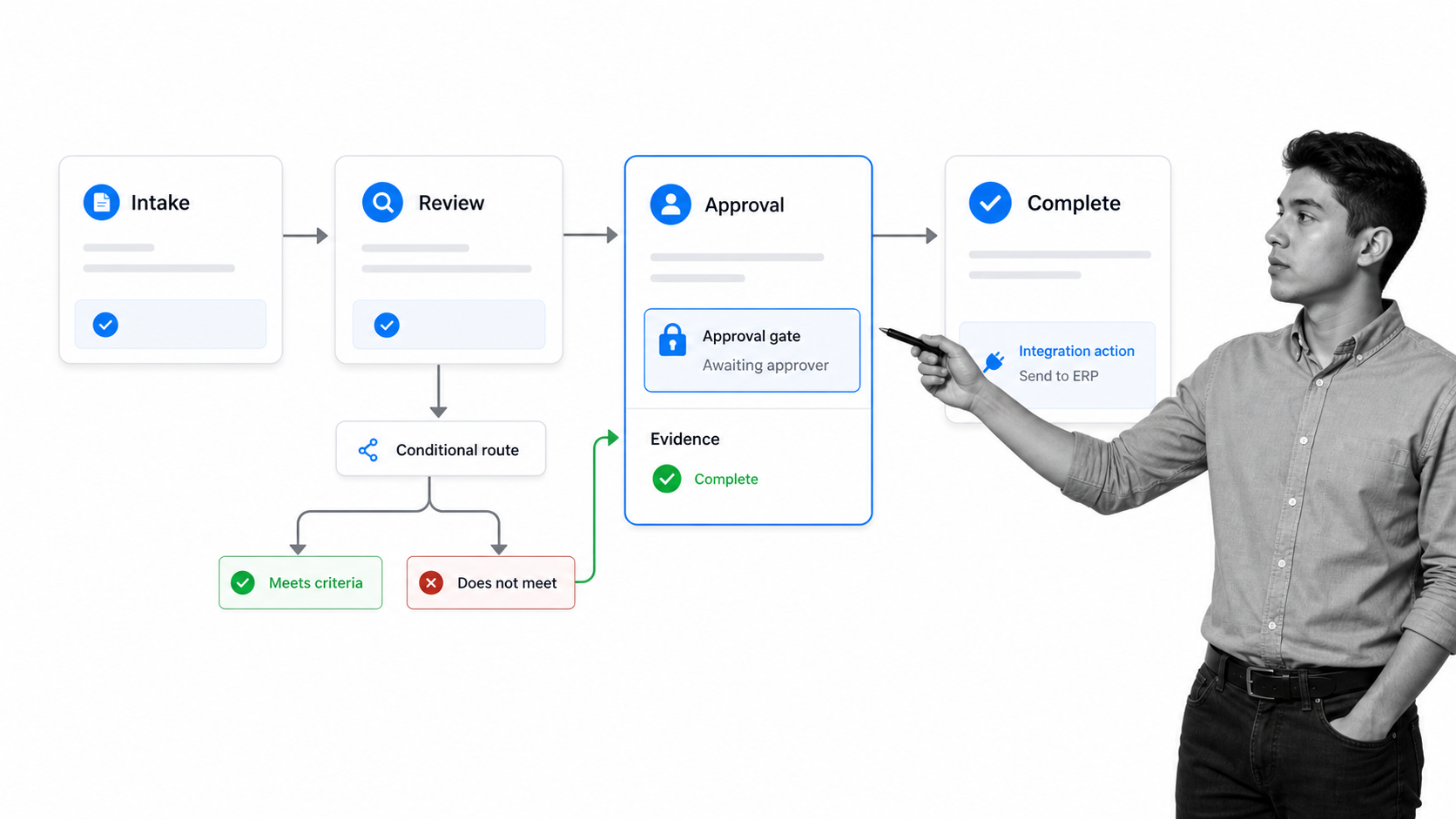
The best automation candidate is usually a stable, high-volume step with clear inputs and an observable result. Keep judgment-heavy exceptions visible to a human owner. A faster process that silently produces bad evidence or routes the wrong work is not optimized.
Prioritize candidates by combining operational impact with implementation risk. A frequent handoff that delays every case may deserve attention before a rare but dramatic exception. Confirm that inputs are consistent, ownership is explicit, and the result can be audited. When those conditions are missing, standardize the step first and automate it only after the operating method is dependable.
Test automation against the same baseline as the process change. Measure cycle time, error rate, rework, exception volume, completion, and control failures. If one metric improves while quality or compliance degrades, the automation has moved the bottleneck rather than removed it.
Process optimization resources to get started now
To give you a last extra little hand, here are a few more resources we have to help you get started.
Move from baseline to controlled improvement
This is a simple little checklist you can run through to guide your optimization efforts. You can add this to your Process Street account and edit it to best suit your internal operations.
It’s always good to keep a record of your process changes in case your changes don’t result in improvements and you need to reverse them. By running this checklist each time you keep yourself and your team accountable while making sure a solid process has been followed.
Or click here to access the template directly: The Process for Optimizing a Process
Use SWOT analysis to frame the opportunity
This SWOT analysis template is configured to help you run a SWOT analysis on your business, but with a few small changes you can make it fit the actions of a large process and be able to use the format, structure, and style to help you analyze your business processes.
Or click here to access the template directly: SWOT Analysis Template
Apply FMEA to likely failure modes
The FMEA template is an in-depth template designed for a technical team to essentially run a risk assessment on a process. This helps you understand your potential failure points and recognize your risk probabilities.
This is a useful template to run as a checklist once you’ve designed your optimized process and you want to make predictions about its performance. Use it to hunt for weaknesses in your new design.
Or click here to access the template directly: FMEA Template: Failure Mode and Effects Analysis
Prioritize improvements with a decision matrix
Like the SWOT analysis template, this process is designed to help you assess a situation and make decisions on the back of your new understandings.
The prioritization matrix helps you understand what order you should approach tasks in based on how important they are and how intensive they are. For process optimization, you may look at something like the benefit of adding on amounts of work per checklist against the level of increased output – to find out not just which of these is more efficient, but which more accurately produces an outcome in line with your idea of quality.
Or click here to access the template directly: Prioritization Matrix Checklist Template
Learn from Ray Dalio’s improvement approach
Ray Dalio is the CEO of Bridgewater Associates, one of the largest hedge funds in the world. He founded the company and built it to where it is today, putting much of his success for his company’s ability to operate well at scale down to the nature of his management and organizational approaches.
Dalio is a huge believer in dialogue. His efforts to increase transparency, honesty, and a Socratic investigation of ideas are central to the radical company culture he has shaped.
But you don’t need to be radical to pick up some of his approaches. Sometimes it is just common sense to discuss process problems with the teams who actually use the processes on a day to day basis, particularly in a business process context. This template guides you through that process based on the process he outlines in his book Principles, which I wrote about here: How Does a Hedge Fund Work? Inside the Processes at Bridgewater Associates.
Or click here to access the template directly: Ray Dalio’s Process Improvement Method
Optimize your processes with Process Street
A good optimization program makes the operating method, the work, and the proof visible in one system. Process Street connects governed documentation in Docs with controlled execution in Ops, while built-in AI supports analysis and execution inside the process.
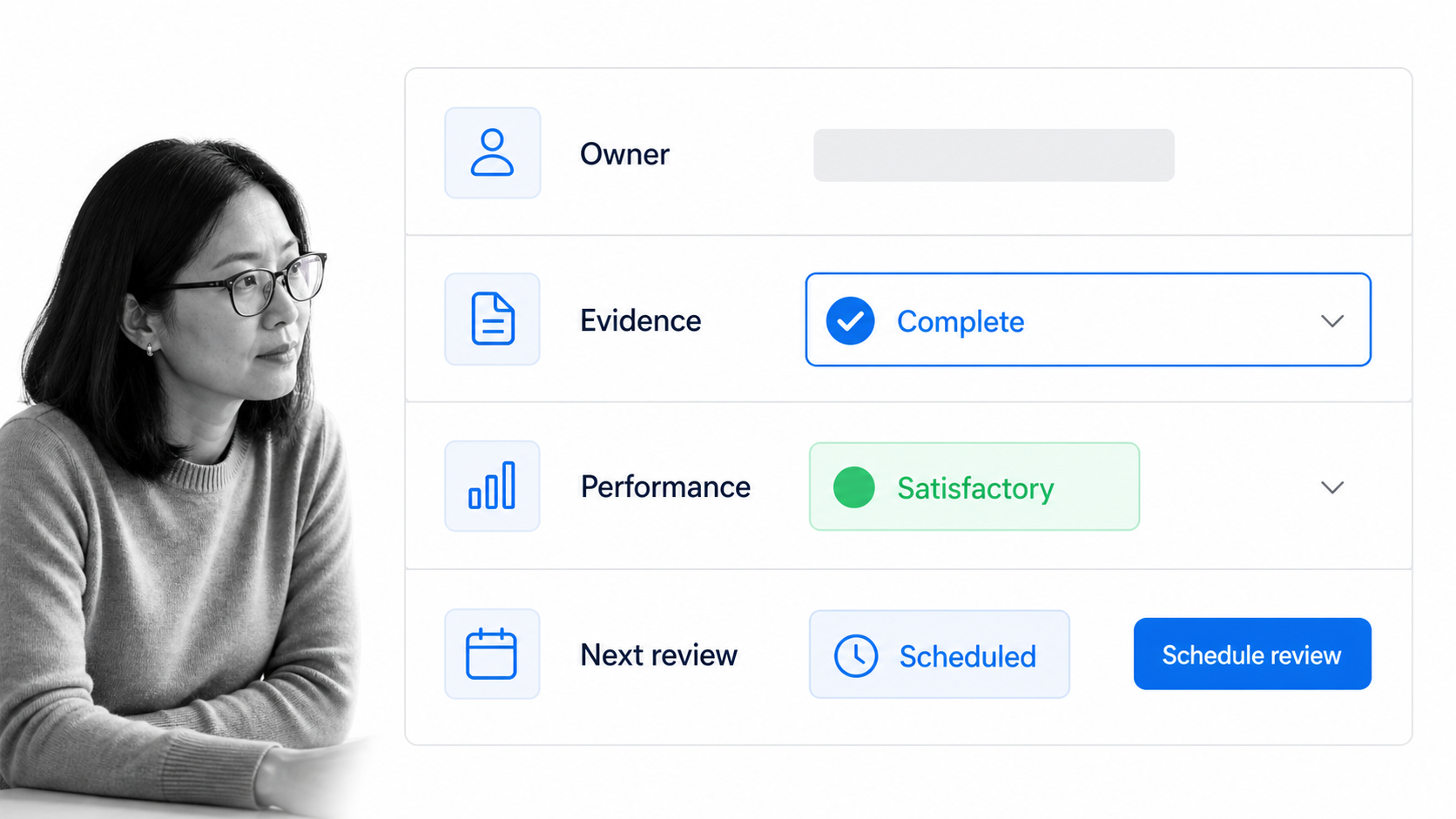
Use this sequence to keep improvement grounded:
- Define the business goal and the constraints that cannot be violated.
- Measure the current process before deciding what to change.
- Find the bottleneck or root cause that best explains the result.
- Predict the outcome, then test one controlled change.
- Study more than the metric you want to improve. Look for new errors, rework, control gaps, or customer friction.
- Implement the better method with clear ownership, evidence, and monitoring.
- Automate stable steps without diminishing quality or human accountability.
- Document what changed and schedule the next review. Processes are a culture, not just a tool.
Do not forget the people at the heart of the process. Numbers show where performance changed, but the people doing the work often know why. If you make the process easier to follow, easier to prove, and easier to improve, the result is more likely to last.
The post Business Process Optimization: What, How, Why? (Free Templates) first appeared on Process Street | Compliance Operations Platform.


0 Commentaires