
A knowledge management system gives people a reliable way to capture, validate, find, share, and apply what an organization knows. It is more than a repository. It combines people, processes, governance, content, and technology so useful knowledge reaches the work at the right time.
Without that system, decisions disappear into messages, experienced employees become single points of failure, and teams repeat mistakes. A strong system preserves institutional knowledge, connects it to execution, and gives owners a way to keep it accurate as the business changes. Process Street helps turn that knowledge into governed documentation and repeatable work.
- What is knowledge management?
- The importance of knowledge management
- Knowledge management through history
- Types of knowledge
- How to create a knowledge management system
- Knowledge management benefits for organizations
What is knowledge management?
“Knowledge management is the process of capturing, distributing, and effectively using knowledge.”
Thomas Davenport, 1994
Davenport’s definition gets to the operational core: a team captures what it knows, makes that knowledge findable, and applies it to real work. A knowledge management system is the combination of people, processes, governance, content, and technology that makes that cycle reliable.
The easiest way to explain knowledge management is to say it is all about collecting information and expertise on a particular topic. It is then stored in an accessible way, shared with those who need it, and used to better achieve your goals.
Think of it as a way to consistently use what you know and learn from your mistakes. This is instead of blundering forwards on a bunch of assumptions.
For example, let’s say that your manager asks you for a monthly sales report. You might use a process like this one here:
If you’ve successfully managed the knowledge available, you should be able to:
- Easily bring together records of their output;
- Discover the results of any experiments.
This could be done by either:
- Asking those directly involved;
- Going into your team’s database/records and accessing the knowledge directly.
Once you have that knowledge, it’s a cinch to create the report and present it to your manager. They can then analyze the results, see what needs improvement and make a decision.
You didn’t know everything off-hand from the beginning, and neither should you be expected to. There is too much going on in our daily work and lives to be able to memorize everything.
Instead, the knowledge that you needed was made available so that you and your manager could use it.
A documented process is knowledge management in action. It turns a result, decision, or expert method into guidance another person can follow without starting from zero.
A well-designed process is a good example of the principle of knowledge management in action.
The importance of knowledge management
“An organization in the Knowledge Age is one that learns, remembers, and acts based on the best available information, knowledge, and know-how.”
, Kimiz Dalkir, Director at McGill University, Knowledge Management: In Theory and Practice
Imagine that it’s your first day at a new job. You haven’t been trained beforehand and you aren’t familiar with the duties you’re expected to perform.
Your new boss walks up to you and says, “Nice to meet you, now get on with your work”. No resources, no mentoring, nothing. That’s what your life would be like without knowledge management.
Knowledge management isn’t just vital to learning how to perform new tasks though. It’s crucial to run any kind of test and reliably improve your processes and practices.
Knowledge management also makes improvement possible. A team needs a reliable record of how work is supposed to happen, what actually happened, and why an exception was handled a certain way before it can test a change or prevent a repeated failure.
Process management puts that knowledge into repeatable execution. The documented method guides the work, the workflow records what happened, and the results show where the method should improve. That connection helps people make better decisions and execute consistently, which is how a knowledge management system helps an organization win.
Knowledge management through history
Knowledge management has a long history because every organization has had to preserve and transfer what its people learn.
The principles of knowledge management have been in use since the beginning of recorded history, albeit not under the same name.
Cave paintings, village elders, early books, and so on. All of these are prime examples of how knowledge has been recorded and shared over the ages.
Even if you haven’t heard the term “knowledge management” before, I can guarantee that you’ve experienced its benefits. Whether you’ve read a book for fun or looked up how to do something using the internet, you’ve benefitted from that shared knowledge.
In 1959, Peter Drucker introduced the term “knowledge worker” for people whose contribution depends on applying specialized knowledge to products, services, and decisions.
“[Drucker] noted that knowledge workers would be the most valuable assets of a 21st-century organization because of their high level of productivity and creativity.”
, Corporate Financial Institute, What are Knowledge Workers?
Drucker and Paul Strassmann studied knowledge as an organizational resource. Chris Argyris, Christopher Bartlett, and Dorothy Leonard-Barton later explored organizational learning, expert practice, and the way knowledge moves through companies.
By the 1980s and 1990s, knowledge was widely treated as a competitive asset. The field reached a broader management audience through work on learning organizations, including the Harvard Business Review article “Building a Learning Organization,” and books such as The Knowledge-Value Revolution by Taichi Sakaiya.
Professional-services firms were early adopters. A 2000 case study of E&Y UK documented how the firm organized knowledge flows. The field also shaped practical disciplines such as change management, best practices, business process management, and risk management.
Types of knowledge
Tacit and explicit knowledge are the two primary categories used in this guide. Other taxonomies add implicit, embedded, or procedural knowledge, but the tacit-explicit distinction exposes the central design problem: some knowledge can be written down cleanly, while some depends on experience and context.
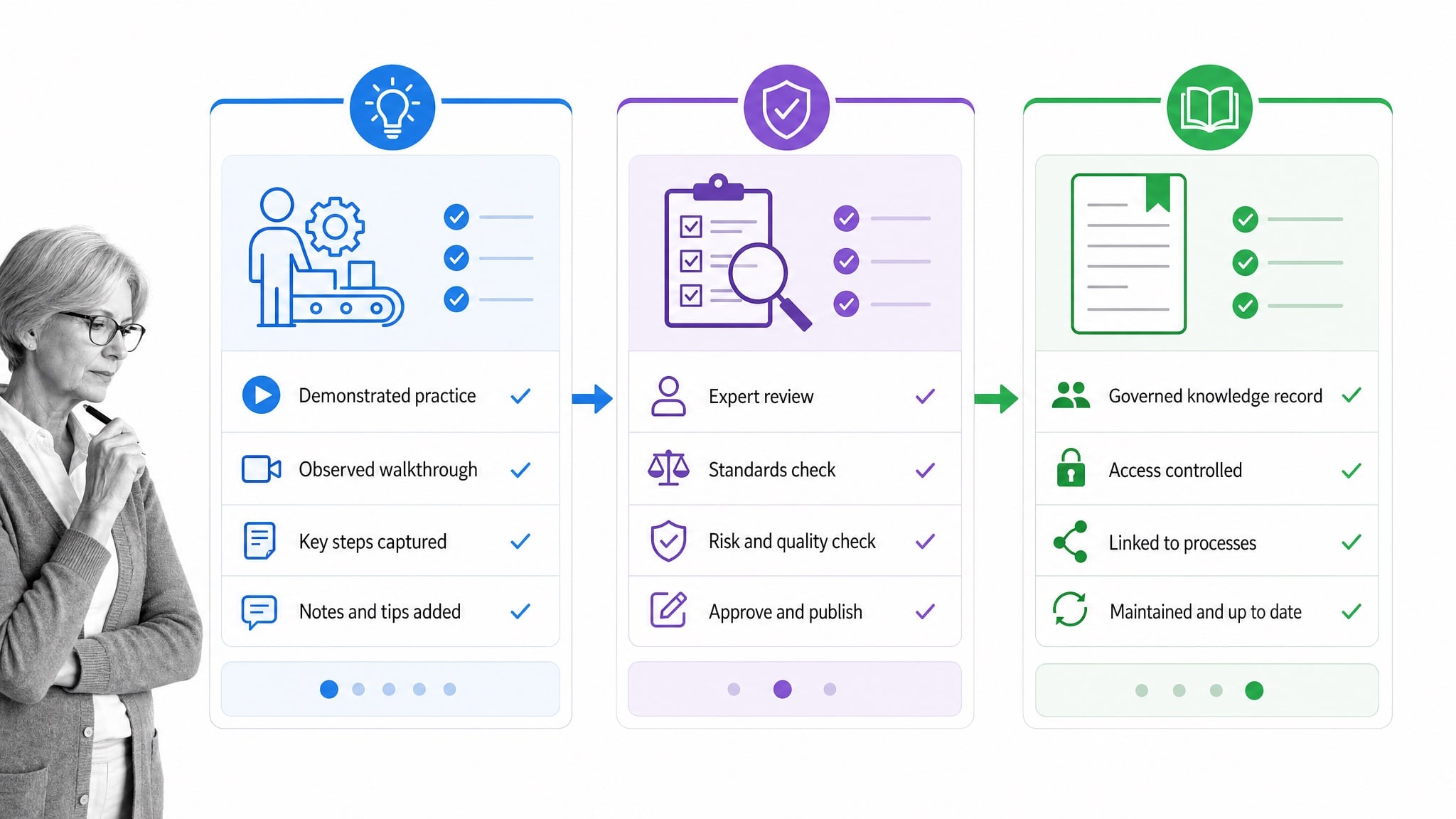
Tacit knowledge is practical know-how and judgment. It shows up when an experienced employee spots an exception, reads a customer’s reaction, diagnoses a weak handoff, or knows which tradeoff matters. It is difficult to transfer because the expert may not notice every decision they make.
Tacit knowledge cannot be captured perfectly, but useful parts of it can be made visible. Interviews, observation, recorded walkthroughs, worked examples, decision rationales, mentoring, and after-action reviews help another person understand both the action and the reasoning behind it.
Explicit knowledge is easier to record, share, search, and teach. Policies, SOPs, process maps, approved templates, product specifications, training material, and completed records all fit this category. A documented process is explicit knowledge that tells someone how to carry out a repeatable set of tasks.
- Tacit knowledge: Know-how and know-why shaped by experience and context. Examples include handling an exception, diagnosing a quality issue, recognizing risk, and adapting a customer conversation.
- Explicit knowledge: Know-what recorded in a form others can retrieve and reuse. Examples include policies, procedures, approved decisions, task instructions, standards, and process records.
A repository can store explicit knowledge, but storage alone does not create a working system. People also need ownership, permissions, search, version history, review dates, expert context, and a direct connection between the guidance and the work it governs.
The best systems do not pretend to convert every judgment into a file. They capture what can be made explicit, identify where an expert or reviewer is still required, and record new decisions so the organization learns from real execution.
Some teams also distinguish implicit knowledge: knowledge a person can explain but has not documented yet. A veteran analyst may know how to reconcile a difficult report, or a customer-success manager may know which warning signs predict an escalation. Treat that as a capture opportunity. Ask the person to demonstrate the work, explain the decision points, and review the resulting guidance before it becomes authoritative.
Embedded knowledge lives inside systems, routines, roles, and culture. A form that requires a risk rating, an approval rule that stops incomplete work, or a meeting cadence that forces a review can carry knowledge without presenting it as a standalone document. A complete knowledge management system accounts for those structural signals as well as written content.
How to create a knowledge management system
The biggest challenge is not choosing software. It is deciding what knowledge matters, who owns it, how people will find it, and how the system will stay trustworthy after launch. Build the operating model first, then select the technology that supports it.
Include the people who perform the work. They know where knowledge is hidden, which documents are ignored, when judgment matters, and which handoffs create repeated questions. Participation also makes adoption more likely because the final system reflects how work actually happens.
- Audit the current state. Map where policies, procedures, decisions, examples, records, and expert knowledge live today.
- Prioritize critical knowledge. Start with knowledge tied to customer outcomes, compliance, safety, quality, revenue, or operational continuity.
- Design the future state. Define the source of truth, owners, audiences, permissions, and the path from guidance to execution.
- Capture knowledge with context. Record steps, decision rules, examples, exceptions, and expert reasoning. Use AI to assist with transcription, classification, summaries, and search, with human review before publication.
- Govern the lifecycle. Set approval, versioning, review, archival, and retirement rules so obsolete guidance does not survive indefinitely.
- Connect knowledge to work. Put the right procedure, policy, or example inside the workflow where a person needs it.
- Deploy in stages. Pilot one high-value area, train users, fix gaps, and expand after the system works in real cases.
- Measure and improve. Track search success, repeated questions, time to competency, content use, stale items, errors, and exceptions.
Start by drawing the current knowledge flow. Show the main processes, where people look for answers, where tacit knowledge changes an outcome, and where missing information creates a bottleneck. This reveals the real system, including workarounds that do not appear in an official diagram.
Plan the ideal state around those gaps. A useful design names the owner of each critical knowledge area, the intended audience, the authoritative source, the review cadence, and the workflow or decision that uses it. Technology comes after the rules are clear.
Assign clear roles. A knowledge owner is accountable for accuracy and relevance. A subject-matter expert contributes context. A reviewer checks quality or compliance. An administrator manages access and system behavior. Users need a simple way to flag a gap, ask a question, or suggest a correction. Without those roles, even a strong initial library decays.
A workflow document management approach connects governed documentation to controlled execution. Instead of leaving an SOP in a folder, link it to the workflow, require the right review or approval, and preserve the evidence that the process was followed.
Migration needs the same care. Move scattered SOPs, decisions, and records without losing their owners, permissions, history, or relationships. Mark duplicates, resolve conflicts, and retire obsolete copies so search does not return several competing answers.
Design search and AI retrieval around trust. Results should respect permissions, identify the authoritative source, show enough context to interpret the answer, and make it easy to open the underlying document or workflow. AI can accelerate capture and retrieval, but it should not invent policy, hide conflicting sources, or publish unreviewed guidance as fact.
Roll the system out one area at a time. Watch how people search, where they still ask an expert, which instructions create errors, and what new knowledge appears during execution. Feed those lessons back into the system. Knowledge management is a lifecycle, not a one-time documentation project.
Measure outcomes, not document volume. Useful signals include fewer repeated questions, faster time to competency, higher search success, lower error and rework rates, fewer stale items, and faster resolution of exceptions. Review usage alongside operational results. A page with many views may still be unclear, while a rarely viewed control may be critical when a specific risk occurs.
Knowledge management benefits for organizations
A well-run knowledge management system improves continuity, training, decision quality, and execution. New employees reach useful context faster. Experienced employees spend less time answering the same question. Managers can see whether guidance is current, whether work followed it, and where an exception exposed a gap.
That is where Process Street fits. Process Street is one Compliance Operations Platform that connects governed knowledge to the work it controls.
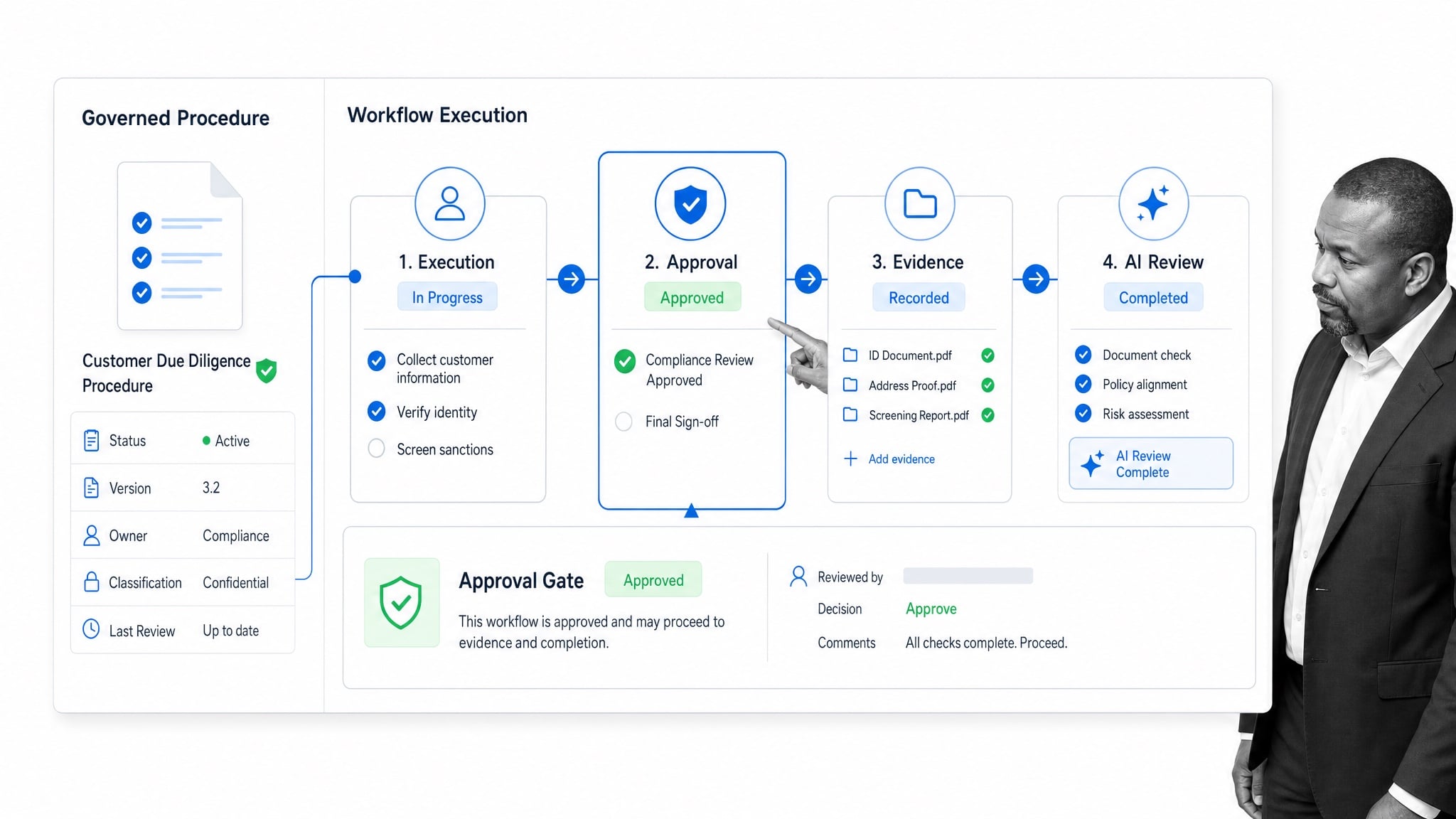
The Docs capability area gives teams a governed place to author, approve, version, and share policies and procedures. The Ops capability area turns that knowledge into assigned workflows with forms, conditional logic, approvals, due dates, permissions, and audit trails. They are capability areas inside the same product, not separate products.
Built-in AI helps teams draft and classify content, find relevant knowledge, surface gaps, and support execution. Human owners still control what becomes authoritative. Permissions, approvals, and version history protect sensitive knowledge and show which guidance applied when the work was completed.
The result is a closed loop: knowledge guides execution, execution produces evidence, and the evidence shows what should improve. That makes the knowledge management system useful in daily work instead of becoming another library people forget to check.
The benefits compound. Better onboarding preserves capacity. Clear ownership improves accountability. Version history and approvals reduce ambiguity. Connected workflows make the guidance visible when a decision is being made. Execution records then provide the evidence needed to update the knowledge instead of relying on memory or assumptions.
Request a demo to see how Process Street connects governed documentation, repeatable workflows, approvals, evidence, and built-in AI.
The post Create a Knowledge Management System to Win first appeared on Process Street | Compliance Operations Platform.


0 Commentaires